

The formative years of Hamilton Academical FC
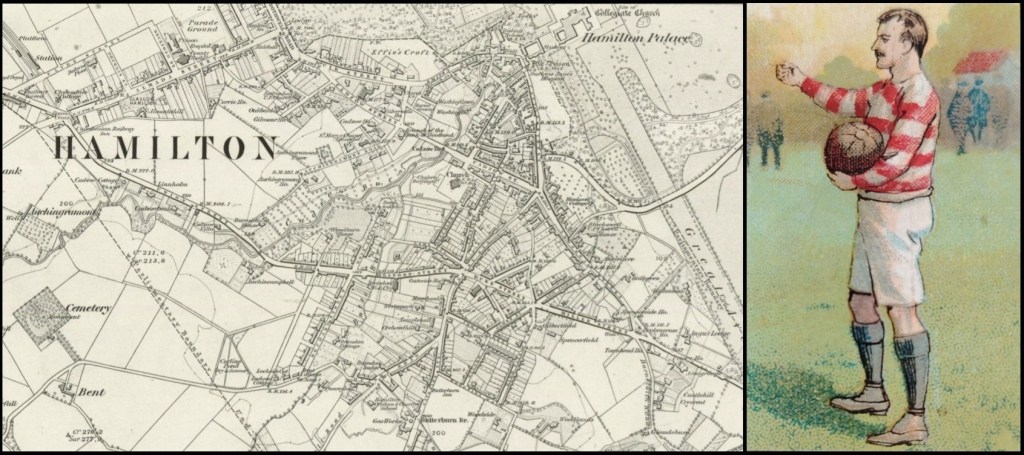
Left: Ordinance map of Hamilton, the ducal town, surveyed in 1858 and published in 1864. Reproduced with permission of the National Library of Scotland. Right: John Davie of Hamilton Academical FC.
Even a brief study of Hamilton Academical’s early history emphasises the incontrovertible fact that the football club, from the very beginning, was deeply rooted within the town. Not just through the connection with Hamilton Academy, from which the club derives its name, or the early locations of playing fields and meeting rooms, but through the early players and committee members who studied, worked and lived within the town. The extensive (but far from complete) list of addresses linked to early club members includes Haddow Street, Quarry Street, Brandon Street, Lamb Street, Leechlee Road, Cadzow Street, Campbell Street, Townhead Street and Miller Street.
In 1874, Hamilton Academy was located at Hope Street (it would not relocate to Auchincampbell Road until 1913). As one would expect, the early players were connected to the Academy and appear in school lists from the late 1860s and early 1870s. James Blacklock, the school rector, is understandably seen as a father figure in the early history of the club. Although Blacklock was a native of Wramphray in Dumfriesshire, he would enjoy a long association with Hamilton Academy, running from 1863 to 1897. Blacklock’s own house was located at the school and from the 1871 census we find the name of a future player listed within his household. Thirteen year old John McLay was one of five scholars lodging with Blacklock in 1871. A talented lad on and off the sports field, McLay would win a silver medal for scholarship in 1873 and is listed playing for Hamilton Academical FC in September 1875 against Carrington FC (of Glasgow).
The football club can clearly be traced to 1874 (although for many years 1875 was believed to be the year of formation). Originally referred to as the ‘Hamilton Academicals Cricket and Football Club’, the summer months of 1874 witnessed the organisation of a number of cricket matches. However, the football club, as we know it today, can officially trace its starting point to Saturday 17th October, 1874. On that day ‘Hamilton Academicals’ (the club originally adopted an ‘s’ at the end of its name) participated in its first ever game – it can therefore be said that on Saturday 17th October, 2026, Hamilton Accies will officially be 152 years old!
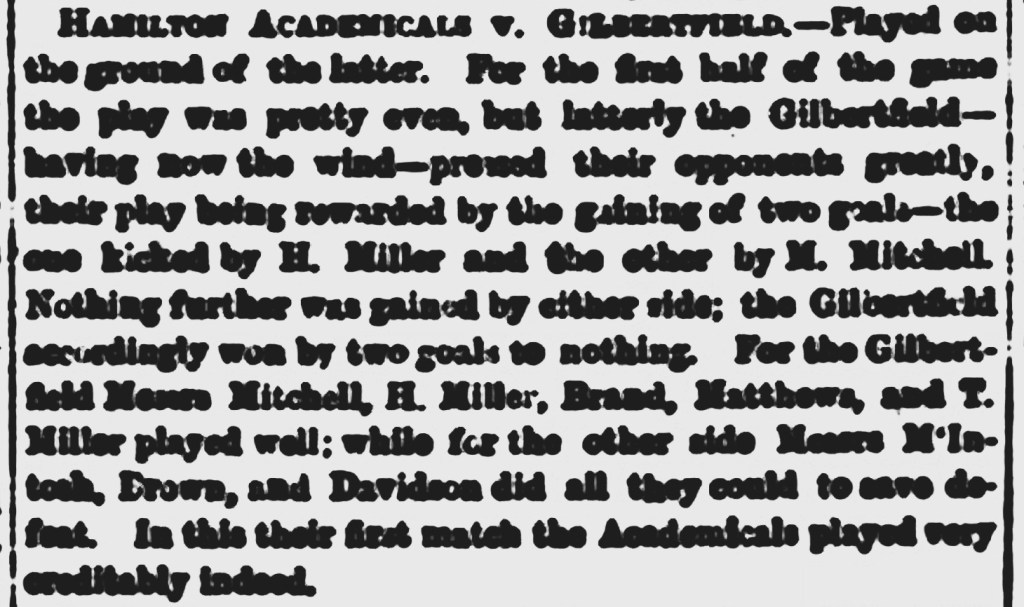
The first game. Hamilton Academicals v Gilbertfield. As reported in the North British Daily Mail, October 19, 1874, p.6. The actual match took place on Saturday 17th October 1874.
The inaugural match of 1874 ended in a 2-0 defeat to Gilbertfield FC, another Hamilton based football club with links to a school. Gilbertfield House was a private school located at High Patrick Street. Although neither team is listed in the match report, three Accies players merited a mention for their performance and from out of that small list, two of the players can be traced. The first of these players was Alexander McIntosh and in the 1871 census, he is recorded as being 12 years old and living with his mother and brothers at 15 Campbell Street. His father, who had been a druggist (chemist), was deceased. Alexander could be found playing cricket for Hamilton Academicals in July 1874. He also featured in the return football match against Gilbertfield in November 1874, which ended in a draw, and would be elected joint secretary of the club at the Annual General Meeting (AGM) of 1875. The second player was Alexander Brown who in 1871 was living at 25 Quarry Street with his parents and brother. He was 11 years old and is listed as being a scholar. His father, Thomas, was employed as a house painter and glazier. Alexander would later be referenced at the Hamilton Academical Club AGM in January 1876 when he was elected onto the committee.
The AGM of March 1875 and the match against Carrington FC in September of the same year are particularly useful as more names of club members appear in the corresponding newspaper reports. For example, in the latter event, two additional players, Kenneth Sage and William McGhie can be quickly identified. Although Sage does not appear in the 1871 census he can be traced back to 1861, living with his parents, brother and sister at Ann Street in Hamilton. His father, John, would sadly die in 1865. In the 1881 census, Kenneth is employed as an iron moulder and is living at 17 Leechlee Road. William McGhie can be found in the 1871 census, aged 14 and living with his mother and stepsister at 1 Quarry Street. He became secretary of the football club in 1878 and followed in his father’s footsteps, by becoming a professional photographer.
In the AGM of 1875, William J. Haley was elected club president. He can be found in the 1871 census, listed as a 14 year old scholar, and living with his father James (a draper to trade), stepmother Mary, as well as three brothers, three sisters and two servants. By the time of the 1881 census, Haley was working as a general law clerk. The Haley family resided in Quarry Street during this period. William’s connections with the football club go back to 1874; he appears in the Accies team which in November of that year played against Woodbank FC at Queen’s Park in Glasgow’s southside. He must have been an influential figure within the club to be elected club president in 1875 (at the age of 18). A wider search for his name in the newspapers of the period shows that he was significantly involved in the world of politics, being secretary of the local Hamilton branch of the Irish Home Rule movement. The ‘Irish question’ was one of the big domestic political issues of the 1870s and 1880s and Haley’s interest may be linked to his father who had been born in Ireland.
The football club appears to have advanced at a significant rate as by 1876 it was in a position to apply for membership to the Scottish Football Association. Amongst other things, this gave the club entry into the Scottish Cup competition, a tournament which had only commenced in season 1873-74 but which was making rapid strides in terms of prestige. On September 9th 1876, the Hamilton Advertiser announced that the club had been admitted into the Scottish Football Association. Hamilton Accies would therefore appear for the very first time in the Scottish Football Annual of 1876-77, and from this source we find some important information relating to the club. By then, David N. Cross had been handed the responsibility of acting as club secretary. A general law clerk (similar to William Haley), Cross lived with his parents and brother at 31 Lamb Street. His father, William, was a master tailor who was also born in the town. The contact address that David provides for the club entry in the Scottish Football Annual is 32 Brandon Street – this is likely to be his work address as it was not unusual for match secretaries employed as clerks to have club correspondence directed to their work address rather than to their home.
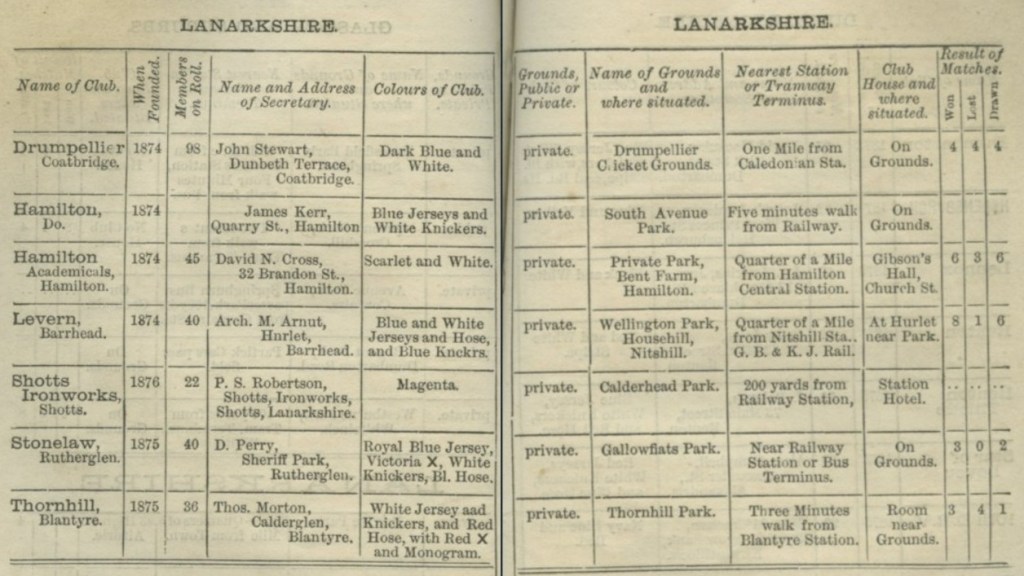
‘Scarlet and White’. Hamilton Academical’s entry in the Scottish Football Annual’s list of clubs from 1876. Image courtesy of the Scottish Football Museum.
Additional information from the Scottish Football Annual includes confirmation of the year of formation (1874), while the location of the club’s playing field is also identified. Accies’ earliest known football pitch was in a private park located at Bent farm, a quarter of a mile distance from Hamilton Central Station (which had only just opened in 1876). The club house is also identified, being Gibson’s Hall on Church Street, and of particular significance, the ‘colours’ of the football club are revealed for the first time – ‘Scarlet and White’.
Part 2 will continue to shed a light on the pioneers who featured in the formative years of the club’s existence and will examine some of the early challenges. As will be seen, the club faced a fight for survival from the earliest of times.

 scottishfootballorigins.org