

The formative years of Hamilton Academical FC
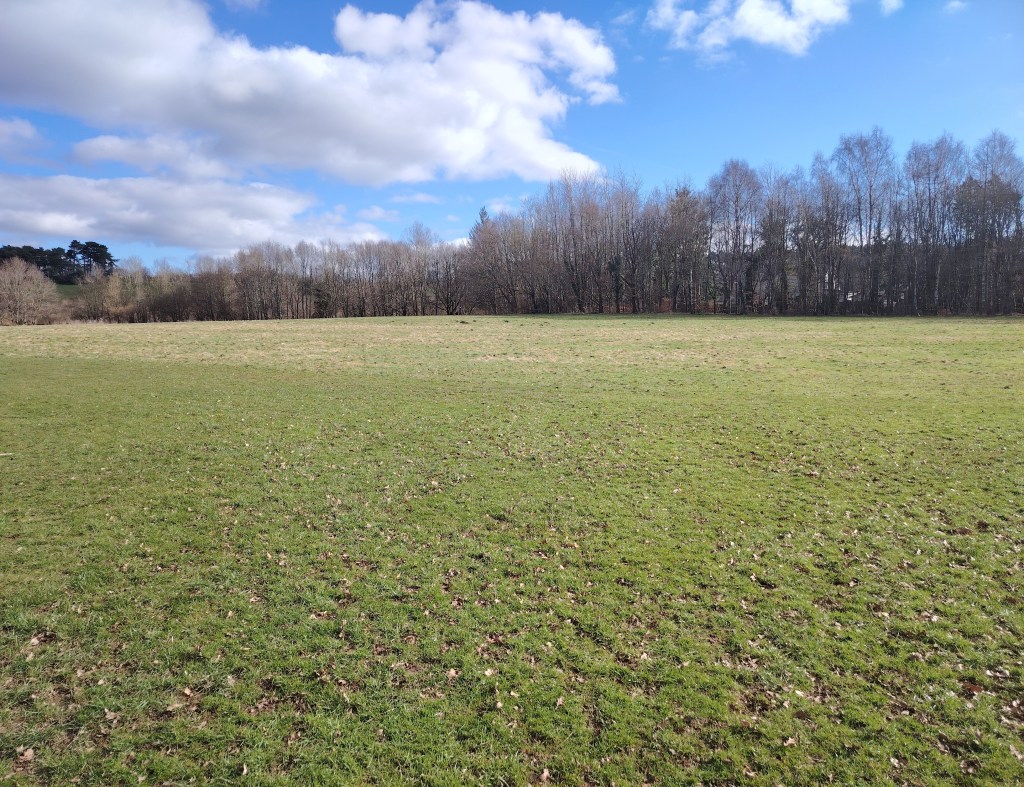
View of the South Haugh with Smithycroft situated on the other side of the tree line. This general area, on the outskirts of Hamilton, holds a special place in the early history of Hamilton Academical FC. Smithycroft was the location of the club’s first ever match on 17th October 1874 while the South Haugh was the location of the club’s home field from 1884 until 1888 (when the club opened Douglas Park).
By 1874 there were at least four clubs playing association football in Hamilton. These were Hamilton FC, Gilbertfield, Hamilton Academical and the Hamilton Volunteers. Hamilton Gymnasium, the pioneering club which had been organising football matches from its year of formation in 1866 and had first played the famous Queen’s Park Club in 1869, appears to have been wound up at some point around 1873. We do know that members of this club moved across to Hamilton FC (which was connected to Hamilton Cricket Club). In particular, Robert Abernethy, Thomas Cassels, Archibald Laidlaw and James Mackie moved onto the Hamilton Club having previously been members of the Gymnasium (for more information on them see, https://scottishfootballorigins.org/2026/01/03/short-biographies-of-association-football-club-members-1868-1873/).
Hamilton FC is known to have played their first game in April 1874 and was viewed as being the ‘senior’ club within the town. This may have, in part, been due to the influx of the former Gymnasium club members. Certainly, in the case of the Hamilton Academical and Gilbertfield clubs (with both being closely connected to schools) it is perhaps understandable that they would be viewed upon during this early period as ‘junior’ clubs. A final point to make relates to the claim that the ‘Hamilton Thistle Cricket and Football Club’ was formed in 1862. This is inaccurate (with respect to football). The Hamilton Thistle Cricket Club could certainly claim to date back to 1862 but the football section connected to the cricket club does not appear to have started until 1875.
Whilst Accies had access to a reasonable number of local clubs and indeed can be found to be playing matches against Gilbertfield, Hamilton FC and the Thornhill Club of Blantyre, it is clear that the railway provided vital access to clubs from further afield. In 1874, what is now Hamilton West station was the sole passenger station within the town and at that time was an ‘end of the line’ terminus. Simply known as ‘Hamilton station’, it’s trains brought passengers into Glasgow, terminating at South Side station on the southern bank of the River Clyde close to the city centre. The latter station would close in 1877 to be replaced two years later by Glasgow Central station (on the opposite bank of the River Clyde). The impressive connectivity enabled Hamilton Accies to visit and host teams from within and around Glasgow. Clubs from the southside of the city were particularly easy to reach. It is no surprise then that names like Parkgrove, Bellahouston, Govan, Rosslyn, Oxford, Ramblers, Abercorn (Dalmarnock) and Victoria can be found in Accies’ fixture lists from 1874 to 1876.
The club by the winter months of 1875 had grown sufficiently in size and organisational capacity to be capable of running first and second elevens. Whilst information relating to the location of early football fields is sketchy, we do know that the earliest games involving the club in 1874 were played at Smithycroft. The earliest reference to a home fixture involving the club that has been found to date was a match against Parkgrove FC, scheduled for September 1875. The location of the playing field is recorded as being ‘Clydesdale Street’ which may have been close to the future site of Douglas Park (the home of Hamilton Accies from 1888 to 1994). From the increase in the number of matches appearing in newspaper reports and the reporting of club meetings, additional information can be found with respect to early club members and wider developments.
For example, we can see from the AGM of January 1876 that the brothers William and John Torrance were involved in club affairs. Indeed, they held important positions. William, the older of the two, was appointed vice-captain of the club in 1876 while John can be found as one of the club secretaries alongside David N. Cross (who appears in Part 1 of this article). John’s secretarial role was to keep minutes at club meetings while David Cross was responsible for general club correspondence. John can also be found as a player, being listed in the match against the Carrington Club of Glasgow in September 1875. Beyond the direct references to Hamilton Accies, the Torrance brothers can be found in the 1871 census, living at 32 Brandon Street with their parents, an additional two brothers and a sister. Their father, John Torrance (senior), is employed as a shoemaker.
Joining the Torrance brothers onto the Accies committee at the 1876 AGM were Alexander Mackie and Roger Allan. Both are referenced as being directors (committee members) of the club. The first named also appears in the team line up against Carrington FC in September 1875. At the time of the 1871 census, Alexander was 14 years old and living at 17 Miller Street with his parents, brother and two sisters. He was employed as a sheriff officer’s clerk. Roger can be traced to the 1871 census (although the spelling of his name is Rodger). He is living at 24 Campbell Street with his parents, Margaret and William (the latter employed as a silk weaver), two brothers and two sisters. Roger is recorded as being a message boy and appears to have continued in the grocery trade as by the time of the 1881 census he had progressed to the position of ‘Grocer Shopman’ and had moved to Cumbernauld.
The name W. R. Patrick can be found in the club AGM of February 24, 1875. William Russell Patrick (to give him his full name) was appointed alongside Alexander McIntosh as secretary of what was still being referred to as the ‘Hamilton Academical Cricket and Football Club’. A local lad, born and living in Hamilton, William was only 12 at the time of the 1871 census. His father, Robert, was a sheriff officer and it is perhaps not a surprise that William would follow into the legal profession; he is listed as a law clerk living at Allison Street in the southside of Glasgow in the census returns of 1881.
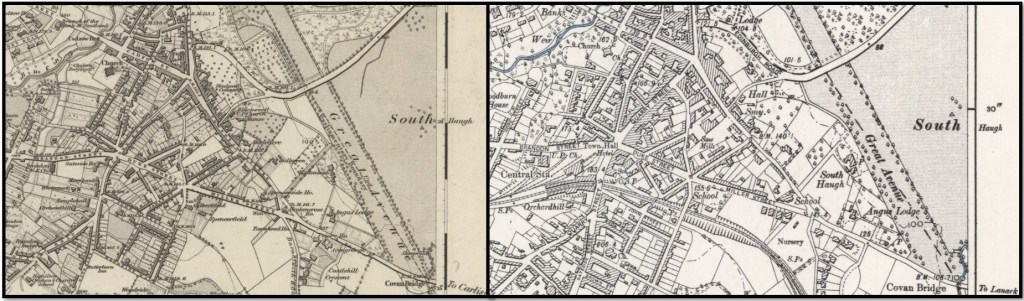
A side by side comparison of ordinance survey maps published in 1864 and 1898. The large expanse of the South Haugh can be seen in both. It was a fairly straight walk from Hamilton Central Station along Duke Street, Miller Street and onto Carlisle Road to access the South Haugh. Interestingly, the 1898 map details a small area of the South Haugh on the western edge of the Great Avenue. It is half a mile from the train station (the distance referenced in the Scottish Football Annuals). Could this be the site of the ‘South Haugh’ football pitch? Reproduced with permission of the National Library of Scotland.
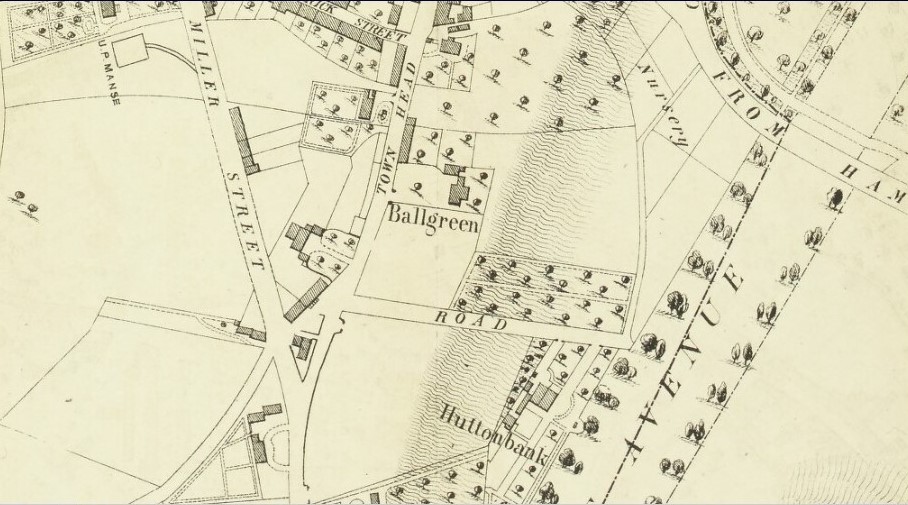
Image detailing the ‘ballgreen’ in Hamilton from a survey by Thomas Boyd in 1855. This image is reproduced in the article on Ba’ Greens – see The Ba’ Green – Scotland’s ancient playing field. The location of the small area of land referred to as ‘South Haugh’ in the 1898 ordinance map can be found on the other side of the road from the ballgreen. The survey highlights a level strip of land with Carlisle Road and Townhead Street running along on one side and a slope on the other side leading down to the Duke of Hamilton’s ‘Great Avenue’. Reproduced with permission of the National Library of Scotland.
Whilst the flow of meetings and the increasing run of first and second eleven team fixtures suggests an early period of sustained growth and activity, it was far from smooth for the club. It is clear that by the early months of 1877, Hamilton Academical was fighting for its very existence. The first indication of this is the name change; the Hamilton Cricket and Football Club had become the Hamilton Academical Athletic and Football Club. This might not appear to be that significant but it draws attention to major changes which had been happening behind the scenes. The main issue appears to have been a move to dissolve the club or at least to incorporate it into Hamilton FC. Certainly, some key members of the Accies had moved to Hamilton FC by 1876. This can be seen, for example, with Alexander McIntosh and William Patrick (joint secretaries of the Hamilton Academical Club in 1875) being elected office bearers of the ‘Hamilton Cricket and Football Club’ at that club’s AGM in 1876.
A letter issued by William Haley and Gavin Frame, the joint secretaries of Hamilton Accies, in April 1877 provides some additional context. The letter is one of complaint and grievance against the Hamilton Football Club. It asserts that the latter club had issued a circular to its members which stated that towards the end of 1876 the Hamilton Academicals had made overtures with respect to joining Hamilton FC and that this had been agreed to. Clearly a major fall out within the club had taken place in 1876 (not reported in the newspapers) which had created two camps; those wishing to continue as Hamilton Academical FC and those wishing for the club to be subsumed under Hamilton FC. The joint secretaries at Accies indeed refer to the ‘present’ club [of April 1877] consisting “of a number of the original members of the old Hamilton Academical Club”. Furthermore they go on to state that the members who left the club “was not more than a fifth”. The upheaval helps to explain why the year of formation would change within subsequent Scottish Football Annuals.
Initially, 1877 was presented as the year of formation (in the Scottish Football Annuals of 1877-78 and 1878-79). However, it can be seen that the restructured club of 1877 had retained original members from 1874, kept the red and white team colours and, importantly, continued to use the name. From season 1879-80 onwards, 1875 was settled upon as the year of formation. The recognition of 1875 pushes the club’s birth back to before the turbulent season of 1876-77 when the restructuring had taken place. However, the link to 1874 was never broken and a clear case can be made for continuity. Indeed, the only peculiarity is the fact that the winter months of 1874 appear to have been completely overlooked. The earlier year would not be rediscovered and officially recognised by the club until season 1993-94.
Perhaps the biggest surprise is the fact that within a short period of time, it would be the name of Hamilton FC that would disappear from the records whilst ‘Hamilton Academical’ would be the sole club from the ducal town listed within the Scottish Football Annual of 1877-78. Accies also appear to have taken over the old ground of Hamilton FC at South Avenue and would remain there from 1877 until 1884 (when the club moved to the South Haugh).

 scottishfootballorigins.org