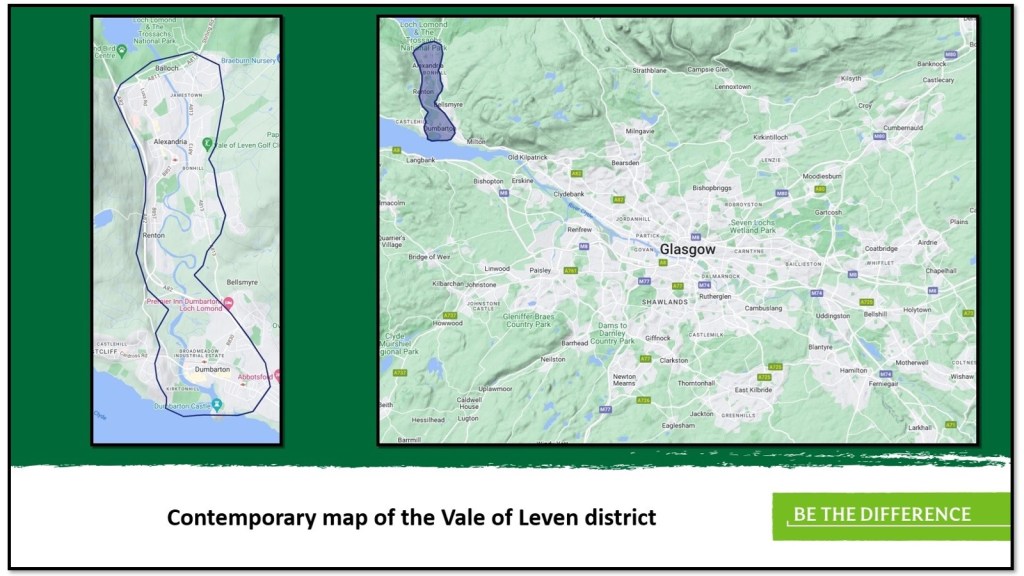
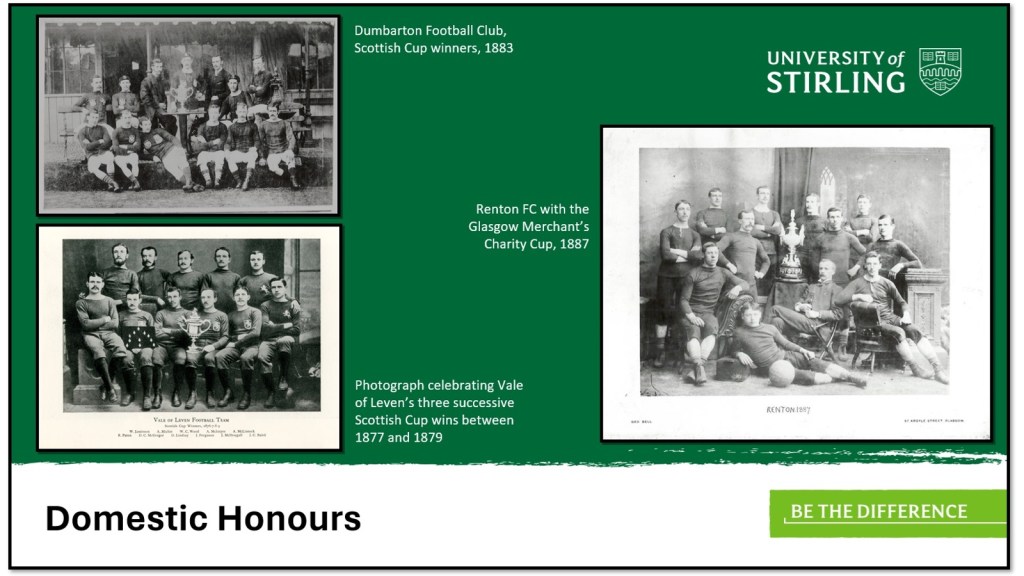
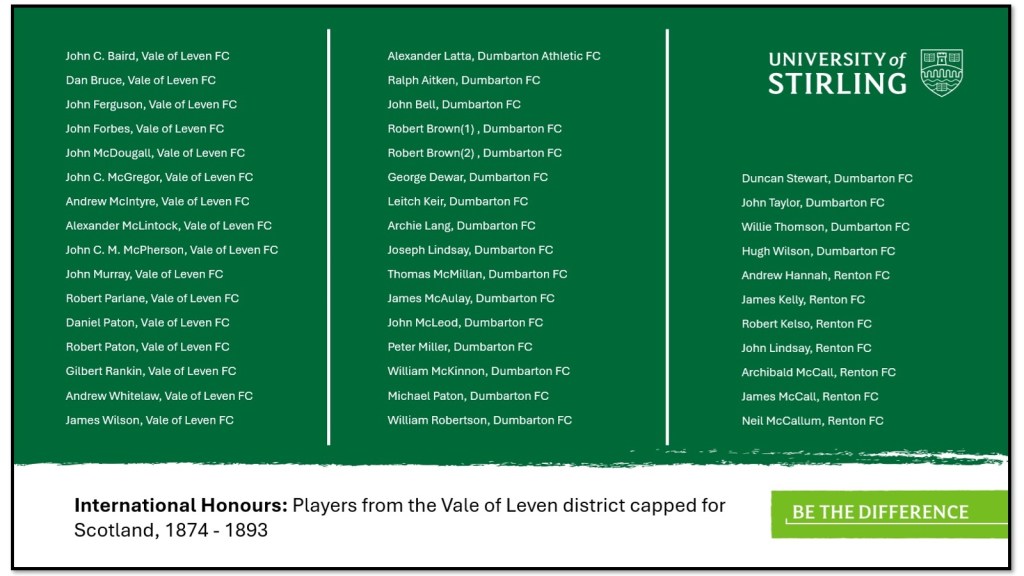
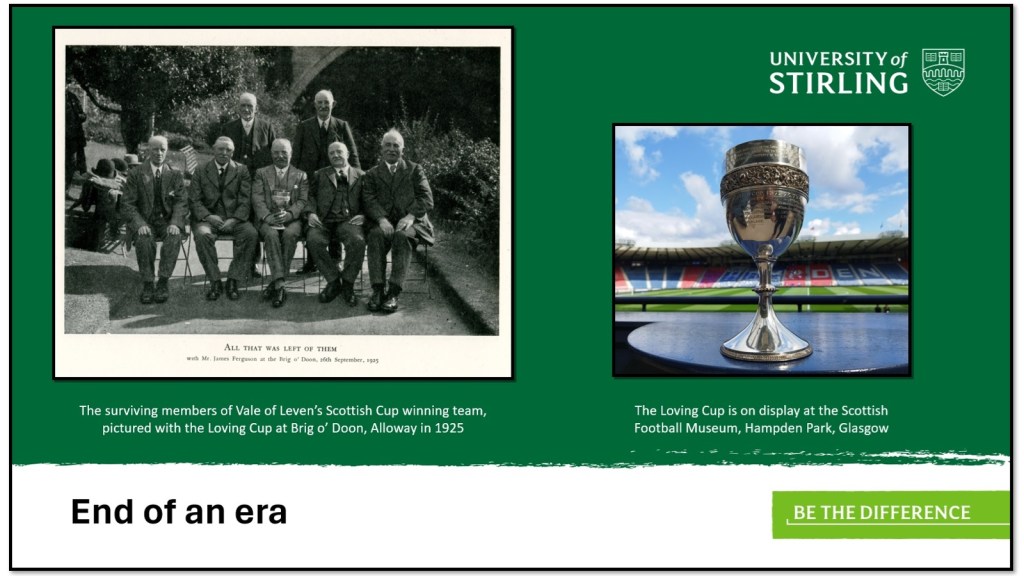
Short biographies of association football club members from the Vale of Leven district (1872-1875)

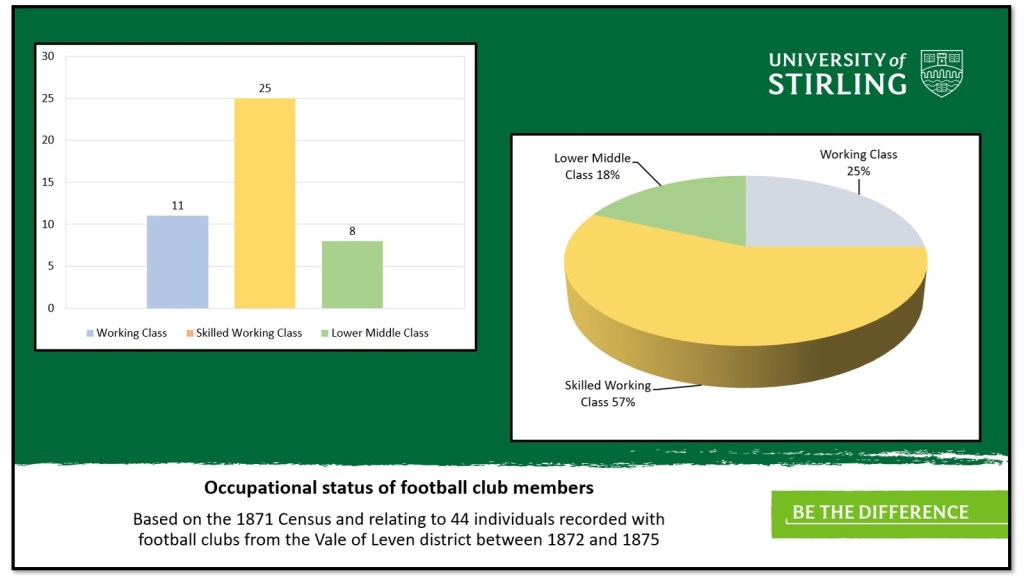
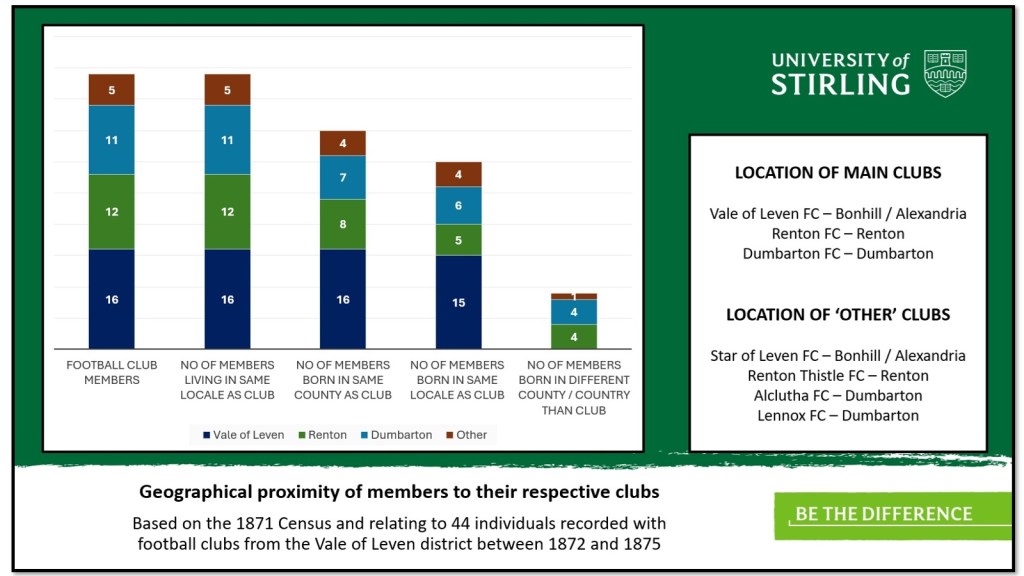
This list of short biographies forms part of Chapter 3 of the thesis. It focuses on association football club members who have been connected to at least one relevant club from the Vale of Leven district between 1872 and 1875. The central aim of this study is to link each club member to the 1871 Census in order to establish the general location of each household, the employment status of each club member and their place of birth. For each individual, a notes field is included where any additional information uncovered during the investigation has been recorded.


Club(s): Star of the Vale FC, Alexandria

Born in Bonhill, Dunbartonshire on October 11, 1855, Robert is recorded as 15 years old in the 1871 Census, living in Bonhill, Dunbartonshire with his parents, 8 brothers and 2 sisters. The household has 0 servants. He is employed as a printfield worker. His father, John Armstrong, is a carter born in Paisley, Renfrewshire and his mother, Mary Baird, has no status in the 1871 Census and is born in Bellshill, Lanarkshire. Robert is a member of Star of the Vale FC and is listed playing for the club against Renton Thistle FC on December 6, 1873. He dies at Kokiri, West Coast, New Zealand in 1913 aged 57.

Additional notes: Robert is referenced playing for Star of Vale FC in the Lennox Herald, December 13, 1873, 3. He emigrates to New Zealand on April 6, 1874.


(2) Atherley, John

Club(s): Lorn Youths FC, Alexandria

Born in Alexandria, Dunbartonshire on September 13, 1858, John is recorded as 11 years old in the 1871 Census, living in Bonhill, Dunbartonshire with his parents and 2 brothers. The household has 0 servants. He is employed as a factory worker. His father, John Atherley, is a shoemaker born in Joppa, near Edinburgh, and his mother, Martha Waddell is not accorded a status in the 1871 Census and is born in Glasgow. John is a member of Lorn Youths FC and is listed playing for the club against Bluebell FC on December 27, 1873. He dies at Invercargill, Southland, New Zealand in 1940 aged 81.

Additional notes: Brother of Robert Atherly. He is referred to as John ‘Eathearly’ in the match against Bluebell FC. John is recorded playing for Lorn Youths FC in the Dumbarton Herald, January 1, 1874, 3.


(3) Atherley, Robert

Club(s): Star of Leven FC, Alexandria

Born in Alexandria, Dunbartonshire on April 23, 1856, Robert is recorded as 13 years old in the 1871 Census, living in Bonhill, Dunbartonshire with his parents and 2 brothers. The household has 0 servants. He is employed as a shoemaker. His father, John Atherley, is a shoemaker born in Joppa, near Edinburgh, and his mother, Martha Waddell, is not accorded a status in the 1871 Census and is born in Glasgow. Robert is a member of Star of Leven FC and is listed playing for the club against Lily FC (Renton) on August 22, 1874. He dies at Bonhill, Dunbartonshire in 1874 aged 17.

Additional notes: Brother of John Atherly. He died from the effects of a kick to the stomach while playing football in the match against Lily FC in August 1874. The incident is recorded in the Dumbarton Herald, August 27, 1874, 3.


(4) Bain, George

Club(s): Star of the Vale FC, Alexandria

Born in Kilmarnock, Ayrshire on March 20, 1856, George is recorded as 15 years old in the 1871 Census, living in Bonhill, Dunbartonshire with his 2 brothers. The household has 0 servants. He is employed as a print work labourer. His father, William Bain, is deceased and was a block printer, born in Glasgow and his mother, Elizabeth McGregor, is deceased and was born in Kilmarnock, Ayrshire. George is a member of Star of the Vale FC and is listed playing for the club against Renton Thistle FC on December 6, 1873. The details of his death are presently unknown.

Additional notes: The family are living in Glasgow in the 1861 Census. William and Elizabeth die at Bonhill, Alexandria in 1868. George is referenced playing for Star of the Vale FC in the Dumbarton Herald, December 11, 1873, 3.


(5) Baillie, James

Club(s): Heatherbell FC, Dumbarton

Born in Paisley, Renfrewshire on October 14, 1857, James is recorded as 13 years old in the 1871 Census, living in Dumbarton with his mother and 2 brothers. The household has 0 servants. He is listed as a scholar. His father, John Baillie, is deceased and was an iron forger born in New Monkland, Lanarkshire, and his mother, Christiana Wilson, is listed as a widow in the 1871 Census and is born in Biggar, Lanarkshire. James is a member of Heatherbell FC and is listed playing for the club against Star of Leven FC on December 13, 1873. The details of his death are presently unknown.

Additional notes: Living in Levenhaugh Street, Dumbarton in 1871. His older brothers work as an ‘Apprentice Forger’ and ‘Fitter Engineer’. James is recorded playing for Heatherbell FC in the Lennox Herald, December 20, 1873, 3.


(6) Baird, James

Club(s): Vale of Leven FC, Alexandria

Born in Bonhill, Dunbartonshire on July 21, 1854, James is recorded as 16 years old in the 1871 Census, living in Bonhill, Dunbartonshire with his mother, 3 brothers and 3 sisters. The household has 0 servants. He is employed as a coppersmith. His father, John Baird, is deceased and was a plumber and coppersmith born in Paisley, Renfrewshire and his mother, Janet Campbell, is recorded as receiving an annuity in the 1871 Census and is born in Greenock, Renfrewshire. James is a member of Vale of Leven FC and is listed playing for the club against Renton FC on November 13, 1875. He dies at Bonhill, Dunbartonshire in 1928 aged 73.

Additional notes: Brother of John C. Baird. James is referenced playing for Vale of Leven FC in the Glasgow Herald, November 16, 1875, 7.


(7) Baird, John Campbell

Club(s): Vale of Leven FC (Alexandria)

Born at Bonhill, Dunbartonshire, on July 27, 1856, John is recorded as 14 years old in the 1871 Census, living in Bonhill, Dunbartonshire with his mother, 3 brothers and 3 sisters. The household has 0 domestic servants. He is employed as a clerk. His father, John Baird, is deceased and was a plumber and coppersmith born in Paisley, Renfrewshire, and his mother, Janet Campbell, is recorded as receiving an annuity in the 1871 Census and is born in Greenock, Renfrewshire. John is a member of Vale of Leven FC and is listed playing for the club against Renton FC on November 13, 1875. He dies at Renton in 1902 aged 45.

Additional notes: Brother of James Baird. His father, John Baird, was working as a plumber and copper smith in the 1861 Census. John is referenced playing for Vale of Leven FC in the Glasgow Herald, November 16, 1875, 7.


(8) Ball, Robert

Club(s): Dumbarton FC

Born in Dumbarton on January 10, 1853, Robert is recorded as 18 years old in the 1871 Census, living in Dumbarton with his parents and 3 sisters. The household has 0 servants. He is employed as an apprentice law clerk. His father, Robert Ball snr, is a ship carpenter and tobacconist born in England and his mother, Janet McGregor, is listed as a carpenter’s wife in the 1871 Census and is born in Port Glasgow, Renfrewshire. Robert jnr is a member of Dumbarton FC and is listed playing for the club against Renton FC on November 29, 1873. He dies at Dennistoun in 1893 aged 39.

Additional notes: Robert is referenced playing for Dumbarton FC in the Dumbarton Herald, December 4, 1873, 3.


(9) Ballantyne, Robert Brown

Club(s): Alclutha FC, Dumbarton

Born in Dumbarton on December 24, 1854, Robert is recorded as 16 years old in the 1871 Census, living in Dumbarton with his mother, 2 brothers and sister. The household has 1 servant. He is listed as a scholar. His father, Robert Bannatyne snr, is a marine engineer born in Irvine, Ayrshire and his mother, Jane Fleck, is listed as a marine engineer’s wife in the 1871 Census and is born in Kilwinning, Ayrshire. Robert is a member of Alclutha FC and plays for the club against Renton FC on October 16, 1875. He dies at Kingarth, Isle of Bute, in 1933 aged 79.

Additional notes: In the 1881 Census, Robert jnr is 26 and employed as a carver and guilders clerk. He is listed as secretary of Alclutha FC in 1875 (see, Dick, W. ed. (1875) Scottish Football Annual, 1875-76. Glasgow: W. Weatherspoon & Son, 28) and is referenced playing for the club in the Lennox Herald, October 23, 1875, 4.


(10) Baxter, Malcolm

Club(s): Star of Leven FC, Alexandria

Born in Bonhill, Dunbartonshire on January 22, 1855, Malcolm is recorded as 16 in the 1871 Census living in Bonhill, Dunbartonshire with his parents, 2 brothers and 2 sisters. The household has 0 servants. He is employed as a calico engraver. His father, James Baxter, is a calico printer, born in Paisley, Renfrewshire and his mother, Catherine McGregor, is not accorded a status in the 1871 Census and is born in Bonhill, Dunbartonshire. Malcolm is a member of Star of Leven FC and is listed as secretary of the club in the Scottish Football Annual of 1875. He dies at Bonhill, Alexandria in 1879 aged 24.

Additional notes: He is listed as secretary of Star of Leven FC in the Scottish Football Annual of 1875 – see, Dick, W. ed. (1875) Scottish Football Annual, 1875-76. Glasgow: W. Weatherspoon & Son, 28.


(11) Boag, Peter

Club(s): West End FC, Dumbarton

Born in Cardross Parish, Dunbartonshire on June 15, 1855, Peter is recorded as 15 years old in the 1871 Census, living in Dumbarton with his parents, and 3 brothers. The household has 0 servants. He is employed as a block maker. His father, Peter Boag snr, is a ship carpenter born in Cardross Parish, Dunbartonshire, and his mother, Frances Miller, is not accorded a status in the 1871 Census and is born in Cardross Parish, Dunbartonshire. Peter jnr is a member of West End FC and is listed playing for the club against Alclutha FC in January 1874. He dies at Dumbarton in 1879 aged 24.

Additional notes: The newspaper article (Lennox Herald, January 31, 1874, 1) does not confirm the exact day of the game.


(12) Brown, James

Club(s): Renton FC

Born in Old Kilpatrick, Dunbartonshire on August 27, 1850, James is recorded as 19 years old in the 1871 Census, living in Renton with his parents, 5 sisters, brother and cousin. The household has 0 domestic servants. He is employed as a shipyard blacksmith. His father, Duncan Brown, is a dyework labourer born in Kilmodan, Argyll and his mother, Mary McLean, does not have a status accorded to her in the 1871 Census and is born in Inverchaolain, Argyll. James is a member of Renton FC and is listed playing for the club against Eastern FC on December 26, 1874. The details of his death are presently unknown.

Additional notes: James is the brother of Lachlan Brown. He is secretary of Renton FC in 1875 and appears in the Scottish Football Annual – see, Dick, W. ed. (1875) Scottish Football Annual, 1875-76. Glasgow: W. Weatherspoon & Son, 28. He is recorded playing for Renton FC in the Dumbarton Herald, December 31, 1874, 3.


(13) Brown, Lachlan

Club(s): Renton FC

Born in Cardross, Dunbartonshire on November 17, 1855, Lachlan is recorded as 15 years old in the 1871 Census, living in Renton with his parents, 5 sisters, brother and cousin. The household has 0 servants. He is employed as a yarn dyer assistant. His father, Duncan Brown, is a dyework labourer born in Kilmodan, Argyll and his mother, Mary McLean, does not have a status accorded to her in the 1871 Census and is born in Inverchaolain, Argyll. Lachlan is a member of Renton FC and is listed playing for the club against Helensburgh FC on August 15, 1874. The details of his death are presently unknown.

Additional notes: Lachlan is the brother of James Brown. He is recorded playing for Renton FC in the Dumbarton Herald, August 20, 1874, 3.


(14) Buchanan, Charles

Club(s): West End FC, Dumbarton

Born in Dumbarton on March 25, 1855, Charles is recorded as 15 years old in the 1871 Census, living in Dumbarton with his parents, and 3 brothers. The household has 0 servants. He is employed as a glue maker. His father, Robert Buchanan, is a councillor and glue manufacturer born in Ladyburn (Greenock), Renfrewshire, and his mother, Mary McAlpin, is listed as a councillor’s wife in the 1871 Census and is born in Dumbarton. Charles is a member of West End FC and is listed playing for the club against Alclutha FC in January 1874. The details of his death are presently unknown.

Additional notes: The newspaper article (Lennox Herald, January 31, 1874, 1) does not confirm the exact day of the game.


(15)  Butler, William

Club(s): Vale of Leven Rovers,  Bonhill

Born in Bonhill, Dunbartonshire on August 11, 1858, William is recorded as 12 years old in the 1871 Census, living in Bonhill, Dunbartonshire with his parents, 2 brothers, sister and nephew. The household has 0 servants. He is not accorded an occupation. His father, William Butler snr, is an agricultural labourer born in Ireland and his mother, Susanna Boyd, is not accorded a status in the 1871 Census and is born in Ireland. William jnr is a member of Vale of Leven Rovers FC and is listed playing for the club against Bluebell FC on January 17, 1874. He dies at Edinburgh, in 1888 aged 29.

Additional notes: William is recorded playing for Bluebell FC in the Lennox Herald, January 24, 1874, 5.


(16) Cameron, James

Club(s): Renton Thistle FC

Born in Paisley, Renfrewshire c.1857, James is recorded as 14 years old in the 1871 Census, living in Renton, Dunbartonshire with his parents, 3 brothers and 2 sisters. The household has 0 servants. He is employed as a tailor’s apprentice. His father, John Cameron, is a calico printer born in Renton, Dunbartonshire and his mother, Mary Ferrier, is not accorded a status in the 1871 Census and is born in Paisley, Renfrewshire. James is a member of Renton Thistle FC and plays for the club against Star of Lennox FC in September 1873. The details of his death are presently unknown.

Additional notes: Brother of Robert Cameron. His parents marry at Paisley on July 31, 1852. James is recorded playing for Renton Thistle FC in the Lennox Herald,  September 27, 1873, 3 – the article does not stipulate the specific date of the match. He is listed as club secretary in the Scottish Football Annual of 1875 – see, Dick, W. ed. (1875) Scottish Football Annual, 1875-76. Glasgow: W. Weatherspoon & Son, 28.


(17) Cameron, Robert

Club(s): Renton Thistle FC

Born in Paisley, Renfrewshire, on February, 9, 1855, Robert is recorded as 16 years old in the 1871 Census, living in Renton, Dunbartonshire with his parents, 3 brothers and 2 sisters. The household has 0 servants. He is employed as a grocer’s apprentice. His father, John Cameron, works as a calico printer, born in Renton, Dunbartonshire, and his mother, Mary Ferrier, is not accorded a status in the 1871 Census and is born in Paisley, Renfrewshire. Robert is a member of Renton Thistle FC and is listed playing for the club against Star of the Vale FC on December 6, 1873. The details of his death are presently unknown.

Additional notes: Brother of James Cameron. He is referenced playing for Renton Thistle FC in the Dumbarton Herald, December 11, 1873, 3.


(18)  Colquhoun, Robert Bell

Club(s): Lennox FC, Dumbarton

Born in Dumbarton on April 18, 1853, Robert is recorded as 18 years old in the 1871 Census, living in Dumbarton with his parents and sister. The household has 1 servant. He is employed as a law clerk. His father, John Colquhoun, is a legal writer born in Dumbarton and his mother, Mary Bell, is not accorded a status in the 1871 Census and is born in Bowling, Dunbartonshire. Robert is a member of Lennox FC and is listed playing for the club against Dumbarton FC on October 16, 1875. The details of his death are presently unknown.

Additional notes: In the 1881 Census, Robert is 28 and a traveller in iron trade. He is referenced playing for Lennox FC in the Dumbarton Herald, October 21, 1875, 4, and is also listed as secretary in the Scottish Football Annual of 1875 – see, Dick, W. ed. (1875) Scottish Football Annual, 1875-76. Glasgow: W. Weatherspoon & Son, 28.


(19) Colville, Alexander McGregor

Club(s): Alclutha FC, Dumbarton

Born in Dumbarton, on December 11, 1857, Alexander is recorded as 14 years old in the 1871 Census, living in Dumbarton, with his parents, 2 sisters and 2 brothers. The household has 0 servants. He is listed as a scholar. His father, Alexander Colville snr, is a master plumber and brass finisher (employing 9 men and 5 boys) born in Barrhead, Renfrewshire, and his mother, Sabina Buchanan, is not accorded a status in the 1871 Census and is born in Dumbarton. Alexander jnr is a member of Alclutha FC and is listed playing for the club against Star of Leven FC on April 17, 1875. He dies at Dumbarton in 1944 aged 86.

Additional notes: Alexander jnr is recorded playing for Alclutha FC in the Dumbarton Herald, April 22, 1875, 4.


(20)  Crawford, John

Club(s): Star of the Vale FC, Alexandria

Born in Cardross, Dunbartonshire on January 28, 1855, John is recorded as 15 years old in the 1871 Census, living in Bonhill, Dunbartonshire with his parents, 3 brothers and 2 sisters. The household has 0 servants. He is employed as a factory boy. His father, George Crawford, is a gardener born in Tillicoultry, Clackmannanshire and his mother, Jane Smith, is not accorded a status in the 1871 Census and is born in Paisley, Renfrewshire. John is a member of Star of the Vale FC and is listed playing for the club against Renton Thistle FC on December 6, 1873. He dies at Bonhill, Dunbartonshire in 1926 aged 71.

Additional notes: In 1881, John is employed as a block printer. He is recorded playing for Star of the Vale FC in the Dumbarton Herald, December 11, 1873, 3.


(21) Dunwoodie / Dunwoody, John

Club(s): Renton FC

Born in Kilmaronock, Dunbartonshire on May 13, 1854, John is recorded as 16 years old in the 1871 Census, living in Renton, Dunbartonshire with his parents and brother. The household has 0 servants. He is employed as a joiner. His father, John Dunwoodie snr, is a blacksmith born in Ireland and his mother, Mary Ann Battersby, does not have a status accorded to her in the 1871 Census and is born in Ireland. John jnr is a member of Renton FC and is listed playing for the club against Queen’s Park FC on December 13, 1873. The details of his death are presently unknown.

Additional notes: John jnr is referenced playing for Renton FC in the North British Daily Mail, December 15, 1873, 6.


(22) Ferguson, John

Club(s): Vale of Leven FC, Alexandria

Born at Bonhill, Dunbartonshire on June 22, 1848, John is recorded as 22 years old in the 1871 Census, living in Bonhill with his mother, 4 sisters, brother, nephew and niece. The household has 0 servants. He is employed as a printfield worker. His father, Donald Ferguson, is deceased and was an agricultural labourer, born in Perthshire and his mother, Christina McLachlan, is listed as a widow in the 1871 Census and is born in Balqhuidder, Perthshire. John is a member of Vale of Leven FC and is listed playing for the club against Queen’s Park FC on January 11, 1873. He dies at Kilmarnock in 1929, aged 81.

Additional notes: John’s mother Christina is listed as Catherine in the 1871 Census but this looks to be an error. John can be traced in the 1861 Census, aged 12 and living in Bonhill, Dunbartonshire with his parents Donald and Christina as well as the wider family members. Donald dies at Bonhill in 1869 aged 66. Christina dies at Bonhill in 1879 aged 68. John is recorded playing for Vale of Leven FC in the North British Daily Mail, January 13, 1873, 6.


(23)  Forbes, James Smith

Club(s): Star of Leven FC, Alexandria

Born in Bonhill, Dunbartonshire on January 8, 1856, James is recorded as 15 years old in the 1871 Census, living in Bonhill, Dunbartonshire with his parents, 2 brothers and 3 sisters. The household has 0 servants. He is employed as a copper engraver to calico printer. His father, George Forbes, is a copper engraver (to calico printer) born in Argyllshire and his mother, Janet Smith, is not accorded a status in the 1871 Census and is born in Dumbarton. James is a member of Star of Leven FC and is listed playing for the club against Alclutha FC on April 17, 1875. The details of his death are presently unknown.

Additional notes: James is referenced playing for Star of Leven FC in the Dumbarton Herald, April 22, 1875, 4.


(24) Galbraith, Alexander

Club(s): Dumbarton FC

Born in Airdrie, Lanarkshire, c.1853, Alexander is recorded as 18 years old in the 1871 Census, living in Dumbarton with his parents, 4 brothers and 3 sisters. The household has 0 servants. He is employed as a cabinet maker. His father, George Galbraith, is a cabinet maker born in Falkirk, Stirlingshire, and his mother, Ann Glasgow, is not accorded a status in the 1871 Census and is born in Airdrie, Lanarkshire. Alexander is a member of Dumbarton FC and is listed playing for the club against Lennox FC on October 16, 1875. He dies at Dumbarton in 1924 aged 71.

Additional notes: Alexander Galbraith, aged 27, is living in Dumbarton in the 1881 Census. Ann Galbraith (Glasgow) dies at Dumbarton in 1902 aged 66. George Galbraith dies at Dumbarton in 1876 aged 46. Alexander is referenced playing for Dumbarton FC in the Dumbarton Herald, October 21, 1875, 4.


(25) Glen, Alexander

Club(s): Renton FC

Born at Renton, Dunbartonshire on October 29, 1852, Alexander is recorded as 18 years old in the 1871 Census, living in Renton, Dunbartonshire with his parents and sister. The household has 0 servants. He is employed as an apprentice engine fitter. His father, John Glen, is a dyework labourer born in Luss, Dunbartonshire and his mother, Margaret [McNie] McNee, does not have a status accorded to her in the 1871 Census and is born in Luss, Dunbartonshire. Alexander is a member of Renton FC and is listed playing for the club against Queen’s Park FC on December 13, 1873. The details of his death are presently unknown.

Additional notes: Margaret Glen (McNee) dies in 1874 aged 65. John Glen dies at Renton in 1885 aged 77. Alexander is recorded playing for Renton FC in the Dumbarton Herald, December 18, 1873, 3.


(26) Glen, Charles

Club(s): Vale of Leven FC, Alexandria

Born at Bonhill, Dunbartonshire on March 20, 1851, Charles is recorded as 19 years old in the 1871 Census, living in Bonhill, with his aunt and sister. The household has 0 servants. He is employed as a printfield clerk. His father, Charles Glen, is deceased, and was a print cutter born in Bonhill, Dunbartonshire, and his mother, Agnes Meikle, is also deceased and was born in Bonhill, Dunbartonshire. Charles is a member of Vale of Leven FC and is listed playing for the club against Queen’s Park FC on December 21, 1872. He dies at Bonhill, Dunbartonshire in 1920 aged 68.

Additional notes: The 1871 and 1881 Census returns suggest he is born in Renfrewshire. The 1851 Census has him under 1 year old with his parents and older sister living in Abbey, Renfrewshire but his 1851 birth certificate states Bonhill, Dunbartonshire. All of his siblings are recorded on the same certificate for different years. His parents got married at Bonhill in 1845. His mother dies in Bonhill in 1860. Charles is referenced playing for Vale of Leven FC in the Sportsman, December 28, 1872, 6.


(27) Grieve, Malcolm

Club(s): Heatherbell FC, Dumbarton

Born in Cardross, Dunbartonshire on February 16, 1857, Malcolm is recorded as 14 years old in the 1871 Census, living in Dumbarton with his parents, 5 sisters, 4 brothers and niece. The household has 0 servants. He is employed as a labourer (engineering). His father, John Grieve, is a boiler shed labourer born in Aberfoyle, Stirlingshire, and his mother, Margaret Key, is not accorded a status in the 1871 Census and is born in England. Malcolm is a member of Heatherbell FC and is listed playing for the club against Star of Leven FC on December 13, 1873. The details of his death are presently unknown.

Additional notes: Malcolm is referenced playing for Heatherbell FC in the Lennox Herald, December 20, 1873, 3.


(28) Hartley, David

Club(s): Dumbarton FC

Born in Dumbarton on September 7, 1851, David is recorded as 19 years old in the 1871 Census, living in Dumbarton with his grandparents, father, and 2 cousins. The household has 0 servants. He is employed as an apprentice shipsmith. His father, David Hartley snr, is a tailor born in Dumbarton, and his mother, Elizabeth Carmichael, is deceased and was born in Dumbarton. David is a member of Dumbarton FC and is listed playing for the club against Arthurlie FC on October 18, 1874. He dies at Dumbarton in 1919 aged 67.

Additional notes: Elizabeth dies at Dumbarton in 1857 aged 27. David is recorded playing for Dumbarton FC in the Lennox Herald, October 24, 1874, 4.


(29) Hicks, William

Club(s): Dumbarton FC

Born at Dumbarton, c.1854, William is recorded as 17 years old in the 1871 Census, living in Dumbarton with his parents, sister and niece. The household has 0 servants. He is employed as an apprentice joiner. His father, William Hicks snr, is a pensioner and storekeeper born in Ireland, and his mother, Sarah Jenning, is listed as a pensioner’s wife in the 1871 Census and is born in England. William is a member of Dumbarton FC and is listed playing for the club against Vale of Leven FC on October 25, 1873. The details of his death are presently unknown.

Additional notes: William Hicks snr dies at Dumbarton in 1877 aged 73. Sarah dies at Dumbarton aged 73 in 1888. The 1861 Census says that William snr has a pension from the Royal Artillery. William Leonard John Hicks marries Mary Duncan at North Leith in 1883 (His parents are recorded as William Hicks and Sarah Jennings). William jnr is referenced playing for Dumbarton FC in the Lennox Herald, November 1, 1873, 4.


(30) Jamieson, Robert

Club(s): Vale of Leven Youths FC, Alexandria

Born in Bonhill, Dunbartonshire on December 8, 1856, Robert is recorded as 14 years old in the 1871 Census, living in Bonhill, Dunbartonshire with his mother, 2 brothers and 3 sisters. The household has 0 servants. He is employed as a carrier. His father, Hugh Jamieson, is deceased, and was a goods carrier born in Bonhill, Dunbartonshire and his mother, Agnes Gardner, is not accorded a status in 1871 and is born in Bonhill, Dunbartonshire. Robert is a member of Vale of Leven Youths FC and is listed playing for the club against Rising Star FC on December 6, 1873. The details of his death are presently unknown.

Additional notes: Robert is recorded playing for Vale of Leven Youths FC in the Dumbarton Herald, December 11, 1873, 3.


(31) Joyce / Joice, Peter

Club(s): Renton FC

Born in Dumbarton on November 20, 1851, Peter is recorded as 19 years old in the 1871 Census, living in Renton, Dunbartonshire with his mother, 3 brothers, sister and a boarder. The household has 0 servants. He is employed as a boiler shop labourer. His father, Michael Joice, is deceased and was a grocer born in Ireland and his mother, Bridget Salmon, is not accorded a status in the 1871 Census and is born in County Galway, Ireland. Peter is a member of Renton FC and is listed playing for the club against Vale of Leven FC on November 1, 1875. He dies at Dumbarton in 1928 aged 76.

Additional notes: Peter is born in St Patrick’s Parish, Dumbarton. Michael Joyce is listed as a general labourer in Peter Joyce’s death certificate but is listed as a grocer in the 1861 Census. Peter is recorded playing for Renton FC in the Dumbarton Herald, November 6, 1873, 3.


(32) Kennedy, Findlay

Club(s): Renton FC

Born in Renton, Dunbartonshire c.1848, Findlay is recorded as 23 years old in the 1871 Census, living in Dumbarton with his parents, 5 sisters and 2 brothers. The household has 0 servants. He is employed as a labourer. His father, Alexander Kennedy, is a blacksmith born in Perth and his mother, Marion McNicol, is listed as a blacksmith’s wife in the 1871 Census and is born in Glenorchy, Argyllshire. Findlay is a member of Renton FC and is listed playing for the club against Queen’s Park FC on December 13, 1873. He dies at Dumbarton, aged 77 in 1930.

Additional notes: Findlay is recorded playing for Renton FC in the Lennox Herald, December 20, 1873, 3.


(33) Kennedy, Matthew

Club(s): Renton FC

Born in Paisley, c.1854, Matthew is recorded as 17 years old in the 1871 Census, living in Renton, Dunbartonshire with his parents, 5 brothers, and 2 sisters. The household has 1 servant. He is employed as a printfield labourer. His father, David Kennedy, is a print cutter born in Maybole, Ayrshire and his mother, Rebecca Anderson, is not accorded a status in the 1871 Census and is born in Neilston, Renfrewshire. Matthew is a member of Renton FC and is listed playing for the club against Vale of Leven FC on November 13, 1875. The details of his death are presently unknown.

Additional notes: In the 1881 Census, Matthew is employed as a stonemason. The Matthew Kennedy who was born in Paisley in 1855 is not the same person. Matthew is referenced playing for Renton FC in the Lennox Herald, November 20, 1873, 3.


(34) Lang, Robert

Club(s): West End FC, Dumbarton

Born in Dumbarton on May 30, 1854, Robert is recorded as 16 years old in the 1871 Census, living in Dumbarton with his mother, 3 sisters and brother. The household has 0 servants. He is employed as a general law clerk. His father, Robert Lang snr, is deceased and was a steam boat captain and his mother, Margaret Elliot, is not accorded a status in the 1871 Census and is born in Renfrew. Robert jnr is a member of West End FC and is listed playing for the club against Alclutha FC in January 1874. He dies at Ayr in 1921 aged 66.

Additional notes: Robert is recorded playing for West End FC in the Lennox Herald, January 31, 1874, 1 – the article does not specify the exact date of the match. At present the birthplace of Robert Lang snr is unknown.


(35) Lawrence, Alexander

Club(s): Alclutha FC, Dumbarton

Born in Greenock, Renfrewshire c.1855, Alexander is recorded as 16 years old in the 1871 Census, living in Dumbarton with his mother and 3 brothers. The household has 0 servants. He is employed as an apprentice compositor. His father, Alexander Lawrence, who is deceased, was a boilermaker, born in Aberdeenshire and his mother, Elizabeth Anderson, is listed as a housekeeper in the 1871 Census and is born in Greenock, Renfrewshire. Alexander is a member of Alclutha FC and is listed playing for the club against Renton FC on October 16, 1875. The details of his death are presently unknown.

Additional notes: Alexander is referenced playing for Alclutha FC in the Lennox Herald, October 23, 1875, 4.


(36) Lindsay, Robert

Club(s): Vale of Leven FC, Alexandria

Born in Alexandria, Dunbartonshire c.1846, Robert is recorded as 25 years old in the 1871 Census, living in Bonhill, Dunbartonshire with his parents, brother and 2 sisters. The household has 0 servants. He is employed as a yarn store man. His father, Robert Lindsay, is a block printer born in Dumbarton and his mother, Mary Anne Bruce, does not have a status accorded to her in the 1871 Census and is born in England. Robert is a member of Vale of Leven FC and is listed playing for the club against Callander FC on August 9, 1873. He dies at Bonhill, Dunbartonshire in 1922 aged 73.

Additional notes: There is a discrepancy with respect to Robert’s age in the 1871 Census and his age at death in 1922 but his parents are recorded in both to verify his identity. Robert is recorded as playing for Vale of Leven FC in the Dumbarton Herald, August 14, 1873, 3.


(37) Lockhart, Alexander

Club(s): Lorn Youths FC, Alexandria

Born in Anderston, Glasgow on May 28, 1856, Alexander is recorded as 15 years old in the 1871 Census, living in Renton, Dunbartonshire with his parents and 5 brothers. The household has 0 servants. He is employed as a factory worker. His father, John Lockhart is a factory engineer born in Annan, Dumfriesshire and his mother, Margaret Byne, is not accorded a status in the 1871 Census and is born in Renton, Dunbartonshire. Alexander is a member of Lorn Youths FC and is listed playing for the club against Bluebell FC on December 27, 1873. The details of his death are presently unknown.

Additional notes: Alexander is referenced playing for Lorn Youths FC in the Dumbarton Herald, January 1, 1874, 3.


(38) Macrae / Mcrae, James

Club(s): Renton FC

Born in Ireland, c.1853, James is recorded as 18 years old in the 1871 Census, living in Renton, Dunbartonshire with his father, 2 sisters and brother. The household has 0 servants. He is employed as a shipyard labourer. His father, James Macrae snr, is an engineer’s labourer, born in Ireland and his mother, Margaret Donnolly, is deceased and was born in Ireland. James jnr is a member of Renton FC and is listed playing for the club against Alclutha FC on October 16, 1875. The details of his death are presently unknown.

Additional notes: James is referenced playing for Renton FC in the Lennox Herald, October 23, 1875, 4.


(39) Mathen, Charles

Club(s): Bluebell FC, Alexandria

Born in Alexandria, Dunbartonshire c.1857, Charles is recorded as 14 years old in the 1871 Census, living in Bonhill, Dunbartonshire with his brother-in-law, sister-in-law, 2 nephews, 2 nieces, brother and sister. The household has 0 servants. He is employed as a printfield worker. His father, John Mathen, is a colour mixer and his mother, Janet (Jessie) Cassells, is deceased. Charles is a member of Bluebell FC and is listed playing for the club against Vale of Leven Rovers FC on January 17, 1874. He dies at Calton, Glasgow in 1922 aged 65.

Additional notes: In 1871 he is living with the Jardine family, along with his brother and sister. Charles is recorded playing for Bluebell FC in the Lennox Herald, January 24, 1874, 5. Jessie dies in 1861 aged 47. The birthplace of his parents are presently unknown.


(40) McAllister, Patrick

Club(s): West End FC, Dumbarton

Born in Dumbarton, c.1859,  Patrick is recorded as 12 years old in the 1871 Census, living in Dumbarton with his parents, 2 sisters and brother. The household has 0 servants. He is listed as a scholar. His father, Robert McAllister, is a boat builder (employing 5 men and 4 boys) born in Bonhill, Dunbartonshire, and his mother, Agnes McAllister, is not accorded a status in the 1871 Census and is born in Maryhill, Glasgow. Patrick is a member of West End FC and is listed playing for the club against Alclutha FC in January 1874. The details of his death are presently unknown.

Additional notes: Patrick is referenced playing for West End FC in the Lennox Herald, January 31, 1874, 1 – the article does not confirm the exact date of the game.


(41) McAulay, David

Club(s): Dumbarton FC

Born in Johnstone, Renfrewshire, c.1851, David is recorded as 20 years old in the 1871 Census, living in Milton with his grandmother, 2 aunts, uncle, 4 cousins, wife and daughter. The household has 0 servants. He is employed as a moulder. His father, Daniel McAulay, is a weaver born in Johnstone, Renfrewshire and his mother, Janet McMillan, is born in Johnstone, Renfrewshire. David is a member of Dumbarton FC and is listed playing for the club against Callander FC on November 8, 1873. The details of his death are presently unknown.

Additional notes: David is a baby, 0 years, in the 1851 Census living with his father Daniel, 24 years old and a weaver born in Johnstone, and his mother Janet, 22 years old and born in Johnstone. David is referenced playing for Dumbarton FC in the Dumbarton Herald, November 13, 1873, 4.


(42) McCrimmond / McCrimmon, Donald

Club(s): Renton Thistle FC and Renton FC

Born in Bracadale, Inverness-shire, c.1850, Donald is recorded as 21 years old in the 1871 Census, living in Renton, Dunbartonshire with his parents, 5 brothers and sister. The household has 0 servants. He is employed as a dye wall labourer. His father, John McCrimmon, is a tailor born in Inverness-shire and his mother, Ann McCrae, does not have a status accorded to her in the 1871 Census and is born in Kintail, Ross-shire. Donald is a member of Renton Thistle FC and Renton FC and is listed playing for the former club against Star of the Vale FC on December 6, 1873 and the latter club against Dumbarton FC on November 29, 1873. He dies at Renton, Dunbartonshire in 1918 aged 66.

Additional notes: Ann McCrimmon (McCrae) dies at Renton aged 72 in 1906. The 1861 Census says she was born in Kintail, Ross-shire. The 1851 Census says that Donald is born in Bracadale. Donald is referenced playing for Renton Thistle FC in the Dumbarton Herald, December 11, 1873, 3, and Renton FC in the Lennox Herald, December 6, 1873, 3.


(43) McEwan / MacEwan, Joseph

Club(s): Vale of Leven FC, Alexandria

Born in Bonhill, Dunbartonshire on June 10, 1848, Joseph is recorded as 22 years old in the 1871 Census, living at Bonhill, Dunbartonshire with 2 two sisters. The household has 0 servants. He is employed as a calico printer. His father, John MacEwan, was employed as a dyer, and his mother was Janet Bilsland. Joseph is a member of Vale of Leven FC and is appointed an office bearer of the club in 1872. Joseph Macewan dies at Hillhead, Glasgow in 1917 aged 69.

Additional notes: In the 1871 Census his sisters are Marion aged 30 and Jessie aged 28. Joseph is appointed treasurer of the club at the inaugural meeting in 1872 – see, Lennox Herald, August 24, 1872, 4. His parents are married at Drymen, Stirlingshire in 1927. At present the birthplace of John MacEwan and Janet Bilsland are unknown. Joseph’s occupation is recorded as ‘Director of a Rivet, Bolt & Nut Company on his death certificate – his sister Marion (who would live until 1922) is the signatory.


(44) McGregor, Bruce

Club(s): Vale of Leven Youths FC, Alexandria

Born in Bonhill, Dunbartonshire, c.1858, Bruce is recorded as 13 years old in the 1871 Census, living in Bonhill, Dunbartonshire with his parents, 7 brothers and sister. The household has 0 servants. He is employed as a printwork labourer. His father, John McGregor, is a print work fireman born in Drymen, Stirlingshire, and his mother, Isabella McIntyre does not have a status accorded to her in the 1871 Census and is born in Drymen, Stirlingshire. Bruce is a member of Vale of Leven Youths FC and is listed playing for the club against Rising Star FC on December 6, 1873. The details of his death are presently unknown.

Additional notes: Brother of George McGregor. Bruce is referenced playing for Vale of Leven Youths FC in the Dumbarton Herald, December 11, 1873, 3.


(45) McGregor, George

Club(s): Vale of Leven FC, Alexandria

Born in Bonhill, Dunbartonshire on August 11, 1847, George is recorded as 22 years old in the 1871 Census, living at Bonhill, Dunbartonshire with his parents, 7 brothers and sister. The household has 0 servants. He is employed as a tailor. His father, John McGregor, is a print work fireman, born in Drymen, Stirlingshire, and his mother, Isabella McIntyre, does not have a status accorded to her in the 1871 Census and is born in Drymen, Stirlingshire. Georgeis a member of Vale of Leven FC and is listed playing for the club against Callander FC on August 9, 1873. He dies at Bonhill, Dunbartonshire in 1900 aged 51.

Additional notes: Brother of Bruce McGregor. George is recorded playing for Vale of Leven FC in the Lennox Herald, August 16, 1873, 3.


(46) McGregor, John Cunningham

Club(s): Vale of Leven FC, Alexandria

Born in Bonhill, Dunbartonshire on February 20, 1851, John is recorded as 19 years old in the 1871 Census, living at Bonhill, Dunbartonshire with his parents, 3 brothers and 3 daughters. The household has 0 servants. He is employed as a yarn worker. His father, Malcolm McGregor, is a cloth dyer, born in Bonhill, Dunbartonshire and his mother, Janet Cunningham, does not have a status accorded to her in the 1871 Census and is born in Bonhill, Dunbartonshire. John is a member of Vale of Leven FC and is listed playing for the club against Renton FC on November 13, 1875. He dies at Bonhill, Dunbartonshire in 1930 aged 78.

Additional notes: John is recorded playing for Vale of Leven FC in the Glasgow Herald, November 16, 1875, 7.


(47) McKay / MacKay, George

Club(s): Renton Thistle FC

Born in Renton, Dunbartonshire, c.1858, George is recorded as 13 years old in the 1871 Census, living in Renton, Dunbartonshire with his mother, 3 sisters and 2 brothers. The household has 0 servants. He is employed as a worker in dye work. Details relating to his father are presently unknown while his mother, Christina McKay, is not accorded a status in the 1871 Census and is born in Tarbet, Ross-shire. George is a member of Renton Thistle FC and is listed playing for the club against Heatherbell FC on November 15, 1873. The details of his death are presently unknown.

Additional notes: George is referenced playing for Renton Thistle FC in the Dumbarton Herald, November 20, 1873, 3.


(48) McIntosh, William

Club(s): Dumbarton FC

Born in Braemar, Aberdeenshire, on July 4, 1845, Williamis recorded as 24 years old in the 1871 Census, living in Dumbarton as a lodger. The household has 0 servants. He is employed as a ship joiner. His father, Alexander McIntosh, is deceased and was a labourer born in Braemar and his mother, Mary Morgan, is deceased and was born in Braemar. William is a member of Dumbarton FC and is listed playing for the club against Callander FC on September 20, 1873. He dies at Ballater, Aberdeenshire aged 58 in 1903.

Additional notes: His parents, Alexander McIntosh and Mary Morgan marry at Braemar in 1844. Alexander is listed as a farmer on William’s death certificate but as a labourer in the 1851 Census. Alexander, who is 31 in the 1851 Census, is born in 1820. He is referenced playing for Dumbarton FC in the Dumbarton Herald, September 25, 1873, 4.


(49) McLay, Alexander

Club(s): Bluebell FC, Alexandria

Born in Bonhill, Dunbartonshire on May 2, 1858, Alexander is recorded as 14 years old in the 1871 Census, living in Bonhill, Dunbartonshire with his father, stepmother, 2 sisters and brother. The household has 0 servants. He is employed as a factory worker. His father, John McLay, is an engine fitter born in Kilmaronock, Dunbartonshire and his mother, Isabella Ferguson, is deceased and was born in Bonhill, Dunbartonshire. Alexander is a member of Bluebell FC and is listed playing for the club against Vale of Leven Rovers FC on December 27, 1873. He dies at Providence, Rhode Island, United States on August 10, 1927 aged 69.

Additional notes: Alexander is recorded playing for Bluebell FC in the Lennox Herald, January 24, 1874, 5.


(50) McLellan, William

Club(s): Lorn Youths FC, Alexandria

Born in Glasgow, c.1855, William is recorded as 15 years old in the 1871 Census, living in Bonhill, Dunbartonshire with his uncle, 2 aunts and cousin. The household has 0 servants. He is employed as a printfield worker. His father, William McLellan snr, is a mill foreman born in Kilmarnonock, Dunbartonshire, and his mother, Agnes Currie, is born in Kilmarnonock, Dunbartonshire. William jnr is a member of Lorn Youths FC and is listed playing for the club against Bluebell FC on December 27, 1873. The details of his death are presently unknown.

Additional notes: William jnr is recorded playing for Lorn Youths FC in the Lennox Herald, January 3, 1874, 3. His place of birth is recorded in the 1871 Census.


(51) McLintock, Alexander

Club(s): Vale of Leven FC (Alexandria)

Born in Alexandria, Dunbartonshire in 1853, Alexander (Sandy) McLintock is recorded as 17 years old in the 1871 Census, living in Bonhill, Dunbartonshire with his parents and aunt. The household has 0 servants. He is employed as a tinsmith. His father, William McLintock, is a colour mixer, born in Alexandria, Dunbartonshire and his mother Margaret Matheson, does not have a status accorded to her in the 1871 Census and is born in Alexandria, Dunbartonshire. Alexander is a member of Vale of Leven FC and is listed playing for the 2nd XI against Jamestown FC on March 29, 1873. He dies in Dumbarton aged 77 in 1931.

Additional notes: Alexander is referenced playing for Vale of Leven FC in the Dumbarton Herald, April 3, 1873, 3.


(52) McMaster, James

Club(s): Heatherbell FC, Dumbarton

Born in Cardross, Dunbartonshire on August 27, 1854, James is recorded as 16 years old in the 1871 Census, living in Dumbarton with his parents, 2 brothers and sister. The household has 0 servants. He is employed as a brassmoulder. His father, Thomas McMaster is an ironmoulder born in Glasgow, and his mother, Mary McAusland, is listed as an ironmoulder’s wife in the 1871 Census and is born in Cardross, Dunbartonshire. James is a member of Heatherbell FC and is listed playing for the club against Star of Leven FC on December 13, 1873. He dies at Eastleigh, Hampshire, England in 1930 aged 75.

Additional notes: James is referenced playing for Heatherbell FC in the Dumbarton Herald, December 18, 1873, 3.


(53) McNaught, Malcolm

Club(s): Lorn Youths FC, Alexandria

Born in Alexandria, Dunbartonshire, c.1858, Malcolm is recorded as 13 years old in the 1871 Census, living in Bonhill, Dunbartonshire with his parents, 2 sisters and 2 brothers. The household has 0 servants. He is employed as a factory worker. His father, Malcolm McNaught, is a peddler born in Strachur, Argyllshire and his mother Elizabeth Cranmer (or Crammer) is not accorded a status in the 1871 Census and is born in Alexandria, Dunbartonshire. Malcolm is a member of Lorn Youths FC and is listed playing for the club against Bluebell FC on December 27, 1873. He dies at Bonhill, Dunbartonshire in 1940 aged 82.

Additional notes: Malcolm is referenced as playing for Lorn Youths FC in the Dumbarton Herald, January 1, 1874, 3.


(54) McNicol / McNichol, John

Club(s): Vale of Leven FC, Alexandria

Born in Bonhill, Dunbartonshire, c.1853, John is recorded as 18 years old in the 1871 Census, living in Bonhill, Dunbartonshire with his parents, brother and 2 sisters.  The household has 0 servants. He is employed as a joiner. His father, Matthew McNicol, is a block printer, born in Strathblane, Stirlingshire and his mother, Janet McFarlane, does not have a status accorded to her in the 1871 Census and is born in Bonhill, Dunbartonshire. John is a member of Vale of Leven FC and is listed playing for the club against Queen’s Park FC on February 28, 1873. The details of his death are presently unknown.

Additional notes: Janet McNicol dies at Bonhill in 1906 aged 78. John is recorded playing for Vale of Leven FC in the Dumbarton Herald, February 20, 1873, 3.


(55) McPherson, John Campbell McLeod

Club(s): Vale of Leven FC, Alexandria

Born in Bonhill, Dunbartonshire, c.1854, John is recorded as 16 years old in the 1871 Census, living in Bonhill, Dunbartonshire. The household has 0 servants. He is employed as a field worker. His father, John McPherson, is a gardener born in Rhu, Dunbartonshire and his mother, Helen Campbell, is not accorded a status in the 1871 Census and born in Rhu, Dunbartonshire. John is a member of Vale of Leven FC and is listed playing for the 2nd XI against Eastern FC 2nd XI on October 2, 1875. He dies at Dumbarton in 1934 aged 79.

Additional notes: His parents marry at Rhu on May 31, 1835. John was born on Balloch estate where his father was a gardener. He becomes a businessman in Dumbarton shipyards and was a manager with Dennystown Brass Works. John is recorded playing for Vale of Leven FC in the Dumbarton Herald, October 7, 1875, 3.


(56) Meikleham, James

Club(s): Dumbarton FC

Born in Dumbarton, c.1854, James is recorded as 17 years old in the 1871 Census, living in Dumbarton with his parents and 3 brothers. The household has 0 servants. He is employed as an apprentice joiner. His father, James Meikleham, is an engineer born in Kilmarnock, Ayrshire and his mother, Catherine Dow, is not accorded a status in the 1871 Census and is born in Bonhill, Dunbartonshire. James is a member of Dumbarton FC and is listed playing for the club against Lennox FC on October 9, 1875. The details of his death are presently unknown.

Additional notes: Brother of Robert Meikleham. In the 1881 Census, James is 26 and living in Dumbarton. He is referenced playing for Dumbarton FC in the Dumbarton Herald, October 14, 1875, 4.


(57) Meikleham, Robert

Club(s): Heatherbell FC, Dumbarton

Born in Alexandria, Dunbartonshire, c.1856, Robert is recorded as 15 years old in the 1871 Census, living in Dumbarton with his parents and 3 brothers. The household has 0 servants. He is employed as a labourer. His father, James Meikleham, is an engineer born in Kilmarnock, Ayrshire and his mother, Catherine Dow, is not accorded a status in the 1871 Census and is born in Bonhill, Dunbartonshire. Robert is a member of Heatherbell FC and is listed playing for the club against Star of Leven FC on December 13, 1873. He dies at Govan, Lanarkshire in 1900 aged 44.

Additional notes: Brother of James Meikleham. Robert is recorded playing for Heatherbell FC in the Dumbarton Herald, December 18, 1873, 3.


(58) Melville, George

Club(s): Renton FC

Born in Renton, Dunbartonshire on December 16, 1845, George is recorded as 24 years old in the 1871 Census, living in Renton, Dunbartonshire with his wife and son. The household has 0 servants. He is employed as a ship carpenter. His father, William Melville, is a fireman at works, born in Kilpatrick, Dunbartonshire and his mother, Barbara McDonald, is not accorded a status in the 1871 Census and is born in Glasgow. George is a member of Renton FC and is listed playing for the club against Dumbarton FC on December 13, 1873. He dies at Renton, Dunbartonshire aged 61 in 1910.

Additional notes: William Melville marries Barbara McDonald on January 11, 1835. George is recorded playing for Renton FC in the North British Daily Mail, December 15, 1873, 6.


(59) Michie, Archibald

Club(s): Vale of Leven FC, Alexandria

Born in Alexandria, Dunbartonshire, c.1851, Archibald is recorded as 20 years old in the 1871 Census, living in Alexandria, Dunbartonshire with his parents. The household has 0 servants. He is employed as an engine works iron turner. His father, George Michie, is a block printer, born in Old Kilpatrick, Dunbartonshire and his mother, Jean Barrie, does not have a status accorded to her in the 1871 Census and is born in Old Kilpatrick, Dunbartonshire. Archibald is a member of Vale of Leven FC and plays for the club against Callander FC on August 9, 1873. He dies at New Kilpatrick aged 79 in 1930.

Additional notes: George Michie marries Jean Barrie at Bonhill, Dunbartonshire on May 25, 1850. Archibald is referenced playing for Vale of Leven FC in the Dumbarton Herald, August 14, 1873, 3.


(60) Munn, James

Club(s): Dumbarton FC

Born in Maryhill, Glasgow on May 3, 1859, James is recorded as 13 years old in the 1871 Census, living in Dumbarton with his parents, sister and brother. The household has 0 servants. He is employed as a rivet boy. His father, Thomas Munn, is a ship carpenter born in Irvine, Ayrshire and his mother, Jean Frew, is listed as a carpenter’s wife in the 1871 Census and is born in Irvine, Ayrshire. James is a member of Dumbarton FC and is listed playing for the club against Drumpellier FC on November 27, 1875. He dies at Partick in 1917 aged 58.

Additional notes: James is referenced playing for Dumbarton FC in the Dumbarton Herald, December 2, 1875, 4.


(61) Neil, George

Club(s): Vale of Leven Rovers, Bonhill

Born in Busby, Renfrewshire on August 22, 1858, George is recorded as 12 years old in the 1871 Census, living in Bonhill, Dumbartonshire with his parents, 3 brothers and 5 sisters. The household has 0 servants. He is employed as a printfield worker. His father, Samuel Neil, is a yarn work dyer born in Ireland, and his mother, Ann Patterson, is not accorded a status in the 1871 Census and is born in Ireland. George is a member of Vale of Leven Rovers FC and is listed playing for the club against Bluebell FC on January 17, 1874. He dies at Bonhill, Dunbartonshire in 1928 aged 69.

Additional notes: George is recorded playing for Vale of Leven Rovers in the Lennox Herald, January 24, 1874, 5.


(62) Nicholson / Nicolson, Matthew

Club(s): Vale of Leven FC, Alexandria

Born in Bonhill, Dunbartonshire on January 18, 1852, Matthew is recorded  as 19 years old in the 1871 Census, living in Alexandria, Dunbartonshire with his parents, 3 brothers and sister. The household has 0 servants. He is employed as a warehouseman. His father, Norman Nicholson, is a store keeper, born in Snizort, Inverness-shire (Isle of Skye) and his mother, Isabella Clark, does not have a status accorded to her in the 1871 Census and is born in Bonhill, Dunbartonshire. Matthew is a member of Vale of Leven FC and is listed playing for the club against Queen’s Park FC on January 11, 1873. The details of his death are presently unknown.

Additional notes: Matthew is recorded playing for Vale of Leven FC in the Dumbarton Herald, January 16, 1873, 3.


(63) Paton, Robert

Vale of Leven FC, Alexandria

Born in Alexandria, Dunbartonshire, c.1854, Robert is recorded as 17 years old in the 1871 Census, living in Bonhill, Dunbartonshire as a boarder. The household has 0 servants. He is employed as an printfield worker. His father, Robert Paton snr, is a factory worker, and his mother is Jeanie McMeechan. Robert jnr is a member of Vale of Leven FC and is listed playing for the 2nd XI against Jamestown FC on March 29, 1873. He dies at Bonhill, Dunbartonshire in 1905 aged 50.

Additional notes: Robert is referenced playing for Vale of Leven FC in the Dumbarton Herald, April 3, 1873, 3. The birthplace of his parents are presently unknown.


(64) Peters, William

Club(s): Star of Leven FC, Alexandria

Born in Bonhill, c.1853, William is recorded as 18 years old in the 1871 Census, living in Bonhill, Dunbartonshire with his sister and brother. The household has 0 servants. He is employed as a printfield worker. His father, James Peters, is deceased and was a Turkey Red Dyer born in Glasgow and his mother, Janet Turner, is deceased and was born in Morvern, Argyllshire. William is a member of Star of Leven FC and is listed playing for the club against Heatherbell FC on December 13, 1873. The details of his death are presently unknown.

Additional notes: William is recorded playing for Star of Leven FC in the Dumbarton Herald, December 18, 1873, 3. In the 1871 Census, his sister is Janet, 20 years old, and his brother is Archibald, 15 years old.


(65) Ralston, William

Club(s): Renton Thistle FC

Born in Cardross, Dunbartonshire in 1856, William is recorded as 14 years old in the 1871 Census, living in Renton, Dunbartonshire with his parents, brother and adopted brother. The household has 1 servant. He is employed as a dye work labourer. His father, William Ralston snr, is a spirit merchant born in Glasgow, and his mother, Lilias Miller, is not accorded a status in the 1871 Census and is born in Bonhill, Dunbartonshire. William jnr is a member of Renton Thistle FC and is listed playing for the club against Star of the Vale FC on December 6, 1873. The details of his death are presently unknown.

Additional notes: William is recorded playing for Renton Thistle FC in the Dumbarton Herald, December 11, 1873, 3. The information on his birth certificate is too difficult to read other than the year of birth.


(66) Rodger / Roger,  George

Club(s):  Alclutha FC, Dumbarton

Born in Dumbarton, c.1854, George is recorded as 17 years old in the 1871 Census, living in Dumbarton with his parents and brother. The household has 0 servants. He is employed as an engineer fitter. His father, George Rodger snr, is a ship joiner born in Glamis, Forfarshire, and his mother, Mary Rodger, is not accorded a status in the 1871 Census and is born in Leswalt, Wigtownshire. George jnr is a member of Alclutha FC and is listed playing for the club against West End FC in January 1874. The details of his death are presently unknown.

Additional notes: George jnr is recorded playing for Alclutha FC in the Lennox Herald, January 31, 1874, 1 – the article does not confirm the exact date of the game.


(67) Scullion, James

Club(s): Renton FC

Born in Ireland, c.1848, James is recorded as 23 years old in the 1871 Census, living in Renton, Dunbartonshire with his parents and 2 sisters. The household has 0 servants. He is employed as a calico block printer. His father, Owen Scullion, is a labourer, born in Ireland and his mother, Mary Doffin, does not have a status accorded to her in the 1871 Census and is born in Ireland. James is a member of Renton FC and is listed playing for the club against Alclutha FC on October 16, 1875. The details of his death are presently unknown.

Additional notes: James is recorded playing for Renton FC in the Lennox Herald, October 23, 1875, 4.


(68) Shankland / Shanklon, John

Club(s): Renton Thistle FC

Born in Renton, Dunbartonshire on July 12, 1855, John is recorded as 15 years old in the 1871 Census, living in Renton, Dunbartonshire with his parents, 2 brothers, sister and 2 boarders. The household has 0 servants. He is employed as an apprentice baker. His father, Henry Shankland, is a dye works labourer born in Ireland, and his mother, Mary Somerville, is not accorded a status in the 1871 Census and is born in Ireland. John is a member of Renton Thistle FC and is listed playing for the club against Star of the Vale FC on December 6, 1873. He dies at Dumbarton in 1913 aged 57.

Additional notes: In the match against Star of the Vale his surname is recorded as ‘Shanklon’ – see, Dumbarton Herald, December 3, 1873, 3.


(69) Sharp, Buchanan

Club(s): Rising Star FC, Jamestown

Born in Bonhill, Dunbartonshire on May 29, 1856, Buchanan is recorded as 15 years old in the 1871 Census, living in Bonhill, Dunbartonshire with his parents, 5 brothers and 2 sisters. The household has 0 servants. He is employed as a printfield worker. His father, Robert Sharp, is a calico printer born in Milngavie, Stirlingshire, and his mother, Elizabeth Currie, is not accorded a status in the 1871 Census and is born in Bonhill, Dunbartonshire. Buchanan is a member of Rising Star FC and is listed playing for the club against Vale of Leven Youths FC on December 6, 1873. He dies at Bonhill, Dunbartonshire in 1939 aged 82.

Additional notes: Brother of William Sharp. Buchanan is recorded playing for Rising Star FC in the Dumbarton Herald, December 11, 1873, 3.


(70) Sharp, William

Club(s): Rising Star FC, Jamestown

Born in Bonhill, Dunbartonshire on October 3, 1857, William is recorded as 13 years old in the 1871 Census, living in Bonhill, Dunbartonshire with his parents, 5 brothers and 2 sisters. The household has 0 servants. He is employed as a printfield worker. His father, Robert Sharp, is a calico printer born in Milngavie, Stirlingshire, and his mother, Elizabeth Currie, is not accorded a status in the 1871 Census and is born in Bonhill, Dunbartonshire. William is a member of Rising Star FC and is listed playing for the club against Vale of Leven Youths FC on December 6, 1873. He dies at Bonhill, Dunbartonshire in 1945 aged 87.

Additional notes: Brother of Buchanan Sharp. William is recorded playing for Rising Star FC in the Dumbarton Herald, December 11, 1873, 3.


(71) Sloan / Sloane, Robert

Club(s): Lennox FC, Dumbarton

Born in Dumbarton on April 29, 1857, Robert is recorded as 14 years old in the 1871 Census, living in Dumbarton with his parents, 3 brothers, and 4 sisters. The household has 2 servants. He is listed as a scholar. His father, William Sloan, is a general draper born in Ireland, and his mother, Jane Harris, is not accorded a status in the 1871 Census and is born in Dumbarton. Andrew is a member of Lennox FC and is listed playing for the club against Dumbarton FC on October 16, 1875. The details of his death are presently unknown.

Additional notes: Robert is recorded playing for Lennox FC in the Dumbarton Herald, October 21, 1875, 4.


(72) Simpson, Andrew

Club(s): Star of the Vale FC, Alexandria

Born in Bonhill, Dunbartonshire on March 4, 1856, Andrew is recorded as 15 years old in the 1871 Census, living in Bonhill, Dunbartonshire with his parents, 5 brothers and 4 sisters. The household has 0 servants. He is employed as a printfield labourer. His father, William Simpson, is an engine keeper born in Rutherglen, Lanarkshire, and his mother, Marion McKinlay, is not accorded a status in the 1871 Census and is born in Bonhill, Dunbartonshire. Andrew is a member of Star of the Vale FC and is listed playing for the club against Renton Thistle FC on December 6, 1873. The details of his death are presently unknown.

Additional notes: Andrew is referenced playing for Star of the Vale FC in the Dumbarton Herald, December 11, 1873, 3.


(73) Strachan, Andrew

Club(s): Renton FC

Born in Renton, Dunbartonshire c.1851, Andrew is recorded as 20 years old in the 1871 Census, living in Renton, Dunbartonshire with his parents, 2 brothers, daughter and aunt. The household has 0 servants. He is employed as a printfield labourer. His father, Peter Strachan, is a boatsman, born in Dundee and his mother, Mary McFarlane, does not have a status accorded to her in the 1871 Census and is born in Helensburgh, Dunbartonshire. Andrew is a member of Renton FC and is listed playing for the club against Dumbarton FC on November 29, 1873. The details of his death are presently unknown.

Additional notes: Andrew is recorded playing for Renton FC in the Dumbarton Herald, December 4, 1873, 3. He is not the Andrew Strachan who dies at Dunbarton aged 57 in 1908.


(74) Thomson, Allan

Club(s): Star of the Vale FC, Alexandria

Born in St Quinox, Ayrshire, c.1859, Allan is recorded as 12 years old in the 1871 Census, living in Bonhill, Dunbartonshire as a lodger. The household has 0 servants. He is employed as a turkey red dyer. The details of his parents are presently unknown. Allan is a member of Star of the Vale FC and is listed playing for the club against Renton Thistle FC on December 6, 1873. The details of his death are presently unknown.

Additional notes: Allan is referenced playing for Star of the Vale FC in the Dumbarton Herald, December 11, 1873, 3.


(75) Thomson, William Beattie

Club(s): Vale of Leven FC, Alexandria

Born in Alexandria, Dunbartonshire on July 27, 1851, William is recorded as 19 years old in the 1871 Census, living in Bonhill, Dunbartonshire with his mother, 2 brothers and 2 sisters. The household has no 0 servants. He is employed as a law clerk. His father, Duncan Thomson, is deceased and was a clothier born in Strathlachlan, Argyllshire, and his mother, Mary Mann (Munn), does not have a status accorded to her in the 1871 Census and is born in Rothesay, Buteshire. William is a member of Vale of Leven FC and is elected vice president at the inaugural meeting in 1872. The details of his death are presently unknown.

Additional notes: William is recorded as being elected vice president of Vale of Leven FC in the Lennox Herald, August 24, 1872, 4. His father dies in 1867.


(76) Turnbull, Robert

Club(s): Renton FC

Born in Cardross, Dunbartonshire, c.1849, Robert is recorded as 22 years old in the 1871 Census, living in Renton, Dunbartonshire with his mother, 3 brothers and sister. The household has 0 servants. He is employed as a block printer. His father, Robert Turnbull snr, is deceased, and was a calico printer born in Denny, Stirlingshire and his mother, Jane McLaren, does not have a status accorded to her in the 1871 Census and is born in Cardross, Dunbartonshire. Robert jnr is a member of Renton FC and is listed playing for the club against Queen’s Park FC on December 13, 1873. He dies at Dumbarton aged 82 in 1930.

Additional notes: Robert jnr is recorded playing for Renton FC in the Dumbarton Herald, December 18, 1873, 3.


(77) Watson, Thomas

Club(s): Star of the Vale FC, Alexandria

Born in Glasgow, c.1856, Thomas is recorded as 15 years old in the 1871 Census, living in Bonhill, Dunbartonshire with his parents, brother and 2 sisters. The household has 0 servants. He is employed as a joiner. His father, James Watson, is a warehouseman born in Paisley, Renfrewshire, and his mother, Janet Watson, is not accorded a status in the 1871 Census and is born in Kilmarnock, Ayrshire. Thomas is a member of Star of the Vale FC and is listed playing for the club against Renton Thistle FC on December 6, 1873.

Additional notes: Thomas is recorded playing for Star of the Vale FC in the Dumbarton Herald, December 11, 1873, 3.


(78) Watt, John

Club(s): Renton Thistle FC

Born in Renton, Dunbartonshire in 1856, John is recorded as 14 years old in the 1871 Census, living in Renton, Dunbartonshire with his parents, 3 sisters and 2 brothers. The household has 0 servants. He is employed as an apprentice boiler maker. His father, James Watt, is an agricultural labourer born in Renton Dunbartonshire, and his mother, Agnes Watt, is not accorded a status in the 1871 Census and is born in Renton, Dunbartonshire. John is a member of Renton Thistle FC and is listed playing for the club against Star of the Vale FC on December 6, 1873. The details of his death are presently unknown.

Additional notes: John’s birth certificate is unintelligible apart from the year. He is recorded playing for Renton Thistle FC in the Dumbarton Herald, December 11, 1873, 3.


(79) Watt, Samuel

Club(s): Alclutha FC, Dumbarton

Born in Dumbarton, on July 23, 1856, Samuel is recorded as 14 years old in the 1871 Census, living in Dumbarton with his parents and 2 brothers. The household has 0 servants. He is employed as a marine engine fitter. His father, Henry Watt, is a boot and shoe maker born in Ireland, and his mother, Janet Watt, is listed as a boot and shoe maker’s wife in the 1871 Census, and is born in Ireland. Samuel is a member of Alclutha FC and is listed playing for the club against Renton FC on October 16, 1875. The details of his death are presently unknown.

Additional notes: Samuel is referenced playing for Alclutha FC in the Lennox Herald, October 23, 1875, 4.


(80) Weir, William

Club(s): Lorn Youths FC, Alexandria

Born in Alexandria, Dunbartonshire on August 29, 1857, William is recorded as 13 years old in the 1871 Census, living in Bonhill, Dunbartonshire with his parents, 5 sisters and 2 nephews. The household has 0 servants. He is employed as a printfield worker. His father, Peter Weir, works as a press printer, born in Falkirk, Stirlingshire, and his mother, Elizabeth Robertson, is not accorded a status in the 1871 Census and is born in Dumbarton. William is a member of Lorn Youths FC and is listed playing for the club against Bluebell FC on December 27, 1873. The details of his death are presently unknown.

Additional notes: William is recorded playing for Lorn Youths FC in the Dumbarton Herald, January 1, 1874, 3.


(81) Wood, James

Club(s): Dumbarton FC

Born in Dumbarton on April 6, 1852, James is recorded as 18 years old in the 1871 Census, living in Dumbarton with his parents, 3 brothers and sister. The household has 0 servants. He is employed as a joiner. His father, John Wood, is a sladesman born in Kilmarnonock, Dunbartonshire and his mother, Janet (Jessie) McIlquham, does not have a status accorded to her in the 1871 Census and is born in Killearn, Stirlingshire. James is a member of Dumbarton FC and is listed playing for the club against Callander FC on November 8, 1873. He dies at Dumbarton in 1929 aged 78.

Additional notes: James is the younger brother and teammate of John Wood. His mother Janet is referred to as ’Jessie’ in the 1871 Census. Janet dies at Dumbarton in 1872 aged 56. She is born at Killearn in 1817. James is recorded playing for Dumbarton FC in the Dumbarton Herald, November 13, 1873, 4.


(82) Wood, John

Club(s): Dumbarton FC

Born in Dumbarton on October 3, 1847, John is recorded as 23 years old in the 1871 Census, living in Dumbarton with his parents, 3 brothers and sister. The household has 0 servants. He is employed as a blacksmith. His father, John Wood snr, is a sladesman, born in Kilmarnonock, Dunbartonshire and his mother, Janet (Jessie) McIlquham, does not have a status accorded to her in the 1871 Census and is born in Killearn, Stirlingshire. John jnr is a member of Dumbarton FC and is listed playing for the club against Vale of Leven FC on January 23, 1875. The details of his death are presently unknown.

Additional notes: John is the older brother and teammate of James Wood. John is referenced playing for Dumbarton FC in the Stirling Journal and Advertiser, January 29, 1875, 5.


(83) Williamson, James

Club(s): Vale of Leven FC, Alexandria

Born in Alexandria, Dunbartonshire, c.1848, James is recorded as 23 years old in the 1871 Census, living in Bonhill, Dunbartonshire with his parents and 3 sisters. The household has 0 servants. He is employed as a dyer. His father, George Williamson, is a calico printer, born in Ireland and his mother, Margaret Fee, does not have a status accorded to her in the 1871 Census and is born in Ireland. James is a member of Vale of Leven FC and is listed playing for the club against Clydesdale FC on January 10, 1874. He dies in Bonhill, Dunbartonshire aged 87 in 1934.

Additional notes: James is recorded playing for Vale of Leven FC in the Lennox Herald, January 17, 1874, 4.


(84) Wright, John Barr

Vale of Leven FC, Alexandria

Born in Balloch, Dunbartonshire on October 4, 1852, John is recorded as 18 years old in the 1871 Census, living in Bonhill, Dunbartonshire with his mother and 2 brothers. The household has 0 servants. He is employed as a clerk. His father, James Wright, is deceased and was a calico printer born in Bonhill, Dunbartonshire and his mother, Rebecca Barr, does not have a status accorded to her in the 1871 Census and is born in Kippen, Stirlingshire. John is a founding member of Vale of Leven FC in 1872. He dies at Bonhill, Dunbartonshire aged 79 in 1932.

List of clubs in Scotland linked to the association game (1866–March 1875)

This list of clubs is linked to Chapter 4 of my thesis on organised football in nineteenth century Scotland. It tallies up the number of clubs linked to the association game in Scotland up to the end of March 1875. I have provided some guidelines below which accompany the list.

Firstly, the year when each club can first be linked to the association game is provided. Secondly, for some clubs, the year of formation is provided separately in brackets if the club originally played to rugby rules or if the nature of the early rules are unknown. Paisley FC, for example, is recorded as 1873 (the earliest reference to playing to association rules) with their actual year of formation [1870] appearing afterwards in brackets as the club originally played rugby football.

It should also be noted that Queen’s Park FC originally played to a hybrid version of the association rules (and were therefore linked to the association game from the outset) and some of their early opponents would have also played to these rules. Thirdly, the list is divided up into three sections to assist with the evaluation in Chapter 4. These are, ‘Rest of Scotland’, ‘West of Scotland’ and ‘Glasgow & District’. Finally, a reference source is included for each club and, for some, additional notes are provided in order to provide additional context.


(1) Annan FC, 1867 (Rest of Scotland)

Source(s): Alcock, C. W. ed. (1868) John Lillywhite’s Football Annual. London: John Lillywhite, p. 81.

(2) Breadalbane FC, Edinburgh, 1875 (Rest of Scotland)

Source(s): Scotsman, March 12, 1875, p. 7.

(3) Dumfries FC, 1870 [1869] (Rest of Scotland)

Source(s): Alcock, C. W. ed. (1870) Football Annual. London: Sportsman, p. 60.

(4) Heart of Midlothian FC, 1874 (Rest of Scotland)

Source(s): Alcock, C. W. ed. (1876) Football Annual. Ward, Lock & Tyler, p. 117.

(5) Kinmount FC, Dumfriesshire, 1866 (Rest of Scotland)

Source(s): Alcock, C. W. ed. (1870) Football Annual. London: Sportsman, p. 60.

(6) Madras College FC, St Andrews, 1872 [1867] (Rest of Scotland)

Source(s): Alcock, C. W. ed. (1872) Football Annual. London: Virtue, p. 74. Note: whilst the club is playing rugby rules from 1867 (see, Fifeshire Journal, October 24, 1867, p. 6), it is first listed as playing to the association code in 1872 while ‘Association rules’ is recorded as being used in one of their games in 1873 (see, Fifeshire Journal, October 9, 1873, p. 5).

(7) Moray House FC, Edinburgh, 1875 [1865]  (Rest of Scotland)

Source(s): Scotsman, March 12, 1875, p. 7. Note: the club originally played to hybrid rules but plays to association rules in 1875.

(8) Queen of the South Wanderers FC, Dumfries, 1872 (Rest of Scotland)

Source(s): Fleming, J. S. ed. (1880) Scottish Football Annual, 1880-81. Glasgow: Gillespie Brothers, p. 57, and Coutts, J. J. (1882) Football in the Southern Counties. In: McDowall, J. K. ed. Scottish Football Annual, 1882-83. Glasgow: W. Weatherston & Son, p. 120. Note: ‘tenth anniversary’ celebrations take place in February 1883 suggesting the club was formed in season 1872-73 (see Dumfries and Galloway Standard, February 10, 1883, p. 4).

(9) Springkell FC, Dumfriesshire, 1870 [1840] (Rest of Scotland)

Source(s): Alcock, C. W. ed. (1870) Football Annual. London: Sportsman, p. 61.Note: they are listed as playing to the Association code in 1870 but in the same section claim a formation year of 1840.

(10) Thistle FC, Edinburgh, 1874 [1871] (Rest of Scotland)

Source(s): Edinburgh Evening News, January 21, 1905, p. 4. Note: while this club was formed in 1871, they did not start to play to the association code until 1874. Edinburgh football pioneer Tom Fraser specifies August 1874 (when he personally supplied a copy of the association rules to the club) as being the month and year of Thistle’s adoption of the code.

(11) 3rd Edinburgh RV FC, 1874 (Rest of Scotland)

Source(s): Scotsman, January 19, 1874, p. 7.


(12) Airdrie FC, 1870 [1868] (West of Scotland)

Source(s): Alcock, C. W. ed. (1876) Football Annual. London: Ward, Lock & Tyler, p. 115, and North British Daily Mail, June 27, 1870, p. 6.

(13) Alclutha FC, Dumbarton, 1872 (West of Scotland)

Source(s): Dick, W. ed. (1876) Scottish Football Annual, 1876-77. Glasgow: Mackay and Kirkwood, p. 68.

(14) Ardrossan FC, 1874 (West of Scotland)

Source(s): Ardrossan and Saltcoats Herald, September 12, 1874, p. 4.

(15) Ayr FC, 1873 [1868] (West of Scotland)

Source(s): North British Daily Mail, September 29, 1873, p. 3. Note: For origins of the club, see, Robinson, R. (1920) History of the Queen’s Park Football Club, 1867-1917. Glasgow: Hay Nisbet & Co. Ltd, pp. 29-30.

(16) Ayr Academy FC, 1873 [1869] (West of Scotland)

Source(s): Kilmarnock Football Club (1872–1879) Minute Book, March 13, 1873. Kilmarnock Football Club Archive, uncatalogued. Ayrshire: Kilmarnock Football Club. Note: original year of formation can also be found in Alcock, C. W. ed. (1874) Football Annual. London: Virtue, p. 126.

(17) Ayr Thistle FC, 1874 [1872] (West of Scotland)

Source(s): Ardrossan and Saltcoats Herald, February 7, 1874, p. 5. See also, Alcock, C. W. (1875) Football Annual, London: Virtue, p. 117.

(18) Blue Bell FC, Alexandria, 1873 (West of Scotland)

Source(s): Dumbarton Herald, January 1, 1874, p. 3.

(19) Cardross FC, 1874 (West of Scotland)

Source(s): Dumbarton Herald, March 26, 1874, p. 3.

(20) Coatbridge FC, 1875 (West of Scotland)

Source(s): North British Daily Mail, March 22, 1875, p. 6. 

(21) Craigielea FC, Paisley, 1875 [1874] (West of Scotland)

Source(s): Glasgow Herald, February 15, 1875, p. 6. Note: started off as a rugby club in 1874.

(22) Cumnock FC, 1874 (West of Scotland)

Source(s): Ardrossan and Saltcoats Herald, November 21, 1874, p. 5. Note: the newspaper article refers to the formation of a new club.

(23) Derby FC, Helensburgh, 1875 (West of Scotland)

Source(s): Dumbarton Herald, February 4, 1875, p. 3.

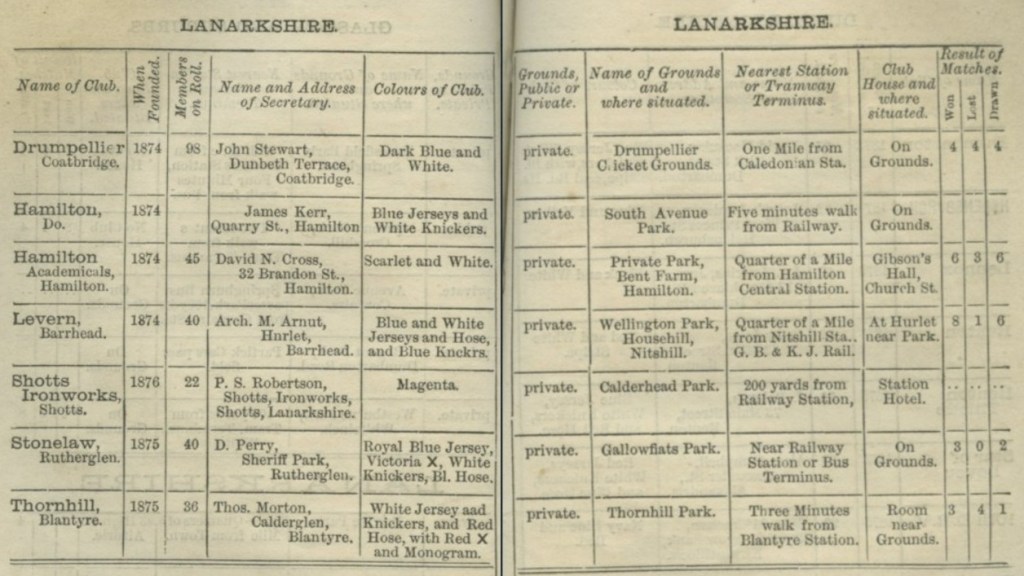
(24) Drumpellier FC, 1874 (West of Scotland)

Source(s): Dick, W. ed. (1876) Scottish Football Annual, 1876-77. Glasgow: Mackay and Kirkwood, p. 68, and Coatbridge Advertiser, October 31, 1874, p. 3. Note: the newspaper article relates to the formation of the club.

(25) Dumbarton FC, 1872 (West of Scotland)

Source(s): Dick, W. ed. (1876) Scottish Football Annual, 1876-77. Glasgow: Mackay and Kirkwood, p. 70.

(26) Dumbarton Cricket & Football Club, 1874 (West of Scotland)

Source(s): Dumbarton Herald, December 3, 1874, p. 4.

(27) East End, Dumbarton, 1873 (West of Scotland)

Source(s): Lennox Herald, December 27, 1873, p. 4.

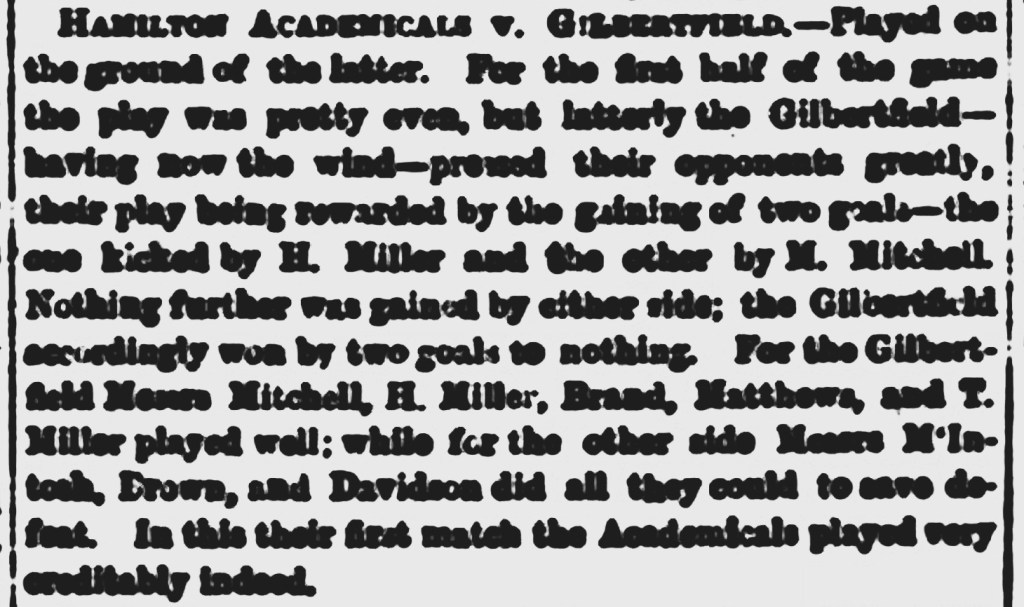
(28) Gilbertfield / Gilbertfield Academicals FC, Hamilton, 1874 (West of Scotland)

Source(s): North British Daily Mail, January 13, 1874, p. 7. Note: This may be the Gilbertfield ‘Academicals’ Club who are also listed for 1875 (see, North British Daily Mail, October 12, 1875, p. 3).

(29) Girvan FC, 1874 (West of Scotland)

Source(s): Dick, W. ed. (1877) Scottish Football Annual, 1877-78. Glasgow: Mackay & Kirkwood, p. 58, and Ardrossan and Saltcoats Herald, August 28, 1875, p. 5. Note: the article relates to the holding of the club’s ‘annual meeting’ implying that the club had existed for at least a year.

(30) Glenkilloch FC, Neilston, 1874 (West of Scotland)

Source(s): Dick, W. ed. (1877) Scottish Football Annual, 1877-78. Glasgow: Mackay and Kirkwood, p. 105.

(31) Hamilton FC, 1874 (West of Scotland)

Source(s): Dick, W. ed. (1876) Scottish Football Annual, 1876-77. Glasgow: Mackay and Kirkwood, p. 68, and Hamilton Advertiser, April 18, 1874, p. 2. Note: connected to the Hamilton Cricket Club. The football club is referenced as being formed in 1873 in Dick, W. ed. (1877) Scottish Football Annual, 1877-78. Glasgow: Mackay and Kirkwood, p. 95, but the newspaper article from April 1874 states that the ‘newly formed Football Club’ had just played its first game.

(32) Hamilton Gymnasium Club, 1869 [1866] (West of Scotland)

Source(s): Hamilton Advertiser, May 12, 1866, p. 2. Note: the club was formed in 1866 but the playing rules are unknown. They first played Queen’s Park in 1869.

(33) Hamilton Academical FC, 1874 (West of Scotland)

Source(s): Dick, W. ed. (1876) Scottish Football Annual, 1876-77. Glasgow: Mackay and Kirkwood, p. 68, and North British Daily Mail, October 19, 1874, p 6.

(34) Hamilton Volunteers FC, 1874 (West of Scotland)

Source(s): North British Daily Mail, January 13, 1874, p. 7.

(35) Hawthorn FC, Dumbarton, 1873 (West of Scotland)

Source(s): Lennox Herald, December 27, 1873, p. 4.

(36) Heatherbell FC, Alexandria, 1874 (West of Scotland)

Source(s): Lennox Herald, February 21, 1874, p. 3. Note: this club is separate from the Dumbarton based club which bears the same name.

(37) Heatherbell FC, Dumbarton, 1873 (West of Scotland)

Source(s): Lennox Herald, November 22, 1873, p. 3.

(38) Helensburgh FC, 1874 (West of Scotland)

Source(s): Dumbarton Herald, April 9, 1874, p. 3, and North British Daily Mail, September 30, 1874, p. 6.

(39) Jamestown FC, 1873 (West of Scotland)

Source(s): Glasgow Herald, April 15, 1873, p. 7.

(40) Kilbirnie Athletic FC, 1874 (West of Scotland)

Source(s): Ardrossan and Saltcoats Herald, November 14, 1874, p. 8.

(41) Kilmarnock FC, 1873 [1869] (West of Scotland)

Source(s): Kilmarnock Football Club (1872–1879) Minute Book, March 3, 1873. Kilmarnock Football Club Archive, uncatalogued. Ayrshire: Kilmarnock Football Club. Note: the earliest reference to the club is a note issued by John Wallace, Secretary, which appears in the Kilmarnock Standard, dated January 2, 1869, p. 2, and advertises a general meeting. While it is likely that the club already existed in December 1868, the club officially recognises 1869 as the year of formation based in part on the newspaper source.

(42) Kilmarnock Dean FC, 1875 (West of Scotland)

Source(s): Kilmarnock Standard, January 30, 1875, p. 2.

(43) Kilmarnock Hawthorn FC, 1875 (West of Scotland)

Source(s): Kilmarnock Standard, January 30, 1875, p. 2.

Source(s): Dick, W. ed. (1877) Scottish Football Annual, 1877-78. Glasgow: Mackay & Kirkwood, p. 97, and Dick, W. ed. (1878) Scottish Football Annual, 1878-79. Glasgow: W. Weatherston & Son, p. 62. Note: Likely to be the Kilmaronock Juvenile Football Club which is referenced in the Dumbarton Herald, February 26, 1874, p. 3.

(45) Lennox FC, Dumbarton, 1873 (West of Scotland)

Source(s): Dick, W. ed. (1876) Scottish Football Annual, 1876-77. Glasgow: Mackay and Kirkwood, p. 70.

(46) Lily FC, Renton, 1874 (West of Scotland)

Source(s): Lennox Herald, September 12, 1874, p. 4.

(47) Linwood FC, 1875 (West of Scotland)

Source(s): North British Daily Mail, March 29, 1875, p. 2.

(48) Loch Lomond Youths FC, Alexandria, 1874 (West of Scotland)

Source(s): Lennox Herald, January 17, 1874, p. 3.

(49) Lorn Youths FC, Alexandria, 1873 (West of Scotland)

Source(s): Dumbarton Herald, January 1, 1874, p. 3.

(50) Mauchline FC, 1873 (West of Scotland)

Source(s): Dick, W. ed. (1876) Scottish Football Annual, 1876-77. Glasgow: Mackay and Kirkwood, p. 76.

(51) Morning FC, Dumbarton, 1875 (West of Scotland)

Source(s): Lennox Herald, March 20, 1875, p. 5.

(52) Paisley FC, 1873 [1870] (West of Scotland)

Source(s): Glasgow Herald, December 29, 1873, p. 6. Note: The club was originally established to play rugby football and the year of formation is recorded in Alcock, C. W. ed. (1872) Football Annual. London: Virtue, p. 74.

(53) Portland FC, Kilmarnock, 1873 (West of Scotland)

Source(s): Dick, W. ed. (1876) Scottish Football Annual, 1876-77. Glasgow: Mackay and Kirkwood, p. 76.

(54) Renton FC, Dunbartonshire, 1873 (West of Scotland)

Source(s): Dumbarton Herald, September 25, 1873, p. 3.

(55) Rising Star FC, Jamestown, 1873 (West of Scotland)

Source(s): Lennox Herald, December 13, 1873, p. 3.

(56) Rob Roy FC, Dumbarton, 1874 (West of Scotland)

Source(s): Lennox Herald, February 7, 1874, p. 4.

(57) Rose FC, Renton, 1874 (West of Scotland)

Source(s): Lennox Herald, February 21, 1874, p. 5.

(58) St Andrews FC, Kilmarnock, 1873 (West of Scotland)

Source(s): Dick, W. ed. (1876) Scottish Football Annual, 1876-77. Glasgow: Mackay and Kirkwood, p. 76.

(59) Star of Leven FC, Alexandria, 1873 (West of Scotland)

Source(s): Dumbarton Herald, December 18, 1873, p. 3.

(60) Star of the Vale FC, Alexandria, 1873 (West of Scotland)

Source(s): Lennox Herald, December 13, 1873, p. 3.

(61) Strathendrick FC, Drymen, 1875 (West of Scotland)

Source(s): Dumbarton Herald, February 25, 1875, p. 3.

(62) Struthers FC, Kilmarnock, 1875 (West of Scotland)

Source(s): Kilmarnock Standard, March 6, 1875, p. 2.

(63) Thistle FC, Renton, 1873 (West of Scotland)

Source(s): Dick, W. ed. (1876) Scottish Football Annual, 1876-77. Glasgow: Mackay and Kirkwood, p. 60.

(64) Vale of Leven FC, Alexandria, 1872 (West of Scotland)

Source(s): North British Daily Mail, August 23, 1872, p. 3.

(65) Vale of Leven Rovers FC, Alexandria, 1873 (West of Scotland)

Source(s): Dick, W. ed. (1876) Scottish Football Annual, 1876-77. Glasgow: Mackay and Kirkwood, p. 70. Note: the club also appears under the shortened title of ‘Leven Rovers’ in 1874 – see, Lennox Herald, January 24, 1874, p. 5.

(66) Vale of Leven Wanderers FC, Alexandria, 1875 (West of Scotland)

Source(s): Dumbarton Herald, February 25, 1875, p. 3.

(67) Vale of Leven Youths FC, Alexandria, 1873 (West of Scotland)

Source(s): Lennox Herald, December 13, 1873, p. 3.

(68) West End FC, Dumbarton, 1874 (West of Scotland)

Source(s): Dumbarton Herald, January 29, 1874, p. 4. Note: the club most likely dates from 1873 but this is the earliest reference that has been found to date.

(69) Winton FC, Kilmarnock 1874 (West of Scotland)

Source: Dick, W. ed. (1876) Scottish Football Annual, 1876-77. Glasgow: Mackay and Kirkwood, p. 76. Note: for an early recorded match see, Kilmarnock Standard, March 6, 1875, p. 2.

(70) 3rd & 14th Ayr RV / Ayrshire Volunteers FC, 1874 (West of Scotland)

Source(s): Ardrossan and Saltcoats Herald, October 24, 1874, p. 5. Note: A club called ‘Ayrshire Volunteers’ is referenced early in 1875 but this likely is the same club (see, Ayr Observer, January 19, 1875, p. 2).

(71) Rothesay FC, 1872 (West of Scotland)

Source(s): Buteman, December 7, 1872, p. 3.


(72) Abercorn FC, 1874 (Glasgow & District)

Source(s): Glasgow Herald, November 23, 1874, p. 7.

(73) Allander FC, Milngavie, 1874 (Glasgow & District)

Source(s): North British Daily Mail, April 27, 1874, p. 3.

(74) Alexandra Athletic FC, 1873 (Glasgow & District)

Source(s): North British Daily Mail, May 27, 1873, p. 3.

(75) Argyle FC, 1873 (Glasgow & District)

Source(s): Scotsman, June 7, 1873, p. 6.

(76) Argyll FC (mk.I), 1874 (Glasgow & District)

Source(s): Glasgow Herald, November 10, 1874, p. 7.

(77) Arthurlie FC, Barrhead, 1874 (Glasgow & District)

Source(s): North British Daily Mail, September 30, 1874, p. 6.

(78) Ashgrove FC / Ibrox FC (mk.II), 1874 (Glasgow & District)

Source(s): Glasgow Herald, March 24, 1874, p. 7.

(79) Balmoral FC, 1874 (Glasgow & District)

Source(s): North British Daily Mail, May 18, 1874, p. 3.

(80) Barrhead FC, 1874 (Glasgow & District)

Source(s): Dick, W. ed. (1876) Scottish Football Annual, 1876-77. Glasgow: Mackay & Kirkwood, p. 66, and Glasgow Herald, December 7, 1874, p. 7.

(81) Barrhead Albert FC, 1874 (Glasgow & District)

Source(s): North British Daily Mail, December 8, 1874, p. 7.

(82) Barrhead Tinsmiths FC, 1875 (Glasgow & District)

Source(s): Renfrewshire Independent, March 13, 1875, p. 5.

(83) Battlefield FC, 1873 (Glasgow & District)

Source(s): McDowell, J. ed. (1884) Scottish Football Annual, 1884-85. Glasgow: H. Nisbet & Co, p. 55.

(84) Belaroma FC, 1874 (Glasgow & District)

Source(s): North British Daily Mail, March 17, 1874, p. 7.

(85) Belgrave FC, 1874 (Glasgow & District)

Source(s): North British Daily Mail, March 23, 1874, p. 7.

(86) Bellahouston FC, 1874 (Glasgow & District)

Source(s): North British Daily Mail, September 8, 1874, p. 7.

(87) Bellahouston Wanderers FC, 1874 (Glasgow & District)

Source(s): North British Daily Mail, April 11, 1874, p. 3.

(88) Berkeley FC, 1875 (Glasgow & District)

Source(s): North British Daily Mail, February 2, 1875, p. 7.

(89) Blythswood FC, 1873 (Glasgow & District)

Source(s): North British Daily Mail, August 25, 1873, p. 2.

(90) Brassfounders FC, Barrhead, 1875 (Glasgow & District)

Source(s): Renfrewshire Independent, March 20, 1875, p. 5.

(91) Britannia FC, Glasgow, 1874 (Glasgow & District)

Source(s): North British Daily Mail, March 10, 1874, p. 7.

(92) Broomhill FC, Partick, 1874 (Glasgow & District)

Source(s): North British Daily Mail, December 14, 1874, p. 6.

(93) Burnhouse FC, 1875 (Glasgow & District)

Source(s): North British Daily Mail, March 8, 1875, p. 6.

(94) Busby FC, 1873 (Glasgow & District)

Source(s): Dick, W. ed. (1876) Scottish Football Annual, 1876-77. Glasgow: Mackay and Kirkwood, p. 60.

(95) Callander FC, 1872 (Glasgow & District)

Source(s): ‘True Blue’ (1881) The Rangers FC. In: Livingstone, R. ed. Scottish Football Annual, 1881-82. Glasgow: Gillespie Brothers, p. 69. Note: they are listed as Rangers’ first opponents in 1872 although Alcock’s Football Annual of 1873 records their formation year as 1873. An early newspaper record of a match involving the club can be found in the Glasgow Herald, June 20, 1873, p. 5.

(96) Cambridge FC / Victoria FC, 1874 (Glasgow & District)

Source(s): Glasgow Herald, December 7, 1874, p. 7.

(97) Cambuslang FC, 1873 (Glasgow & District)

Source(s): Alcock, C. W. ed. (1873) Football Annual. London: Virtue, p. 93.

(98) Camphill FC, 1874 (Glasgow & District)

Source(s): North British Daily Mail, April 21, 1874, p. 7.

(99) Carlton FC, 1874 (Glasgow & District)

Source(s): North British Daily Mail, April 6, 1874, p. 6.

(100) Carrington FC, 1874 (Glasgow & District)

Source(s): North British Daily Mail, November 23, 1874, p. 3.

(101) Cathcart FC, 1874 (Glasgow & District)

Source(s): Glasgow Herald, March 17, 1874, p. 6.

(102) Cartvale FC, 1875 (Glasgow & District)

Source(s): North British Daily Mail, March 9, 1875, p. 7.

(103) Cathcart Good Templars FC, 1875 (Glasgow & District)

Source(s): North British Daily Mail, March 9, 1875, p. 7.

(104) Celtic FC, 1873 (Glasgow & District)

Source(s): Glasgow Herald, January 27, 1873, p. 6.

(105) Clairmont FC / Claremont FC, 1874 (Glasgow & District)

Source(s): Glasgow Herald, November 23, 1874, p. 7, and North British Daily Mail, February 15, 1875, p. 3.

(106) Clyde FC, 1872 (Glasgow & District)

Source(s): ‘True Blue’ (1881) The Rangers FC. In: Livingstone, R. ed. Scottish Football Annual, 1881-82. Glasgow: Gillespie Brothers, p. 69. Note: Rangers’ second opponent in summer of 1872.

(107) Clydebank FC, Rutherglen, 1873 (Glasgow & District)

Source(s): Dick, W. ed. (1879) Scottish Football Annual, 1879-80. Glasgow: Dunlop & Foote, p. 76.

(108) Clydesdale FC, 1872 (Glasgow & District)

Source(s): Alcock, C. W. ed. (1873) Football Annual. London: Virtue, p. 93.

(109) Clutha FC, 1875 (Glasgow & District)

Source(s): North British Daily Mail, March 8, 1875, p. 6.

(110) Craigpark FC, 1874 (Glasgow & District)

Source(s): Dick, W. ed. (1876) Scottish Football Annual, 1876-77. Glasgow: Mackay & Kirkwood, p. 58, and North British Daily Mail, December 23, 1874, p. 6.

(111) Craigton FC, 1874 (Glasgow & District)

Source(s): North British Daily Mail, November 24, 1874, p. 6.

(112) Crescent FC, 1875 (Glasgow & District)

Source(s): North British Daily Mail, March 22, 1875, p. 6.

(113) Darnley FC, 1875 (Glasgow & District)

Source(s): North British Daily Mail, March 30, 1875, p. 7.

(114) Deaf & Dumb FC, 1872 (Glasgow & District)

Source(s): Alcock, C. W. ed. (1874) Football Annual. London: Virtue, p. 127.

(115) Derby FC, 1873 (Glasgow & District)

Source(s): Glasgow Herald, December 23, 1873, p. 7.

(116) Don FC, 1874 (Glasgow & District)

Source(s): North British Daily Mail, May 18, 1874, p. 3.

(117) Drummond FC, 1870 [1869] (Glasgow & District)

Source(s): Robinson, R. (1920) History of the Queen’s Park Football Club, 1867-1917. Glasgow: Hay Nisbet & Co. Ltd, p. 36.

(118) Dumbreck FC, 1871 (Glasgow & District)

Source(s): Dick, W. ed. (1876) Scottish Football Annual, 1876-77. Glasgow: Mackay and Kirkwood, p. 58.

(119) Eastern FC, 1872 (Glasgow & District)

Source(s): Alcock, C. W. ed. (1873) Football Annual. London: Virtue, p. 93.

(120) Eastern Star FC, 1874 (Glasgow & District)

Source(s): Glasgow Herald, November 10, 1874, p. 7.

(121) East Kilbride FC, 1871 (Glasgow & District)

Source(s): Hamilton Advertiser, December 16, 1871, p. 2.

(122) Edgehill FC, 1874 (Glasgow & District)

Source(s): North British Daily Mail, March 31, 1874, p. 6.

(123) Eglinton FC, 1874 (Glasgow & District)

Source(s): North British Daily Mail, October 19, 1874, p. 6.

(124) Engineers FC, Barrhead, 1875 (Glasgow & District)

Source(s): Renfrewshire Independent, March 20, 1875, p. 5.

(125) Excelsior FC, 1874 (Glasgow & District)

Source(s): North British Daily Mail, November 23, 1874, p. 3.

(126) Glasgow University FC (mk.III), 1875 (Glasgow & District)

Source(s): Edinburgh Evening News, March 29, 1875, p. 3.

(127) Glasgow Wanderers FC, 1873 (Glasgow & District)

Source(s): Glasgow Herald, April 7, 1873, p. 6.

(128) Govan FC, 1873 (Glasgow & District)

Source(s): Dick, W. ed. (1876) Scottish Football Annual, 1876-77. Glasgow: Mackay and Kirkwood, p. 60.

(129) Grafton FC, 1874 (Glasgow & District)

Source(s): Glasgow Herald, March 24, 1874, p. 7.

(130) Grahamston Mechanics FC, Barrhead, 1875 (Glasgow & District)

Source(s): Renfrewshire independent, March 13, 1875, p. 5.

(131) Granby FC, 1874 ((Glasgow & District)

Source(s): Glasgow Herald, January 12, 1874, p. 7.

(132) Granville FC, 1871 (Glasgow & District)

Source(s): Robinson, R. (1920) History of the Queen’s Park Football Club, 1867-1917. Glasgow: Hay Nisbet & Co. Ltd, p. 36.

(133) Greenvale FC / Burnbank FC, 1874 (Glasgow & District)

Source(s): North British Daily Mail, February 9, 1874, p. 7, and North British Daily Mail, October 12, 1874, p. 6.

(134) Havelock FC, 1873 (Glasgow & District)

Source(s): Dick, W. ed. (1876) Scottish Football Annual, 1876-77. Glasgow: Mackay and Kirkwood, p. 60.

(135) Hawthorn FC, 1874 (Glasgow & District)

Source(s): North British Daily Mail, April 7, 1874, p. 7.

(136) Hazelbank FC, 1874 (Glasgow & District)

Source(s): North British Daily Mail, March 31, 1874, p. 6.

(137) Hutchesontown FC, 1874 (Glasgow & District)

Source(s): North British Daily Mail, November 2, 1874, p. 3.

(138) Ibrox FC, 1873 (Glasgow & District)

Source(s): Glasgow Herald, November 25, 1873, p. 6.

(139) Kelvinside FC, 1874 (Glasgow & District)

Source(s): Glasgow Herald, November 10, 1874, p. 7.

(140) Kerland FC, 1874 (Glasgow & District)

Source(s): North British Daily Mail, October 19, 1874, p. 6.

(141) King’s Cross FC, 1875 (Glasgow & District)

Source(s): North British Daily Mail, March 29, 1875, p. 2.

(142) King’s Park FC, 1875 (Glasgow & District)

Source(s): North British Daily Mail, January 18, 1875, p. 7.

(143) Kirkland FC, 1874 (Glasgow & District)

Source(s): North British Daily Mail, November 16, 1874, p. 6.

(144) Lancefield FC, 1874 (Glasgow & District)

Source(s): Dick, W. ed. (1877) Scottish Football Annual, 1877-78. Glasgow: Mackay & Kirkwood, p. 88, and Glasgow Herald, November 30, 1874, p. 6.

(145) Lancelot FC, 1874 (Glasgow & District)

Source(s): Glasgow Herald, November 30, 1874, p. 6.

(146) Langshot FC, 1874 (Glasgow & District)

Source(s): North British Daily Mail, April 6, 1874, p. 6.

(147) Langside FC, 1874 (Glasgow & District)

Source(s): North British Daily Mail, February 3, 1874, p. 5.

(148) Largo FC, 1874 (Glasgow & District)

Source(s): North British Daily Mail, April 1, 1874, p. 6.

(149) Levern FC (mk.I), 1874 (Glasgow & District)

Source(s): Glasgow Herald, November 10, 1874, p. 7.

(150) Levern FC (mk.II), 1875 (Glasgow & District)

Source(s): North British Daily Mail, March 22, 1875, p. 6.

(151) Marchtown FC, 1873 (Glasgow & District)

Source(s): Alcock, C. W. ed. (1879) Football Annual. London: Cricket Press, p. 130.

(152) Maxwell FC, 1874 (Glasgow & District)

Source(s): Glasgow Herald, November 10, 1874, p. 7.

(153) Maybank FC, 1874 (Glasgow & District)

Source(s): North British Daily Mail, March 31, 1874, p. 6.

(154) Millburn FC, 1874 (Glasgow & District)

Source(s): Glasgow Herald, December 7, 1874, p. 7.

(155) Mount Vernon FC, 1874 (Glasgow & District)

Source(s): Glasgow Herald, December 14, 1874, p. 6.

(156) Netherlee FC, 1875 (Glasgow & District)

Source(s): North British Daily Mail, March 8, 1875, p. 6.

(157) Netherlee Star FC, Cathcart, 1875 (Glasgow & District)

Source(s): North British Daily Mail, February 8, 1875, p. 6.

(158) Northern FC, 1874 (Glasgow & District)

Source(s): Dick, W. ed. (1876) Scottish Football Annual, 1876-77. Glasgow: Mackay & Kirkwood, p. 62, and North British Daily Mail, September 22, 1874, p. 6.

(159) Oakbank FC, 1874 (Glasgow & District)

Source(s): North British Daily Mail, May 18, 1874, p. 3.

(160) Oxford FC, Glasgow, 1873 (Glasgow & District)

Source(s): Dick, W. ed. (1877) Scottish Football Annual, 1877-78. Glasgow: Mackay and Kirkwood, p. 89.

(161) Oxford Juniors FC, 1874 (Glasgow & District)

Source(s): Glasgow Herald, November 10, 1874, p. 7.

(162) Parkgrove FC, 1873 (Glasgow & District)

Source(s): Dick, W. ed. (1876) Scottish Football Annual, 1876-77. Glasgow: Mackay and Kirkwood, p. 62.

(163) Partick FC, 1875 (Glasgow & District)

Source(s): Dick, W. ed. (1875) Scottish Football Annual, 1875-76. Glasgow: W. Weatherspoon & Son, p. 29, and North British Daily Mail, March 30, 1875, p. 3.

(164) Pollok FC / Pollokshaws FC, 1875 [1874] (Glasgow & District)

Source(s): Hamilton Advertiser, February 27, 1875, p. 2, and North British Daily Mail, March 9, 1875, p. 7.

(165) Pollokshields FC, 1875 (Glasgow & District)

Source(s): North British Daily Mail, March 15, 1875, p. 3.

(166) Queen’s Park FC, 1867 (Glasgow & District)

Source(s): Queen’s Park Football Club (1867 – 1877) Cash Book. Queen’s Park Football Club Archive, QP.E454. Glasgow: Scottish Football Museum.

(167) Queen’s Park Juniors FC, 1870 (Glasgow & District)

Source(s): Alcock, C. W. ed. (1876) Football Annual. London: Ward, Lock & Tyler, p. 118.

(168) Ramblers FC, 1874 (Glasgow & District)

Source(s): Dick, W. ed. (1876) Scottish Football Annual, 1876-77. Glasgow: Mackay & Kirkwood, p. 62, and North British Daily Mail, November 23, 1874, p. 3.

(169) Rangers FC, 1872 (Glasgow & District)

Source(s): Dick, W. ed. (1876) Scottish Football Annual, 1876-77. Glasgow: Mackay and Kirkwood, p. 64.

(170) Rangers Juniors FC / Young Rangers FC, 1875 (Glasgow & District)

Source(s): North British Daily Mail, March 16, 1875, p. 6.

(171) Regent Park FC (mk.II), 1874 (Glasgow & District)

Source(s): North British Daily Mail, April 7, 1874, p. 7.

(172) Richmond FC, 1874 (Glasgow & District)

Source(s): North British Daily Mail, December 14, 1874, p. 6.

(173) Rosslyn FC, Govan, 1872 (Glasgow & District)

Source(s): Dick, W. ed. (1877) Scottish Football Annual, 1877-78. Glasgow: Mackay and Kirkwood, p. 91.

(174) Rovers FC, 1872 (Glasgow & District)

Source(s): Dick, W. ed. (1876) Scottish Football Annual, 1876-77. Glasgow: Mackay and Kirkwood, p. 64.

(175) Sandyford FC, 1874 (Glasgow & District)

Source(s): Dick, W. ed. (1876) Scottish Football Annual, 1876-77. Glasgow: Mackay & Kirkwood, p. 64, and Glasgow Herald, November 16, 1874, p. 7.

(176) Springhill FC, 1875 (Glasgow & District)

Source(s): Glasgow Herald, January 19, 1875, p. 7.

(177) Southern FC, 1872 (Glasgow & District)

Source(s): North British Daily Mail, March 25, 1872, p. 3.

(178) St Andrews FC (mk.III), 1874 (Glasgow & District)

Source(s): Dick, W. ed. (1875) Scottish Football Annual, 1875-76. Glasgow: W. Weatherspoon & Son, p. 29, and North British Daily Mail, October 19, 1874, p. 6.

(179) Standard FC, 1873 (Glasgow & District)

Source(s): Dick, W. ed. (1876) Scottish Football Annual, 1876-77. Glasgow: Mackay and Kirkwood, p. 64.

(180) St Enoch FC, 1875 (Glasgow & District)

Source(s): North British Daily Mail, March 22, 1875, p. 6.

(181) Stonefield FC, 1871 (Glasgow & District)

Source(s): Dick, W. ed. (1877) Scottish Football Annual, 1877-78. Glasgow: Mackay and Kirkwood, p. 92.

(182) Summertown FC, 1873 (Glasgow & District)

Source(s): Alcock, C. W. ed. (1874) Football Annual., London: Virtue, p. 128.

(183) Telegraphists FC, 1874 (Glasgow & District)

Source(s): Dick, W. ed. (1876) Scottish Football Annual, 1876-77. Glasgow: Mackay & Kirkwood, p. 64.

(184) Thistle FC, Glasgow, 1868 (Glasgow & District)

Source(s): Robinson, R. (1920) History of the Queen’s Park Football Club, 1867-1917. Glasgow: Hay Nisbet & Co. Ltd, p. 30.

(185) Thistle FC, Barrhead, 1875 (Glasgow & District)

Source(s): North British Daily Mail, March 22, 1875, p. 6.

(186) Thornbank FC, 1875 (Glasgow & District)

Source(s): North British Daily Mail, February 15, 1875, p. 3.

(187) Towerhill FC, 1874 (Glasgow & District)

Source(s): Dick, W. ed. (1876) Scottish Football Annual, 1876-77. Glasgow: Mackay & Kirkwood, p.66, and North British Daily Mail, September 29, 1874, p. 6.

(188) Tubal Foundry FC, Barrhead, 1875 (Glasgow & District)

Source(s): Renfrewshire Independent, March 20, 1875, p. 5.

(189) Uddingston FC, 1874 (Glasgow & District)

Source(s): Glasgow Herald, October 27, 1874, p. 7.

(190) Ulva FC, 1874 (Glasgow & District)

Source(s): Glasgow Herald, November 10, 1874, p. 7. 

(191) Union FC, 1873 (Glasgow & District)

Source(s): Dick, W. ed. (1877) Scottish Football Annual, 1877-78. Glasgow: Mackay and Kirkwood, p. 93.

(192) Union Jack FC, 1874 (Glasgow & District)

Source(s): Glasgow Herald, January 20, 1874, p. 7.

(193) Vale of Leven Rovers FC, Glasgow, 1874 (Glasgow & District)

Source(s): Dick, W. ed. (1875) Scottish Football Annual, 1875-76. Glasgow: W. Weatherspoon & Son, p. 29, and North British Daily Mail, November 16, 1874, p. 6.

(194) Valetta FC, 1874 (Glasgow & District)

Source(s): North British Daily Mail, November 16, 1874, p. 6.

(195) Violet FC, 1874 (Glasgow & District)

Source(s): Glasgow Herald, November 30, 1874, p. 6.

(196) Waverley FC, Busby, 1874 (Glasgow & District)

Source(s): North British Daily Mail, December 8, 1874, p. 7.

(197) Wellpark FC, 1875 (Glasgow & District)

Source(s): Dick, W. ed. (1878) Scottish Football Annual, 1878-79. Glasgow: W. Weatherston & Son, p. 56, and North British Daily Mail, March 9, 1875, p. 7.

(198) Westburn FC, 1875 (Glasgow & District)

Source(s): North British Daily Mail, March 29, 1875, p. 2.

(199) West End FC / West End Wanderers FC, 1873 (Glasgow & District)

Source(s): Dick, W. ed. (1876) Scottish Football Annual, 1876-77. Glasgow: Mackay and Kirkwood, p. 66, and Glasgow Herald, September 1, 1873, p. 7.

(200) Western FC (mk.II), 1873 (Glasgow & District)

Source(s): North British Daily Mail, October 27, 1873, p. 6.

(201) Whiteinch FC, 1874 (Glasgow & District)

Source(s): Dick, W. ed. (1876) Scottish Football Annual, 1876-77. Glasgow: Mackay and Kirkwood, p. 66.

(202) Woodbank FC, 1873 (Glasgow & District)

Source(s): North British Daily Mail, September 16, 1873, p. 3. Note: becomes Crosshill FC mk.II in 1875.

(203) 1st Lanark RV FC, 1873 (Glasgow & District)

Source(s): Alcock, C. W. ed. (1873) Football Annual. London: Virtue, p. 52. Note: formally recorded as being a football club in the source.

(204) 3rd Lanark RV FC, 1872 (Glasgow & District)

Source(s): Glasgow Herald, December 20, 1872, p. 7. Note: article records the formation of the football club.

(205) 4th Renfrew RV FC, 1874 (Glasgow & District)

Source(s): Dick, W. ed. (1876) Scottish Football Annual, 1876-77. Glasgow: Mackay & Kirkwood, p. 60. Note: formally recorded as being a football club in the source.

(206) 21st Fusiliers FC, 1873 (Glasgow & District)

Source(s): Glasgow Herald, December 22, 1873, p. 7. Note: the club’s fixture list for 1873-74 includes matches against the Alexandra Athletic Club in December 1873, the 105th Lanark RV Club in February 1874 and the Eastern Club in March 1874.

(207) 23rd Renfrew RV FC, 1873 (Glasgow & District)

Source(s): North British Daily Mail, November 15, 1873, p. 15. Note: the article relates to the formation of the football club.

(208) 105th Lanark RV FC, 1874 (Glasgow & District)

Source(s): Glasgow Herald, March 3, 1874, p. 6. Note: the 105th Lanark RV Club are running 1st and 2nd XIs by March 1874. The first match of the new club is against the 21st Fusiliers Club in February 1874. This is followed by a match against the 3rd Lanark RV Club later in the same month then Blythswood FC in March 1874 (see North British Daily Mail editions of February 16, 1874, p. 3, March 3, 1874, p. 6, & March 10, 1874, p. 7).

Glasgow Football Study

List of known clubs up to the end of 1875

Glasgow Academical Football Club (pictured 1870) and Queen’s Park Football Club (pictured 1874)

This study was undertaken for Chapter 4 of the thesis and relates to all football clubs that are known to have existed across Glasgow and the surrounding area (up to a 7 mile radius of Glasgow Cross), from the earliest reference of 1851 up to the end of 1875. Although Paisley is located at the very edge of the 7 mile limit, the football clubs from that town have not been included. This is because the Renfrewshire town, with a sizeable population, is considered to be a distinctive entity within the Greater Glasgow conurbation.

The College Green, Glasgow (surveyed in 1856), home to the Glasgow University Football Club. Reproduced with the permission of the National Library of Scotland.

INDEX

1. Name of club

2. Playing code

3. Year of formation or earliest known recorded year

4. Territory / District

5. Sources


CLUBS

(001) 1. Abercorn FC. 2. Association. 3. 1874. 4. Strathclyde Park, Dalmarnock. 5. Glasgow Herald, November 23, 1874, p. 7.

(002) 1. Abington FC. 2. Association. 3. 1875. 4. Ravenswood, Shawlands. 5. North British Daily Mail, November 1, 1875, p. 3.

(003) 1. Ailsa FC. 2. Association. 3. 1875. 4. Pollokshields. 5. North British Daily Mail, August 23, 1875, p. 6. Note: the article refers to the formation of the club by members of the Ailsa Cricket Club.

(004) 1. Albert FC. 2. Association. 3. 1875. 4. Pollokshields (Albert Drive). 5. North British Daily Mail, September 21, 1875, p. 6. Note: the club plays at Queen’s Park.

(005) 1. Albion FC. 2. Association. 3. 1875. 4. Queen’s Park. 5. Glasgow Herald, November 22, 1875, p. 7.

(006) 1. Alexandra Athletic FC. 2. Association. 3. 1873. 4. Dennistoun (Alexandra Park). 5. Dick, W. ed. (1876) Scottish Football Annual, 1876-7. Glasgow: Mackay & Kirkwood, p. 58, and North British Daily Mail, May 27, 1873, p. 3.

(007) 1. Allander FC (Milngavie). 2. Association. 3. 1874. 4. Milngavie. 5. North British Daily Mail, April 27, 1874, p. 3.

(008) 1. Allison FC. 2. Association. 3. 1875. 4. Govanhill (Allison St). 5. North British Daily Mail, November 29, 1875, p. 3.

(009) 1. Argyle FC. 2. Association. 3. 1873.  4. Glasgow Green. 5. Scotsman, June 7, 1873, p. 6.

(010) 1. Argyll FC (mk.I). 2. Association. 3. 1874. 4. Dennistoun. 5. Glasgow Herald, November 10, 1874, p. 7. Note: the match against Govan is played in Dennistoun.

(011) 1. Argyll FC (mk.II). 2. Association. 3. 1875. 4. Crosshill. 5. North British Daily Mail, December 27, 1875, p. 3. Note: was originally the 2nd team of the Kerland Club before setting up as a separate club.

(012) 1. Armadale FC. 2. Association. 3. 1875. 4. Kennyhill Park, Dennistoun. 5. North British Daily Mail, September 27, 1875, p. 3. Note: Armadale Street is in Dennistoun.

(013) 1. Arthurlie FC. 2. Association. 3. 1874. 4. Barrhead. 5. Dick, W. ed. (1876) Scottish Football Annual, 1876-77. Glasgow: Mackay & Kirkwood, p. 66, and North British Daily Mail, September 30, 1874, p. 6.

(014) 1. Ashgrove FC / Ibrox FC (mk.II). 2. Association. 3. 1874. 4. Ibroxhill. 5. Glasgow Herald, March 24, 1874, p. 7. Note: becomes Ibrox (mk.II) in 1875 (Glasgow Herald, February 23, 1875, p. 7), although an Ashgrove (Ibrox) can be found in 1876 (North British Daily Mail, January 10, 1876, p. 7).

(015) 1. Ashton FC. 2. Rugby. 3. 1874. 4. Blochairn (near Dennistoun). 5. Glasgow Herald, November 16, 1874, p. 7. Note: linked to the Ashton Cricket Club which was based at Blochairn (see, North British Daily Mail, June 23, 1874, p. 7).

(016) 1. Balmoral FC (Crosshill). 2. Association. 3. 1874. 4. Crosshill. 5. North British Daily Mail, May 18, 1874, p. 3. Note: in the article the club is referred as being from Crosshill.

(017) 1. Barrhead FC. 2. Association. 3. 1874. 4. Barrhead. 5. Dick, W. ed. (1876) Scottish Football Annual, 1876-77. Glasgow: Mackay & Kirkwood, p. 66, and Glasgow Herald, December 7, 1874, p. 7.

(018) 1. Barrhead Albert FC. 2. Association. 3. 1874. 4. Barrhead. 5. North British Daily Mail, December 8, 1874, p. 7, and Glasgow Herald, February 23, 1875, p. 7.

(019) 1. Barrhead Juniors FC. 2. Association. 3. 1875. 4. Barrhead. 5. North British Daily Mail, December 27, 1875, p. 3.

(020) 1. Barrhead Tinsmiths FC. 2. Association. 3. 1875. Barrhead. 5. Renfrewshire Independent, March 13, 1875, p. 5. Note: one of a small cluster of clubs in and around Barrhead linked to local industry.

(021) 1. Battlefield FC. 2. Association. 3. 1873. 4. Langside. 5. McDowall, J. ed. (1884) Scottish Football Annual, 1881-82. Glasgow: H. Nisbet & Co., p. 55. Note: an early match involving the club can be found at North British Daily Mail, March 15, 1875, p. 3.

(022) 1. Bedford FC. 2. Association. 3. 1875. 4. Queen’s Park. 5. North British Daily Mail, August 30, 1875, p. 3. Note: there is a Bedford Street in Laurieston.

(023) 1. Belaroma FC. 2. Association. 3. 1874. 4. Glasgow (Unknown). 5. North British Daily Mail, March 17, 1874, p. 7. Note: spelling given as ‘Beldroma’ in the Glasgow Herald, March 17, 1874, p. 6.

(024) 1. Belgrave FC. 2. Association. 3. 1874. 4. Hillhead (Belgrave Ter). 5. North British Daily Mail, March 23, 1874, p. 7. Note: the Belgrave Cricket Club is based at St Vincent Park.

(025) 1. Bellahouston FC. 2. Association. 3. 1874. 4. Bellahouston. 5. North British Daily Mail, September 8, 1874, p. 7.

(026) 1. Bellahouston Wanderers FC. 2. Association. 3. 1874. 4. Bellahouston. 5. North British Daily Mail, April 11, 1874, p. 3.

(027) 1. Bell Street Juveniles FC. 2. Unknown. 3. 1873. 4. Central Glasgow. 5. North British Daily Mail, January 1, 1874, p. 4. Note: the article is an acknowledgement of payment (towards an appeal issued by the Public Commissioner) which is made by the ‘Bell Street Juvenile Football Club’.

(028) 1. Belmont FC. 2. Rugby. 3. 1873. 4. Kelvinbridge. 5. North British Daily Mail, November 11, 1873, p. 7.

(029) 1. Berkeley FC. 2. Association. 3. 1875. 4. Finnieston (Berkeley Street). 5. North British Daily Mail, February 2, 1875, p. 7.

(030) 1. Bluebell FC. 2. Association. 3. 1875. 4. Possibly St Rollox. 5. North British Daily Mail, November 29, 1875, p. 3. Note: may be connected to the Bluebell Cricket Club based in St Rollox (Sighthill).

(031) 1. Blythswood FC. 2. Association. 3. 1873. 4. Blythswood Hill. 5. North British Daily Mail, August 25, 1873, p. 2. Note: the article states that the football club was formed after a proposal was accepted at a general meeting of the Blythswood Cricket Club.

(032) 1. Bowerbank FC. 2. Association. 3. 1875. 4. North Woodlands. 5. North British Daily Mail, November 29, 1875, p. 3.

(033) 1. Brassfounders FC (Barrhead). 2. Association. 3. 1875. 4. Barrhead. 5. Renfrewshire Independent, March 20, 1875, p. 5.

(034) 1. Breadalbane FC. 2. Association. 3. 1875. 4. Glasgow Green. 5. North British Daily Mail, November 29, 1875, p. 3. Note: club based at Glasgow Green.

(035) 1. Bridgeton FC. 2. Association. 3. 1875. 4. Bridgeton. 5. Glasgow Herald, December 27, 1875, p. 5.

(036) 1. Britannia FC. 2. Association. 3. 1874. 4. Glasgow (Unknown) 5. North British Daily Mail, March 10, 1874, p. 7. Note: in the newspaper report, an ‘A. Sliman’ is recorded as scoring for Britannia against Maybank. This may be Archibald Sliman who would become President of the Scottish Football Association in 1892.

(037) 1. Broomhill FC (Partick).  2. Association. 3. 1874. 4. Broomhill. 5. North British Daily Mail, December 14, 1874, p. 6.

(038) 1. Broompark FC. 2. Association. 3. 1875. 4. Dennistoun (Broompark). 5. North British Daily Mail, October 26, 1875, p. 6.

(039) 1. Brownfield FC. 2. In-house rules. 3. 1859. 4. Central Glasgow (Brownfield Chapel). 5. Glasgow Herald, August 23, 1859, p. 3.

(040) 1. Brunswick FC. 2. Association. 3. 1875. 4. Glasgow Green. 5. North British Daily Mail, November 1, 1875, p. 3.

(041) 1. Burnhouse FC. 2. Association. 3. 1875. 4. Maryhill (Burnhouse Street). 5. North British Daily Mail, March 8, 1875, p. 6.

(042) 1. Busby FC. 2. Association. 3. 1873. 4. Busby. 5. Dick, W. ed. (1876) Scottish Football Annual, 1876-77. Glasgow: Mackay & Kirkwood, p. 78, and Dick, W. ed. (1877) Scottish Football Annual, 1877-78. Glasgow: Mackay & Kirkwood, p. 105. Note: an early recorded match involving the club can be found in the Glasgow Herald, March 17, 1874, p. 6.

(043) 1. Busby Thistle FC. 2. Association. 3. 1875. 4. Busby. 5. North British Daily Mail, April 5, 1875, p. 3.

(044) 1. Callander FC. 2. Association. 3. 1872. 4. Glasgow Green. 5. ‘True Blue’ (1881) The Rangers FC. In: Livingstone, R. ed. Scottish Football Annual, 1881-82. Glasgow: Gillespie Brothers, p. 69. Note: they are listed as Rangers’ first opponents in 1872 although Alcock’s Football Annual of 1873 records their formation year as 1873. An early newspaper record of a match involving the club can be found in the Glasgow Herald, June 20, 1873, p. 5.

(045) 1. Caledonia FC. 2. Association. 3. 1875. 4. Thornliebank. 5. North British Daily Mail, April 13, 1875, p. 7. Note: this club changes its name to Kennishead in 1879.

(046) 1. Caledonian FC. 2. Association. 3. 1875. 4. Kelvinbridge (Great Western Rd). 5. Dick, W. ed. (1876) Scottish Football Annual, 1876-77. Glasgow: Mackay & Kirkwood, p. 5 and. North British Daily Mail, September 8, 1875, p. 4. Note: in the article the cricket club forms a football club and decides to canvas members as to whether to play association or rugby rules. They choose association rules and are known as the Caledonian Football and Lacrosse Club (See, Glasgow Herald, December 22, 1875, p. 2).

(047) 1. Cambridge FC / Victoria FC. 2. Association. 3. 1874. 4. Glasgow Green. 5. Glasgow Herald, December 7, 1874, p. 7. Note: club changes name to Victoria in 1875 (See, North British Daily Mail, September 13, 1875, p. 6).

(048) 1. Cambuslang FC. 2. Association. 3. 1873. 4. Cambuslang. 5. Alcock, C. W. ed. (1873) Football Annual. London: Virtue, p. 93. Note: in 1873 the club are based at Westburn Green.

(049) 1. Camphill FC. 2. Association. 3. 1874. 4. Queen’s Park (Camphill). 5. North British Daily Mail, April 21, 1874, p. 7.

(050) 1. Carlton FC. 2. Association. 3. 1874. 4. Laurieston (Carlton Place). 5. North British Daily Mail, April 6, 1874, p. 6.

(051) 1. Carmunock FC. 2. Association. 3. 1875. 4. Carmunock. 5. Glasgow Herald, April 27, 1875, p. 3.

(052) 1. Carrington FC. 2. Association. 3. 1874. 4. Wilton Park. 5. North British Daily Mail, November 23, 1874, p. 3. Note: there is a Carrington Street at Woodlands.

(053) 1. Cartvale FC. 2. Association. 3. 1875. 4. Busby. 5. North British Daily Mail, March 9, 1875, p. 7.

(054) 1. Cathcart FC. 2. Association. 3. 1874. 4. Cathcart. 5. Glasgow Herald, March 17, 1874, p. 6.

(055) 1. Cathcart Good Templars FC. 2. Association. 3. 1875. 4. Cathcart. 5. North British Daily Mail, March 9, 1875, p. 7.

(056) 1. Cathkin FC. 2. Association. 3. 1875. 4. Queen’s Park. 5. North British Daily Mail, December 13, 1875, p. 3.

(057) 1. Celtic FC. 2. Association. 3. 1873. 4. Glasgow Green. 5. Glasgow Herald, January 27, 1873, p. 6.

(058) 1. Clairmont FC / Claremont FC. 2. Association. 3. 1874. 4. Queen’s Park. 5. Glasgow Herald, November 23, 1874, p. 7, and North British Daily Mail, February 15, 1875, p. 3. Note: it is likely that these two names relate to one football club as they never appear together in fixture lists.

(059) 1. Clarendon FC. 2. Association. 3. 1875. 4. Kelvinside. 5. North British Daily Mail, October 25, 1875, p. 3. Note, the club are recorded playing at Kelvinside which neighbours Woodside (Clarendon Street).

(060) 1. Clyde FC. 2. Association. 3. 1872. 4. Glasgow Green. 5. ‘True Blue’ (1881) The Rangers FC. In: Livingstone, R. ed.Scottish football annual, 1881-82. Glasgow: Gillespie Brothers, p. 69. Note: Clyde are Rangers’ second opponent in the summer of 1872. Another early game can be found at Scotsman, September 22, 1873, p. 6.

(061) 1. Clydebank FC (Rutherglen). 2. Association. 3. 1873. 4. Rutherglen. 5. Dick, W. ed. (1879) Scottish Football Annual, 1879-80. Glasgow: Dunlop & Foote, p. 76. Note: an early record of a match can be found in the North British Daily Mail,October 26, 1875, p. 6.

(062) 1. Clydebank FC. 2. Association. 3. 1875. 4. Whiteinch. 5. North British Daily Mail, November 22, 1875, p. 6. Note: Clydebank play Valencia on Glasgow Green in the same day that Clydebank (Rutherglen) are playing in Linwood, Renfrewshire. This club is likely an offshoot of the Clydebank Cricket Club of Whiteinch.

(063) 1. Clydesdale FC. 2. Association. 3. 1872. 4. Pollokshields (Titwood Park). 5. Alcock, C. W. ed. (1873) Football Annual, London: Virtue, p. 93, and Dick, W. ed. (1876) Scottish Football Annual, 1876-77. Glasgow: Mackay & Kirkwood, p. 58. Note: an early reference to the football club being connected to Clydesdale Cricket Club can be found in the North British Daily Mail, February 17, 1873, p. 4.

(064) 1. Clydesdale FC (Partick). 2. Association. 3. 1875. 4. Partick. 5. North British Daily Mail, April 12, 1875, p. 6.

(065) 1. Clydeview FC. 2. Association. 3. 1875. 4. Partick. 5. North British Daily Mail, September 27, 1875, p. 3.

(066) 1. Clutha FC. 2. Association. 3. 1875. 4. Pollokshields. 5. North British Daily Mail, March 8, 1875, p. 6.

(067) 1. Colour Mixers FC (Barrhead). 2. Association. 3. 1875. 4. Barrhead. 5. Renfrewshire Independent, December 11, 1875, p. 5. Note: one of a small cluster of clubs in and around Barrhead linked to local industry.

(068) 1. Corunna FC. 2. Rugby. 3. 1874. 4. Finnieston (Corunna St). 5. North British Daily Mail, February 3, 1874, p. 5.

(069) 1. Craigpark FC. 2. Association. 3. 1874. 4. Dennistoun (Craigpark). 5. Dick, W. ed., (1876) Scottish Football Annual, 1876-77. Glasgow: Mackay & Kirkwood,58. North British Daily Mail, December 23, 1874, p. 6.

(070) 1. Craigpark Juniors FC. 2. Association. 3. 1875. 4. Dennistoun (Craigpark). 5. North British Daily Mail, November 22, 1875, p. 6.

(071) 1. Craigton FC. 2. Association. 3. 1874. 4. Craigton. 5. North British Daily Mail, November 24, 1874, p. 6. Note: in the article Queen’s Park is said to be the home of Craigton but this may be a typo as their opponents Maxwell played in that park. The Craigton neighbourhood is close to Bellahouston Park.

(072) 1. Crescent FC. 2. Association. 3. 1875. 4. Kinning Park. 5. North British Daily Mail, March 22, 1875, p. 6. Note: Crescent Cricket Club is based at Kinning Park in 1875.

(073) 1. Crosshill FC (mk.I). 2. Rugby. 3. 1871. 4. Crosshill. 5. Glasgow Herald, November 21, 1871, p. 5. Note: Crosshill amalgamates with Regent Park (mk.I) to form Southern Cricket and Football Club in March 1872 (see, North British Daily Mail, March 25, 1872, p. 3).

(074) 1. Cumberland FC. 2. Association. 3. 1875. 4. Queen’s Park. 5. North British Daily Mail, September 27, 1875, p. 3. Note: there is a Cumberland Street in the Gorbals.

(075) 1. Darnley FC. 2. Association. 3. 1875. 4. Darnley. 5. North British Daily Mail, March 30, 1875, p. 7.

(076) 1. Darnley Juniors FC. 2. Association. 3. 1875. 4. Darnley. 5. North British Daily Mail, May 5, 1875, p. 6.

(077) 1. Deaf & Dumb FC. 2. Association. 3. 1872. 4. Queen’s Park. 5. Alcock, C. W. ed. (1874) Football Annual. London: Virtue, p. 127. Note: one of their matches is listed in the North British Daily Mail, October 26, 1874, p. 3.

(078) 1. Dennistoun FC. 2. Association. 3. 1875. 4. Dennistoun 5. Dick, W. ed., (1876) Scottish Football Annual, 1876-77. Glasgow: Mackay & Kirkwood, p. 58. North British Daily Mail, September 24, 1875, p. 6. Note: article references a meeting of the Dennistoun Football and Cricket Club.

(079) 1. Dennistoun Academicals FC. 2. Association. 3. 1875. 4. Dennistoun. 5. North British Daily Mail, November 1, 1875, p. 3. Note: they are confirmed an Association team in the match against Argyle (See, North British Daily Mail, November 8, 1875, p. 6).

(080) 1. Dennistoun Onslow FC. 2. Association. 3. 1875. 4. Onslow Park, Dennistoun. 5. North British Daily Mail, October 25, 1875, p. 3.

(081) 1. Derby FC. 2. Association & Rugby. 3. 1873. 4. Kelvingrove (Derby St). 5. Glasgow Herald, December 29, 1873, p. 6 (Association) and North British Daily Mail, December 8, 1873, p. 3 (Rugby). Note: the team plays at Belmont Park, Kelvinbridge.

(082) 1. Don FC. 2. Association. 3. 1874. 4. Glasgow Green. 5. North British Dail Mail, May 18, 1874, p. 3. Note: in the article they play Balmoral FC of Crosshill at Glasgow Green. Note: the name may be linked to the River Don in Northeast Scotland. In February 1876 a club called ‘Tay; played Dennistoun Academicals (see, North British Daily Mail, February 21, 1876, p. 3) which likewise, may be a reference to the River Tay. Glasgow’s main river (Clyde) can be found in the names of numerous clubs.

(083) 1. Dowanhill FC. 2. Rugby. 3. 1875. 4. Dowanhill. 5. Glasgow Herald, January 19, 1875, p. 7.

(084) 1. Drummond FC. 2. Association. 3. 1869. 4. Glasgow Green. 5. Robinson, R. (1920) History of the Queen’s Park Football Club, 1867-1917, Glasgow, 1920, p. 36. Glasgow Evening Citizen, April 8, 1870, p. 3.

(085) 1. Dumbreck FC. 2. Association. 3. 1871. 4. Bellahouston (Dumbreck Rd). 5. Dick, W. ed., (1876) Scottish Football Annual, 1876-77. Glasgow: Mackay & Kirkwood, p. 58. Note: an early reference to the football club being connected to Dumbreck Cricket Club can be found in the North British Daily Mail, February 17, 1873, p. 4.

(086) 1. Eastern FC. 2. Association. 3. 1872. 4. Bridgeton. 5. Alcock, C. W. ed. (1873) Football Annual, London: Virtue, p. 93. Note: an early match report can be found at North British Daily Mail, January 27, 1873, p. 7.

(087) 1. Eastern Star FC. 2. Association. 3. 1874. 4. Glasgow Green. 5. Glasgow Herald, November 10, 1874, p. 7. Note: may have been linked to the temperance movement. A club called Easter Star appears in the Glasgow Herald, November 23, 1874, p. 7, but this may be the same club.

(088) 1. East Kilbride FC. 2. Association. 3. 1871. 4. East Kilbride village, 5. Hamilton Advertiser, December 16, 1871, p. 2.

(089) 1. Eastwood FC. 2. Association. 3. 1875. 4. Eastwood. 5. North British Daily Mail, April 5, 1875, p. 3.

(090) 1. Edgehill FC. 2. Association. 3. 1874. 4. Queen’s Park. 5. North British Daily Mail, March 31, 1874, p. 6.

(091) 1. Eglinton FC. 2. Association. 3. 1874. 4. Queen’s Park. 5. North British Daily Mail, October 19, 1874, p. 6. Note: the article states that after a very successful cricket season, the club opened their football season. Most likely connected to the Eglinton Toll area in Glasgow’s southside.

(092) 1. Engineers FC (Barrhead). 2. Association. 3. 1875. 4. Barrhead. 5. Renfrewshire Independent, March 20, 1875, p. 5. Note: one of a small cluster of clubs in and around Barrhead linked to local industry.

(093) 1. Excelsior FC. 2. Association. 3. 1874. 4. West End Park. 5. North British Daily Mail, November 23, 1874, p. 3.

(094) 1. Garnet FC (Barrhead). 2. Association. 3. 1875. 4. Barrhead. 5. North British Daily Mail, November 16, 1875, p. 6.

(095) 1. Glasgow Academical FC. 2. Rugby. 3. 1866. 4. Glasgow Academy. 5. Glasgow Academical Club, Centenary Volume, 1866-1966, London, 1966, pp. 3-6, and Glasgow Academical Club (1866-1878) Minute Book. Glasgow Academy Archive, TGA/GAC/2. Glasgow: Glasgow Academy.

(096) 1. Glasgow Academy FC. 2. Rugby. 3. 1870. 4. Burnbank. 5. Scotsman, January 11, 1870, p. 7.

(097) 1. Glasgow University FC (mk.I). 2. In-house rules. 3. 1851. 4. Townhead (College Green). 5. Bell’s Life in London, April 6, 1851, p. 6.

(098) 1. Glasgow University FC (mk.II). 2. Rugby. 3. 1869. 4. Townhead (College Green). 5. https://www.gla.ac.uk/myglasgow/sport/whatson/club/rugbymen/ (Accessed December 12, 2025). Note: an early game can be found in the Scotsman, January 11, 1870, p. 7.

(099) 1. Glasgow University FC (mk.III). 2. Association. 3. 1875. 4. Gilmorehill. 5. Edinburgh Evening News, March 29, 1875, p. 3. Note: the club is also recorded playing against Caledonian FC in March 1876 (see North British Daily Mail, March 20, 1876, p. 3).

(100) 1. Glasgow Wanderers FC / West of Scotland Wanderers FC. 2. Association. 3. 1873. 4. Glasgow (no home ground). 5. Glasgow Herald, April 7, 1873, p. 6. Note: Glasgow Wanderers were an offshoot of the rugby club West of Scotland FC and are therefore likely to be the West of Scotland ‘Wanderers’ Club who played Glasgow University FC at association rules in March 1875 (See Edinburgh Evening News, March 29, 1875, p. 3).

(101) 1. Govan FC. 2. Association. 3. 1873. 4. Govan. 5. Dick, W. ed. (1876) Scottish Football Annual, 1876-77. Glasgow: Mackay & Kirkwood, p. 60, and Alcock, C. W. (1877). Football Annual. London, p. 129. Note: one of the earliest records of a match involving the club can be found in the Glasgow Herald, October 19, 1874, p. 5.

(102) 1. Grafton FC. 2. Association. 3. 1874. 4. Townhead (Grafton Street). 5. Glasgow Herald, March 24, 1874, p. 7.

(103) 1. Grahamston Mechanics FC. 2. Association. 3. 1875. 4. Grahamston, near Barrhead. 5. Renfrewshire independent, March 13, 1875, p. 5. Note: one of a small cluster of clubs in and around Barrhead linked to local industry.

(104) 1. Granby FC. 2. Association. 3. 1874. 4. Hillhead (Granby Lane). 5. Glasgow Herald, January 12, 1874, p. 7. Note: the club name is misspelt as ‘Gramby’ but all other references to the club are for Granby.

(105) 1. Granville FC. 2. Association. 3. 1871. 4. Myrtle Park, Crosshill. 5. Robinson, R. (1920) History of the Queen’s Park Football Club, 1867-1917, Glasgow: Hay Nisbet & Co, p. 36. Note: Robinson, who had access to the QPFC minute book, references a game played between Queen’s Park and Granville on October 7, 1871. An early reference to the football club can be found in the North British Daily Mail, April 8, 1872, p. 3.

(106) 1. Greenbank FC (Pollokshaws). 2. Association. 3. 1875. 4. Pollokshaws. North British Daily Mail, May 5, 1875, p. 6.

(107) 1. Greenvale FC / Burnbank FC. 2. Association. 3. 1874. 4. Burnbank (Woodlands) 5. North British Daily Mail, February 9, 1874, p. 7. Note: Greenvale changes its name to Burnbank (see, North British Daily Mail, October 12, 1874, p. 6). Greenvale Place was located in Woodlands.

(108) 1. Guiding Star FC. 2. Association. 3. 1875. 4. Kinning Park. 5. North British Daily Mail, November 22, 1875, p. 6.

(109) 1. Hanover FC. 2. Association. 3. 1875. 4. Alexandra Park, Dennistoun. 5. North British Daily Mail, September 13, 1875, p. 6. Note: in the article the club play at Glasgow Green.

(110) 1. Havelock FC. 2. Association. 3. 1873. 4. Middleton Park (Paisley Road West). 5. Alcock, C. W. ed. (1874) Football Annual. London: Virtue, p. 127, Dick, W. ed. (1876) Scottish Football Annual, 1876-77. Glasgow: Mackay & Kirkwood, p. 60, and North British Daily Mail, December 29, 1873, p. 6.

(111) 1. Hawthorn FC. 2. Association. 3. 1874. 4. Glasgow Green. 5. North British Daily Mail, April 7, 1874, p. 7. Note: the club is based at Glasgow Green (see, North British Daily Mail, February 4, 1876, p. 6 and Paisley Herald, March 3, 1877, p. 3).

(112) 1. Hazelbank FC (Cathcart). 2. Association. 3. 1874. 4. Cathcart. 5. North British Daily Mail, March 31, 1874, p. 6. Note: the club is referred to as ‘Cathcart’ Hazelbank (see, North British Daily Mail, February 22, 1875, p. 6).

(113) 1. Hillhead House School FC. 2. Rugby. 3. 1874. 4. Hillhead. 5. North British Daily Mail, February 3, 1874, p. 5.

(114) 1. Hillside FC. 2. Association. 3. 1875. 4. Partickhill (Hillside House). 5. North British Daily Mail, December 20, 1875, p. 3.

(115) 1. Hutchesontown FC. 2. Association. 3. 1874.  4. Hutchesontown. 5. North British Daily Mail, November 2, 1874, p. 3.

(116) 1. Ibrox FC. 2. Association. 3. 1873. 4. Ibrox. 5. Glasgow Herald, November 25, 1873, p. 6.

(117) 1. John Street FC. 2. Association. 3. 1875. 4. Glasgow. 5. North British Daily Mail, November 1, 1875, p. 3. Note: while the game took place in Cambuslang, the club was most likely connected to the John Street UP Church in Glasgow as the connected ‘John Street Vocal Association’ are recorded defeating the ‘Choral Union’ at Hampden Park in 1878 (see, North British Daily Mail, April 8, 1878, p.3).

(118) 1. Jordanhill FC. 2. Association. 3. 1875. 4. Jordanhill. 5. Dick, W. ed, (1876) Scottish Football Annual, 1876-77. Glasgow: Mackay & Kirkwood, p. 60, and Alcock, C. W. (1877) Football Annual, London, p. 129. Note: an early newspaper record of the club can be found in the North British Daily Mail, November 18, 1876, p. 3.

(119) 1. Jordanvale FC. 2. Association. 3. 1875. 4. Whiteinch (Jordanvale Avenue). 5. North British Daily Mail, September 27, 1875, p. 3.

(120) 1. Kelvinside FC. 2. Association. 3. 1874. 4. Kelvinside. 5. Glasgow Herald, November 10, 1874, p. 7.

(121) 1. Kerland FC. 2. Association. 3. 1874. 4. Crosshill. 5. North British Daily Mail, October 19, 1874, p. 6.

(122) 1. King’s Cross FC. 2. Association. 3. 1875. 4. Dennistoun (King’s Cross). 5. North British Daily Mail, March 29, 1875, p. 2.

(123) 1. King’s Park FC. 2. Association. 3. 1874. 4. King’s Park, Glasgow Green. 5. Glasgow Herald, November 16, 1874, p. 7.  Note: article in the North British Daily Mail, January 18, 1875, p. 7, references King’s Park as a ‘new start’.

(124) 1. Kirkland FC. 2. Association. 3. 1874. 4. North Kelvinside (Kirkland Street). 5. North British Daily Mail, November 16, 1874, p. 6.

(125) 1. Lancefield FC. 2. Association. 3. 1874. 4. Queen’s Park. 5. Dick, W. ed. (1877) Scottish Football Annual, 1877-78. Glasgow: Mackay & Kirkwood, p. 88, and Glasgow Herald, November 30, 1874, p. 6. Note: there is a Lancefield Street and Lancefield Quay in Anderston. They also play Lancelot at Kinning Park.

(126) 1. Lancelot FC. 2. Association. 3. 1874. 4. Glasgow Green. 5. Glasgow Herald, November 30, 1874, p. 6.

(127) 1. Langshot FC. 2. Association. 3. 1874. 4. Plantation (Langshot Street). 5. North British Daily Mail, April 6, 1874, p. 6.

(128) 1. Langside FC. 2. Association & Rugby. 3. 1874 [1875]. 4. Langside. 5. North British Daily Mail, February 3, 1874, p. 5 (Association), and Greenock Telegraph, November 20, 1875, p. 4 (Rugby).

(129) 1. Lansdowne FC. 2. Rugby. 3. 1873. 4. Kelvinbridge (Lansdowne Crescent). 5. North British Daily Mail, October 28, 1873, p. 7.

(130) 1. Largo FC. 2. Association. 3. 1874. 4. Glasgow (Unknown). 5. North British Daily Mail, April 1, 1874, p. 6.

(131) 1. Lenzie FC. 2. Association. 3. 1875. 4. Lenzie. 5. Dick, W. ed., (1877) Scottish Football Annual, 1877-78. Glasgow: Mackay & Kirkwood, p. 88, and Glasgow Herald, October 11, 1875, p. 5.

(132) 1. Levern FC (mk.I). 2. Association. 3. 1874. 4. Hurlet. 5. Dick, W. ed. (1876) Scottish Football Annual, 1876-77. Glasgow: Mackay & Kirkwood, p. 68, and Glasgow Herald, November 10, 1874, p. 7.

(133) 1. Levern FC (mk.II). 2. Association. 3. 1875. 4. Nitshill. 5. North British Daily Mail, March 22, 1875, p. 6. Note: the players in this club are listed as being schoolboys.

(134) 1. Levern Juniors FC. 2. Association. 3. 1875. 4. Hurlet. 5. North British Daily Mail, April 13, 1875, p. 7.

(135) 1. Marchtown FC. 2. Association. 3. 1873. 4. Pollokshields. 5. Alcock, C. W. ed. (1879) Football Annual. London: Cricket Press, p. 130.

(136) 1. Marybank FC. 2. Association. 3. 1875. 4. Glasgow (Unknown). 5. North British Daily Mail, November 29, 1875, p. 3. Note: in the newspaper report, Marybank and Maybank are recorded playing separately on the same day.

(137) 1. Matilda FC (Pollokshields). 2. Association. 3. 1875. 4. Pollokshields (Matilda Road). 5. Glasgow Herald, November 8, 1875, p. 6.

(138) 1. Maxwell FC. 2. Association. 3. 1874. 4. Pollokshields. 5. Glasgow Herald, November 10, 1874, p. 7.

(139) 1. Maybank FC. 2. Association. 3. 1874. 4. Queen’s Park (Maybank Street). 5. North British Daily Mail, March 31, 1874, p. 6.

(140) 1. Millburn FC. 2. Association. 3. 1874. 4. Garngad (Millburn Street). 5. Glasgow Herald, December 7, 1874, p. 7.

(141) 1. Milngavie FC. 2. Association. 3. 1875. 4. Milngavie. 5. Dick, W. ed. (1877) Scottish Football Annual, 1877-78. Glasgow: Mackay & Kirkwood, p. 97. Note: an early published fixture relating to the club can be found in the North British Daily Mail, February 21, 1876, p. 3.

(142) 1. Mount Vernon FC. 2. Association. 3. 1874. 4. Mount Vernon. 5. Glasgow Herald, December 14, 1874, p. 6.

(143) 1. Murraybank FC / Moray Bank FC. 2. Association. 3. 1875. 4. Queen’s Park. 5. Glasgow Herald, November 8, 1875, p. 6, and North British Daily Mail, November 29, 1875, p. 3. Note: it is likely the two names refer to the same football club.

(144) 1. Nelson FC. 2. Association. 3. 1875. 4. Glasgow (Unknown). 5. North British Daily Mail, April 26, 1875, p. 3. Note: the newspaper article refers to a match against 1st Dennistoun and separately references a club meeting.

(145) 1. Netherlee FC. 2. Association. 3. 1875. 4. Netherlee. 5. North British Daily Mail, March 8, 1875, p. 6.

(146) 1. Netherlee Star FC (Cathcart). 2. Association. 3. 1875. 4. Cathcart. 5. North British Daily Mail, February 8, 1875, p. 6.

(147) 1. Newhall FC. 2. Association. 3. 1875. 4. Bridgeton (Newhalll Street). 5. North British Daily Mail, April 5, 1875, p. 3.

(148) 1. Norfolk FC. 2. Association. 3. 1875. 4. Laurieston (Norfolk Street). 5. North British Daily Mail, November 22, 1875, p. 6.

(149) 1. Northern FC. 2. Association. 3. 1874. 4. Lodge Park. 5. Dick, W. ed. (1876) Scottish Football Annual, 1876-77. Glasgow: Mackay & Kirkwood, p. 62, and North British Daily Mail, September 22, 1874, p. 6. Notes: in the article Northern Cricket Club forms a football club under association rules.

(150) 1. Oakbank FC. 2. Association. 3. 1874. 4. Pollokshields. 5. North British Daily Mail, May 18, 1874, p. 3. Note: the club is still going in 1876 as they hold an annual meeting to elect office bearers for the new season (see North British Daily Mail, August 12, 1876, p. 6).

(151) 1. Olympic FC. 2. Association. 3. 1875. 4. Queen’s Park. 5. North British Daily Mail, December 21, 1875, p. 7. Note: the article refers to the opening match.

(152) 1. Our Boys FC. 2. Association. 3. 1875. Parkhead. 5. Dick, W. ed. (1877) Scottish Football Annual, 1877-78. Glasgow: Mackay & Kirkwood, p. 88. Note: an early recorded match involving the club took place in Rothesay (see Rothesay Chronicle, August 19, 1876, p. 2).

(153) 1. Oxford FC. 2. Association. 3. 1873. 4. Laurieston (Oxford Street). 5. Dick, W. ed. (1877) Scottish Football Annual, 1877-78. Glasgow: Mackay & Kirkwood, p. 89, and Scotsman, October 27, 1873, p. 7.

(154) 1. Oxford Juniors FC. 2. Association. 3. 1874. 4. Laurieston (Oxford Street). 5. Glasgow Herald, November 10, 1874, p. 7. Note: the Oxford Club and Oxford Juniors are separate clubs. The 2nd team of both clubs play on the same day (see, North British Daily Mail, January 25, 1875, p. 6). The home ground is listed as Queen’s Park (see, Glasgow Herald, November 10, 1874, p. 7).

(155) 1. Parkgrove FC. 2. Association & Rugby. 3. 1873. 4. Govan. 5. Dick, W. ed. (1876) Scottish Football Annual, 1876-77. Glasgow: Mackay & Kirkwood, p. 62. Note: early recorded games for each code can be found in the Glasgow Herald, March 24, 1874, p. 7 (Association) and Glasgow Herald, November 16, 1874, p. 7 (Rugby).

(156) 1. Park School FC. 2. Rugby. 3. 1872. 4. Partick. 5. Scotsman, December 21, 1872, p. 6.

(157) 1. Partick FC. 2. Association. 3. 1875. 4. Partick. 5. North British Daily Mail, March 24, 1875, p. 2. Note: the article refers to the formation of a club in 1875. It is originally referred to as the Partick Cricket and Football Club.

(158) 1. Partick Academy FC. 2. Rugby. 3. 1874. 4. Partick. 5. North British Daily Mail, March 2, 1874, p. 7. Note: the club appears to have switched to association rules by 1876 but they are playing rugby football in 1874.

(159) 1. Partickhill FC. 2. Rugby. 3. 1872. 4. Partickhill. 5. North British Daily Mail, December 2, 1872, p. 6.

(160) 1. Partick Thistle FC. 2. Association. 3. 1875. 4. Partick. 5. Fleming, J. S. ed. (1880) Scottish Football Annual, 1880-81. Glasgow: Gillespie Brothers, p. 40, and Livingstone, R. ed. (1881) Scottish Football Annual, 1881-82. Glasgow: Gillespie Brothers, p. 99. Note: although the club later adopts 1876 as its year of formation, the original entries in consecutive Scottish Football Annuals specify ‘December 1875’. The earliest match to be recorded in a newspaper appears to be against the Valencia Club (See, North British Daily Mail, February 21, 1876, p. 3).

(161) 1. Partick Violet FC. 2. Association & Rugby. 3. 1874 [1875]. 4. Partick. 5. North British Daily Mail, November 16, 1875, p. 6 (Association), and Glasgow Herald, December 1, 1874, p. 6 (Rugby). Note: this club plays Thistle FC on same Saturday that the Kinning Park ‘Violet’ plays Guiding Star (see, North British Daily Mail, November 15, 1875, p. 3).

(162) 1. Pollok FC / Pollokshaws FC. 2. Association & Rugby. 3. 1874 [1875]. 4. Pollokshaws. 5. Renfrewshire Independent, November 14, 1874, p. 5 (rugby), and Hamilton Advertiser, February 27, 1875, p. 2 (association). Note: appears to be the same club. See also North British Daily Mail, March 9, 1875, p. 7.

(163) 1. Pollokshaws Rovers FC. 2. Association. 3. 1875. 4. Pollokshaws. 4. North British Daily Mail, April 13, 1875, p. 7.

(164) 1. Pollokshields FC. 2. Association & Rugby. 3. 1872 [1875]. 4. Pollokshields. 5. North British Daily Mail, March 15, 1875, p. 3 (association) and North British Daily Mail, December 2, 1872, p. 6 (rugby). Note: the club initially plays rugby football but later plays to the association code.

(165) 1. Pollokshields Academy FC. 2. Association. 3. 1875. 4. Pollokshields. 5. Glasgow Herald, November 23, 1875, p. 7, and North British Daily Mail, November 29, 1875, p. 3. Note: The Academy has links to the formation of Pollokshields Athletic in 1877 – Matt McDowell, quoting from the Scottish Umpire, states that the membership of the Athletic club was made up from ‘scholars’ at the school. See, McDowell, M. L. (2010) The origins, patronage and culture of association football in the west of Scotland, c.1865-1902. PhD thesis, University of Glasgow, p. 32. Available at: https://theses.gla.ac.uk/1654/1/2009mcdowellphd.pdf (Accessed December 12, 2025).

(166) 1. Queen’s Park FC. 2. Association. 3. 1867. 4. Queen’s Park. 5. Queen’s Park Football Club (1867-1877) Cash Book. Queen’s Park Football Club Archive, QP.E454. Glasgow: Scottish Football Museum.

(167) 1. Queen’s Park Juniors FC. 2. Association. 3. 1870. 4. Queen’s Park. 5. Alcock, C. W. ed. (1876) Football Annual, London: Ward, Lock & Tyler, p. 118, and Dick, W. ed. (1876) Scottish Football Annual, 1876-77. Glasgow: Mackay & Kirkwood, p. 62. Note: for an early recorded match see, North British Daily Mail, September 16, 1873, p. 3.

(168) 1. Queen’s Park Rovers FC. 2. Rugby. 3. 1872. 4. Queen’s Park. 5. North British Daily Mail, December 25, 1872, p. 2. Note: this article advertises a fixture against Southern FC set for January 18, 1873.

(169) 1. Rainbow FC (Thornliebank). 2. Association. 3. 1875. 4. Thornliebank. 5. North British Daily Mail, April 12, 1875, p. 6.

(170) 1. Ramblers FC. 2. Association. 3. 1874. 4. Queen’s Park. 5. Dick, W. ed. (1876) Scottish Football Annual, 1876-77. Glasgow: Mackay & Kirkwood, p. 62, and North British Daily Mail, November 23, 1874, p. 3. Note: the yearly general meeting of the club is held in August 1875 (see, North British Daily Mail, August 27, 1875, p. 3).

(171) 1. Ramblers Juniors FC. 2. Association. 3. 1875. 4. Queen’s Park. 5. North British Daily Mail, October 18, 1875, p. 3.

(172) 1. Rangers FC. 2. Association. 3. 1872. 4. Glasgow Green. 5. Dick, W. ed. (1876) Scottish Football Annual, 1876-77. Glasgow: Mackay & Kirkwood, p. 64, and Alcock, C. W. (1876) Football Annual, London: Ward, Lock & Tyler, p. 118. For an early recorded match see, Scotsman, September 22, 1873, p. 6.

(173) 1. Rangers Juniors FC / Young Rangers FC. 2. Association. 3. 1875. 4. Glasgow Green. 5. North British Daily Mail, March 16, 1875, p. 6. Note: there is a club called ‘Young Rangers’ which most likely refers to the Rangers Juniors club (see, North British Daily Mail, February 8, 1875, p. 6).

(174) 1. Regent Park FC (mk.I). 2. Rugby. 3. 1871. 4. Strathbungo (Regent Park Square). 5. Glasgow Herald, November 15, 1871, p. 3. Note: the club amalgamates with the Crosshill Club (mk.I) in March 1872 to form Southern FC (see, North British Daily Mail, March 25, 1872, p. 3).

(175) 1. Regent Park FC (mk.II). 2. Association. 3. 1874. 4. Strathbungo. 5. North British Daily Mail, April 7, 1874, p. 7. Note: this club dates from after the amalgamation of Regent Park (mk.I) with Crosshill (mk.I) to form Southern FC in 1872.

(176) 1. Renfrew FC. 2. Association. 3. 1875. 4. Paisley Road, Renfrew. 5. Dick, W. ed. (1876) Scottish Football Annual, 1876-77. Glasgow: Mackay & Kirkwood, p. 78, and Dick, W. ed. (1877) Scottish Football Annual, 1877-78. Glasgow: Mackay & Kirkwood, p. 106. Note: an early fixture is referenced in the North British Daily Mail, January 6, 1876, p. 7, while the club’s ‘end of season’ game is recorded in the Paisley Herald, May 6, 1876, p. 6.

(177) 1. Renfrew Ramblers FC. 2. Association. 3. 1875. 4. Renfrew. 5. Dick, W. ed. (1879) Scottish Football Annual, 1879-80. Glasgow: Dunlop & Foote, p. 75, and Fleming, J. S. ed. (1880) Scottish Football Annual, 1880-81. Glasgow: Gillespie Brothers, p. 45. Note: for early recorded newspaper references see the North British Daily Mail editions of March 23, 1876, p. 7, and September 4, 1876, p. 3.

(178) 1. Richmond FC. 2. Association. 3. 1874. 4. Queens Park. 5. North British Daily Mail, December 14, 1874, p. 6.

(179) 1. Roslin FC / Rosslyn FC. 2. Association. 3. 1872. 4. Govan. 5. Dick, W. ed. (1877) Scottish Football Annual, 1877-78. Glasgow: Mackay & Kirkwood, p. 91. Note: it is likely that both names relate to the same club. See, Glasgow Herald, October 19, 1874, p. 6, and North British Daily Mail, November 1, 1875, p. 3.

(180) 1. Rosevale FC. 2. Association. 3. 1875. 4. Partick (Rosevale Street). 5. North British Daily Mail, December 20, 1875, p. 3.

(181) 1. Roseville FC. 2. Association. 3. 1875. 4. Queen’s Park. 5. North British Daily Mail, December 13, 1875, p. 3.

(182) 1. Rosehall FC. 2. Association. 3. 1875. 4. Possibly Woodside (Rosehall Street). 5. North British Daily Mail, September 21, 1875, p. 6. Note: Rosehall Street was located just off New City Road.

(183) 1. Rovers FC. 2. Association. 3. 1872. 4. Queen’s Park. 5. Alcock, C. W. ed. (1874) Football Annual. London: Virtue, p. 128, and Dick, W. ed. (1876) Scottish Football Annual, 1876-77. Glasgow: Mackay & Kirkwood, p. 64. Note: for an early recorded game involving the club, see North British Daily Mail, September 15, 1873, p. 6.

(184) 1. Royal Alberta FC. 2. Association. 3. 1875. 4. Glasgow Green. 5. North British Daily Mail, November 22, 1875, p. 6. Note: possibly named after the Royal Yacht Alberta.

(185) 1. Sandyford FC. 2. Association. 3. 1874. 4. Sandyford. 5. Dick, W. ed. (1876) Scottish Football Annual, 1876-77. Glasgow: Mackay & Kirkwood, p. 64, and Glasgow Herald, November 16, 1874, p. 7. Note: Kelvinbank Park is mentioned as the home ground (see, Glasgow Herald, November 23, 1874, p. 7).

(186) 1. Shaftesbury FC. 2. Association. 3. 1875. 4. Ashton Park, Partick. 5. North British Daily Mail, October 18, 1875, p. 3.

(187) 1. Shawlands FC. 2. Association. 3. 1875. 4. Shawlands. 5. North British Daily Mail, May 10, 1875, p. 3.

(188) 1. Smithfield FC. 2. Association. 3. 1875. 4. Partick. 5. North British Daily Mail, December 20, 1875, p. 3. Note: article states that they are based at Partick.

(189) 1. Snowdrop FC. 2. Association. 3. 1875. 4. Queen’s Park (Southside Park). 5. North British Daily Mail, November 15, 1875, p. 3.

(190) 1. South Arthurlie Mechanics FC. 2. Association. 3. 1875. 4. Barrhead. 5. Renfrewshire Independent, December 11, 1875, p. 5. Note: one of a small cluster of clubs in and around Barrhead linked to local industry.

(191) 1. Southern FC. 2. Association & Rugby. 3. 1872. 4. Crosshill (Albert Park). 5. North British Daily Mail, March 25, 1872, p. 3. Note: the ‘Southern Cricket and Football Club’ is created in 1872 out of an amalgamation of the “cricket and football clubs hitherto called the Crosshill and Regent Park”. In Alcock’s Football Annual of 1873, the formation year is given as 1871 (see, Alcock, C. W. ed. (1873) Football Annual. London: Virtue, p. 95), but this may relate to the year of formation of the founder clubs as Crosshill and Regent’s Park can be traced back to 1871. The earliest record of matches involving Southern FC can be found in the Glasgow Herald, March 25, 1872, p. 5 (Association) and Scotsman, November 25, 1872, p. 7, (Rugby).

(192) 1. Southern Juniors FC. 2. Rugby. 3. 1875. 4. Crosshill. 5. Paisley & Renfrewshire Gazette, October 23, 1875, p. 7.

(193) 1. South Western FC. 2. Association. 3. 1875. 4. Govan. 5. Dick, W. ed., (1876) Scottish Football Annual, 1876-77. Glasgow: Mackay & Kirkwood, p. 64, and North British Daily Mail, November 1, 1875, p. 3.

(194) 1. Springfield FC. 2. Association. 3. 1875. 4. Glasgow Green. 5. Glasgow Herald, November 16, 1875, p. 7. Note: there is a Springfield Print Works on McNeil Street which is close to Glasgow Green.

(195) 1. Springhill FC. 2. Association. 3. 1875. 4. Pollokshields. 5. Glasgow Herald, January 19, 1875, p. 7. Note: in the article they are referenced as being from Pollokshields.

(196) 1. Standard FC. 2. Association. 3. 1873. 4. Shawlands. 5. Dick, W. ed. (1876) Scottish Football Annual, 1876-77. Glasgow: Mackay & Kirkwood, p. 64. Note: a newspaper article in 1874 refers to the holding of the club’s ‘first annual supper’ (see, North British Daily Mail, April 27, 1874, p. 3).

(197) 1. St Andrew FC (mk.I). 2. Unknown. 3. 1865. 4. Queen’s Park (Great Western Road). 5. Glasgow Herald, November 24, 1865, p. 1.

(198) 1. St Andrews Wanderers / Rovers FC. 2. Rugby. 3. 1871. 4. Glasgow. 5. North British Daily Mail, editions of February 20, 1871, p. 6, and November 6, 1871, p. 3. Note: this club, which changes from Wanderers to Rovers, is Glasgow based and is not therefore connected to the London based club bearing the Rovers name or to the Edinburgh based club bearing the Wanderers name. It also does not appear to be connected to the team of St Andrews residents living in Glasgow that played a match in 1870 (see, North British Daily Mail, November 21, 1870, p. 3).

(199) 1. St Andrews FC (mk.II). 2. Association. 3. 1874. 4. Port Dundas. 5. Dick, W. ed. (1875) Scottish Football Annual, 1875-76. Glasgow: W. Weatherspoon & Son, p. 29, and North British Daily Mail, October 12, 1874, p. 6.

(200) 1. Stanley FC. 2. Association. 3. 1875. 4. Kinning Park. 4. North British Daily Mail, August 30, 1875, p. 3. Note: there is a Stanley Street in Kinning Park.

(201) 1. Star FC. 2. Association. 3. 1875. 4. Queen’s Park (Southside Park). 5. North British Daily Mail, December 29, 1875, p. 7.

(202) 1. St Clair FC. 2. Association. 3. 1875. 4. Woodside. 5. North British Daily Mail, May 5, 1875, p. 6. Note: St Clair Street is in the Woodside district of Glasgow.

(203) 1. St Enoch FC. 2. Association. 3. 1875. 4. Possibly Queen’s Park (Southside Park). 5. North British Daily Mail, March 22, 1875, p. 6. Note: St Enoch (Teneu) was the mother of St Mungo (Kentigern), patron saint of Glasgow.

(204) 1. Stonefield FC. 2. Association. 3. 1871. 4. Bridgeton. 5. Dick, W. ed. (1877) Scottish Football Annual, 1877-78. Glasgow: Mackay & Kirkwood, 92, and Dick, W. ed. (1878) Scottish Football Annual, 1878-79. Glasgow: W. Weatherston & Son, p. 55. Note: an early newspaper record of a game involving the club can be found at the North British Daily Mail, April 21, 1874, p. 7.

(205) 1. Stonelaw FC (Rutherglen). 2. Association. 3. 1875. 4. Rutherglen. 5. Dick, W. ed. (1876) Scottish Football Annual, 1876-77. Glasgow: Mackay & Kirkwood, p. 68, and Dick, W. ed. (1877) Scottish Football Annual, 1877-78. Glasgow: Mackay & Kirkwood, p. 96. Note: an early newspaper record of the club can be found in the North British Daily Mail, February 16, 1876, p. 7.

(206) 1. Stray Eleven FC (Pollokshields). 2. Association. 3. 1875. 4. Pollokshields. 5. North British Daily Mail, November 29, 1875, p. 3.

(207) 1. St Vincent FC. 2. Rugby. 3. 1872. 4. Finnieston (St Vincent Crescent).5. Alcock, C. W. ed. (1877) Football Annual, London, p. 136, and Glasgow Herald, January 23, 1872, p. 6.

(208) 1. Summertown FC (Govan). 2. Association. 3. 1873. 4. Govan. 5. Alcock, C. W. ed. (1874) Football Annual, London: Virtue, p. 128. Note: in the Football Annual of 1874, the club publishes a season’s worth of fixtures taking its formation year back into 1873. For an early example of a recorded game see, Glasgow Herald, January 20, 1874, p. 7.

(209) 1. Telegraphists FC. 2. Association. 3. 1874. 4. Govan. 5. Dick, W. ed. (1876) Scottish Football Annual, 1876-77. Glasgow: Mackay & Kirkwood, p. 64. Note: for an early recorded match involving the club, see the Renfrewshire Independent, October 30, 1875, p. 5.

(210) 1. Thistle FC (mk.I). 2. Association. 3. 1868. 4. Glasgow Green. 5. Queen’s Park Football Club (1868) Letter. Queen’s Park Football Club Archive, QP.0605. Glasgow: Scottish Football Museum. Note: this club were the first ever opponents of Queen’s Park FC in 1868.

(211) 1. Thistle FC (mk.II). 2. Association. 3. 1875. 4. Dalmarnock. 5. Dick, W. ed. (1878) Scottish Football Annual, 1878-79. Glasgow: W. Weatherston & Son, p. 56, Dick, W. ed. (1879) Scottish Football Annual, 1879-80. Glasgow: Dunlop & Foote, p. 70, and North British Daily Mail, May 10, 1875, p. 3.

(212) 1. Thistle FC (Kelvinhaugh). 2. Association. 3. 1875. 4. Kelvinhaugh. 5. North British Daily Mail, April 12, 1875, p. 6.

(213) 1. Thistle FC (Barrhead). 2. Association. 3. 1875. 4. Barrhead. 5. North British Daily Mail, March 22, 1875, p. 6. Note: the players in this club are listed as being schoolboys.

(214) 1. Thornbank FC (Cathcart). 2. Association. 3. 1875. 4. Cathcart. 5. North British Daily Mail, February 15, 1875, p. 3.

(215) 1. Thornliebank FC. 2. Association. 3. 1875. 4. Thornliebank. 5. Dick, W. ed. (1877) Scottish Football Annual, 1877-78. Glasgow: Mackay & Kirkwood, p. 106, and Glasgow Herald, October 26, 1875, p. 7.

(216) 1. Towerhill FC. 2. Association. 3. 1874. 4. Springburn. 5. Dick, W. ed. (1876) Scottish Football Annual, 1876-77. Glasgow: Mackay & Kirkwood, p. 66, and North British Daily Mail, September 29, 1874, p. 6. Note: the article relates to the formation of the club under association rules.

(217) 1. Towerhill Juniors FC. 2. Association. 3. 1875. 4. Springburn. 5. North British Daily Mail, October 25, 1875, p. 3.

(218) 1. Triumph FC. 2. Association. 3. 1875. 4. Glasgow Green. 5. North British Daily Mail, November 22, 1875, p. 6.

(219) 1. Tubal Foundry FC (Barrhead). 2. Association. 3. 1875. 4. Barrhead. 5. Renfrewshire Independent, March 20, 1875, p. 5. Note: one of a small cluster of clubs in and around Barrhead linked to local industry.

(220) 1. Uddingston FC. 2. Association & Rugby. 3. 1874 [1875]. 4. Uddingston. 5. Glasgow Herald, October 27, 1874, p. 7 (association), and Paisley Herald, January 9, 1875, p. 1 (rugby).

(221) 1. Ulva FC. 2. Association. 3. 1874. 4. Cornwall Park (Kinning Park). 5. Glasgow Herald, November 10, 1874, p. 7.

(222) 1. Union FC. 2. Association. 3. 1873. 4. Queen’s Park (Southside Park). 5. Alcock, C. W. ed. (1877) Football Annual. London, p. 130, and Dick, W. ed. (1877) Scottish Football Annual, 1877-78. Glasgow: Mackay & Kirkwood, p. 93. Note: for an early recorded match involving the club, see the North British Daily Mail, March 1, 1875, p. 3.

(223) 1. Union Jack FC. 2. Association. 3. 1874. 4. Govan. 5. Glasgow Herald, January 20, 1874, p. 7.

(224) 1. Valencia FC. 2. Association. 3. 1875. 4. Glasgow Green. 5. North British Daily Mail, November 29, 1875, p. 3.

(225) 1. Vale of Leven Rovers FC (Glasgow). 2. Association. 3. 1874. 4. Glasgow Green. 5. Dick, W. ed. (1875) Scottish Football Annual, 1875-76. Glasgow: W. Weatherspoon & Son, p. 29, and North British Daily Mail, November 16, 1874, p. 6. Note: there are separate Vale of Leven Rovers clubs in Glasgow and Alexandria.

(226) 1. Valetta FC. 2. Association. 3. 1874. 4. Dennistoun (Alexandra Park). 5. North British Daily Mail, November 16, 1874, p. 6.

(227) 1. Victory FC. 2. Association. 3. 1875. 4. Govan. 5. North British Daily Mail, November 30, 1875, p. 7. Note: there is a Victory Cricket Club from Govan (see, North British Daily Mail, July 13 1875, p. 6.)

(228) 1. Violet FC (Kinning Park). 2. Association. 3. 1874. 4. Kinning Park. 5. Glasgow Herald, November 30, 1874, p. 6.

(229) 1. Warwick FC. 2. Association. 3. 1875. 4. Queen’s Park. 5. North British Daily Mail, November 22, 1875, p. 6. Note: there is a Warwick Street in Laurieston.

(230) 1. Waverley FC (Busby). 2. Association. 3. 1874. 4. Busby. 5. North British Daily Mail, December 8, 1874, p. 7.

(231) 1. Waverley FC (Pollokshaws). 2. Association. 3. 1875. 4. Pollokshaws. 5. North British Daily Mail, December 13, 1875, p. 3.

(232) 1. Wellpark FC. 2. Association. 3. 1875. 4. Dalmarnock. 5. Dick, W. ed. (1878) Scottish Football Annual, 1878-79. Glasgow: W. Weatherston & Son, p. 56, and North British Daily Mail, March 9, 1875, p. 7.

(233) 1. Westburn FC. 2. Association. 3. 1875. 4. Rutherglen. 5. North British Daily Mail, March 29, 1875, p. 2.

(234) 1. West End FC / West End Wanderers FC. 2. Association. 3. 1873. 4. Burnbank. 5. Alcock, C. W. ed. (1874) Football Annual. London: Virtue, p. 129, Dick, W. ed. (1875) Scottish Football Annual, 1875-76. Glasgow: W. Weatherspoon & Son, p. 29, and Glasgow Herald, September 1, 1873, p. 7. Note: an offshoot of the West End Cricket Club based at Burnbank in the west end of Glasgow although the club appears to have relocated to the north of the city by 1876 (see, Dick, W. ed. (1876) Scottish Football Annual, 1876-77. Glasgow: Mackay & Kirkwood, p. 66). As early as March 1873, a letter appears in the Glasgow Herald proposing the establishment of a ‘West End Football Club’ (See, Glasgow Herald, March 8, 1873, p. 3). They are recorded as ‘West End Wanderers’ in their match against Alexandra Athletic on account of the fact that they did not have access to the cricket field for the winter months (see, Glasgow Herald, December 8, 1873, p. 6).

(235) 1. West End Academicals FC. 2. Association. 3. 1875. 4. Glasgow (Unknown). 5. North British Daily Mail, November 2, 1875, p. 7. Note: this club plays against Langside FC on the same Saturday that the older West End FC fields 1st and 2nd XIs against the Sandyford Club (see, North British Daily Mail, November 1, 1875, p. 3).

(236) 1. Western FC (mk.I). 2. Rugby. 3. 1869. 4. Glasgow. 5. Glasgow Evening Citizen, October 15, 1869, p. 1. Note: this is a separate club from the one which forms in 1873.

(237) 1. Western FC (mk.II). 2. Association & Rugby. 3. 1873. 4. Kelvinbridge (Holyrood Park). 5. Dick, W. ed. (1876) Scottish Football Annual, 1876-77. Glasgow: Mackay & Kirkwood, p. 66, North British Daily Mail, September 15, 1873, p. 6 (association), and North British Daily Mail, December 8, 1873, p. 3 (rugby). Note: the latter newspaper entry relates to an up and coming fixture against the rugby club St Vincent’s FC.

(238) 1. West of Scotland FC. 2. Rugby. 3. 1865. 4. Partick. 5. Stuart, C. D. (1965) West of Scotland Football Club, 1865-1965, Glasgow, p. 1. Note: for an early match involving the club see, Glasgow Herald, December 2, 1867, p. 4.

(239) 1. Whitehill FC. 2. Association. 3. 1875. 4. Dennistoun. 5. North British Daily Mail, December 20, 1875, p. 3. Note: they are referenced as playing at Alexandra Park (see, North British Daily Mail, March 17, 1876, p. 6).

(240) 1. Whiteinch FC. 2. Association. 3. 1874. 4. Whiteinch. 5. Dick, W. ed. (1876) Scottish Football Annual, 1876-77. Glasgow: Mackay & Kirkwood, p. 66. Note: for an early match involving the club see, North British Daily Mail, November 29, 1875, p. 3.

(241) 1. Whitestar FC. 2. Rugby. 3. 1874. 4. Kelvinside. 5. Glasgow Herald, December 1, 1874, p. 6.

(242) 1. Wilford FC. 2. Association. 3. 1875. 4. Glasgow Green. 5. North British Daily Mail, November 29, 1875, p. 3.

(243) 1.Windsor FC (mk.I). 2. In-house rules. 3. 1859. 4. Central Glasgow. 5.Glasgow Herald, August 23, 1859, p. 3.

(244) 1. Windsor FC (mk.II). 2. Association. 3. 1875. 4. Glasgow Green. 5. North British Daily Mail, November 30, 1875, p. 7.

(245) 1. Woodbank FC / Crosshill FC (mk.II). 2. Association. 3. 1873. 4. Queen’s Park. 5. North British Daily Mail, September 16, 1873, p. 3. Note: becomes Crosshill in 1875 (see, Glasgow Herald, February 23, 1875, p. 7).

(246) 1. Woodlands FC. 2. Association. 3. 1875. 4. Woodlands. 5. North British Daily Mail, November 9, 1875, p. 7.

(247) 1. 1st Lanark RV FC. 2. Association. 3. 1873. 4. Woodlands (Burnbank). 5. Dick, W. ed., (1876) Scottish Football Annual, 1876-77. Glasgow: Mackay & Kirkwood, p. 60. Note: an early fixture involving the club can be found in the Glasgow Herald, November 10, 1874, p. 7.

(248) 1. 3rd Lanark RV FC. 2. Association. 3. 1872. 4. Strathbungo 5. Dick, W. ed. (1876) Scottish Football Annual, 1876-77. Glasgow: Mackay & Kirkwood, p. 64, and Glasgow Herald, December 20, 1872, p. 7.

(249) 1. 4th Renfrew RV FC. 2. Association. 3. 1874. 4. Pollok. 5. Dick, W. ed. (1876) Scottish Football Annual, 1876-77. Glasgow: Mackay & Kirkwood, p. 60. Note: the football club is formally recorded in the source. An early recorded match can be found in the North British Daily Mail, March 1, 1875, p. 3.

(250) 1. 5th Lanark RV FC. 2. Unknown. 3. 1872. 4. Bridgeton. 5. North British Daily Mail, December 21, 1872, p. 1. Note: the source relates to practise matches being arranged by the football club.

(251) 1. 10th Dunbarton RV FC (Kirkintilloch). 2. Association. 3. 1875. 4. Kirkintilloch. 5. Dick, W. ed. (1876) Scottish Football Annual, 1876-77. Glasgow: Mackay & Kirkwood, p. 70, and Dumbarton Herald, November 11, 1875, p. 3. Note: article refers to the formation of the football club.

(252) 1. 21st Fusiliers FC. 2. Association. 3. 1873. 4. Maryhill Barracks. 5. Glasgow Herald, December 22, 1873, p. 7. Note: the club’s fixture list for 1873-74 includes matches against the Alexandra Athletic Club in December 1873, the 105th Lanark RV Club in February 1874 and the Eastern Club in March 1874 (see, Glasgow Herald editions of December 22, 1873, p. 7, February 16, 1874, p. 5, and North British Daily Mail, March 10, 1874, p. 7).

(253) 1. 23rd Renfrew RV FC. 2. Association. 3. 1873. 4. Cathcart. 5. Dick, W. ed. (1876) Scottish Football Annual, 1876-77. Glasgow: Mackay & Kirkwood, p. 78, and North British Daily Mail, December 15, 1873, p. 6. Note: the article relates to the formation of the football club.

(254) 1. 105th Lanark RV FC. 2. Association. 3. 1874. 4. Glasgow Green. 5. Glasgow Herald, March 3, 1874, p. 6. Note: the 105th Lanark RV Club are running 1st and 2nd XIs by March 1874. The first match of the new club is against the 21st Fusiliers Club in February 1874. This is followed by fixtures against the 3rd Lanark RV Club later in the same month then Blythswood FC in March 1874 (see, North British Daily Mail editions of February 16, 1874, p. 3, March 3, 1874, p. 6, and March 10, 1874, p. 7).

Short biographies of football club members involved with both codes (1868-1873)

This list of short biographies forms part of Chapter 3 of the thesis. It focuses on football club members who have been linked to the rugby and association codes between 1868 and 1873. The primary aim of this study is to link each club member to the 1871 Census. In doing so, information relating to their place of birth, their employment status and birth information relating to their parents can be unearthed. For verification purposes, each member has also been linked to a particular football match or committee meeting at the relevant club / clubs within the six year period. For each individual, a notes field is included where any additional information uncovered during the investigation has been recorded.


(1) Anderson, Peter

Club(s): Kilmarnock FC (rugby and association)

Born in Ayr, on April 8, 1846, Peter is recorded as 24 years old in the 1871 Census, living in Kilmarnock with his parents. The household has 0 servants. Peter is employed as a schoolmaster. His father, Thomas Anderson, is a retired brewer born in Maybole, Ayrshire and his mother, Margaret Goudie, is not accorded a status in the 1871 Census and is born in Kirkmichael, Ayrshire. Peter is appointed to the committee of Kilmarnock FC on November 25, 1872 and takes part in the meeting which accepts rugby rules on October 29, 1872. He also takes part in the meeting of March 28, 1873 when the club formally agrees to join the Scottish Football Association. Peter dies in North Riverside, Illinois, United States in 1926, aged 80.

Additional notes: In the 1871 Census he is living at 14 East Shaw Street, Kilmarnock, Ayrshire. In the 1861 Census he is 15 and living in Ayr with his parents and possibly 2 sisters. In 1872, Peter Anderson marries Jessie Connell in Kilmarnock. In 1878, Jessie, aged 24, dies at Kilmarnock. In the 1881 Census, Peter Anderson, age 34, and born in Ayr is living at 11 Montgomerie Terrace in Ayr. He is listed as a teacher. Peter’s baptism date is April 26, 1846. For information on his emigration to America see the Ayr Observer, December 9, 1884, 4. The Kilmarnock FC committee meetings of November 25, 1872, October 29, 1872 and March 28, 1873 can be found in the Kilmarnock FC Minute Book, 1872-1879.


(2) Barclay, Rev James

Club(s): Dumfries FC (rugby and association)

Born in Paisley, Renfrewshire on June 19, 1844, James is recorded as 26 years old in the 1871 Census, living in Dumfries as a boarder. The household has 1 servant. James is employed as a parish minister. His father, James Barclay snr, is a residenter born in Paisley, Renfrewshire and his mother, Margaret Cochrane Brown, is not accorded a status in the 1871 Census and is born in Beith, Ayrshire. James jnr is a member of Dumfries FC and is linked to both codes, being listed as a candidate for the first official international match under association rules in 1872 and playing to the rugby code during season 1873-74.* He dies in Keswick, England in 1920, aged 75.

Additional notes: *Although Dumfries FC switched from rugby to association rules around 1870 (see Alcock, Charles W. ed. (1870) Football Annual. London: Virtue, 60), the club was clearly still playing rugby matches. In the 1871 Census, James jnr is living at 9 Assembly Street, Dumfries. He is listed as a candidate for the international football match in the Glasgow Herald, November 19, 1872, 6. James jnr was a famous athlete in his student days, being captain of the Glasgow University cricket and football clubs for some years (he is listed as being president of the football club in 1865). He was also captain of the Gentlemen of Scotland Cricketers. James jnr played for the Merchiston Castle School team against Edinburgh Academy under rugby rules on December 10, 1859. After university, his ministry took him to Dumfries in 1870 and Canonbie in 1874 where he played for the local football clubs.


(3) Cochrane, Andrew

Club(s): West of Scotland FC (rugby) and Glasgow Wanderers FC (association)

Born in Laurieston, Glasgow, on July 8, 1853, Andrew is recorded as 17 years old in the 1871 Census, living in Partick, Lanarkshire with his stepmother, 2 brothers, sister, stepbrother and cousin. The household has 2 servants. Andrew is employed as a warehouseman. His father, William Cochrane is deceased, and was a merchant and warehouseman born in Strathaven, Lanarkshire and his mother, Elizabeth Dykes, is deceased and was born in Strathaven (Avondale), Lanarkshire. Andrew is a member of West of Scotland FC and Glasgow Wanderers FC and is listed playing for the former club against Glasgow Academical FC on December 2, 1871 and the latter club against Clydesdale FC on March 29, 1873. He dies at Hillhead, Glasgow in 1922 aged 68.

Additional notes: In the 1871 Census he is living at 6 Hamilton Cresent, Partick, Lanarkshire. His father William dies in 1868. His mother Elizabeth Dykes dies aged 36 in 1860. Andrew dies on January 21, 1922. He is recorded playing for West of Scotland FC in the Glasgow Herald, December 4, 1871, 5, and Glasgow Wanderers FC in the Glasgow Herald, March 31, 1873, 5.


(4) Dickie, James

Club(s): Kilmarnock FC (rugby and association)

Born in Kilmarnock, Ayrshire on December 9, 1845, James is recorded as 26 years old in the 1871 Census, living in Kilmarnock, Ayrshire with his parents, 2 brothers, sister and a visitor. The household has 2 servants. James is employed as a seedsman’s clerk. His father, John Dickie, is a seed merchant and provost, born in Kilmarnock, Ayrshire and his mother, Elizabeth Morton, is listed as a Seed Merchant’s Wife and is born in Girvan, Ayrshire. James is a member of Kilmarnock FC and is listed as being president of the club at the meeting of November 2, 1872 when rugby rules are formally accepted. He is later listed playing for the club’s 2nd XI against Paisley FC 2nd XI on December 27, 1873 under association rules. He dies at Kilmarnock in 1936 aged 92.

Additional notes: In the 1871 Census he is living at Titchfield House, 97 Titchfield Street, Kilmarnock, Ayrshire. He is 16 in the 1861 Census, living in Kilmarnock. In the 1881 Census he is 36 years old, living at 20 London Road, Kilmarnock. He is a seed merchant and head of household, living with his brother, two sisters and an aunt, plus 2 servants. The Kilmarnock FC committee meeting of November 2, 1872 can be found in the Kilmarnock FC Minute Book, 1872-1879. James is recorded playing for Kilmarnock FC under association rules in the Glasgow Herald, December 29, 1873, 6.


(5) Easdon, Ralph

Club(s): Callander FC (association) and 105th Lanark RV FC (rugby)

Born in Port of Menteith, Stirlingshire on May 4, 1843, Ralph is recorded as 27 years old in the 1871 Census, living in High Church, Glasgow as a boarder. The household has 0 servants. Ralph is employed as a vanman. His father, Ralph Easdon, is a wood forester born in Stirling and his mother, Catherine Campbell, is listed as a wife in the 1871 Census and is born in Killin, Perthshire. Ralph is a member of Callander FC and the 105th Lanark RV Club and is listed playing for the former club against the Alexandria Athletic Club on October 18, 1873, under association rules, and for the latter club against the 93rd Sutherland Highlanders on April 6, 1871 under rugby rules. He dies at Cumberland, England in 1917 aged 73.

Additional notes: In the 1871 Census he is living at  19 Blackfriars Street, High Church, Glasgow. He is 37 years old in the 1881 Census and is listed as a gamekeeper living in Maybole, Ayrshire. His mother Catherine’s birthplace of Killin is mentioned in the 1861 Census. Ralph is referenced playing for Callander FC (association rules) in the Glasgow Herald, October 20, 1873, 7, and 105th Lanark RV FC (rugby rules) in the Falkirk Herald, April 13, 1871, 3.


(6) Elliot, Edward Hay Mackenzie

Club(s): Craigmount FC (rugby), Harrow Chequers FC (association) and London Wanderers FC (association)

Born in Madras (Chennai), India on November 30, 1852, Edward is recorded as 18 years old in the 1871 Census, living in Edinburgh as a boarder. The household has 0 servants. Edward is listed as a scholar. His father, Walter Elliot, is a landowner and retired member of the Indian civil service, born in Edinburgh and his mother, Maria Dorothea Hunter Blair, is not accorded a status in the 1871 Census and is born in Doonholm, Ayrshire. Edward is a member of Craigmount FC, Harrow Chequers FC and London Wanderers FC and is listed playing for the first club against Edinburgh Wanderers FC, under rugby rules, on December 10, 1870. For the second club he is listed as being a member when playing for Scotland in the unofficial international match with England, under association rules, on February 24, 1872. He is listed playing for the third club against Queen’s Park FC, under association rules, on March 4, 1872. Edward dies in Herefordshire, England in 1920 aged 68.

Additional notes: In the 1871 Census he is living at Craigmount House, Dick Place, St Cuthbert, Edinburgh. A soldier, he rose to the rank of major. He dies on December 9, 1920. Edward is recorded playing for Craigmount FC in the Scotsman, December 12, 1870, 7. He is listed as a Harrow Chequers FC member in the Sportsman, February 27, 1872, 3, and is recorded playing for London Wanderers FC in the Sportsman, March 5, 1872, 3.


(7) Kidston, William Hamilton

Club(s): West of Scotland FC (rugby) and Glasgow Wanderers FC (association)

Born in Govan, Lanarkshire, on April 29, 1852, William is recorded as 18 years old in the 1871 Census, living in Anderston, Glasgow with his grandmother, sister and cousin. The household has 3 servants. William is employed as a merchant’s clerk. His father, William Kidston, is deceased and was a merchant born in Glasgow and his mother, Hamilton Campbell Wallace, is not accorded a status in the 1871 Census and is born in Glasgow. William is a member of West of Scotland FC and Glasgow Wanderers FC and is listed playing for the former club against Glasgow University FC on November 29, 1873, under rugby rules, and for the latter club against Clydesdale FC on March 29, 1873, under association rules. He dies at Cornwall, England in 1929 aged 77.

Additional notes: In the 1871 Census he is living at 10 Woodlands Terrace, Anderston, Glasgow. In the 1861 Census, William H. Kidston, age 8, is living in Blythswood. In the 1881 Census, Wm. H. Kidston, age 28, is living at 16 Glasgow Street, Rhu (Row), Dunbartonshire – he is recorded as an iron merchant living with his wife, 2 children, brother and sister-in-law and 3 servants. He is president of the Scottish Amateur Athletic Association in 1885. William Hamilton Kidston dies at Falmouth, Cornwall on June 4, 1929. He is referenced playing for West of Scotland FC in the Sportsman, December 4, 1873, 3, and Glasgow Wanderers FC in the Glasgow Herald, March 31, 1873, 5.


(8) Liddell, Alexander Murdoch

Club(s): Western FC (rugby and association)

Born in Glasgow, on June 28, 1851, Alexander is recorded as 19 years old in the 1871 Census, living in Milton, Glasgow with his parents, 2 brothers and 4 sisters. The household has 1 servant. Alexander is employed as a commission merchant. His father, James Liddell, is a commission merchant born in Mearns, Renfrewshire and his mother, Ann Murdoch, is not accorded a status in the 1871 Census and is born in Rutherglen, Lanarkshire. Alexander is a member of Western FC and is listed playing for the club against Southern FC on November 22, 1873, under rugby rules, and against Dumbreck FC on November 15, 1873, under association rules. He dies at Nova Scotia, Canada in 1891 aged 42.

Additional notes: In the 1871 Census he is living at  63 Cumberland Street, Milton, Glasgow. A. M. Liddell is playing cricket with Blythswood Cricket Club in 1869. He emigrates to Canada and is recorded in the Montreal Daily Witness newspaper, September 27, 1879 (Alexander M. Liddell, Glasgow Scotland) marrying Katherine E. Swabey. His occupation is recorded as commercial traveller on his death record. He dies on September 17, 1891. Alexander is recorded playing for Western FC at rugby rules in the Glasgow Herald, November 24, 1873, 5, and association rules in the Scotsman, November 17, 1873, 7.


(9) Liddell, Robert Murdoch

Club(s): Western FC (rugby and association)

Born in Barony, Glasgow on January 17, 1853, Robert is recorded as 18 years old in the 1871 Census, living in Milton, Glasgow with his parents, 2 brothers and 4 sisters. The household has 1 servant. Robert is employed as a clerk. His father, James Liddell, is a commission merchant born in Mearns, Renfrewshire and his mother, Ann Murdoch, is not accorded a status in the 1871 Census and is born in Rutherglen, Lanarkshire. Robert is a member of Western FC and is listed playing for the club against Southern FC on November 22, 1873, under rugby rules, and against Dumbreck FC on November 15, 1873, under association rules. He dies in Montreal, Canada in 1918, aged 65.

Additional notes: In the 1871 Census, Robert is living at 63 Cumberland Street, Milton, Glasgow. His date of birth and date of death can be found in a biographical sketch published in Wood, W. (1931) The storied province of Quebec. Vol 4. Toronto: Dominion Publishing Company Limited, 231-232 (an obituary also appears in the Glasgow Herald, March 22, 1918, 1). However the suggested birth year in the biographical sketch (1855) is an error as he is recorded as being 18 in the 1871 Census, 8 in the 1861 Census and 65 in the obituary in 1918. The book states that Robert emigrated to Quebec in 1875, where he became a successful businessman. Robert can be found playing football and cricket for the Western Club in 1873 and is elected treasurer of the Scottish Football Association in 1874. He dies on February 10, 1918. He is recorded playing for Western FC at rugby rules in the Glasgow Herald, November 24, 1873, 5, and association rules in the Scotsman, November 17, 1873, 7.


(10) McClure, James Howe

Club(s): West of Scotland FC (rugby) and Glasgow Wanderers FC (association)

Born in Barony, Glasgow, on July 8, 1851, James is recorded as 19 years old in the 1871 Census, living in Glasgow with his father, 2 brothers, sister and a visitor. The household has 3 servants. James is employed as a merchant’s clerk. His father, James Howe McClure snr, is a writer born in Glasgow and his mother, Grace Buchanan, is deceased and was born in Glasgow. James jnr is a member of West of Scotland FC and Glasgow Wanderers FC and is listed playing for the former club against Glasgow Academical FC on November 19, 1870, under rugby rules, and for the latter club against Clydesdale FC on March 29, 1873, under association rules. He dies at Hillhead, Glasgow in 1909 aged 57.

Additional notes: In the 1871 Census he is living at 9 Berkeley Terrace, Anderston, Glasgow. He is referenced attending Glasgow Academy in 1866 and playing cricket for the West of Scotland Club in 1872. In the 1881 Census, James Howe McClure jnr, aged 29, is living in Partick and in the 1891 Census, James H. McClure jnr, aged 39, is living in Maryhill. He dies on May 11, 1909. He has a twin brother, George Buchanan McClure. James jnr is referenced playing for West of Scotland FC in the Glasgow Herald, November 22, 1870, 5, and Glasgow Wanderers FC in the Glasgow Herald, March 31, 1873, 5.


(11) McGeoch, Alexander

Club(s): West of Scotland FC (rugby) and Glasgow Wanderers FC (association)

Born in Partick, Lanarkshire on September 23, 1854, Alexander is recorded as 16 years old in the 1871 Census, living in Partick, Lanarkshire with his parents, 4 sisters and brother. The household has 2 servants. Alexander is employed as a clerk. His father, William McGeoch, is a retired ironmonger born in Kirkinner, Wigtownshire and his mother, Helen Jackson, is not accorded a status in the 1871 Census and is born in Govan, Lanarkshire. Alexander is a member of West of Scotland FC and Glasgow Wanderers FC and is listed playing for the former club against Glasgow Academical FC on February 5, 1870, under rugby rules, and for the latter club against Queen’s Park FC on April 5, 1873, under association rules. He dies at Birmingham in 1922 aged 67.

Additional notes: In the 1871 Census he is living at 4 Hamilton Street, Partick, Lanarkshire. He worked for William McGeoch & Co., a brass foundry owned by his family which specialised in shipping hardware and had works in Glasgow and Birmingham. He played rugby and cricket for West of Scotland and later played for Glasgow v Edinburgh (rugby rules) in December 1875 and Glasgow v Sheffield (Sheffield association rules) in February 1876. He joined Dumbreck FC and played 4 times for Scotland (association) in 1876 and 1877. In the 1911 Census he is living in Warwickshire and has ‘brass founder’ listed as his occupation. He dies on January 24, 1922. Alexander is recorded playing for West of Scotland FC in the Scotsman, February 8, 1870, 7, and Glasgow Wanderers FC in the Glasgow Herald, April 7, 1873, 6.


(12) MacKean / McKean, James Anderson Dunlop

Club(s): West of Scotland FC (rugby) and Paisley FC (rugby and association)

Born in Paisley, Renfrewshire on May 17, 1849, James is recorded as 21 years old in the 1871 Census, living in Abbey Burgh (Paisley), Renfrewshire with his parents and 3 brothers. The household has 3 servants. James is employed as a soap maker. His father, William McKean, is a soap and starch manufacturer, justice of the peace and town councillor, born in Paisley, Renfrewshire and his mother, Mary Muir, is not accorded a status in the 1871 Census and is born in Paisley, Renfrewshire. James is a member of West of Scotland FC and Paisley FC and is listed playing for the former club against Glasgow University FC on November 29, 1873 and for the latter club against Glasgow University FC on January 11, 1873, under rugby rules, and Kilmarnock FC on December 27, 1873, under association rules. He dies at Paisley, Renfrewshire in 1932 aged 82.

Additional notes: In the 1871 Census he is living at 9 Garthland Place, Paisley, Renfrewshire. J. A. D. MacKean is proposed a member of the West of Scotland Football Club in 1872. J. A. D. MacKean is recorded playing cricket for Kelburne CC in 1876 (J. L. Pinkerton is a team mate). James A. D. McKean is living in Paisley, Renfrewshire, age 31, in the 1881 Census. He dies on April 19, 1932. His brother is Louis Kossuth MacKean. James is recorded playing for West of Scotland FC in the Sportsman, December 4, 1873, 3, and Paisley FC at rugby rules in the Scotsman, January 13, 1873, 7, and at association rules in the Glasgow Herald, December 29, 1873, 6.


(13) Orr, John Campbell

Club(s): St Leonard’s FC (rugby), St Andrews University FC (rugby) and Birmingham Clerks FC (association)

Born in Gorbals, Glasgow on November 21, 1850, Campbell is recorded as 19 years old in the 1871 Census, living in Edinburgh as a lodger. The household has 0 servants. John is employed as a clerk to writer to signet. His father, John Cunningham Orr, is a bookseller and printer born in Maybole, Ayrshire and his mother, Wilhelmina Campbell, is deceased and was born in Ireland. Campbell is a member of St Leonard’s FC, St Andrew’s University FC and Birmingham Clerks FC and is listed playing for the first club against Edinburgh Academy FC on January 8, 1870, under rugby rules, for the second club against Glasgow Academical FC on March 5, 1870, under rugby rules, and is acknowledged as being co-founder of the third club in 1873 under association rules. He dies at Staffordshire, England in 1921 aged 70.

Additional notes: In the 1871 Census, ’John C. Orr’ is living at 2 Alfred Place, Edinburgh. He didn’t use his first name and was better known as Campbell Orr. He is recorded playing for St Leonard’s FC in the Fifeshire Journal, January 13, 1870, 5, and St Andrews University FC in the Scotsman, March 7, 1870, 7. Alongside John Carson, Campbell was co-founder of Birmingham Clerks FC in 1873 (which became Calthorpe FC) and was an early pioneer of association football in Birmingham (see Huddersfield Daily Examiner, January 23, 1932, 4). He dies on November 16, 1921.


(14) Pinkerton, John Latta

Club(s): Paisley FC (rugby and association)

Born in Inchinnan, Renfrewshire on February 17, 1854, John is recorded as 17 years old in the 1871 Census, living in Anderston, Glasgow as a boarder. The household has 1 servant. John is listed as a student of arts at Glasgow University. His father, William Pinkerton, is a potato merchant born in Paisley, Renfrewshire and his mother, Jean Gardner, is not accorded a status in the 1871 Census and is born in Paisley, Renfrewshire. John is a member of Paisley FC and is listed playing for the club against Southern FC on December 20, 1873, under rugby rules and against Kilmarnock FC on December 27, 1873, under association rules. He dies at Paisley in 1918 aged 64.

Additional notes: In the 1871 Census he is living at 421 St Vincent Street, Anderston, Glasgow. John L. Pinkerton from Paisley is listed as a Glasgow University prize taker, being commended for writing in the Faculty of Arts. J. L. Pinkerton is playing cricket for Kelburne in 1876 (J. A. D. MacKean is a team mate). He is recorded playing for Paisley FC under rugby rules in the Glasgow Herald, December 22, 1873, 7, and under association rules in the Glasgow Herald, December 29, 1873, 6.


(15) Robinson, Arthur Grene

Club(s): West of Scotland FC (rugby) and Glasgow Wanderers FC (association)

Born in Partick, Lanarkshire, c.1852, Arthur is recorded as 19 years old in the 1871 Census, living in Partick, Lanarkshire with his father, mother-in-law, 6 brothers and sister. The household has 3 servants. Arthur is employed as a clerk. His father, Robert Robinson, is a timber merchant born in Ireland and his mother, Sarah Wilson, is deceased and was born in Ireland. Arthur is a member of West of Scotland FC and Glasgow Wanderers FC and is listed playing for the former club’s 2nd XX against St Vincent FC on December 13, 1873, under rugby rules, and for the latter club against Queen’s Park FC on April 5, 1873, under association rules. Arthur Grene Robinson dies in Tenerife in 1898 aged 45.

Additional notes: In the 1871 Census he is living at Clydeview, Dumbarton Road, Partick, Lanarkshire. Arthur’s baptism date is April 5, 1852. His mother Sarah died on March 14, 1858. Arthur marries Elinor Louise Winterbotham on March 16, 1881. His father, Robert, remarried in 1860 to Mary Steel Watt. Arthur dies on February 17, 1898. He is referenced playing for West of Scotland FC in the North British Daily Mail, December 23, 1872, 6, and Glasgow Wanderers FC in the Glasgow Herald, April 7, 1873, 6.


(16) Tennent, John Pattison

Club(s): West of Scotland FC (rugby), Clydesdale FC (association), Alexandra Athletic FC (association) and Glasgow Wanderers FC (association)

Born in Hobart, Tasmania on July 31, 1846, John is recorded as 24 years old in the 1871 Census, living as a lodger with his brother in North Meols, Lancashire, England. The household has 1 servant. John is listed as an undergraduate of Wadham College, Oxford. His father, William Middleton Tennent, is a merchant born in Errol, Perthshire and his mother, Wilhelmina Simson, is deceased and was born in Islay, Argyllshire. John is a member of West of Scotland FC, Clydesdale FC, Alexandra Athletic FC and Glasgow Wanderers FC and is listed playing for the first club against Glasgow University FC on November 29, 1873, under rugby rules, for the second club against Granville FC on October 25, 1873, under association rules, for the third club against West End Wanderers FC on December 6, 1873, under association rules, and for the fourth club against Queen’s Park FC on April 5, 1873, under association rules. He dies in Melbourne, Australia in 1893 aged 47.

Additional notes: In the 1871 Census he is living at Promenade, North Meols, Omskirk, Lancashire. He was an athletics champion at Oxford University in the late 1860s, winning the 100 yards for Oxford against Cambridge in 1868. In 1873, it is recorded that “John Pattison Tennent, Gent., to be Sub-Lieutenant of the 105th Lanarkshire Rifles”. He is playing cricket for the West of Scotland Club in 1875. In the 1861 Census, John is boarding at Merchiston Academy, Colinton Road in Edinburgh. His father, William Middleton Tennent is described as a merchant residing in Liverpool in a petition for liquidation which appears in the Liverpool Daily Post, December 28, 1875, 4. John dies on October 31, 1893. He is recorded playing for West of Scotland FC in the Sportsman, December 4, 1873, 3, Clydesdale FC in the Scotsman, October 27, 1873, 7, Alexandra Athletic Club in the Glasgow Herald, December 8, 1873, 6, and Glasgow Wanderers FC in the Glasgow Herald, April 7, 1873, 6.


(17) Thomson, William

Club(s): Kilmarnock FC (rugby and association)

Born in Kilmarnock, Ayrshire on June 24, 1841, William is recorded as 29 years old in the 1871 Census, living in Kilmarnock, Ayrshire with his wife, 3 sons and daughter. The household has 2 servants. William is employed as a grain merchant. His father Joseph Thomson is a master baker and grain merchant born in Girvan, Ayrshire and his mother Mary Young is not accorded a status in the 1871 Census and is born in Kilmarnock, Ayrshire. William is a member of Kilmarnock FC and is a member of the committee which agrees to play Paisley FC at rugby rules during the meeting of February 4, 1873 and is on the committee which agrees to change to association rules at the meeting of March 3, 1873. He dies at Kilmarnock in 1925 aged 84.

Additional notes: In the 1871 Census he is living at 8 South Hamilton Street, Kilmarnock, Ayrshire. A founder of the football club and of the older Kilmarnock Cricket Club, he was the first president of the Ayrshire Football Association. His wife is Jessie Ritchie McKie of Kilmarnock. William dies on December 27, 1925. The Kilmarnock FC committee meetings of February 4, 1873 and March 3, 1873 can be found in the Kilmarnock FC Minute Book, 1872-1879.


(18) Verel, Francis William

Club(s): Southern FC (rugby and association)

Born in MacDuff, Banffshire on December 11, 1852, Francis is recorded as 18 years old in the 1871 Census, living in the Queen’s Park district of Glasgow with his parents, 4 brothers and sister. The household has 3 servants. Francis is employed as a chemist. His father, William Aristides Verel, is a company manager, born in Caen, France and his mother, Ann Bisset, is not accorded a status in the 1871 Census and is born in Monifieth, Forfarshire. Francis is a member of Southern FC and is listed playing for the club against Helensburgh FC on November 16, 1872, under rugby rules, and against Granville FC on February 1, 1873, under association rules. He dies at Hillhead, Glasgow in 1914 aged 61.

Additional notes: In the 1871 Census he is living at 35 Regent Park Square, Glasgow. In the 1881 Census, Francis William Verel is 28 and from Cathcart. Francis is a brother and team mate of Julien James Verel. He dies on September 12, 1914. Francis is referenced playing for Southern FC under rugby rules in the Scotsman, November 18, 1872, 7, and under association rules in the North British Daily Mail, February 3, 1873, 6.


(19) Verel, Julien James

Club(s): Southern FC (rugby and association)

Born in Banff, on March 14, 1858, Julien is recorded as 13 years old in the 1871 Census, living in the Queen’s Park district of Glasgow with his parents, 4 brothers and sister. The household has 3 servants. Julien is listed as a scholar. His father, William Aristides Verel, is a company manager, born in Caen, France, and his mother, Ann Bisset, is not accorded a status in the 1871 Census and is born in Monifieth, Forfarshire. James is a member of Southern FC and is listed playing for the club against Partickhill FC on March 29, 1873, under rugby rules, and against Granville FC on February 1, 1873, under association rules. He dies at Linwoood, Renfrewshire in 1949 aged 92.

Additional notes: In the 1871 Census he is living at 35 Regent Park Square, Glasgow. In the 1881 Census, Julien James Verel is living at 18 Queen’s Square, Glasgow – he is 23 years old, an alcohol and india rubber merchant who is son-in-law to the head of the household. Also at the address is Julien’s wife, a visitor and 2 servants. Julien is a brother and team mate of Francis William Verel. He dies on July 5, 1849. Julien is referenced playing for Southern FC under rugby rules in the Glasgow Herald, March 31, 1873, 5, and under association rules in the North British Daily Mail, February 3, 1873, 6.


(20) Wilson, Hugh

Club(s): Kilmarnock FC (rugby and association)

Born in Kilmarnock, Ayrshire on April 11, 1850, Hugh is recorded as 20 years old in the 1871 Census, living in Kilmarnock, Ayrshire with his parents, 2 sisters and 4 brothers. The household has 2 servants. Hugh is employed as a clerk. His father, Hugh Wilson snr, is a carpet manufacturer born in Kilmarnock, Ayrshire and his mother, Jessie Paterson, is not accorded a status in the 1871 Census and is born in Edinburgh. Hugh jnr is a member of Kilmarnock FC and participates in the meeting of October 29, 1872 when the rugby rules are adopted ’in toto’. Hugh is listed playing for the club against Queen’s Park FC, under rugby rules, on December 6, 1873. He dies at Kilmarnock in 1912 aged 62.

Additional notes: In the 1871 Census he is living at Bellsbrae House, 78 Titchfield Street, Kilmarnock, Ayrshire. In the 1881 Census, Hugh Wilson jnr is living at Howard Street Maybank, Kilmarnock; age 30, he is head of the household. A carpet manufacturer born in Kilmarnock, Ayrshire, he lives with his wife, 4 children and 2 servants. He dies on September 17, 1912. The Kilmarnock FC committee meeting of October 29, 1872 can be found in the Kilmarnock FC Minute Book, 1872-1879. Hugh is referenced playing for Kilmarnock FC under association rules in the Glasgow Herald, December 8, 1873, 6.

Short biographies of rugby football club members (1868-1873)

This list of short biographies forms part of Chapter 3 of the thesis. It focuses on rugby football club members who have been connected to at least one relevant club between 1868 and 1873. The primary aim of this study is to link each club member to the 1871 Census. In doing so, information relating to their place of birth, their employment status and birth information relating to their parents can be unearthed. For verification purposes, each member has also been linked to a particular football match or committee meeting at the relevant club / clubs within the six year period. For each individual, a notes field is included where any additional information uncovered during the investigation has been recorded.


(1) Abercrombie, Robert Graham

Club(s): Paisley FC

Born in Paisley, Renfrewshire on April 4, 1854, Robert is recorded as 17 years old in the 1871 Census, living in Paisley with his parents, 7 brothers, 2 sisters and great aunt. The household has 4 servants. Robert is an engineer turner. His father, William Abercrombie, is a bank agent born in Inchinnan, Renfrewshire and his mother, Robina Graham, is not accorded a status in the 1871 Census and is born in Glasgow. Robert is a member of Paisley FC and is listed playing for the club against the Glasgow Academical FC 2nd XX on December 23, 1871. He dies at Alloa, Clackmannanshire in 1926 aged 72.

Additional notes: In the 1871 Census the family are residing at 3 Gilmour Street, Paisley. In the 1861 Census, Robert is 7 years old, no status given, born in Paisley and living with 3 brothers, 2 sisters, a great aunt and a visitor. In 1875 Robert Graham Abercrombie of the 3rd Renfrewshire Rifles is promoted from Sub-Lieutenant to Lieutenant. Robert Graham Abercrombie is 27 years old in the 1881 Census, born in Paisley, lodging at 14 Forth Street Alloa. A mechanical engineer master employing 20 men and 8 boys. Robert is recorded playing for Paisley in the Paisley Herald and Renfrewshire Advertiser, December 30, 1871, 4.


(2) Allan, Henry William

Club(s): Glasgow Academical FC

Born in Barony, Glasgow on April 2, 1850, Henry is recorded as 20 years old in the 1871 Census, living in Partick, Lanarkshire with his parents and 4 sisters. The household has 2 servants. Henry is employed as an ironfounder. His father, James Allan, is an ironfounder employing between 200 and 300 men, born in Glasgow and his mother, Jane Spence, is not accorded a status in the 1871 Census and is born in Glasgow. Henry is a member of Glasgow Academical FC and is listed playing for the club against West of Scotland FC on December 2, 1871. He dies at Beith, Ayrshire in 1926 aged 76.

Additional notes: In the 1871 Census the family are living at 1 Grosvenor Terrace, Partick. Henry played for Scotland in 1873. He dies on December 12, 1926 aged 76 at Beith, Ayrshire. His mother’s maiden name is Spence. Henry is recorded playing for Glasgow Academical FC in the Glasgow Herald, December 4, 1871, 5.


(3) Allan, William Henry

Club(s): St Vincent FC

Born in Barony, Glasgow on August 16, 1853, William is recorded as 17 years old in the 1871 Census, living in Blythswood, Glasgow with his parents, 6 brothers, 3 sisters and a visitor. The household has 3 servants. William is employed as a calico printer’s clerk. His father, William Allan snr, is a merchant born in Dundee and his mother, Henrietta Mary Cave, is not accorded a status in the 1871 Census and is born in India. William is a member of St Vincent FC and is listed playing for the club against Helensburgh FC on February 22, 1873. He dies in 1890 in New Zealand aged 36.

Additional notes: In the 1871 Census, he is living at 308 Renfrew Street, Blythswood. In the 1861 Census, he is 7 years old and living at Milton. William jnr is recorded playing for St Vincent FC in the Glasgow Herald, February 24, 1873, 6.


(4) Andrews, John Stuart

Club(s): Paisley FC

Born in Paisley, Renfrewshire, c.1850, John is recorded as 20 years old in the 1871 Census, living in Paisley with his parents, 4 brothers and sister. The household has 1 servant. John is employed as a draper’s warehouseman. His father, John Andrews snr, is a draper, employing 2 assistants, born in Greenock, Renfrewshire and his mother, Margaret Stuart, is not accorded a status in the 1871 Census and is born in Paisley, Renfrewshire.  John jnr is a member of Paisley FC and is listed playing for the club against the West of Scotland FC 2nd XX on February 22, 1873. He dies at Paisley in 1886 aged 36.

Additional notes: In the 1871 Census he is living at 101 High Street, Paisley, Renfrewshire. He is 11 years old and living in Paisley in the 1861 Census. He dies at Paisley on March 15, 1886. Brother of Thomas Andrews and William Stuart Andrews. John is recorded playing for Paisley FC in the Glasgow Herald, February 24, 1873, 6.


(5) Andrews, Thomas

Club(s): Paisley FC

Born in Paisley, Renfrewshire, c.1848, Thomas is recorded as 22 years old in the 1871 Census, living in Paisley with his parents, 4 brothers and sister. The household has 1 servant. Thomas is employed as a draper’s shopman. His father, John Andrews, is a draper, employing 2 assistants, born in Greenock, Renfrewshire and his mother, Margaret Stuart, is not accorded a status in the 1871 Census and is born in Paisley, Renfrewshire. Thomas is a member of Paisley FC and is listed playing for the club against Glasgow Academical 2nd XX on March 2, 1872. He dies at Paisley in 1883 aged 35.

Additional notes: In the 1871 Census he is living at 101 High Street, Paisley, Renfrewshire. He is 13 years old and living in Paisley in the 1861 Census. He dies at Paisley on January 1, 1883. Brother of John Stuart Andrews and William Stuart Andrews. Thomas is recorded playing for Paisley FC in the Glasgow Herald, March 5, 1872, 6.


(6) Andrews, William Stuart

Club(s): Paisley FC

Born in Paisley, Renfrewshire, c.1852, William is recorded as 18 years old in the 1871 Census, living in Paisley, Renfrewshire with his parents, 4 brothers and sister. The household has 1 servant. William is employed as a draper’s warehouseman. His father, John Andrews, is a draper employing 2 assistants, born in Greenock and his mother, Margaret Stuart, is not accorded a status in the 1871 Census and is born in Paisley. William Andrews is a member of Paisley FC and is listed playing for the club against Helensburgh FC on March 16, 1872. He dies at Paisley in 1892 aged 39.

Additional notes: In the 1871 Census he is living at 101 High Street, Paisley, Renfrewshire. He is 9 years old and living in Paisley in the 1861 Census. He dies at Paisley on February 14, 1892. Brother of John Stuart Andrews and Thomas Andrews. William is recorded playing for Paisley FC in the North British Daily Mail, March 18, 1872, 4.


(7) Anton, Peter

Club(s): St Andrews University FC

Born in Errol, Perthshire on June 25, 1850, Peter is recorded as 20 years old in the 1871 Census, living as a lodger at St Leonards (St Andrews), Fife. He is listed as a student of arts. The household has 0 servants. His father, George Anton, is a cooper and farmer born in Kinnaird, Perthshire and his mother, Elspeth Thomson, is not accorded a status in the 1871 Census and is born in Errol, Perthshire. Peter is a member of St Andrews University FC and is listed playing for the club against Glasgow Academical FC on December 20, 1873. He dies at Kilsyth, Stirlingshire in 1911 aged 61.

Additional notes: In the 1871 Census Peter is living at St Regulus Cottage in St Andrews. He becomes a minister in the Church of Scotland.  George Anton, age 69, and Elspeth Thomson, age 63, are in the 1871 Census for Liff and Benvie, Invergowrie. George and Elspeth marry at Kinnoull in 1829. Elspeth Thomson dies at Newmill of Gray, Inverbervie in 1880 age 73. George dies at the same place in 1877 age 75. He is referred to as a farmer on the certificate. In the 1861 Census Peter’s father, George Anton, is a cooper and farmer, living in Errol and born in Kinnaird, Perthshire and his mother, Elspeth Thomson, is a Cooper’s Wife and is born in Errol, Perthshire. Peter Anton serves on the first committee of the Scottish Football Union in 1873 and plays in the rugby interational against England in the same year. He dies at Kilsyth on December 10, 1911. He is recorded playing for St Andrews University FC in the Scotsman, December 22, 1873, 7.


(8) Arthur, John William

Club(s): Glasgow Academical FC

Born in Barony (Bridgeton), Glasgow on April 25, 1848, John is recorded as 22 years old in the 1871 Census, living in Partick, Lanarkshire with his parents, 3 brothers and 4 sisters. The household has 5 servants. John is employed as a cotton manufacturer Salesman. His father, Allan Arthur, is a justice of the peace and turkey red dyer calico printer, born in Glasgow and his mother, Margaret Hamilton Thomson, is not accorded a status in the 1871 Census and is born in Glasgow. John is a founder member of Glasgow Academical FC in 1866 and is listed playing for the club against Edinburgh Wanderers FC on February 17, 1872. He dies in France in 1921 aged 72.

Additional notes: In the 1871 Census John is living at Laurel Bank, Crow Rd, Partick. John plays for Scotland against England in 1871 and 1872. He also plays for Glasgow in the Inter-city match against Edinburgh in 1872 and 1873 and is selected for the first committee of the Scottish Football Union in 1873. He is the brother of Sir Allan Arthur who also played for Scotland. He dies at Saint-Jean-de-Luz, France on March 15, 1921. John is recorded playing for Glasgow Academical FC in the North British Daily Mail, February 19, 1872, 3.


(9) Auldjo, John Carnegy

Club(s): Abertay FC

Born in Bengal, India on January 23, 1857, John is recorded as 14 years old in the 1871 Census, living in Monifieth, Forfarshire with his mother, 2 brothers and 2 sisters. The household has 2 servants. John is listed as a scholar. His father, John Richardson Auldjo, is an army officer born in Quebec, Canada and his mother, Mary Ann Carnegy, is listed as being the wife of Lieutenant Colonel Auldjo in the 1871 Census and is born in India. John jnr is a member of Abertay FC and is listed playing for the club against Dundee Juniors FC on March 30, 1872. He dies in Australia in 1928 aged 71.

Additional notes: In the 1871 Census, John is living at 5 Brook Street, Monifieth. He is a pupil at Dundee High School in 1870 and is a student at St Andrews University by 1873. His father who is not present in the household in the 1871 Census, has reached the rank of Major General by the time of his death at Broughty Ferry in 1879 (aged 54). In 1881 John jnr is listed as a jute merchant’s clerk living in Dundee with his mother and sister. A death notice in the Dundee Courier, February 7, 1929, 12, states that he died in Kalgoorlie, Western Australia on December 26, 1928. John is recorded playing for Abertay FC in the Dundee Courier, April 1, 1872, 2.


(10) Bairnsfather, Peter Robert

Club(s): Madras FC, St Leonards FC, Edinburgh Wanderers FC and St Andrews University FC

Born in Rescobie, Forfarshire on February 3, 1850, Peter is recorded as 21 years old in the 1871 Census, living in St Andrews, Fife with his parents, 3 brothers and 3 daughters. The household has 3 servants. Peter is not accorded a status in the 1871 Census. His father, Peter Bairnsfather snr, is a landowner and magnate born in Edinburgh (West Church) and his mother, Sarah Every Miller, is not accorded a status in the 1871 Census and is born in Dumfries. Peter jnr is a member of Madras FC, St Leonards FC, Edinburgh Wanderers FC and St Andrews University FC. He is listed playing for the 1st XI of the first club against the 2nd XX of the same club on October 19, 1867, for the second club against Edinburgh Academy FC on January 8, 1870, for the third club against Merchistonian FC on January 27, 1872 and for the fourth club against Aberdeen University FC on December 17, 1870. He dies at Kettins, Perthshire in 1919 aged 69.

Additional notes: In the 1871 Census he is 21 years old and living at Abbey Villa, St Andrews and St Leonards, Fife. His father, Peter Bairnsfather snr was a member of John Hope’s Foot-Ball Club. Peter is referred to as being captain of the Madras Club in 1867. He dies at Kettins on June 17, 1919. He is recorded playing for Madras FC 1st XI in the Fifeshire Journal, October 24, 1867, 6, for St Leonards FC in the Fifeshire Journal, January 13, 1870, 5, for Edinburgh Wanderers FC in the Scotsman, January 29, 1872, 7, and for St Andrews University FC in the Aberdeen Journal, December 21, 1870, 3.

(11) Balfour, Leslie Melville

Club(s): Edinburgh Academical FC

Born in Bonnington (St Cuthberts), Edinburgh on March 9, 1854, Leslie is recorded as 17 years old in the 1871 Census, living in St George, Edinburgh with his parents, 3 brothers, sister and cousin. The household has 4 servants. Leslie is recorded as a scholar. His father, James Balfour, is a writer to the signet, born in Edinburgh and his mother, Eliza Ogilvie Maitland, is not accorded a status in the 1871 Census and is born in Edinburgh. Leslie is a member of Edinburgh Academical FC and is listed playing for the club against Merchistonian FC on December 3, 1870. He dies at North Berwick, East Lothian in 1937 aged 83.

Additional notes: In the 1871 Census he is living at 13 Eton Terrace, Edinburgh. He is also referred to as Leslie Melville Balfour-Melville. He dies on July 16, 1937. An all-round sportsman he was captain of the Scottish cricket team, played for the Scotland rugby team in 1872 and won Scottish titles at golf, billiards and lawn tennis. He was a lawyer who became a writer to the signet. Leslie is recorded playing for Edinburgh Academical FC in the Scotsman, December 5, 1870, 7.


(12) Bamber, Frederick Trevor

Club(s): Partickhill FC

Born in Govan, Lanarkshire, on July 27, 1857, Frederick is recorded as 13 years old in the 1871 Census, living in Anderston, Glasgow with his parents, 3 sisters, 2 brothers and niece. The household has 2 servants. Frederick is not accorded a status in the 1871 Census. His father, Paterson Bamber, is a surveyor of customs, born in England and his mother, Louisa Catherine Donne, is not accorded a status in the 1871 Census and is born in England. Frederick Bamber is a member of Partickhill FC and is listed playing for the club against the Southern FC 2nd XV on March 29, 1873. He dies in Suffolk, England in 1922 aged 65.

Additional notes: In the 1871 Census he is living at 3 Corunna Street, Glasgow. In the 1881 Census he is a commercial clerk living in Partick, Lanarkshire. His brother is William Richard Bamber. He dies on May 22, 1922. Frederick is recorded playing for Partickhill FC in the Glasgow Herald, March 31, 1873, 5.


(13) Bamber, William Richard

Club(s): Partickhill FC

Born in Govan, Lanarkshire, on August 9, 1855, William is recorded as 15 years old in the 1871 Census, living in Anderston, Glasgow with his parents, 3 sisters, 2 brothers and niece. The household has 2 servants. William is not accorded a status in the 1871 Census. His father, Paterson Bamber, is a surveyor of customs born in England and his mother, Louisa Catherine Donne, is not accorded a status in the 1871 Census and is born in England. William Bamber is a member of Partickhill FC and is listed playing for the club against the Southern FC 2nd XV on March 29, 1873. He dies in Kent, England in 1893 aged 37.

Additional notes: In the 1871 Census he is living at 3 Corunna Street, Glasgow. In the 1881 Census he is Curate of St Stephen’s Church, Salford, England. His brother is Frederick Trevor Bamber. He dies on March 18, 1893. Bamber is recorded playing for Partickhill FC in the Glasgow Herald, March 31, 1873, 5.


(14) Bannerman, Edward Mordant

Club(s): Edinburgh Academical FC

Born in Aberdeen on January 14, 1850, Edward is recorded as 21 years old in the 1871 Census, living at St Andrew, Edinburgh with his mother, 3 sisters, 3 nieces and nephew. The household has 4 servants. Edward’s status is not recorded in the 1871 Census. His father, Patrick Bannerman, is deceased and was an advocate born in Aberdeen and his mother, Anna Maria Johnston, is not accorded a status in the 1871 Census and is born in England. Edward Bannerman is a member of Edinburgh Academical FC and is listed playing for the club against Royal High School FP FC on November 2, 1872. He dies at Bodmin, England in 1923 aged 73.

Additional notes: In the 1871 Census he is living at 11 Fettes Row, Edinburgh. In the 1881 Census he is living in Hereford, England and is listed as having income derived from interest of money. He was a Scotland international rugby player and cricketer. Edward dies on March 29, 1923, age 73, at Bodmin in England. He is recorded playing for Edinburgh Academical FC in the Scotsman, November 4, 1872, 6.


(15) Blain / Blane, Quintin

Club(s): Ayr FC

Born in Ayr on December 2, 1850, Quintin is recorded as 20 years old in the 1871 Census, living in Ayr with his parents, 2 brothers and 2 sisters. The household has 0 servants. Quintin is employed as a teller with the Bank of Scotland. His father, William Blane, is a grocer and weaving agent (employing about 100 weavers) born in Newton, Ayrshire and his mother, Elizabeth McGill, is not accorded a status in the 1871 Census and is born in St Quivox, Ayshire. Quintin is a member of Ayr FC and is listed playing for the club against Ardrossan Castle FC on December 22, 1870. He dies in Ayr in 1904 aged 53.

Additional notes: In the 1871 Census he is living at Cross Street, St Quivox, Ayr. ‘Quinton’ Blane is 30 and living at 54 Cross Street, Ayr in the 1881 Census. He is a bank accountant, living with his father (head of household), mother, 2 brothers and a sister. He dies on May 3, 1904. Quintin is recorded playing for Ayr FC in the North British Daily Mail, December 24, 1870, 3.


(16) Blyth, Benjamin Hall

Club(s): Merchistonian FC

Born in St Cuthbert’s, Edinburgh on May 25, 1849, Benjamin is recorded as 21 years old in the 1871 Census and living in Newington, Edinburgh with his 5 brothers, 2 sisters and an aunt. The household has 4 servants. Benjamin is employed as a civil engineer. His father, Benjamin Hall Blyth snr, is deceased and was a civil engineer born in Edinburgh and his mother, Mary Dudgeon Wright, is also deceased and was born in Edinburgh. Benjamin jnr is a member of Merchistonian FC and is listed playing for the club against Edinburgh Wanderers FC on November 30, 1872. He dies at North Berwick, East Lothian in 1917 aged 67.

Additional notes: In the 1871 Census he is living at 6 Merchiston Crescent, Edinburgh. Educated at Merchiston Castle School and Edinburgh University, he plays for Edinburgh in the inter-city matches against Glasgow in 1872 and 1873. Benjamin jnr is also a member of the first Scottish Football Union committee in 1873. He dies on May 13, 1917. Benjamin jnr is recorded playing for Merchistonian FC in the Scotsman, December 4, 1872, 7.


(17) Brittain, Samuel George

Club(s): Perth FC

Born in Carlisle, England c.1855, Samuel is recorded as 15 years old in the 1871 Census, living in Perth with his parents, 2 sisters and 2 brothers. The household has 1 servant. Samuel is listed as being a scholar. His father, George Brittain, is a civil engineer born in Chester, England and his mother, Margaret Grant, is not accorded a status in the 1871 Census and is born in Greenock, Renfrewshire. Samuel is a member of Perth FC and is listed playing for the club against Dundee FC on April 5, 1873. He dies in Gloucestershire, England in 1933 aged 77.

Additional notes: In the 1871 Census he is living at Bellvue House, Perth. In the 1881 Census ‘Sam. Geo. Brittain’ is living at Bellvue House, Perth. He is a mechanical engineer, 25 years old, born in England. His father George (head of the household) is 60 years old, a mechanical engineer, born in England. Also listed are Samuel’s mother, 2 sisters, brother and 2 servants. He is christened on September 27, 1855 and dies on January 18, 1933. Samuel is recorded playing for Perth FC in the Perthshire Journal and Constitutional, April 7, 1873, 3.


(18) Broadfoot, William Allison

Club(s): Greenock FC and Glasgow University FC

Born in Greenock, Renfrewshire on January 6, 1855, William is recorded as 15 years old in the 1871 Census and living in Greenock, Renfrewshire with his parents, 4 sisters and 4 brothers. The household has 1 servant. William is listed as a scholar. His father, William Broadfoot snr, is a grocer born in Greenock, Renfrewshire and his mother, Jane Allison, is not accorded a status in the 1871 Census and is born in Greenock, Renfrewshire. William jnr is a member of Greenock FC and Glasgow University FC and is listed playing for the former club against Paisley FC on November 20, 1873 and for the latter club against West of Scotland FC on November 29, 1873. He dies in Greenock, Renfrewshire in 1931 aged 76.

Additional notes: In the 1871 Census he is living at 51 Brougham Street, Greenock. A second William Allison Broadfoot is born in Greenock in 1847 (to the same parents) and may have died in infancy. In 1871, W. A. Broadfoot of the Collegiate School, Greenock passes the Edinburgh University Local Examinations. He is 15 years old and living in Greenock. W. A. Broadfoot is playing cricket for Greenock Cricket Club in 1874. He later plays cricket for the West of Scotland Club. By the time of the 1901 Census, he is a general practitioner living at 23 Bentinck Street, Greenock. He dies on December 11, 1931. William jnr is recorded playing for Greenock FC in the Greenock Telegraph and Clyde Shipping Gazette, November 24, 1873, 2, and Glasgow University FC in the Scotsman, December 1, 1873, 7.


(19) Brown, William Davie

Club(s): Glasgow Academical FC

Born in Barony, Glasgow, on May 29, 1852, William is recorded as 18 years old in the 1871 Census. He is living in Anderston, Glasgow, with his parents, 4 brothers and 2 sisters. The household has 5 servants. William is employed as a merchant’s clerk. His father, James Kay Brown, is a merchant born in Glasgow and his mother, Maria Davie, is not accorded a status in the 1871 Census and is born in Glasgow. William is a member of Glasgow Academical FC and is listed playing for the club against Edinburgh Academical FC on January 20, 1872. William dies at Blantyre, Lanarkshire in 1876 aged 24.

Additional notes: In the 1871 Census he is living in 2 Park Terrace, Glasgow. Born in Woodside Crescent, (Barony)  Glasgow, he plays for Scotland in the first 5 rugby football international matches from 1871 and plays for Glasgow in the inter-city matches against Edinburgh in 1872 and 1873. He dies when struck by a train on March 24, 1876. William is recorded playing for Glasgow Academical FC in the Scotsman, January 22, 1872, 7.


(20) Brunton, Duncan McNaughton

Club(s): Paisley FC and Glasgow University FC

Born in Paisley, Renfrewshire on February 5, 1852, Duncan is recorded as 19 years old in the 1871 Census, living as a lodger in Partick, Lanarkshire. The household has 0 servants. Duncan is listed as an arts student at Glasgow University. His father, William Brunton is a grammar school teacher, born in Stitchel, Roxburghshire and his mother Catherine MacNaughton, is listed as a grammar school teacher’s wife and is born at Campbeltown, Argyllshire. Duncan is a member of Paisley FC and Glasgow University FC and is listed playing for the former against the Glasgow Academical FC 2nd XX on March 2, 1872, and for the latter against West of Scotland FC on January 18, 1873. He dies at Paisley in 1876 aged 24.

Additional notes: In the 1871 Census, Duncan is living at 212 Dumbarton Road, Partick. A keen cricketer as well as footballer, he serves on the first committee of the Scottish Football Union in 1873. In the 1871 Census, his father is living at Church Hill, Paisley, Renfrewshire with his wife, 2 daughters, a son, and sister-in-law. The family household has 1 servant. His father Dr William Brunton becomes rector of Paisley Grammar School. Duncan McNaughton Brunton dies on November 14, 1876. He had recently graduated and was working as house surgeon at Paisley Infirmary. Duncan is recorded playing for Paisley FC in the North British Daily Mail, March 5, 1872, 5, and Glasgow University FC in the Scotsman, January 20, 1873, 7.


(21) Bryce, Charles Chalmers

Club(s): Glasgow Academical FC

Born in Govan, Lanarkshire on April 16, 1848, Charles is recorded as 22 years old in the 1871 Census, living in Anderston, Glasgow with his 2 brothers. The household has 1 servant. Charles is employed as an oil manufacturer. His father, David Bryce, is an oil work manager born in Glasgow and his mother, Grace McKean, is not accorded a status in the 1871 Census and is born in Glasgow. Charles is a member of Glasgow Academical FC and is listed playing for the club against West of Scotland FC on November 19, 1870. He dies at Partick, Lanarkshire in 1895 aged 46.

Additional notes: In the 1871 Census, Charles is living at 14 Gray Street (Sandyford), Anderston. In the 1881 Census, he is living at 35 Westbourne Gardens, Glasgow and is 32 years old, a chemical merchant born in Glasgow. He is married with 2 children and 3 servants. Charles plays for Scotland in 1873 and 1874. He dies on February 12, 1895. He is recorded playing for Glasgow Academical FC in the North British Daily Mail, November 21, 1870, 3.


(22) Brydie, Matthew

Club(s): Alloa FC

Born in Alloa, Clackmannanshire on December 30, 1846, Matthew is recorded as 24 years old in the 1871 Census, living in Alloa, Clackmannanshire with his parents, 2 brothers and 2 daughters. The household has 2 servants. Matthew is employed as a writer. His father, Thomas Brydie, is a bank agent born in Alloa, Clackmannanshire and his mother, Mary Henderson, is not accorded a status in the 1871 Census and is born in Alloa, Clackmannanshire. Matthew Brydie is a member of Alloa FC and is listed playing for the club against Dollar FC on October 25, 1869. He dies at Lasswade, Midlothian in 1912 aged 65.

Additional notes: In the 1871 Census he is living at 17 Mar Street, Alloa, Clackmannanshire. In the 1881 Census Matthew Brydie lives at Westview in Alloa. He is 34 years old, head of the household, a (legal) writer, living with his wife, son, daughter and 2 servants. He dies on May 1, 1912. Matthew is recorded playing for Alloa FC in the Edinburgh Evening Courant, October 26, 1869, 8. He is captain of the football club in 1869.


(23) Buchanan, Angus

Club(s): Royal High School FP FC and Edinburgh University FC

Born in Inveraray, Argyllshire on January 15, 1847, Angus is recorded as 24 years old in the 1871 Census, living in St Andrew, Edinburgh as a lodger. The household has 0 servants. Angus is employed as a bank clerk and student of law. His father, John Buchanan, is deceased and was a haberdasher and grocer born in Glenorchy, Argyllshire and his mother, Mary Proctor, is not accorded a status in the 1871 Censusand is born in Bonaw, Argyllshire. Angus is a member of Royal High School FP FC and Edinburgh University FC and is listed playing for the former club against Edinburgh Institution FP FC on November 19, 1870 and the latter club against Edinburgh Wanderers FC on February 10, 1872. He dies at Aberfeldy, Perthshire in 1927 aged 80.

Additional notes: In the 1871 Census he is living at 13 Pitt Street, Edinburgh. Buchanan played for the Scotland cricket team. He also played for Scotland against England in the first rugby international of 1871, for Edinburgh against Glasgow in the inter-city match of 1873 and was president of the Scottish Football Union in 1879. His father in the 1861 Census is a haberdasher, grocer and provost. His mother, Mary, is 46 in the 1861 Census. She is listed as a visitor in the 1871 Census, age 56, and living with her daughter’s family in Glasgow. Angus dies on February 21, 1927. He is recorded playing for Royal High School FP FC in the Scotsman, November 21, 1870, 7, and Edinburgh University FC in the Scotsman, February 12, 1872, 7.


(24) Buik, Kirkwood Hewat

Club(s): Dundee Juniors FC

Born in Perth on October 5, 1855, Kirkwood is recorded as 15 years old in the 1871 Census, living in Dundee with his father, 2 brothers and 2 boarders. The household has 3 servants. Kirkwood is listed as a scholar. His father, Henry Buik, is a rope and sail maker, born in Perth and his mother, Beatrice Black Hewat, is not accorded a status in the 1871 Census and is born in Perth. Kirkwood is a member of Dundee Juniors FC and is listed playing for the club against Abertay FC on April 6, 1872. The details of his death are presently unknown.

Additional notes: In the 1871 Census he is living at 142 Nethergate, Dundee. In the 1881 Census, Kirkwood is 25, a solicitor’s clerk listed as a visitor in Leuchars, Fife. Beatrice is not listed with the family in the 1871 Census, but she is recorded living with her husband and 3 of her sons in Dundee in the 1881 Census. Kirkwood is recorded playing for Dundee Juniors FC in the Dundee Courier, April 8, 1872, 3.


(25) Carr, Harry Roger L’Estrange

Club(s): Warriston FC

Born in Ireland, on December 24, 1855, Harry is recorded as 16 years old in the 1871 Census, living in St Andrew, Edinburgh with his mother, 3 brothers, sister and grandfather. The household has 2 servants. Harry is employed as a clerk. His father, George Carr, is deceased and was a deputy inspector general of hospitals, born in Northumberland, England and his mother, Annie Percival L’Estrange, is not accorded a status in the 1871 Census and is born in Ireland. Harry is a member of Warriston FC and is listed playing for the club against Royal High School FP FC on November 15, 1873. He dies at Morningside, Edinburgh in 1941 aged 88.

Additional notes: In the 1871 Census he is living at 17 Howard Place, Edinburgh. The Edinburgh Academy school register gives his date of birth as December 24, 1855 (he attended the school between 1866 and 1870). In the 1881 Census, Harry Carr is 26 years old and living at Lasswade, Midlothian. He works as a bank clerk and lives with his mother (who is head of the household), a brother, 2 sisters, a granddaughter, 3 cousin visitors and 2 servants. All of the siblings (2 brothers and 2 sisters) are bank clerks according to occupation and Harry’s younger siblings were born in the West Indies. In the 1891 Census, Harry R. Carr is 35 and living at Lasswade, Midlothian. He dies on April 22, 1941. Harry is recorded playing for Warriston FC in the Scotsman, November 17, 1873, 7.


(26) Cathcart, Charles Walker

Club(s): Roland’s Rooms FC and Edinburgh University FC

Born in Edinburgh on March 16, 1853, Charles is recorded as 18 years old in the 1871 Census, living in St Andrew, Edinburgh with his mother, 4 brothers and sister. The household has 7 servants. Charles is listed as an arts student. His father, James Cathcart, is a merchant born in Edinburgh and his mother, Helen Weir, is listed as a merchant’s wife and is born in England. Charles is a member of Roland’s Rooms FC and Edinburgh University FC and is listed playing for the former club against Fettes College FC on October 26, 1872 and the latter club against Edinburgh Academical FC on February 22, 1872. He dies in Edinburgh in 1932 aged 78.

Additional notes: In the 1871 Census he is living at 12 Carlton Terrace, Edinburgh. Charles became a surgeon and represented Scotland at rugby. His brother is James Weir Cathcart. He dies on February 22, 1932. Charles is recorded playing for Roland’s Rooms FC in the Scotsman, October 28, 1872, 6-7, and Edinburgh Academy FC in the Scotsman, February 24, 1873, 7.


(27) Cathcart, James Weir

Club(s): Edinburgh Wanderers FC and Edinburgh University FC

Born in Edinburgh on November 9, 1851, James is recorded as 19 years old in the 1871 Census, living in St Andrew, Edinburgh with his mother, 4 brothers and sister. The household has 7 servants. James is listed as a merchant’s son. His father, James Cathcart snr, is a merchant born in Edinburgh and his mother, Helen Weir, is listed as a merchant’s wife and is born in England. James jnr is a member of Edinburgh Wanderers FC, Roland’s Rooms FC and Edinburgh University FC and is listed playing for the first club against Royal High School FP FC on February 15, 1873 and the second club against Glasgow Academical FC on February 22, 1872. He dies at Paddington, London in 1890 aged 38.

Additional notes: In the 1871 Census he is living at 12 Carlton Terrace, Edinburgh. His brother is Charles Walker Cathcart. He dies on July 29, 1890. James jnr is recorded playing for Edinburgh Wanderers FC in the Scotsman, February 17, 1873, 7, and Edinburgh University FC in the Scotsman, February 24, 1873, 7.


(28) Chalmers, Thomas

Club(s): Glasgow Academical FC

Born in Glasgow on March 19, 1850, Thomas is recorded as 21 years old in the 1871 Census, living in Cadder, Lanarkshire with his parents, 2 sisters, brother and a visitor. The household has 2 servants. Thomas is employed as a clerk. His father, William Chalmers is a retired merchant born in Kinfauns, Perthshire and his mother, Agnes Baird, is not accorded a status in the 1871 Census and is born in Ayr. Thomas is a member of Glasgow Academical FC and is listed playing for the club against St Andrews University FC on February 4, 1871. He dies in Milton, Glasgow in 1926 aged 76.

Additional notes: In the 1871 Census, Thomas is living at Glenara Cottage, Cadder. A stockbroker to trade, he was the son of a merchant draper. Thomas represented Scotland at rugby and cricket and married Marion Dun Carrick in 1883. Thomas is recorded playing for Glasgow Academical FC in the Scotsman, February 6, 1871, 7.


(29) Chase, Morgan Benny

Club(s): Arbroath FC

Born in India on July 9, 1852, Morgan is recorded as 18 years old in the 1871 Census, living in Arbroath, Forfarshire as a lodger. The household has 0 servants. Morgan is employed as a clerk. His father, Thomas Alexander Nicholls Chase, is an Indian civil servant born in India and his mother, Annie Benny, is listed as a wife and is born in Kirriemuir, Forfarshire. Morgan is a member of Arbroath FC and is listed playing for the club against Montrose FC on February 26, 1872. He dies at sea in 1879 aged 26.

Additional notes: In the 1871 Census, he is living at Princes Street, Arbroath. In the 1861 Census, ‘Morgan B. Chase’ is 8 years old and living in Forfar. He dies on February 28, 1879. Morgan is referenced playing for Arbroath FC in the Montrose, Arbroath and Brechin Review, March 1, 1872, 7.


(30) Chiene, George Todd

Club(s): Edinburgh Academical FC

Born in Bowmore, Islay on July 11, 1845, George is recorded as 26 years old in the 1871 Census, living in Edinburgh with his parents, sister, 2 cousins and a visitor. The household has 4 servants. George is employed as a chartered accountant. His father, George Todd Chiene snr, is a chartered accountant born in Crail, Fife and his mother, Barbara Todd, is not accorded a status in the 1871 Census and is born in Edinburgh. George jnr is a member of Edinburgh Academical FC and is secretary of the club in 1868. He dies at Largo, Fife in 1900 aged 55.

Additional notes: In the 1871 Census he is living at 27 Northumberland Street, Edinburgh. His father, George Todd Chiene snr, was a member of John Hope’s Foot-Ball Club. George Todd Chiene jnr dies on November 5, 1900. In his position as secretary of Edinburgh Academical FC, he writes a letter, dated February 8, 1868, to ‘Hely H. Almond’ of Loretto School with suggested amendments to the framework of playing rules which would become the Green Book (see, Letter, 1868, Edinburgh Academical FC. Edinburgh: Edinburgh Academy Archives).


(31) Chiene, John David

Club(s): Helensburgh FC and Greenock Wanderers FC

Born in St Andrews, Fife on February 4, 1853, John is recorded as 18 years old in the 1871 Census, living in Rhu, Dunbartonshire with his parents and 2 brothers. The household has 2 servants. John is listed as being a major’s son. His father, Patrick John Chiene, is an infantry major born in Georgetown, Penang and his mother, Margaret Morgan, is not accorded a status in the 1871 Census and is born in Kirkcaldy, Fife. John is a member of Helensburgh FC and Greenock Wanderers FC and is listed playing for the former club against the West of Scotland 2nd XV on January 11, 1873 and the latter club against the Glasgow Academical FC 2nd XV on December 27, 1873. He dies in California, United States in 1941, aged 88.

Additional notes: In the 1871 Census he is living at East Burns Cottage, East Kings Street, Rhu, Helensburgh. He emigrated to the USA in 1882. He dies on October 26, 1941 (an obituary to him appears in the San Francisco Chronicle on November 4, 1941). John is the brother of Walter Glass Chiene. He is referenced playing for Helensburgh FC in the Glasgow Herald, January 13, 1873, 6 and Greenock Wanderers FC in the Glasgow Herald, December 29, 1873, 6.


(32) Chiene, Walter Glass

Club(s): Helensburgh FC and Greenock Wanderers FC

Born in Newington and Grange, Edinburgh on July 15, 1855, Walter is recorded as 15 years old in the 1871 Census, living in Rhu, Dunbartonshire with his parents and 2 brothers. The household has 2 servants. Walter is employed as an engineer’s apprentice. His father, Patrick John Chiene, is an infantry major born in Georgetown, Penang and his mother, Margaret Morgan, is not accorded a status in the 1871 Census and is born in Kirkcaldy, Fife. Walter is a member of Helensburgh FC and Greenock Wanderers FC and is listed playing for the former club against West of Scotland 2nd XV on January 11, 1873 and the latter club against Glasgow Academical FC 2nd XV on December 27, 1873. He dies in the Sudan, Africa in 1883 aged 28.

Additional notes: In the 1871 Census he is living at East Burns Cottage, East Kings Street, Rhu, Helensburgh. He dies on November 5, 1883, serving as an engineer under Colonel William Hicks in the Egyptian army. Walter is the brother of John David Chiene. He is referenced playing for Helensburgh FC in the Glasgow Herald, January 13, 1873, 6 and Greenock Wanderers FC in the Glasgow Herald, December 29, 1873, 6.


(33) Christie, Nimmo

Club(s): Dundee Juniors FC

Born in Dundee on January 8, 1855, Nimmo is recorded as 16 years old in the 1871 Census, living in St Peter, Dundee with his parents, 2 brothers and 3 sisters. The household has 1 servant. Nimmo is employed as a flax merchant’s clerk. His father, Sinclair Christie, is a linen merchant born in Dundee and his mother, Mary Key Mackay, is not accorded a status in the 1871 Census and is born in Dundee. Nimmo is a member of Dundee Juniors FC and is listed playing for the club against Abertay FC on April 6, 1872. He dies at St Clement, Dundee in 1920 aged 65.

Additional notes: In the 1871 Census, Nimmo is living at 362 Perth Road, St Peter, Dundee. He dies on February 8, 1920. Nimmo is referenced playing for Dundee Juniors FC in the Dundee Courier, April 8, 1872, 3.


(34) Christie, Robert Henry

Club(s): Carlton FC and Royal High School FP FC

Born in Kirkcaldy, Fife on June 2, 1850, Robert is recorded as 20 years old in the 1871 Census, living as a boarder in St George, Edinburgh. The household has 1 servant. Robert is employed as a writer (general). His father, Henry Christie, is a confectioner (employing 1 man and 3 boys), born in Ceres, Fife and his mother, Grace Salmond, is not accorded a status in the 1871 Census and is born in Kirkcaldy, Fife. Robert is a member of Carlton FC and Royal High School FP FC and is listed playing for the former club against Royal High School FP FC on January 20, 1872 and the latter club against Edinburgh Wanderers FC on November 22, 1873. He dies at St Giles, Edinburgh in 1918 aged 68.

Additional notes: In the 1871 Census he is living at 11 Gardeners Crescent, Edinburgh. Henry and Grace are 39 in the 1851 Census. Grace dies at Inverness in 1898 aged 87. Henry and Grace are living in Inverness (both aged 59) in the 1871 Census. Robert dies on August 16, 1918. He is referenced playing for Carlton FC in the Scotsman, January 22, 1872, 7, and Royal High School FP FC in the Scotsman, January 22, 1872, 7.


(35) Clunies-Ross, Alfred

Club(s): St Andrews University FC and Edinburgh Wanderers FC

Born in the Cocos Islands, Indian Ocean, c.1851, Alfred is recorded as 20 years old in the 1871 Census, living in St Andrew, Edinburgh with his sister and 2 brothers. The household has 2 servants. Alfred is listed as being a student of medicine. His father, John George Clunies-Ross, is deceased and was proprietor of the Cocos Islands, born in London, England and his mother, S’pia Dupong, is deceased and was born in Surakarta, Indonesia. Alfred is a member of St Andrews University FC and Edinburgh Wanderers FC and is listed playing for the former club against Glasgow Academical FC on November 19, 1870 and for the latter club against Edinburgh University FC on November 15, 1873. He dies at the Cocos Islands in 1903 aged approximately 52.

Additional notes: In the 1871 Census he is living at 26 Dundas Street, Edinburgh. Alfred played for Scotland in 1871 and was the first non-white international rugby player. His father and elder brother were ruler-proprietors of the Cocos Islands. He is referenced playing for St Andrews University FC in the St Andrews Gazette, November 26, 1870, 2, and Edinburgh Wanderers FC in the Scotsman, November 17, 1873, 7.


(36) Colvil, John

Club(s): St Vincent FC

Born in Belfast, Ireland, on October 5, 1851, John is recorded as 19 years old in the 1871 Census, living in Blythswood, Glasgow with his parents, 4 brothers and sister. The household has 2 servants. John is employed as a commercial clerk. His father, Archibald Campbell Colvil, is a steamship broker born in Kilmarnock, Ayrshire and his mother, Charlotte Rachel McClelland, is not accorded a status in the 1871 Census and is born in County Down, Ireland. John is a member of St Vincent FC and is listed playing for the club against the West of Scotland 2nd XX on December 13, 1873. He dies at Partick, Lanarkshire in 1900 aged 48.

Additional notes: In the 1871 Census he is living at 184 West Regent Street, Blythswood. In the 1881 Census John Colvil is 29 and lives at 13 Hamilton Crescent, Glasgow. He is head of the household and is a steamship broker. He lives with his 4 brothers and 2 servants. He dies on March 30, 1900. John is referenced playing for St Vincent FC in the Glasgow Herald, December 15, 1873, 7.


(37) Considine, William

Club(s): Royal High School FP FC

Born in Edinburgh on February 25, 1853, William is recorded as 18 years old in the 1871 Census, living in St Giles, Edinburgh with his parents, brother and 2 sisters. The household has 0 servants. William is employed as a law apprentice. His father, Patrick Considine, is listed as a Chelsea hospital out pensioner, born in Ireland, and his mother, Elizabeth McKay, is not accorded a status in the 1871 Census and is born in Poultneytown, Caithness. William is a member of Royal High School FP FC and is listed playing for the 2nd XV against the Glasgow Academical FC 2nd XV on February 15, 1873. He dies at Morningside, Edinburgh in 1939 aged 86.

Additional notes: In the 1871 Census he is living at 15 James Court and Lawnmarket, Tolbooth, St Giles, Edinburgh. In the 1881 Census William Considine is 28 years old, born in Edinburgh and living at 13 Annandale Street. He is living with his father Patrick Considine who is 71, and whose income stems from properties, his mother Elizabeth, 52 years old, and his brother Hugh P. Considine. William is employed as a supreme court solicitor. He dies on May 9, 1939. William is recorded as being a member of Royal High School FP FC in the North British Daily Mail, February 18, 1873, 3.


(38) Couper, George John

Club(s): Warriston FC

Born in Edinburgh on May 7, 1853, George is recorded as 17 years old in the 1871 Census, living in St Andrew, Edinburgh with his mother, 2 brothers, sister and cousin. The household has 2 servants. George is employed as a general merchant. His father, William Petrie Couper, is deceased and was a solicitor in the supreme court, born in Arbroath, Forfarshire and his mother, Jane Robertson, is listed as an Annuitant and is born in Stromness, Orkney. George is a member of Warriston FC and is listed playing for the club against Edinburgh University FC on February 1, 1873. He dies at Essex, England in 1939 aged 85.

Additional notes: In the 1871 Census he is living at 19 Warriston Crescent, Edinburgh. His father is William Petrie Couper and his mother is Jane Robertson. An obituary to him in the Dundee Evening Telegraph, March 13, 1939, 7, states that he was living in South Africa during the 1890s in the Matabele Wars. George is referenced playing for Warriston FC in the Scotsman, February 3, 1873, 6. 


(39) Cross, William

Club(s): Glasgow Academical FC and Merchistonian FC

Born in Glasgow on September 10, 1850, William is recorded as 20 years old in the 1871 Census, living in Anderston, Glasgow with his mother, 3 brothers and 6 sisters. The household has 4 servants. William is employed as a clerk in an iron merchants. His father, William Cross snr, is deceased and was a seed merchant born in Bothwell, Lanarkshire and his mother, Marion McLaren, is listed as an Annuitant and is born in Glasgow. William jnr is a member of Glasgow Academical FC and Merchiston FC and is listed playing for the former club against Craigmount FC on December 11, 1869 and the latter club against Glasgow Academical FC on November 27, 1869. He dies in Bournemouth, England in 1890 aged 40.

Additional notes: In the 1871 Census he is living at 4 Park Circus East, Glasgow. William jnr plays for Scotland in 1871 and becomes president of the Scottish Football Union in 1882. His brother Malcolm Cross also played for Scotland. He dies at Bournemouth, England on October 13, 1890 and is buried in the Glasgow Necropolis. William jnr is recorded playing for Glasgow Academical FC in the Glasgow Evening Citizen, December 13, 1869, 2 and Merchistonian FC in the North British Daily Mail, November 30, 1869, 6.


(40) Dietrichsen, James Mark

Club(s): Southern FC

Born in Gorbals, Glasgow on June 5, 1853, James is recorded as 17 years old in the 1871 Census, living in Eastwood, Renfrewshire with his parents, brother, sister and grandmother. The household has 0 servants. James is employed as a drapery warehouseman. His father, Frederick Dietrichsen, is a newspaper publishing manager born in Haddington, East Lothian and his mother, Helen Bell, is not accorded a status in the 1871 Census and is born in Jedburgh, Roxburghshire. James is a member of Southern FC and is listed playing for the 2nd XV against St Vincent FC 2nd XV on April 5, 1873. He dies at Essex, England in 1929 aged 76.

Additional notes: In the 1871 Census he is living at 8 Elgin Villas, Shawlands, Eastwood. He dies on December 11, 1929. James is referenced playing for Southern FC in the North British Daily Mail, April 8, 1873, 3.


(41) Donald, John Douglas

Arbroath St Thomas FC

Born in Kirriemuir, Forfarshire on July 9, 1848, John is recorded as 22 years old in the 1871 Census, living in Arbroath, Forfarshire as a lodger. The household has 0 servants. John is employed as a grocer. His father, David Donald, is a shoemaker born in Kirriemuir, Forfarshire and his mother, Ann Smith, is a housekeeper and is born in Lintrathen, Forfarshire. John is a member of Arbroath St Thomas FC and is appointed as club captain on February 14, 1872. He dies at Montrose, Forfarshire in 1885 aged 37.

Additional notes: In the 1871 Census he is living at 24 St Mary Street. John is 32 and living in Montrose in the 1881 Census. He is married with 3 children, working as ‘general manager of Co-op Store’ and living at 46 King Street. He is referenced as being club captain of Arbroath St Thomas FC in the Arbroath Guide, February 17, 1872, 2.


(42) Drew, Daniel

Club(s): Glasgow Academical FC

Born in Dunoon, Argyllshire, c.1850, Daniel is recorded as 20 years old in the 1871 Census, living in Partick, Lanarkshire with his father, stepmother, brother, sister and cousin. The household has 3 servants. Daniel is listed as a medical student. His father, Alexander Drew, is a calico printer, employing 800 persons, born in Glasgow, and his mother, Isabella Robertson, is deceased and was born in Glasgow. Daniel is a member of Glasgow Academical FC and is listed playing for the club against Royal High School FP FC on March 2, 1872. He dies at Burnley, England in 1914 aged 64.

Additional notes: In the 1871 Census he is living at 31 Hamilton Drive, Partick. His brother Thomas Auchterlonie Drew also played for Glasgow Academical FC. Daniel played for Scotland in 1871 and 1876. His mother Isabella dies in 1853. Daniel dies on February 2, 1914. An obituary appears in the Manchester Courier, February 4, 1914, 2. He is recorded playing for Glasgow Academical FC in the North British Daily Mail, March 4, 1872, 5.


(43) Dunlop, William Hamilton

Club(s): West of Scotland FC

Born in Ayr on November 27, 1844, William is recorded as 26 years old in the 1871 Census, living in Ayr with his 3 aunts. The household has 4 servants. William is employed as a solicitor. His father, Alexander Dunlop, is an advocate born in Glasgow and his mother, Christian Douglas Boswell, is deceased and was born in Ayr. William is a member of Edinburgh Academical FC and West of Scotland FC and is listed playing for the former club against Merchistonian FC on December 3, 1870 and for the latter club against Edinburgh Academical FC on January 9, 1869. He dies at Alloway, Ayrshire in 1913 aged 69.

Additional notes: In the 1871 Census he is living at 51 Sandgate Street, Ayr. William H. Dunlop is 36 years old and living in Ayr in the 1881 Census – a solicitor and bank agent living with his wife, 2 children and 3 servants. An obituary to him (Edinburgh Evening News, December 2, 1913, refers to him as a Burns enthusiast who helped with the acquisition of the Burns Cottage and the purchase of many relics. It also states that he had a keen interest in sport, most notably the West of Scotland Rugby Football Club, Grange Cricket Club and he was one time captain of Prestwick Golf Club. He had formerly been connected to Edinburgh Academical FC, having been appointed secretary and treasurer of that club in 1864. William dies on December 1, 1913. He is referenced playing for West of Scotland FC in the Sportsman, January 27, 1869, 3.


(44) Edington, Stewart

Club(s): Ayr FC

Born in Ayr on May 26, 1854, Stewart is recorded as 16 years old in the 1871 Census, living in Ayr with his mother, brother and 5 sisters. The household has 1 servant. Stewart is employed as a clerk in the Clyde navigation office. His father, Stewart Edington snr, is deceased and was a shipmaster born in Greenock, Renfrewshire and his mother, Margaret Baird, is listed as an annuitant and is born in Ayr. Stewart jnr is a member of Ayr FC and is listed playing for the club against Ayr Academy FC on October 4, 1873. He dies in Barberton, South Africa in 1922 aged 68.

Additional notes: In the 1871 Census he is living at 7 Queen’s Terrace, Ayr. He signs up for a 4 year apprenticeship in the merchant navy on August 4, 1871. Stewart Edington jnr dies in Barberton, Transvaal, South Africa on November 15, 1922. He is referenced playing for Ayr FC in the North British Daily Mail, October 6. 1873, 6.


(45) Farquharson, Charles

Club(s): Abertay FC

Born in Dundee on March 16, 1854, Charles is recorded as 17 years old in the 1871 Census, living in Dundee with his parents, 5 sisters and brother. The household has 1 servant. Charles is employed as a commercial clerk. His father, Donald Farqhuarson, is a commissioner of police and water treasurer, born in Pittenweem, Fife and his mother, Catherine Thomson, is not accorded a status in the 1871 Census and is born in Pittenweem, Fife. Charles Farquharson is a member of Abertay FC and is listed playing for the club against Dundee Juniors FC on April 6, 1872. The details of his death are presently unknown.

Additional notes: In the 1871 Census, Charles is living at 15 Maryfield Terrace, Dundee. He is recorded playing for Abertay FC in the Dundee Courier, April 8, 1872, 3.


(46) Finlay, Hunter Gilchrist

Club(s): Glasgow Academical FC

Born in Edinburgh on September 7, 1853, Hunter is recorded as 17 years old in the 1871 Census, living in Partick, Lanarkshire with his parents, brother and 2 sisters. The household has 3 servants. Hunter is employed as a clerk. His father, Robert Gilchrist Finlay, is a woollen manufacturer (employing 21 men, 143 women, 3 boys and 13 girls in warehouse), born in Glasgow, and his mother, Elizabeth Cowan, is not accorded a status in the 1871 Census and is born in Stranraer, Wigtownshire. Hunter is a member of Glasgow Academical FC and is elected as a member at the club’s annual meeting on March 8, 1872. He dies at Hillhead, Glasgow in 1925 aged 70.

Additional notes: In the 1871 Census he is living at Gravity Terrace, 11 Hillhead Street, Partick. He dies on July 25, 1925. Hunter is the brother of William Cowan Finlay. He is elected a member of Glasgow Academical FC on March 8, 1872 (see, Minute Book of the Glasgow Academical Club, 1866–1878, Glasgow Academy).


(47) Finlay, James Fairbairn

Club(s): Edinburgh Academical FC and Edinburgh University FC

Born in Leith, Midlothian, on April 8, 1852, James is recorded as 18 years old in the 1871 Census, living in North Leith, Midlothian with his father, stepmother, 2 sisters and 3 brothers. The household has 3 servants. James is listed as a student of arts. His father, William Finlay is a general practitioner (FRCP) born in Eaglesham, Renfrewshire and his mother, Ann Banatyne is deceased and was born in North Leith, Midlothian. James is a member of Edinburgh Academical FC and Edinburgh University FC and is listed playing for the former club against West of Scotland FC on November 15, 1873 and for the latter club against Glasgow University FC on December 20, 1873. He dies at Surrey, England in 1930 aged 78.

Additional notes: In the 1871 Census he is living at Newfield East, Trinity Road, North Leith. His mother Ann Bannatyne dies in 1862. James is the brother of Ninian Jamieson Finlay. He is referenced playing for Edinburgh Academical FC in the Scotsman, November 17, 1873, 6, and Edinburgh University FC in the Glasgow Herald, December 22, 1873, 7.


(48) Finlay, Ninian Jamieson

Club(s): Edinburgh Academy FC

Born in North Leith, Midlothian, on January 31, 1858, Ninian is recorded as 13 years old in the 1871 Census, living in North Leith, Midlothian with his father, stepmother, 2 sisters and 3 brothers. The household has 3 servants. Ninian is listed as being a scholar. His father, William Finlay is a general practitioner (FRCP) born in Eaglesham, Renfrewshire and his mother, Ann Banatyne is deceased and was born in North Leith, Midlothian. Ninian is a member of Edinburgh Academy FC and Edinburgh Academical FC and is listed playing for Edinburgh Academy FC against Merchiston Castle FC on November 23, 1872. He dies at Haymarket, Edinburgh in 1936 aged 78.

Additional notes: In the 1871 Census he is living at Newfield East, Trinity Road, North Leith. He dies on March 7, 1936. Ninian is the brother of James Fairbairn Finlay. His date of birth is recorded in the Edinburgh Academy school register. Ninian later played for Edinburgh Academical FC and Edinburgh University FC, and made 9 appearances for Scotland between 1875 and 1881. He became a lawyer and was a sriter to the Signet. Ninian is recorded playing for Edinburgh Academy FC in the Scotsman, November 25, 1872, 7.


(49) Finlay, William Cowan

Club(s): Glasgow Academical FC

Born in Govan, Lanarkshire on February 15, 1851, William is recorded as 20 years old in the 1871 Census, living in Partick, Lanarkshire with his parents, brother and two sisters. The household has 3 servants. William is employed as a clerk. His father, Robert Gilchrist Finlay, is a woolen manufacturer (employing 21 men, 143 women, 3 boys, 13 girls in warehouse), born in Glasgow, and his mother, Elizabeth Cowan, is not accorded a status in the 1871 Census and is born in Stranraer, Wigtownshire. William is a member of Glasgow Academical FC and is listed playing for the 2nd XX against Glasgow University FC on December 17, 1870. He dies at Hillhead, Glasgow in 1925 aged 73.

Additional notes: In the 1871 Census he is living at Gravity Terrace, 11 Hillhead Street, Partick. He dies on March 16, 1925. William is the brother of Hunter Gilchrist Finlay. He is recorded playing for Glasgow Academical FC in the North British Daily Mail, December 19, 1870, 6.


(50) Fleming, George Raphael

Club(s): Glasgow Academical FC

Born at Cathcart, Renfrewshire on August 5, 1850, George is recorded as 20 years old in the 1871 Census, living in Cathcart, Renfrewshire with his father and stepmother. The household has 3 servants. George is not accorded a status in the 1871 Census. His father, James Fleming, is a master bleacher employer born in Mearns, Renfrewshire and his mother, Helen Agnew Raphael, is deceased and was born in Ireland. George is a member of Glasgow Academical FC and is listed playing for the club against West of Scotland FC on December 2, 1871. He dies at Hillend, Glasgow in 1909 aged 59.

Additional notes: In the 1871 Census, George is living at Newlands Fields, Newlands, Cathcart. In the 1881 Census, George, age 30, is listed as a retired bleacher and is still living with his father and stepmother in Cathcart. He dies on December 13, 1909. He is referenced playing for Glasgow Academical FC in the Glasgow Herald, December 4, 1871, 5.


(51) Fowler, Donald George MacKay

Club(s): Black Isle Wasps FC and Inverness FC

Born in Rosemarkie, Rosshire on October 29, 1850, Donald is recorded as 20 years old in the 1871 Census, living in Ardersier, Inverness-shire. Donald is serving in the army as an officer. His father, Henry Mackenzie Fowler, is a landed proprietor, born in Rosemarkie, Ross-shire and his mother, Louisa Campbell Mackay, is listed as a proprietor’s wife and is born in Aberdeen. Donald is a member of Black Isle Wasps FC and Inverness FC and is listed playing for the former club against Inverness FC on January 4, 1873 and for the latter club against Royal Academy FC on February 1, 1873. He dies at Stirling in 1927 aged 76.

Additional notes: In the 1871 Census, Donald is living at the Fort George barracks, Ardersier. The information on Donald’s parents can’t be found in the 1871 Census and are taken from 1861 and 1881. Henry is a landed proprietor in both and they have 6 domestic servants and a governess in 1861 and 3 domestic servants in 1881. Donald dies on November 25, 1927. His brother is Louis Neil Fowler. Donald is recorded playing for Black Isle Wasps FC in the Inverness Advertiser, January 11, 1873, 2, and Inverness FC in the Inverness Advertiser, February 4, 1873, 2.


(52) Fowler, Louis Neil

Club(s): Inverness FC

Born in Rosemarkie, Rosshire on August 15, 1854, Louis is recorded as 15 years old in the 1871 Census, living as a boarder in St Andrews, Fife. Louis is listed as being a scholar. The household has 7 servants. His father, Henry Mackenzie Fowler, is a landed proprietor born in Rosemarkie, Ross-shire and his mother, Louisa Campbell Mackay, is listed in the 1861 Census as a proprietor’s wife and is born in Aberdeen. Louis is a member of Inverness FC and is listed playing for the club against the Royal Academy Club on February 1, 1873. He dies at Bournemouth, England in 1908 aged 54.

Additional notes: In the 1871 Census, Louis is boarding at Clifton Bank, St Andrews with John Paterson, ’Schoolmaster & Boarding Establishment’. The establishment has 7 servants and approximately 33 boarders and 2 assistant schoolmasters (as well as Paterson’s family). The information on Louis’ parents can’t be found in the 1871 Census and are taken from 1861 and 1881. Henry is a landed proprietor in both and they have 6 domestic servants and a governess in 1861 and 3 domestic servants in 1881. He emigrates to South Africa in 1899. Louis dies on October 21, 1908. His brother is Donald George Mackay Fowler. Louis is recorded playing for Inverness FC in the Inverness Advertiser, February 4, 1873, 2.


(53) Freeborn, James Joseph

Club(s): Derby FC

Born at Campbeltown, Argyllshire on October 7, 1853, James is recorded as 17 years old in the 1871 Census, living as a boarder in Barony, Glasgow. The household has 0 servants. William is employed as a commercial clerk. His father, James Freeborn, is listed as a retired innkeeper, living in Campbeltown and born in England and his mother, Elizabeth Wisker, is listed as James’ wife and is born in England. James is a member of Derby FC and is listed playing for the club against the Southern FC 2nd XI on October 25, 1873. He dies at Blythswood, Glasgow in 1876 aged 23.

Additional notes: In the 1871 Census he is living at 40 Buccleuch Street, Glasgow. He is mistakenly recorded as J. G. Freeborn (rather than J. J. Freeborn) in the match against the Southern FC 2nd XI. He dies on November 18, 1876. He is referenced playing for Derby FC in the Glasgow Herald, October 27, 1873, 7.


(54) Gartly / Gartley, Thomas Clark

Club(s): West of Scotland FC

Born in Glasgow, c.1854, Thomas is recorded as 17 years old in the 1871 Census, living in Partick, Lanarkshire with his parents, brother and 4 sisters. The household has 2 servants. Thomas is employed as a printer’s clerk. His father, George Gartly, is a merchant born in Glasgow and his mother, Jessie Baillie Clerk, is not accorded a status in the 1871 Census and is born in Edinburgh. Thomas is a member of West of Scotland FC and is listed playing for the club’s 2nd XV against Helensburgh FC on December 20, 1873. He dies in London, England in 1929, aged approximately 75 years old.

Additional Notes: In the 1871 Census he is living at 11 Nelson Terrace, Partick. Thomas plays for the Caledonian Cricket Club (North British Daily Mail, September 21, 1874, 6) and becomes a member of the West of Scotland Football Club at a club meeting held on October 5, 1872. He dies on March 8, 1929. He is referenced playing for West of Scotland FC in the Glasgow Herald, December 22, 1873, 7.


(55) Gibbes, Cuthbert Chapman

Club(s): Aberdeen University FC

Born in Sidmouth, England on September 5, 1850, Cuthbert is recorded as 21 years old in the 1871 Census, living as a boarder in Aberdeen. The Household has 0 servants. William is listed as being a medical student. His father, Heneage Gibbs is a church minister born in Somerset, England and his mother Margaretta Murray is a minister’s wife born in Somerset, England. James is a member of Aberdeen University FC and is listed playing for the club against St Andrews University FC on December 17, 1870. He dies at West Sussex, England in 1927 aged 76.

Additional notes: In the 1871 Census he is living at 54 St Nicholas Street, Aberdeen. He dies on August 25, 1927. Cuthbert is referenced playing for Aberdeen University FC in the Aberdeen Journal, December 21, 1870, 3.


(56) Glassford, Walter Paton

Club(s): Dundee Juniors FC

Born in Greenock, Renfrewshire on April 8, 1855, Walter is recorded as 16 years old in the 1871 Census, living in Lochee, Dundee as a boarder. The household has 0 servants. Walter is employed as a machine fitter. His father, David Glassford is deceased and was a writer and procurator in practice, born in Greenock, Renfrewshire and his mother, Joanna Crichton is deceased and was born in Irvine, Ayrshire. Walter is a member of Dundee Juniors FC and is listed playing for the club against Abertay FC on March 30, 1873. He dies in Shanghai, China in 1883 aged 28.

Additional notes: In the 1871 Census he is living at 10 Gray’s Lane with the Ogilvy family. Joanna Glassford dies aged 52 at St Andrews in 1867. She is the widow of David Glassford, writer, who dies at Greenock in 1857. In the 1861 Census she is listed as a proprietor of house property, living with 4 daughters, 2 sons, 3 boarders and 2 servants in her household in Greenock. Walter is employed as a marine engineer in Shanghai when he dies in 1883. He is recorded playing for Dundee Juniors FC in the Dundee Courier, April 1, 1872, 2.


(57) Grieve, William Weir

Club(s): Glasgow University FC and Greenock Wanderers FC

Born in Gifford, East Lothian on July 26, 1847, William is recorded as 23 years old in the 1871 Census, living in Port Glasgow, Renfrewshire with his parents, sister and a visitor. The household has 1 servant. William is listed as a law student at Glasgow University. His father, James Grieve, is a general practitioner recorded as being a Licentiate of Royal College of Physicians, Edinburgh, born at Dunbar, East Lothian, and his mother, Elizabeth Weir, is not accorded a status in the 1871 Census and is born in Galashiels, Roxburghshire. William is a member of Glasgow University FC and Greenock Wanderers FC and is listed playing for the former club against Edinburgh University FC on February 25, 1871 and is listed playing for the latter club against Greenock FC on December 13, 1873. He dies at Hillhead, Glasgow in 1916 aged 68.

Additional notes: In the 1871 Census he is living at 43 Princes Street, Port Glasgow. He dies on April 9, 1916.  William is referenced playing for Glasgow University FC in the Scotsman, February 27, 1871, 7, and Greenock Wanderers FC in the Greenock Telegraph and Clyde Shipping Gazette, December 16, 1873, 4. He is also referenced as the primary contact for Greenock Wanderers in 1871 – see, Alcock, C. W. ed. (1871) Football Annual. London: Virtue, 74.


(58) Hall, John George

Club(s): Aberdeen University FC

Born in Aberdeen on October 12, 1851, John is recorded as 19 years old in the 1871 Census, living in Old Machar, Aberdeen with his parents, sister and a visitor. The household has 2 servants. John is listed as being a student of medicine. His father, John Hall snr, is a merchant born in Aberdeen and his mother, Margaret Emslie, is not accorded a status in the 1871 Census and is born in Aberdeen. John jnr is a member of Aberdeen University FC and is listed playing for the club against Dalhousie FC on December 7, 1872. He dies at Old Machar, Aberdeen in 1891 aged 39.

Additional notes: In the 1871 Census he is living at 79 Crown Street, Aberdeen. He dies on September 11, 1891. John jnr is recorded playing for Aberdeen University FC in the Dundee Courier, December 9, 1872, 3.


(59) Hunter, George

Club(s): West of Scotland FC

Born in Govan, Lanarkshire on January 27, 1851, George is recorded as 20 years old in the 1871 Census, living in Partick, Lanarkshire with his parents, 6 sisters and brother. The household has 3 servants. George is employed as a clerk. His father, Moses Hunter, is a retired wood merchant born in Glasgow and his mother, Jane Alexander Thomson, is not accorded a status in the 1871 Census and is born in Glasgow. George is a member of West of Scotland FC and is listed playing for the club against Glasgow Academical FC on November 19, 1870. He dies at Blythswood, Glasgow in 1914 aged 63.

Additional notes: In the 1871 Census he is living at 1 Hamilton Crescent, Partick. He is referenced playing for West of Scotland FC in the Glasgow Herald, November 22, 1870, 5.


(60) Hunter, John

Club(s): St Andrews University FC

Born in Methven, Perthshire on October 2, 1848, John is recorded as 22 years old in the 1871 Census, living in St Andrews, Fife as a boarder. The household has 0 servants. John is listed as a student of arts. His father, James Cosens Hunter, is a schoolmaster born in Kirkmichael, Perthshire and his mother, Elizabeth Christie, is not accorded a status in the 1871 Census and is born in Errol, Perthshire. John is a member of St Andrews University FC and is listed playing for the club against Edinburgh Wanderers FC on November 29, 1873. He dies at Crieff, Perthshire in 1917 aged 69.

Additional notes: In the 1871 Census he is living at 18 College Street, St Andrews. In the 1881 Census, John is 32 years old, a minister of West Parish in Crief, living with his sister and a servant. He dies on October 22, 1917. In the 1871 Census, John’s parents are living in Weymss, Fife, with a son, 4 daughters and a nephew. They have 0 servants in their household. John is recorded playing for St Andrews University FC in the Dundee Courier, December 2, 1873, 3.


(61) Irvine, Robert William

Club(s): Edinburgh Academical FC

Born in Blair Atholl, Perthshire on October 31, 1853, Robert is recorded as 17 years old in the 1871 Census, living in Edinburgh as a lodger. Robert is listed as being a student of arts at Edinburgh University. His father, Alexander Robertson Irvine, is a minister of Blair Atholl parish, born in Fortingall, Perthshire and his mother, Sophia Jane Stewart Robertson, is deceased and was born in Blair Atholl, Perthshire. Robert ’Bulldog’ Irvine is a member of Edinburgh Academical FC and is listed playing for the club against Merchistonian FC on December 18, 1869. He dies at Pitlochry, Perthshire in 1897 aged 43.

Additional notes: In the 1871 Census, Robert is living at 1 Scotland Street, Edinburgh. He dies on April 18, 1897. A prominent Scotland rugby internationalist, ‘Bulldog’ Irvine played 13 times for Scotland between 1871 and 1880 (including the inaugural international match against England). He also played for Edinburgh against Glasgow in the inter-city matches, including the inaugural game of 1872. Robert is referenced playing for Edinburgh Academical FC in the Scotsman, December 20, 1869. 7.


(62) Junor, Patrick Bruce

Club(s): Royal High School FP FC and Glasgow Academical FC

Born in St Cuthbert’s, Edinburgh on April 11, 1852, Patrick is recorded as 18 years old in the 1871 Census, living in Leith South, Midlothian as a boarder. The household has 1 servant. Patrick is employed as a brewer’s clerk. His father, Patrick Bruce Junor snr, is a banker born in Edinburgh and his mother, Isabella Burgess, is not accorded a status in the 1871 and is born in Edinburgh. Patrick jnr is a member of Royal High School FP FC and Glasgow Academical FC and is listed playing for the former club against Edinburgh University FC on January 11, 1873 and for the latter club against Edinburgh University FC on February 22, 1873. He dies at Durham, England in 1904 aged 51.

Additional notes: In the 1871 Census he is living at 7 Cassells Place, South Leith. In the 1871 Census his parents are recorded staying as visitors at Albany Lodge, Dunoon. Patrick jnr actually attended Glasgow Academy but later played for the Royal High School FP Club even though he had no formal connection. He moved to Durham in 1874 and would go on to play for Northumberland. Patrick jnr dies in England on March 28, 1904, leaving a substantial figure of £22,390 in his will. He is recorded playing for Royal High School FP FC in the Scotsman, January 13, 1873, 7, and for Glasgow Academical FC in the Scotsman, February 24, 1873, 7.


(63) Kennedy, James Young

Club(s): West of Scotland FC

Born in Glasgow on July 27, 1852, James is recorded as 18 years old in the 1871 Census, living in Partick, Lanarkshire with his parents and brother. The household has 2 servants. James is employed as a clerk. His father, Thomas Kennedy, is a merchant born in Old Kilpatrick, Dunbartonshire and his mother, Christina McCorkle Young, is not accorded a status in the 1871 Census and is born in Glasgow. James is a member of West of Scotland FC and is listed playing for the club against Edinburgh Academical FC on January 11, 1873. He dies at Surrey, England in 1935 aged 83.

Additional notes: In the 1871 Census he is living at 5 Eton Terrace, Partick. He dies on May 12, 1935. James is recorded playing for West of Scotland FC in the Scotsman, January 13, 1873, 7.


(64) Ker / Kerr, Thomas

Club(s): Hawick FC

Born in Kelso, Roxburghshire on July 4, 1856, Thomas is recorded as 14 years old in the 1871 Census, living in Hawick, Roxburghshire with his parents, 4 sisters and 2 brothers. The household has 0 servants. Thomas is listed as being a scholar. His father, James Ker, is a schoolmaster born in Kelso, Roxburghshire and his mother, Margaret McGregor, is not accorded a status in the 1871 Census and is born in Kelso, Roxburghshire. Thomas is a founding member of Hawick FC, attending the inaugural meeting of October 16, 1872. He dies at Glasgow in 1932 aged 76.

Additional notes: In the 1871 Census he is living at 14 Loan Street, Hawick. For many years Thomas Ker (Tee Kay) was a representative of Messrs R. Pringle & Sons Ltd, hosiery manufacturers, Hawick. Son of James Ker, headmaster of the Hawick Industrial School. Thomas Ker (Mother, Margaret McGregor) is listed as being born in Hawick and Kelso in 1856. In the 1881 Census, Thomas Ker, aged 24 and born in Kelso, is working as a hosiery warehouseman in Dumfries (living as a lodger). He latterly lived in Edinburgh, then Glasgow. Thomas is referenced as being a founder of Hawick FC in an obituary in the Hawick News, November 25, 1932, 2. He dies on November 19, 1932.


(65) Knott, Tavernor Lumgair

Club(s): Royal High School FP FC

Born in Penicuik, Midlothian on October 1, 1854, Tavernor is recorded as 16 years old in the 1871 Census, living in Edinburgh with his mother, 2 brothers and sister. The household has 0 servants. Tavernor is employed as an apprentice grocer. His father, Pelham Knott, is deceased and was a paper maker’s agent born in Aberdeen and his mother, Ellen McIntyre Macomish, is listed as an Annuitant in the 1871 Census and is born in Edinburgh. Tavernor is a member of the Royal High School FP FC and is listed playing for the club against Edinburgh University FC on January 11, 1873. He dies at St Giles, Edinburgh in 1885 aged 30.

Additional notes: In the 1871 Census he is living at 102 Gilmore Place, Edinburgh. He is listed as being a law clerk at the time of his death (he dies on March 25, 1885). Tavernor is referenced as playing for Royal High School FP FC in the Scotsman, January 13, 1873, 7.


(66) Laing, David Colville Carruthers

Club(s): Dalhousie FC

Born in Dundee on March 27, 1848, David is recorded as 23 years old in the 1871 Census, living in Baldovie, Dundee with his parents and brother. The household has 3 servants. David is employed as a commercial clerk. His father, John Laing, is a linen (jute) manufacturer born in Montrose, Forfarshire and his mother, Ann Christie, is not accorded a status in the 1871 Census and is born in Dundee. David is a member of Dalhousie FC and is listed playing for the club against Aberdeen University FC on January 13, 1872. He dies at Lasswade, Midlothian in 1928 aged 80.

Additional notes: In the 1871 Census he is living at Pitkerro House, Dundee. In the 1881 Census, David C. C. Laing, age 33, is living at 3 Westfield Place, Dundee. He is head of household, a jute manufacturer, living with his wife, 3 children and 3 servants. He is a notable golfer and is a partner with William R. Laing in Laing Brothers & Co, jute spinners in Dundee. David is referenced playing for Dalhousie FC in the Aberdeen Journal, January 17, 1872, 5.


(67) Landles, Andrew

Club(s): Hawick FC

Born in Hawick, Roxburghshire, c.1854, Andrew is recorded as 17 years old in the 1871 Census, living in Hawick, Roxburghshire with his mother. The household has 0 servants. Andrew is employed as a wool sorter. His father, Andrew Landles snr is deceased and was a blacksmith (framesmith) born in England and his mother, Mary Affleck, is not accorded a status in the 1871 Census and is born in Wigtown, Wigtownshire. Andrew jnr is a member of Hawick FC and in several obtituaries to him in 1940, is referenced as having been a founding member. He dies in Hawick, Roxburghshire in 1940 aged 86.

Additional notes: In the 1871 Census he is living at Wilton Path, Hawick, Roxburghshire. He is 7 years old and living in Hawick in the 1861 Census. In the 1881 Census he is 27 and living at 5 Langlands Road, Hawick with his mother Mary Landles who is 65 and a seamstress who was born in Wigtown. Andrew jnr is a wool sorter, and his place of birth is Hawick. He later becomes a bailie of the town. Several newspapers acknowledge Andrew as an original member of the football club, including the Hawick Express, February 28, 1940, 3. He dies on February 22, 1940.


(68) Lightbody, William

Club(s): Langholm FC

Born in Langholm, Dumfriesshire on August 31, 1852, William is recorded as 18 years old in the 1871 Census, living in Langholm with his parents and brother. The household has 1 servant. William is employed as a woollen manufacturer. His father, Thomas Lightbody, is a woollen manufacturer born in Langholm, Dumfriesshire and his mother, Helen Reid, is not accorded a status in the 1871 Census and is born in Langholm, Dumfriesshire. William is a member of Langholm FC and is listed as being a founder of the club in 1871.* He dies at Langholm in 1883 aged 30.

Additional notes: In the 1871 Census he is living at Buccleuch Square, Langholm. He dies on April 11, 1883. *See, Langholm R.F.C. 1871–1971 (1971) Langholm: Langholm R.F.C., 1.


(69) Little, Henry Ward

Club(s): Greenock FC

Born in Greenock, Renfrewshire on March 2, 1856, Henry is recorded as 15 years old in the 1871 Census, living in Rhu, Dunbartonshire with his parents, 4 sisters, 2 brothers and 4 visitors. The household has 3 servants. Henry is not accorded a status in the 1871 Census. His father, Robert Little, is a justice of the peace and steam ship owner born in Greenock, Renfrewshire and his mother, Annie Pitcairn, is not accorded a status in the 1872 Census and is born in Holy Loch, Argyllshire. Henry is a member of Greenock FC and is listed playing for the club against Derby FC on November 29, 1873. He dies at Kirkpatrick-Fleming, Dumfriesshire in 1903 aged 47.

Additional notes: In the 1871 Census he is liiving at Ardenlee, John Street, Helensburgh. Henry W. Little is 25 years old in the 1881 Census, living at 16 Glasgow Street, Rhu (Row). He is a steam ship owner, living with his brother-in-law, William H. Kidston (head of household), who is 28 years old and an iron merchant (also living there is William’s family, Henry’s sister Margaret D. Little and 3 servants). W. H. Kidston is associated with the West of Scotland Club. Henry dies on March 23, 1903. He is referenced playing for Greenock FC in the Greenock Telegraph and Clyde Shipping Gazette, December 2, 1873, 3.


(70) Lyall, William John Campbell

Club(s): Edinburgh Academical FC

Born in St Cuthbert’s, Edinburgh on January 27, 1848, William is recorded as 23 years old in the 1871 Census, living in St George, Midlothian with his mother, 2 sisters, sister in law, 2 nephews and niece. The household has 4 servants. William is not accorded a status in the 1871 Census. His father, David Lyall, is deceased and was a merchant in Calcutta, born in St Vigeans, Forfarshire and his mother, Isabella Lyall, is listed as being a Property Owner and is born in Farnell, Forfarshire. William is listed as a member of Edinburgh Academical FC in 1870. He dies in the United States in 1931 aged 83.

Additional notes: In the 1871 Census he is living at 6 West Maitland Street, Edinburgh. In the 1930 US Census, William J. C. Lyall, born in Scotland, is living in Kansas, USA aged 82. He dies on April 22, 1931. William is recorded as a member of Edinburgh Academical FC at the annual general meeting of October 18, 1870 (see, Edinburgh Academical Football Club Archives: Edinburgh Academy).


(71) MacFarlane / McFarlane, John Lisle Hall

Club(s): Edinburgh University FC

Born in Jamaica, West Indies on June 19, 1851, John is recorded as 19 years old in the 1871 Census, living in St Giles, Edinburgh with his mother, 3 sisters and grandmother. The household has 1 servant. John is a student of medicine at Edinburgh University. His father, John MacFarlane snr, is deceased and was a surgeon born in Dull, Perthshire and his mother, Anna Smith Lawson, is listed as an annuitant and is born in Jamaica, West Indies. John jnr is a member of Edinburgh University FC and is listed playing for the club against Edinburgh Institution FP FC on November 8, 1873. He dies in Edinburgh in 1874 aged 22.

Additional notes: In the 1871 Census he is living at 10 Buccleuch Place. Father, John MacFarlane, a Scottish physician, and mother, Anna Smith, daughter of a Jamaican estate owner (J. L. H. McFarlane’s death certificate has his father as Archibald John Campbell McFarlane, a surgeon). Educated at Abbey Park, St Andrews and Craigmount School, Edinburgh. He studied medicine at Edinburgh University and played rugby for the club. He became a resident doctor at the Edinburgh Royal Infirmary. He played for Scotland in 1871, 1872 and 1873. An all-round sportsman, John jnr played for Carlton Cricket Club. He died on March 17, 1874 having developed rheumatic fever after sustaining and injury at rugby. He is recorded playing for Edinburgh University FC in the Scotsman, November 10, 1873, 6.


(72) MacKean / McKean, Louis Kossuth

Club(s): Paisley FC

Born in Paisley, Renfrewshire on July 30, 1854, Louis is recorded as 16 years old in the 1871 Census, living in Abbey Burgh (Paisley), Renfrewshire with his parents and 3 brothers. The household has 3 servants. Louis is listed as a medical student. His father, William MacKean, is a soap and starch manufacturer, justice of the peace and town councillor, born in Paisley, Renfrewshire and his mother, Mary Muir, is not accorded a status in the 1871 Census and is born in Paisley, Renfrewshire. Louis is a member of Paisley FC and is listed playing for the club against Glasgow Academical FC 2nd XX on December 23, 1871. He dies in Victoria, Australia in 1876 aged 21.

Additional notes: In the 1871 Census he is living at 5 Garthland Place, Paisley. Louis is recorded playing for Paisley FC in the Paisley Herald and Renfrewshire Advertiser, December 30, 1871, 4.


(73) Marshall, Thomas Roger

Club(s): Edinburgh Academical FC

Born in Northumberland, England on June 26, 1849, Thomas is recorded as 21 years old in the 1871 Census, living in St Andrew, Edinburgh with his brother and aunt. The household has 3 servants. Thomas is employed as an apprentice writer to the signet. His father, John Marshall, is a farmer born in Northumberland, England and his mother, Sarah Robson, is not accorded a status in the 1871 Census and is born in Morebattle, Roxburghshire. Thomas is a member of Edinburgh Academical FC and is listed playing for the club against Edinburgh University FC on November 29, 1873. He dies at Carlisle, England in 1913 aged 64.

Additional notes: In the 1871 Census he is living at 22 Drummond Place, Edinburgh. T. R. Marshall was a member of the ‘Gentlemen of Scotland’ who played Australia at cricket in 1880. In 1890, Thomas Roger Marshall, third son of John Marshall esq of Annstead, Northumberland marries Agnes Stuart Gilmour in London. He lived at Carnsalloch, Dumfriesshire and Kingsfield Penton, Carlisle and had a personal estate of £30,176. He dies on June 27, 1913. Thomas is referenced playing for Edinburgh Academical FC in the Scotsman, December 1, 1873, 7.


(74) McClure, George Buchanan

Club(s): West of Scotland FC

Born in Barony, Glasgow on July 8, 1851, George is recorded as 19 years old in the 1871 Census, living in Anderston, Glasgow with his father, 2 brothers, sister and a visitor. The household has 3 servants. George is employed as an accounts clerk. His father, James Howe McClure, is a writer born in Glasgow and his mother, Grace Buchanan, is deceased and was born in Glasgow. George is a member of West of Scotland FC and is listed playing for the club against Glasgow Academical FC on November 19, 1870. He dies at New South Wales, Australia in 1888 aged 37.

Additional notes: In the 1871 Census he is living at 9 Berkeley Terrace, Anderston. He is at Glasgow Academy in 1866 and playing cricket for West of Scotland in 1872. George Buchanan McClure aged 29, is living at Partick in the 1881 Census. His brother is James Howe McClure. George is recorded playing for West of Scotland FC in the North British Daily Mail, November 21, 1870, 3.


(75) McCririck, Robert Andrew

Club(s): Ayr Thistle FC

Born in Ayr on March 6, 1856, Robert is recorded as 15 years old in the 1871 Census, living in Ayr with his parents, 5 brothers and daughter. The household has 1 servant. Robert is employed as an apprentice writer. His father, James McCririck, is a gunmaker master (employing 3 men and 1 boy), born in Loudon, Ayrshire and his mother, Margaret Gilmour, is not accorded a status in the 1871 Census and is born in Irvine, Ayrshire. Robert is a member of Ayr Thistle FC and is listed playing for the club against Ayr Academy FC on December 6, 1873. He dies at Portobello, Edinburgh in 1907 aged 51.

Additional notes: In the 1871 Census he is living at 16 Academy Street, Ayr. Robert is referenced playing for Ayr Thistle FC in the North British Daily Mail, December 8, 1873, 3.


(76) McFeat, William

Club(s): Ayr FC

Born in Glasgow on June 5, 1854, William is recorded as 16 years old in the 1871 Census, living in Ayr with his parents, 4 sisters and 3 brothers. The household has 0 servants. William is employed as a draper assistant. His father, John McFeat, is a glass and china salesman born in Glasgow and his mother, Susan McDougall, is not accorded a status in the 1871 Census and is born in Glasgow. William is a member of Ayr FC and is listed playing for the club against Ayr Academy FC on October 4, 1873. The details of his death are presently unknown.


(77) McFee, John

Club(s): Ardrossan Castle FC

Born in Ardrossan, Ayrshire on March 23, 1849, John is recorded as 21 years old in the 1871 Census, living in Ardrossan, Ayrshire with his parents, brother and a relative. The household has 0 servants. John is employed as a clerk. His father, Peter McFee, is a ship owner born in Saltcoats, Ayrshire and his mother, Jane Bolton, is not accorded a status in the 1871 Census and is born in Saltcoats, Ayrshire. John is a member of Ardrossan Castle FC and is listed playing for the club against Ayr FC on December 22, 1870. He dies at sea in 1893 aged 44.

Additional notes: In the 1871 Census he is living at 7 Arran Place, Ardrossan. John is recorded playing for Ardrossan Castle FC in the North British Daily Mail, December 24, 1870, 3.


(78) McFarlane, Richard

Club(s): West of Scotland FC

Born in Glasgow on October 31, 1853, Richard is recorded as 17 years old in the 1871 Census, living in Partick, Lanarkshire with his parents, 5 brothers and 2 sisters. The household has 7 servants. Richard is listed as a student. His father, Daniel McFarlane, is a distiller born in Glasgow and his mother, Catherine Schaw, is not accorded a status in the 1871 Census and is born in Leith, Midlothian. Richard is a member of West of Scotland FC and is listed playing for the club against Glasgow Academical FC on December 2, 1871. He dies at Alloway, Ayrshire in 1905 aged 51.

Additional notes: In the 1871 Census he is living at 1 Great Western Terrace, Partick. He dies on January 11, 1905. Richard is referenced playing for West of Scotland FC in the Glasgow Herald, December 4, 1871, 5.


(79) McGeoch, John James

Club(s): West of Scotland FC

Born in Partick, Lanarkshire on August 16, 1856, John is recorded as 14 years old in the 1871 Census, living in Partick, Lanarkshire with his parents, brother and 4 sisters. The household has 2 servants. John is listed as a scholar. His father, William McGeoch, is a retired ironmonger born in Kirkinner, Wigtownshire and his mother, Helen Jackson, is not accorded a status in the 1871 Census and is born in Govan, Lanarkshire. John is a member of West of Scotland FC and is listed playing for the 2nd XV against Helensburgh FC on December 20, 1873. He dies at Newton Mearns in 1940 aged 83.

Additional notes: In the 1871 Census he is living at 4 Hamilton Terrace, Hamilton Street, Partick. His brother is Alexander McGeoch who was a Scotland internationalist at association football. John dies on January 1, 1940. He is recorded playing for West of Scotland FC in the Glasgow Herald, December 22, 1873, 7.


(80) McKelvie, Alexander Stirling

Club(s): Ardrossan Castle FC

Born in Ardrossan, Ayrshire on July 24, 1847, Alexander is recorded as 23 years old in the 1871 Census, living in Ardrossan, Ayrshire with his mother, sister and 2 nieces. The household has 0 servants. Alexander is employed as a banker and writer’s clerk. His father, John McKelvie, is deceased and was a sailmaker born in Dundonald, Ayrshire and his mother, Jean Miller, is not accorded a status in the 1871 Census and is born in Irvine, Ayrshire. Alexander is a member of Ardrossan Castle FC and is listed playing for the club against Ayr FC on December 22, 1870. The details of his death are presently unknown.

Additional notes: In the 1871 Census he is living at 23 Montgomerie Street, Ardrossan. His mother Jean is recorded as Jane in the 1871 Census return. Alexander is recorded playing for Ardrossan Castle FC in the North British Daily Mail, December 24, 1870, 3.


(81) McKirdy, John

Club(s): Greenock FC

Born in Rothesay, Buteshire on January 22, 1857, John is recorded as 15 years old in the 1871 Census, living in Greenock, Renfrewshire with his parents, 2 sisters and brother. The household has 1 servant. John is employed as a clerk. His father, James McKirdy, is a master mariner born in Rothesay and his mother, Jessie McAllister, is not accorded a status in the 1871 Census and is born in Rothesay, Buteshire. John is a member of Greenock FC and is listed playing for the club against Paisley FC on November 22, 1873. He dies at Greenock, Renfrewshire in 1903 aged 46.

Additional notes: In the 1871 Census, John is living at 34 Brisbane Street, Greenock and he is still living in Greenock (age 25) by the time of the 1881 Census. John is referenced playing for Greenock FC in the Paisley Herald and Renfrewshire Advertiser, November 29, 1873, 1.


(82) McWatt / MacWatt, Norman

Club(s): Alloa FC

Born in Alloa, Clackmannanshire on May 27, 1853, Norman is recorded as 18 years old in the 1871 Census, living in Alloa, Clackmannanshire with his parents and 2 sisters. The household has 3 servants. Norman is employed as a law apprentice. His father, David McWatt, is a procurator fiscal born in Duns, Berwickshire and his mother, Annie Dalgleish Forrest, is not accorded a status in the 1871 Census and is born in Edinburgh. Norman is a member of Alloa FC and is listed playing for the club against Dollar FC on October 26, 1872. He dies at Alloa, Clackmannanshire in 1897 aged 44.

Additional notes: In the 1871 Census he is living at 13 Bedford Place, Alloa. In the 1861 Census, Norman McWatt, age 8, is living at Alloa. In the 1881 Census, Norman MacWatt is living at 4 Grange Place, Alloa. He is 28 years old, a law agent living with his aunt (head of the household) and a servant. He dies on May 17, 1897. Norman is referenced playing for Alloa FC in the Alloa Advertiser, November 2, 1872, 3.


(83) Mein, James

Club(s): Edinburgh Academical FC

Born in Jedburgh, Roxburghshire on July 1, 1852, James is recorded as 18 years old in the 1871 Census, living in St Giles, Edinburgh as a boarder. The household has 2 servants. James is listed as a student in arts. His father, James Mein snr, is deceased and was a landed proprietor born in Jedburgh and his mother, Margaret Pott Elliot, who cannot be traced in the 1871 Census, is born in Newcastleton, Roxburghshire. James jnr is a member of Edinburgh Academical FC and is listed playing for the club against St Andrews University FC on January 8, 1870. He dies at Kelso, Roxburghshire in 1918 aged 65.

Additional notes: In the 1871 Census he is living at 1 Ramsay Gardens, Edinburgh. He played 5 times for Scotland between 1871 and 1875. His mother Margaret dies at Jedburgh in 1875 aged 63. James jnr added two middle names on receiving an inheritance in 1890, becoming James Andrew Whitelock Mein. He dies on March 2, 1918. James jnr is recorded playing for Edinburgh Academical FC in the Scotsman, January 11, 1870, 7.


(84) Michie, Robert

Club(s): Hawick FC

Born in Hawick, Roxburghshire on April 11, 1848, Robert is recorded as 22 years old in the 1871 Census, living in Hawick with his father, brother and 2 sisters. The household has 1 servant. Robert is employed as a journeyman currier. His father, Robert Michie snr, is a tanner and currier (employing 7 men), born in Hawick, Roxburghshire and his mother, Agnes Smith, is deceased and was born in Hawick, Roxburghshire. Robert jnr is a founding member of Hawick FC, attending the inaugural meeting of October 16, 1872. He dies at Hawick in 1928 aged 80.

Additional notes: In the 1871 Census he is living at Ellabank, Hawick. Robert jnr is 32 years old in the 1881 Census, living in Hawick. He was living at 3 Wilton Hill when he died in his 81st year in 1928. Described as an athlete and stalwart of the temperance movement, he was the youngest son of Robert Michie, Ellabank. Along with brother Alexander he was involved in his father’s skin work business but later was engaged in business as a commission agent. He is referenced as being a co-founder of Hawick FC – see, Fifty Years’ Football in Hawick 1873–1923. Hawick, 1923, 5.


(85) Millar, William Pitcairn

Club(s): Greenock FC

Born in Greenock, Renfrewshire on September 4, 1855, William is recorded as 15 years old in the 1871 Census, living in Greenock, Renfrewshire with his father, 2 sisters and a visitor. The household has 1 servant. William is employed as a clerk. His father, John Millar, is a harbour master born in Greenock, Renfrewshire and his mother, Catherine Pitcairn, is deceased and was born in Ayrshire. William is a member of Greenock FC and is listed playing for the club against Paisley FC on November 22, 1873. He dies in Hampshire, England in 1932 aged 76.

Additional notes: In the 1871 Census he is living at 11 Ardgowan Square, Greenock. W. P. Millar is honorary secretary of Greenock FC in 1873. He dies on January 9, 1932. He is recorded playing for Greenock FC in the Paisley Herald and Renfrewshire Advertiser, November 29, 1873, 1.


(86) Moncreiff, Francis Jeffrey

Club(s): Edinburgh Academical FC

Born in Canongate, Edinburgh, on August 27, 1849, Francis is recorded as 21 years old in the 1871 Census, living in St George, Edinburgh with his parents, 2 brothers and 2 sisters. The household has 8 servants. Francis is not accorded a status in the 1871 Census. His father, James Moncreiff, is Lord Justice Clerk (senior judge), born in Edinburgh and his mother, Isabella Bell, is not accorded a status in the 1871 Census and is born in Edinburgh. Francis is a member of Edinburgh Academical FC and is listed playing for the club against Merchistonian FC on December 18, 1869. He dies at St George, Edinburgh in 1900 aged 50.

Additional notes: In the 1871 Census he is living at 15 Great Stuart Street, Edinburgh. Francis was the first captain of the Scotland rugby football team in 1871. In 1880 he marries Mildred Fitzherbert. His father, James Moncreiff (who was created 1st Baron Moncreiff of Tulliebole in 1874) was, in his youth, a member of John Hope’s Foot-Ball Club. Francis dies on July 30, 1900. He is referenced playing for Edinburgh Academical FC in the Scotsman, December 20, 1869, 7.


(87) Morrison / Morison, Charles Lindsay

Club(s): Alloa FC

Born in Alloa, Clackmannanshire on September 14, 1852, Charles is recorded as 18 years old in the 1871 Census, living in Alloa, Clackmannanshire with his 4 sisters. The household has 1 servant. Charles is employed as a writer’s clerk. His father, Stephen Nicol Morrison, is a publisher and bookseller born in Alloa, Clackmannanshire and his mother, Margaret Lindsay is not accorded a status in the 1871 Census and is born in Alloa, Clackmannanshire. Charles is a member of Alloa FC and is listed playing for the club against Dollar FC on October 26, 1872. He dies at Durham, England in 1895 aged 42.

Additional notes: In the 1871 Census he is living at 37 Mill Street, Alloa. His parents are living in Callander and are listed as being visitors. In the 1881 Census Charles is 28 years old and living at 37 Mill Street, Alloa; an assistant book keeper, he lives with his father (head of the household) who is a book keeper, his mother, 3 sisters, a nephew, a cousin and a servant. Charles is recorded playing for Alloa FC in the Alloa Advertiser, November 2, 1872, 3.


(88) Napier, Henry Melville

Club(s): Glasgow University FC and West of Scotland FC

Born in Barony, Glasgow on May 2, 1854, Henry is recorded as 16 years old in the 1871 Census, living in Blythswood, Glasgow with his mother, 3 brothers and 2 sisters. The household has 3 servants. Henry is listed as a student. His father, James Robert Napier, who does not appear at the address in the 1871 Census, is a shipbuilder born in Glasgow and his mother, Emma Mary Twentyman, is not accorded a status in the 1871 Census and is born in South Africa. Henry is a member of Glasgow University FC and West of Scotland FC and is listed playing for the former club against Edinburgh University FC on December 20, 1873 and for the latter club against Merchistonian FC on November 22, 1873. He dies at Old Kilpatrick, Dunbartonshire in 1940 aged 86.

Additional notes: In the 1871 Census, Henry is living at 32 Blythswood Square, Glasgow. In the 1881 Census, Henry M. Napier is 26 and living at Old Patrick. He dies on December 18, 1940. Henry is referenced playing for Glasgow University FC in the Scotsman, December 22, 1873, 7, and West of Scotland FC in the Glasgow Herald, November 24, 1873, 5.


(89) Pirie, William Robinson

Club(s): Aberdeen University FC

Born in Aberdeen on October 21, 1851, William is recorded as 19 years old in the 1871 Census, living in Old Machar, Aberdeen with his parents and 2 sisters. The household has 2 servants. William is listed as a student of theology. His father, William Robinson Pirie snr, is a professor of church history, born in Slains, Aberdeenshire and his mother, Margaret Chalmers Forbes, is not accorded a status in the 1871 Census and is born in Boharm, Banffshire. William jnr is a member of Aberdeen University FC and is listed playing for the club against Dalhousie FC on December 7, 1872. He dies at Leith North, Midlothian in 1934 aged 83.

Additional notes: In the 1871 Census, William jnr is living at 13 Bon Accord Square, Aberdeen. His father was a Scottish minister who served as principal of Aberdeen University and was moderator of the General Assembly of the Church of Scotland in 1864. William Robinson Pirie jnr became minister of Nairn. He dies on December 20, 1934. He is referenced playing for Aberdeen University FC in the Dundee Courier, December 9, 1872, 3.


(90) Playfair, George William Forbes

Club(s): Royal High School FP FC

Born in Waltair, India, c.1852, George is recorded as 19 years old in the 1871 Census, living in Newington, Edinburgh as a lodger. The household has 0 servants. George is employed as an insurance clerk. His father, George W. Playfair snr, is a lieutenant colonel in the army and is born in India and his mother, Helen Margaret Grace, is not accorded a status in the 1871 Census and is born in St Andrews, Fife. George jnr is a member of Royal High School FP FC and is listed playing for the club against Edinburgh Institution FP FC on November 19, 1870. He dies in Essex, England in 1918 aged 66.

Additional notes: In the 1871 Census he is living at 1 Sciennes Hill Place, Edinburgh and was attending the Royal High School in 1869. His father, George William Playfair snr, Lieutenant Colonel of Madras Staff Corps, dies in 1875. George jnr dies on May 16, 1918. He is recorded playing for Royal High School FP FC in the Scotsman, November 21, 1870, 7.


(91) Pollock, Alexander Barr

Club(s): St Vincent FC

Born in Glasgow on February 18, 1851, Alexander is recorded as 20 years old in the 1871 Census, living in Anderston, Glasgow with his parents. The household has 2 servants. Alexander is employed as a manufacturer of cotton spinners’ apprentice. His father, William Pollock, is a manufacturer of cotton spinners born in Pollokshaws, Renfrewshire and his mother, Margaret Inglis, is not accorded a status in the 1871 Census and is born in Kirkcaldy, Fife. Alexander is a member of St Vincent FC and is listed playing for the 2nd XV against Paisley FC 2nd XV on November 30, 1872. He dies at Hillhead, Glasgow in 1918 aged 67.

Additional notes: In the 1871 Census he is living at 63 St Vincent Crescent, Glasgow. He dies on April 27, 1918. Alexander is referenced playing for St Vincent FC in the North British Daily Mail, December 2, 1872, 6.


(92) Raitt / Rait, Alexander Ritchie

Club(s): Dundee Juniors FC

Born in Dundee on February 19, 1853, Alexander is recorded as 18 years old in the 1871 Census, living in Dundee with his parents and 2 sisters. The household has 0 servants. Alexander is employed as an apprentice dentist. His father, Thomas Raitt, is a missionary born in Dundee and his mother, Margaret Miller, is not accorded a status in the 1871 Census and is born in Dundee. Alexander is a member of Dundee Juniors FC and is listed playing for the club against Abertay FC on March 30, 1872. He dies at Dundee in 1879 aged 26.

Additional notes: In the 1871 Census he is living at 101 Hilltown, Dundee. In the 1861 Census, Alexander is 8 years old, a scholar living at Overgate, Dundee with his parents, brother, 3 sisters and a servant. He dies on December 12, 1876. He is recorded playing for Dundee Juniors FC in the Dundee Courier, April 1, 1872, 2.


(93) Robertson, Alexander Hamilton

Club(s): West of Scotland FC

Born in Ayr on October 1, 1848, Alexander is recorded as 22 years old in the 1871 Census, living as a lodger in Milton, Glasgow. The household has 0 servants. Alexander is employed as an accountant’s clerk. His father, Robert Robertson, is a writer born in Ayr and his mother, Grace Gordon Brown, is deceased and was born in Ayr. Alexander is a member of West of Scotland FC and is listed playing for the club against Edinburgh Academical FC on January 9, 1869. He dies at London, England in 1913 aged 64.

Additional notes: In the 1871 Census he is living at 14 West Princes Street, Glasgow. He played for Scotland in 1871 and was a member of the Royal Ayrshire and Wigton Militia. He dies on May 12, 1913. Alexander is referenced playing for West of Scotland FC in the Sportsman, January 27, 1869, 3.


(94) Roland, George Richard

Club(s): Merchistonian FC and Roland’s Rooms FC

Born in Edinburgh, c.1849, George is recorded as 22 years old in the 1871 Census, living in St Andrew, Edinburgh with his parents, 5 brothers and 5 sisters. The household has 4 servants. George is employed as a teacher of fencing and gymnastics. His father, George Roland snr, is a teacher of fencing and gymnastics born in London, England and his mother, Wilhelmina Miller Richard, is not accorded a status in the 1871 Census and is born in Edinburgh. George jnr is a member of Merchistonian FC and Roland’s Rooms FC and is listed playing for the former club against Edinburgh Academical FC on December 18, 1869 and for the latter club against Fettes College FC on October 25, 1873. He dies at Edinburgh in 1882 aged approximately 33.

Additional notes: In the 1871 Census he is living at 7 Bellvue Terrace, Edinburgh. In the 1881 Census he is 32 years old and living at the same address – his father, George snr, a teacher of fencing, is 61 years old, born in England and head of the household. George jnr dies on December 10, 1882. He is recorded playing for Merchistonian FC in the Scotsman, December 20, 1869, 7, and Roland’s Rooms FC in the Scotsman, October 27, 1873, 7.


(95) Roland, Walter Miller

Club(s): Merchistonian FC, Edinburgh Wanderers FC, Edinburgh University FC and Roland’s Rooms FC

Born in Edinburgh on November 8, 1851, Walter is recorded as 19 years old in the 1871 Census, living in St Andrew, Edinburgh with his parents, 5 brothers and 5 sisters. The household has 4 servants. Walter is employed as a teacher of fencing and gymnastics. His father, George Roland, is a teacher of fencing and gymnastics, born in London, England and his mother, Wilhelmina Miller Richard, is not accorded a status in the 1871 Census and is born in Edinburgh. Walter is a member of, Merchistonian FC, Edinburgh Wanderers FC, Edinburgh University FC and Roland’s Rooms FC, and is listed playing, for the first club against Glasgow Academical FC on February 25, 1871, for the second club against Glasgow Academical FC on February 17, 1872, for the third club against Royal High School FP FC on March 9, 1872, and for the fourth club against Fettes College FC on October 25, 1873. He dies at Glasgow in 1883 aged 31.

Additional notes: In the 1871 Census he is living at 7 Bellvue Terrace, Edinburgh. In the 1881 Census he is 29 years old, born in Edinburgh and living at the same address – his father, George, a teacher of fencing, is 61 years old, born in England and head of the household. Walter M. Rolland is also a teacher of fencing. He dies at Kelvin, Glasgow on November 5, 1883 and is buried at Warriston Cemetery, Edinburgh. Walter is recorded playing for Merchistonian FC in the Scotsman, February 27, 1871, 7, Edinburgh Wanderers FC in the North British Daily Mail, February 19, 1872, 3, Edinburgh University FC in the Scotsman, March 11, 1872, 7, and Roland’s Rooms FC in the Scotsman, October 27, 1873, 7.


(96) Ronaldson, Thomas Rutherford

Club(s): Edinburgh Institution FP FC

Born in Dunbar, East Lothian on December 26, 1852, Thomas is recorded as 18 years old in the 1871 Census, living in Newington, Edinburgh with his mother, 4 brothers and 2 sisters. The household has 2 servants. Thomas is employed as a medical student. His father, Thomas Sherriff Ronaldson snr, who is not listed at the address in the 1871 Census, is a farmer born in Carnbee, Fife and his mother, Janet Carfrae Martine, is listed as a farmer’s wife and is born in Haddington, East Lothian. Thomas jnr is a member of Edinburgh Institution FP FC and is listed playing for the club against Royal High School FP FC on November 19, 1870. He dies at Haymarket, Edinburgh in 1943 aged 90.

Additional notes: In the 1871 Census he is living at 7 North Mansion House Road, Edinburgh. In the 1881 Census, ‘Thomas R. Ronaldson’ is 28 and lives at 18 Bruntsfield Place. He is a medical practitioner, head of the household, living with his brother-in-law and 2 servants. He dies on April 27, 1943. Thomas is referenced playing for Edinburgh Institution FP FC in the Sportsman, November 24, 1870, 4.


(97) Rowan, Carruth Boyle

Club(s): Ayr FC

Born in Ayr on January 13, 1834, Carruth is recorded as 37 years old in the 1871 Census, living in Ayr. The household has 1 servant. Carruth is employed as a procurator fiscal. His father, Stephen Rowan, is deceased and was a writer and session clerk born in Irvine, Ayrshire and his mother, Janet Hood, is deceased and was born in Port Glasgow, Renfrewshire. Carruth is a member of Ayr FC and chairs a meeting of the club in 1873. He dies at Ayr in 1903 aged 69.

Additional notes: In the 1871 Census he is living at 8 Cathcart Street, Ayr. Carruth is recorded chairing a meeting of Ayr FC in the Ardrossan and Saltcoats Herald, June 7, 1873, 5.


(98) Scotland, James Robertson

Club(s): West of Scotland FC

Born in Govan, Lanarkshire on March 2, 1852, James is recorded as 19 years old in the 1871 Census, living in Partick, Lanarkshire with his parents and brother. The household has 2 servants. James is employed as a civil engineer apprentice. His father, Patrick Scotland, is a merchant born in Dunfermline, Fife and his mother, Lilias Grahame Robertson, is not accorded a status in the 1871 Census and is born in Glasgow. James is a member of West of Scotland FC and is listed playing for the club against Glasgow Academical FC on January 8, 1870. He dies at Partick, Lanarkshire in 1887 aged 35.

Additional notes: In the 1871 Census he is living at Laurelbank, Crow Road, Partick. In 1875, James R. Scotland attends a dinner for the Fife, Kinross and Clackmannan Charitable Society of Glasgow. He is living at Luscan, Minard Road, Govan in the 1881 Census. Aged 29, he is a yarn merchant’s agent. His father, Patrick (head of household) is 71 and a yarn and linen merchant’s agent, living with his wife (Lily. G) and his 2 sons (including James’ brother John, who is 30 years old and a banker) and 2 servants. James dies on October 5, 1887. He is referenced playing for West of Scotland FC in the Scotsman, January 11, 1870, 7.


(99) Sherwill / Sherwell, James Lind

Club(s): Perth FC

Born in Calcutta, India on February 4, 1855, James is recorded as 16 years old in the 1871 Census, living in Dollar, Clackmannanshire as a boarder. The household has 3 servants. James is listed as a scholar. His father, Walter Stanhope Sherwill, is an army officer and is born in England and his mother, Cecilia Hill, is not accorded a status in the 1871 Census and is born in Spain. James is a member of Perth FC and is listed playing for the club against Dollar FC on November 2, 1872. He dies in London, England in 1917 aged 62.

Additional notes: In the 1871 Census he is living at 16 Burnside, Dollar, Clackmannanshire. In 1871, ‘J. Sherwill’ is playing cricket for Dollar Academy and in 1872, J. Sherwill is playing for the Kinnoull Cricket Club of Perth. In the 1881 Census, Walter S. Sherwill is living at 2 Barossa Place, Perth; listed as head of household, 65 years old and born in England. He is a retired lieutenant colonel of the Bengal army, living with 2 daughters and a servant. James dies on August 24, 1917. He is referenced playing for Perth FC in the Alloa Advertiser, November 3, 1872, 3.


(100) Shield, James

Club(s): Abertay FC

Born in Dundee on March 1, 1856, James is recorded as 15 years old in the 1871 Census, living in St Andrew, Dundee with his parents, 3 sisters, niece and a visitor. The household has 2 servants. James is not accorded a status in the 1871 Census. His father, James Shield snr, is a solicitor born in Arbirlot, Forfarshire and his mother, Caroline Taylor, is not accorded a status in the 1871 Census and is born in Inverkeilor, Forfarshire. James jnr is a member of Abertay FC and is listed playing for the club against Dundee Juniors FC on April 6, 1872. The details of his death are presently unknown.

Additional notes: In the 1871 Census he is living at Dundee Road, Dundee. In the 1881 Census, James jnr is a jute merchant, living in St Andrew, Dundee with his father, sister and 2 servants. He is recorded playing for Abertay FC in the Dundee Courier, April 8, 1872, 3.


(101) Sim, John Keith

Club(s): Southern FC

Born in Glasgow on March 15, 1854, John is recorded as 17 years old in the 1871 Census, living in Tradeston, Glasgow with his parents, brother and sister. The household has 1 servant. John is employed as an accountant clerk. His father, John Keith Sim snr, is a bank agent born in Perth and his mother, Jessie Edmiston, is listed as a banker’s wife and is born in Glasgow. John jnr is a member of Southern FC and is listed playing for the club against Gilbertfield Academy FC on October 18, 1873. He dies in a shipwreck in the Bay of Bengal in 1887 aged 33.

Additional notes: In the 1871 Census he is living at 23 Abbotsford Place, Glasgow. He was an insurance company secretary when he died on May 26, 1887. John jnr is referenced playing for Southern FC in the North British Daily Mail, October 20, 1873, 3.


(102) Sime, Edward Erskine

Club(s): Dundee Juniors FC

Born in Inchture, Perthshire on May 11, 1856, Edward is recorded as 14 years old in the 1871 Census, living in St Peter, Dundee with his parents and 2 sisters. The household has 1 servant. Edward is not accorded a status in the 1871 Census. His father, John Sime, is not accorded a status in the 1871 Census and is born in Dundee and his mother, Juliet Erskine, is not accorded a status in the 1871 Census and is born in Montrose, Forfarshire. Edward is a member of Dundee Juniors FC and is listed playing for the club against Abertay FC on March 30, 1872. He dies in the Northern Cape, South Africa in 1917 aged 61.

Additional notes: In the 1871 Census he is living at 8 Strawberry Bank, Dundee. John Sime is listed as a ‘stationer’ in the 1861 Census. In 1862 he is listed as being bankrupt. John marries Juliet Erskine at Monifieth, Forfarshire in 1853. In the 1881 Census, Edward is a clerk and living In Edinburgh. He dies on June 23, 1917. Edward is referenced playing for Dundee Juniors FC in the Dundee Courier, April 1, 1872, 2.


(103) Skene, James

Club(s): Helensburgh FC

Born in Rhu, Dunbartonshire on December 18, 1850, James is recorded as 21 years old in the 1871 Census, living in Helensburgh, Dunbartonshire with his parents, brother, 2 sisters and half-sister. The household has 2 servants. James is employed as a clerk in merchant’s office. His father, John Skene, is a general practitioner born in Methil, Fife and his mother, Elizabeth Patterson, is not accorded a status in the 1871 Census and is born in Milngavie, Dunbartonshire. James is a member of Helensburgh FC and is listed playing for the club against Paisley FC on March 16, 1872. The details of his death are presently unknown.

Additional notes: In the 1871 Census he is living at 15 William Street, Helensburgh. In the 1881 Census, James Skene lives at 32 William Street (Greenhaugh), Rhu / Row. He is 30 years old, head of the household, a clerk merchant born in Helensburgh. He lives with his wife, son and 2 servants. James is recorded playing for Helensburgh FC in the North British Daily Mail, March 18, 1872, 4.


(104) Smith, William Whyte

Club(s): Craigmount FC

Born in India, c.1850, William is recorded as 21 years old in the 1871 Census, living in Newington, Edinburgh with his parents and sister. The household has 1 servant. William is listed as a student of theology. His father, Thomas Smith, is a Free Church minister born in Symington, Lanarkshire and his mother, Grace Whyte, is not accorded a status in the 1871 Census and is born in Edinburgh. William is a member of Craigmount FC and is listed playing for the club against Glasgow Academical FC on February 19, 1870. He dies at Newington, Edinburgh in 1904 aged 54.

Additional notes: In the 1871 Census he is living at 10 North Mansion Road, Edinburgh. He dies on March 1, 1904. William is referenced playing for Craigmount FC in the Scotsman, February 21, 1870. 7.


(105) Spence, John

Club(s): Helensburgh FC

Born in Rhu, Dunbartonshire on June 30, 1852, John is recorded as 18 years old in the 1871 Census, living in Helensburgh, Dunbartonshire with his mother, 2 sisters and a boarder. The household has 0 servants. John is employed as a joiner. His father, John Spence snr, is deceased and was a druggist born in Swinton, Berwickshire and his mother, Ann Drew, is employed as a druggist and is born in Portobello, Midlothian. John jnr is a member of Helensburgh FC and is listed playing for the club against Southern FC on November 16, 1872. He dies at Garngadhill, Glasgow in 1917 aged 65.

Additional notes: In the 1871 Census he is living at 31 West Clyde Street, Helensburgh. John jnr is recorded playing for Helensburgh FC in the Scotsman, November 18, 1872, 7.


(106) Sutherland, Donald James

Club(s): Inverness FC

Born in Rosskeen, Ross-shire on December 26, 1853, Donald is recorded as 17 years old in the 1871 Census, living in Inverness with his mother, 3 sisters and 2 visitors. The household has 1 servant. Donald is employed as a clerk. His father, Donald Sutherland snr, is deceased and was a distiller born in Caithness and his mother, Margaret Sutherland, is listed as living as an Annuitant and is born in Edinburgh. Donald jnr is a member of Inverness FC and is listed playing for the club against Black Isle Wasps FC on January 11, 1873. He dies at Inverness in 1886 aged 31.

Additional notes: In the 1871 Census he is living at Ardconnel Terrace, Inverness. Donald jnr is referenced playing for Inverness FC in the Saturday Inverness Advertiser, January 18, 1873, 2.


(107) Swaine, Charles Lethbridge

Club(s): Aberdeen University FC

Born in Bengal, India on July 23, 1852, Charles is recorded as 18 years old in the 1871 Census, living in Old Machar, Aberdeen as a lodger. The household has 1 servant. Charles is listed as a student of medicine. His father, Charles Swaine snr, is deceased and was a factory manager in India who was born in Devon, England and his mother, Mary Ann Lethbridge, is deceased and was born in Bengal, India. Charles jnr is a member of Aberdeen University FC and is listed playing for the club against Dalhousie FC on January 13, 1872. He dies at Sussex, England in 1945 aged 92.

Additional notes: In the 1871 Census he is living at 83 Bon Accord Street, Aberdeen. Charles Swain snr dies in Cawnpore, India aged 43 on December 4, 1862. He was manager of an indigo factory in Contai. His wife, Mary Ann dies at Contai, Tirhoot, India on November 30, 1854. Charles jnr dies on January 16, 1945. He is recorded playing for Aberdeen University FC in the Aberdeen Journal, January 17, 1872, 5.


(108) Sym, James Pitcairn

Club(s): Craigmount FC

Born in Southampton, England, June 1, 1853, James is recorded as 17 years old in the 1871 Census, living in Edinburgh with his mother, 5 brothers and 2 sisters. The household has 2 servants. James is not accorded a status in the 1871 Census. His father, William Sym, is deceased and was an accountant born in Paisley, Renfrewshire, and his mother, Mary Thomson Pitcairn, is not accorded a status in the 1871 Census and is born in Edinburgh. James is a member of Craigmount FC and is listed playing for the club against Edinburgh University FC on January 20, 1872. He dies at Haymarket, Edinburgh in 1931 aged 77.

Additional notes: In the 1871 Census he is living at 8 Strathearn Road, Edinburgh. In the 1881 Census, James P. Sym is 27 years old, a writer to the signet. He is living at 4 Greenhill Place, Edinburgh with his mother (head of household), sister, 3 brothers and 2 servants. He dies on March 13, 1931. James is referenced playing for Craigmount FC in the Scotsman, January 22, 1872, 7.


(109) Todd, William Lang

Club(s): Craigmount FC

Born in Edinburgh on September 13, 1852, William is recorded as 18 years old in the 1871 Census, living in Edinburgh with his 2 cousins and sister. The household has 2 servants. William is listed as a student of arts at Edinburgh University. His father, Robert Todd, is deceased and was a manufacturer born in Bonhill, Dunbartonshire and his mother, Jessie Lang, is deceased and was born in Bonhill, Dunbartonshire. William is a member of Craigmount FC and is listed playing for the club against Edinburgh Wanderers FC on December 10, 1870. He dies in London, England in 1905 aged 52.

Additional notes: In the 1871 Census he is living at 4 Abercorn Terrace, Duddingston, Edinburgh. In the 1881 Census, William Lang Tod is living at 16 Alva Street, St George, Midlothian, aged 28. He is an advocate in practise living with his wife and 2 servants. William L. Todd, aged 38, is living at St George, Midlothian in the 1891 Census. His father, Robert, dies in Irvine in 1867 aged 57 (a manufacturer). In the 1861 Census, Robert, 49, widowed, is a retired manufacturer living as a boarder with his two sons William, 11 and Robert jnr, 8, in Melrose, Roxburghshire. William dies on April 14, 1905. He is recorded playing for Craigmount FC in the Scotsman, December 12, 1870, 7.


(110) Traill / Trail, Edward

Club(s): Dalhousie FC

Born in Monifieth, Forfarshire on December 25, 1853, Edward is recorded as 17 years old in the 1871 Census, living in Monifieth, Forfarshire with his parents, brother and 2 sisters. The household has 3 servants. Edward is employed as an apprentice banker. His father, Anthony Traill, is a superintendent of marine board, born in Panbride, Forfarshire and his mother, Agnes Collier, is listed as a wife in the 1871 Census and is born in Monifieth, Forfarshire. Edward is a member of Dalhousie FC and is listed playing for the club against Dundee FC on April 6, 1872. He dies at Madras, India in 1887 aged 33.

Additional notes: In the 1871 Census he is living at Seafield Road, Monifieth. He is a member of committee of Dalhousie FC in 1871. Edward was working as an acting agent for a chartered mercantile bank when he died on July 21, 1887 and had only arrived at Madras in February 1887. He is described as a native of Broughty Ferry and the second son of Captain Anthony Traill, Seafield, Broughty Ferry. Edward is referenced playing for Dalhousie FC in the Dundee Courier, April 8, 1872, 3.


(111) Whittington, Thomas Price

Club(s): Merchistonian FC and Edinburgh University FC

Born in Neath, Wales on August 12, 1848, Thomas is recorded as 22 years old in the 1871 Census, living in Newington, Edinburgh as a lodger. The household has 0 servants. Thomas is listed as a medical student. His father, Matthew Whittington, is deceased and was a landed proprietor born in Neath, Wales and his mother, Jane Price, is deceased and was born in Wales. Thomas is a member of Merchistonian FC and Edinburgh University FC and is listed playing for the former club against West of Scotland FC on February 19, 1870 and for the latter club against Royal High School FP FC on March 9, 1872. He dies at Neath, Wales in 1919 aged 71.

Additional notes: In the 1871 Census, ‘Thos Pryce Whittington’ is living at 1 Lower Gilmore Place, Edinburgh. He was a rugby internationalist and played for Scotland in 1873. Thomas dies on October 7, 1919. He is recorded playing for Merchistonian FC in the Scotsman, February 21, 1870, 7 and Edinburgh University FC in the Scotsman, March 11, 1872, 7.


(112) Wood, Archibald Colquhoun

Club(s): Ardrossan Castle FC

Born in Gorbals, Glasgow on December 28, 1846, Archibald is recorded as 24 years old in the 1871 Census, living in Old Ardrossan, Ayrshire with his mother and brother. The household has 1 servant. Archibald is not accorded a status in the 1871 Census. His father, Archibald Colquhoun Wood snr, appears to be deceased and was a beam and scale maker born in Glasgow and his mother, Janet Weir Craig, is not accorded a status in the 1871 Census and is born in Paisley, Renfrewshire. Archibald jnr is a member of Ardrossan Castle FC and is listed playing for the club against Ayr FC on December 22, 1870. He dies at Old Ardrossan in 1909 aged 62.

Additional notes: In the 1871 Census he is living at Carrick Cottage, Ardrossan Road, Old Ardrossan. In the 1851 Census, Archibald C. Wood snr is 37 years old, living in Paisley. He is an ironmonger and smith master (employing 20 men). Janet is 28 and Archibald jnr is 4. The father appears to be deceased by 1871 as he is not recorded in the family household for 1871 or 1891. Archibald snr is listed as a beam and scale maker on Archibald jnr’s death certificate. Archibald jnr dies on August 12, 1909. He is referenced playing for Ardrossan Castle FC in the North British Daily Mail, December 24, 1870, 3.


(113) Wren, Thomas

Club(s): Warriston FC

Born in Edinburgh on May 11, 1854, Thomas is recorded as 16 years old in the 1871 Census, living in Leith South, Midlothian with his father, 3 brothers and 3 sisters. The household has 2 servants. Thomas is employed as an apprenticed mercantile clerk. His father, George Wren, is a corn merchant, born in England and his mother, Mary Ann Lax, is deceased and was born in England. Thomas is a member of Warriston FC and is listed playing for the club against Royal High School FP FC on November 15, 1873. He dies at Tenerife, Canary Islands in 1891 aged 37.

Additional notes: In the 1871 Census he is living at 57 Constitution Road, South Leith. He dies on June 6, 1891. Thomas is recorded playing for Warriston FC in the Scotsman, November 17, 1873, 7.

Short biographies of association football club members (1868-1873)

This list of short biographies forms part of Chapter 3 of the thesis. It focuses on association football club members who have been connected to at least one relevant club between 1868 and 1873. The primary aim of this study is to link each club member to the 1871 Census. In doing so, information relating to their place of birth, their employment status and birth information relating to their parents can be unearthed. For verification purposes, each member has also been linked to a particular football match or committee meeting at the relevant club / clubs within the six year period. For each individual, a notes field is included where any additional information uncovered during the investigation has been recorded.


(1) Abernethy, Robert

Club(s): Hamilton Gymnasium Club

Born in Hamilton, Lanarkshire on April 11, 1852, Robert is recorded as 19 years old in the 1871 Census, living in Hamilton, Lanarkshire with his mother and sister. The household has 0 servants. Robert is employed as a railway clerk. His father, Thomas Abernethy, is deceased and was a mason journeyman born in Hamilton, Lanarkshire and his mother, Elizabeth Smith, is listed as a housekeeper and is born in Hamilton, Lanarkshire. Robert is a member of the Hamilton Gymnasium Club and is listed as match secretary in 1872. He dies at Hutchesontown, Glasgow in 1881 aged 29.

Additional notes: In the 1871 Census he is living at 3 Millar Street, Hamilton, Lanarkshire. Robert is recorded as being match secretary of the gymnasium in the Hamilton Advertiser, April 27, 1872, 2. He is one of a number of young members of the Hamilton Gymnasium Club who move onto Hamilton FC and is recorded playing for that club in 1874 – See North British Daily Mail, October 24, 1874, 3.


(2) Agnew, William

Club(s): Deaf & Dumb FC

Born in Glasgow on February 28, 1847, William is recorded as 24 years old in the 1871 Census, living in Anderston, Glasgow with his parents, 2 brothers and sister. The household has 0 servants. William is employed as a bookbinder. His father, William Agnew, is a shoemaker born in Stranraer, Wigtownshire and his mother, Christina Hepburn, is not accorded a status in the 1871 Census and is born in Glasgow. William is a member of Deaf & Dumb FC and is referenced as being a founder and first captain of the club. He dies at Eastwood in 1914 aged 67.

Additional notes: In the 1871 Census, William is living at 85 Candleriggs Street, Glasgow. He is recorded as deaf and dumb. In the 1901 Census, William is living at 19 Lime Street Glasgow. He is 54 years old, a law clerk born in Glasgow. His wife Jessie is 49 years old. An article in the Daily Record in 1900 confirms his address from the 1901 Census. He is referenced as being a co-founder of the club by fellow co-founder Alexander McGregor (writing under the pseudonym ’Sanct Mungo’ (1906) British Deaf Times (3) May edition). Agnew’s name can be found in games involving the club, for example, against Arthurlie FC in 1874, Govan FC in 1875 and Wellington Park FC (Greenock) in 1877 (See, Paisley and Renfrewshire Gazette, November 14, 1874, 7, North British Daily Mail, February 15, 1875, 3 and Greenock Telegraph and Clyde Shipping Gazette, January 29, 1877, 3).


(3) Alexander, Thomas McLaren

Club(s): Oxford FC

Born in Glasgow on November 9, 1853, Thomas is recorded as 18 years old in the 1871 Census, living in Tradeston, Glasgow with his parents, 3 brothers, 3 sisters and grandmother. The household has 0 servants. Thomas is employed as a factor’s clerk. His father, Thomas Alexander, is a joiner employing 8 men, born in Bridge of Earn, Perthshire and his mother, Ann Laing, is listed as a joiner’s wife and is born in Kersewell, Lanarkshire. Thomas is a member of Oxford FC and is listed playing for the club against Rangers FC on October 25, 1873. He dies at Gorbals, Glasgow in 1896 aged 43.

Additional notes: In the 1871 Census, Thomas is living at 66 Portland Street, Tradeston, Glasgow. He is referenced as an Oxford FC player in the North British Daily Mail, October 27, 1873, 6. He is recorded as match secretary of the club in 1874.


(4) Anderson, Frederick

Club(s): Clydesdale FC

Born in Milton, Glasgow on November 17, 1855, Frederick is recorded as 15 years old in the 1871 Census, living in Cheshire, England with his parents, 4 brothers, 2 sisters and a visitor. The household has 3 servants. Frederick is employed as a commercial clerk. His father, James Anderson, is a grey cloth merchant born in Paisley, Renfrewshire and his mother, Janet Ure, is not accorded a status in the 1871 Census and is born in Glasgow. Frederick is a member of Clydesdale FC and is listed playing for the club against Dumbreck FC on October 18, 1873. He dies in Berkshire, England in 1940 aged 84.

Additional notes: In the 1871 Census he is living at Hough, Bollin Fee, Altringham, Cheshire. Educated at Glasgow Academy and later Hawthorn Hall in Cheshire (when his family moved to England), Anderson later worked in China before retiring in England. In 1874 he plays for Clydesdale in the inaugural Scottish Cup Final and for Scotland, scoring the opening goal in a 2-1 win over England. He is referenced playing for Clydesdale FC in the Glasgow Herald, October 20, 1873, 7.


(5) Andrew / Andrews, Peter

Club(s): Eastern FC and Callander FC

Born in Kilwinning, Ayrshire on November 10, 1845, Peter is recorded as 25 years old in the 1871 Census, living in High Church, Glasgow with his wife, son and a boarder. The household has 0 servants. Peter is employed as a baker. His father, James Andrew, is deceased and was a master baker born in Dundonald, Ayrshire and his mother, Marion Paterson, is a washerwoman born in Old Cumnock, Ayrshire. Peter is a member of  Eastern FC and Callander FC, playing for the former against Rovers FC on October 18, 1873, and for the latter against Dumbarton FC on November 8, 1873. He dies at Paisley in 1916 aged 65.

Additional notes: In the 1871 Census he is living at 5 Dunchattan Street, Springburn, Glasgow. In the 1861 Census his mother Marion is recorded as head of household, 50 years old and a washerwoman – the family are living in Dundonald, Ayrshire. His older brother Maitland is 22 and a baker. Peter is 15 and an apprentice baker. James and Marion are married at Dundonald on June 7, 1843. Peter aged 5, Marion aged 41 and Maitland aged 13 are living in Dundonald in the 1851 Census. Maitland has a different mother – Agnes Herbert. Agnes and James are married in Glasgow in 1818. In the 1841 Census, James Andrew, 45, is a baker living in Dundonald with James, 15, Jean, 10, and Maitland 2 (the latter is wrongly recorded on the Scotland’s People website as Matthew). Peter is referenced playing for Eastern FC and Callander FC in the North British Daily Mail, October 20, 1873, 3, and Glasgow Herald, November 10, 1873, 5. In 1875 Peter scores one of the goals for Scotland in a 2-2 draw with England. In 1876 he scores both goals for Glasgow in a 2-0 win over Sheffield and plays for Clydesdale in a 2-0 win over the Wednesday Club of Sheffield.


(6) Ball, Robert

Club(s): Dumbarton FC

Born in Dumbarton on January 10, 1853, Robert is recorded as 18 years old in the 1871 Census, living in Dumbarton with his parents and 3 sisters. The household has 0 servants. Robert is employed as an apprentice law clerk. His father, Robert Ball snr, is a ship carpenter and tobacconist born in England and his mother, Janet McGregor, is listed as a carpenter’s wife and is born in Port Glasgow, Renfrewshire. Robert Ball jnr is a member of Dumbarton FC and is listed playing for the club against Renton FC on November 29, 1873. He dies at the Royal Infirmary, Dennistoun, Glasgow in 1893 aged 39.

Additional notes: In the 1871 Census he is living at 43 High Street, Dumbarton. He dies on March 12, 1893. The private residence given on his death certificate is Eglinton Street, Glasgow. He is referenced playing for Dumbarton in the North British Daily Mail, December 1, 1873, 5.


(7) Bell, James Sommerville

Club(s): Rovers FC

Born in Gorbals, Glasgow on November 11, 1854, James is recorded as 16 years old in the 1871 Census, living in Hutchesontown, Glasgow with his father, stepmother, 3 brothers and a sister. The household has 0 servants. James is employed as a registrar’s assistant. His father, John Bell, is an engine factory storekeeper born in Paisley and his mother, Margaret Sommerville is deceased and was born in Glasgow. James is a member of Rovers FC and is listed playing for the club against Rangers FC on November 8, 1873. He dies at Natal, South Africa in 1896 aged 42.

Additional notes: In the 1871 Census he is living at 113 Hospital Street, Hutchesontown, Glasgow. His mother Margaret Bell dies at Hutchesontown, Glasgow in 1866. James dies on October 28, 1896. He is recorded playing for Rovers in the North British Daily Mail, November 10, 1873, 7.


(8) Berry, James

Club(s): Airdrie FC

Born in Airdrie, Lanarkshire on March 23, 1848, James is recorded as 22 years old in the 1871 Census, living in Airdrie, Lanarkshire, with his stepmother, brother and stepsister. The household has 0 servants. James is employed as a coal miner. His father, James Berry, is deceased and was an ironstone miner born in Ireland and his mother, Mary Gaffy, is deceased and was born in Ireland. James is a member of Airdrie FC and is listed playing for the club against Queen’s Park FC on September 22, 1870. The details of his death are presently unknown.

Additional notes: In the 1871 Census he is living at 13 Aitchison Street, Airdrie, Lanarkshire. His mother, Mary Berry, dies in 1860 and his father, James Berry, dies in 1870. His second wife Bridget McFadyen dies at Dennistoun in 1902 aged 70. In the 1851 Census James is living with his parents, 2 brothers and 3 lodgers at 39 High Street, Airdrie, Lanarkshire. He is referenced as having played for Airdrie FC in the Airdrie and Coatbridge Advertiser, August 10, 1929, 6.


(9) Bird, Robert

Club(s): Ibrox FC

Born in Govan, Lanarkshire on May 21, 1854, Robert is recorded as 16 years old in the 1871 Census, living in Govan, Lanarkshire with his parents, 3 brothers and sister. The household has 1 servant. Robert is employed as a mercantile clerk. His father, David Bird, is a writer born in Linlithgow, West Lothian and his mother, Eliza Neilson, is not accorded a status in the 1871 Census and is born in Linlithgow, West Lothian. Robert is a member of Ibrox FC and is listed playing for the club against the Clydesdale FC 2nd XI on December 27, 1873. He dies at Kilbarchan, Renfrewshire in 1929 aged 74.

Additional notes: In the 1871 Census Robert is living at Ashton Villa, Govan. He is recorded playing for Ibrox in the Glasgow Herald, December 29, 1873, 6.


(10) Black, Lewis Stuart

Club(s): Queen’s Park FC

Born in Cullen, Banffshire on September 22, 1841, Lewis is recorded as 29 years old in the 1871 Census, living as a lodger at Queen’s Park, Glasgow. The household has 0 servants. Lewis is employed as a commission agent. His father, James Stuart Black, is a merchant born in Abernethy, Invernesshire and his mother, Elizabeth Grant, is listed as a merchant’s wife and is born in Duthil, Invernesshire. Lewis is a member of Queen’s Park FC and is elected club president in 1868. He dies at Strathbungo, Glasgow in 1901 aged 59.

Additional notes: In the 1871 Census he is living at 10 Struan Terrace, Glasgow and has a fellow lodger in Queen’s Park FC teammate James Grant. His parents marry in Cullen in 1839. His full name may be Lewis Alexander Stuart Black as he is called Lewis Alexander Black on his birth certificate and is the Lewis A. S. Black who is 9 in the 1851 Census. He is referred to as Lewis S. Black in the Queen’s Park FC records. He chaired the meeting which founded the club in 1867 and was elected club president in 1868 – see, Robinson, R. (1920) History of the Queen’s Park Football Club, 1867-1917. Glasgow: Hay Nisbet & Co. Ltd, 13. Lewis marries Agnes Weir in 1872 (employed as a commission merchant); his parents are recorded as James Stuart Black and Betsy Grant Black. He dies on April 2, 1901.


(11) Blackadder, John Tannahill

Club(s): Eastern FC

Born in Glasgow on December 16, 1851, John is recorded as 19 years old in the 1871 Census, living in the Clyde district of Glasgow with his parents, brother and sister. The household has 0 servants. John is employed as a draper. His father, William Blackadder, is a spirit dealer born in Ayr and his mother, Margaret Tannahill, is not accorded a status in the 1871 Census and is born in Glasgow. John is a member of Eastern FC and is listed playing for the club against Queen’s Park FC on November 22, 1873. He dies at Pollokshields, Glasgow in 1929 aged 76.

Additional notes: In the 1871 Census he is living at 99 Great Clyde Street, Glasgow. He dies on August 15, 1929. Brother and teammate of William Blackadder. He is referenced playing for Eastern FC in The Goal; The Chronicle of Football, December 6, 1873.


(12) Blackadder, William

Club(s): Eastern FC

Born in Glasgow on December 4, 1849, William is recorded as 21 years old in the 1871 Census, living in the Clyde district of Glasgow with his parents, brother and sister. The household has 0 servants. William is employed as a spirit dealer. His father, William Blackadder, is a spirit dealer born in Ayr and his mother, Margaret Tannahill, is not accorded a status in the 1871 Census and is born in Glasgow. William is a member of Eastern FC and is listed playing for the club against Queen’s Park FC on November 22, 1873. He dies at Rutherglen in 1911 aged 61.

Additional notes: In the 1871 Census he is living at 99 Great Clyde Street, Glasgow. Brother and teammate of John T. Blackadder. He is referenced playing for Eastern FC in The Goal; The Chronicle of Football, December 6, 1873.


(13) Blackley / Blackly / Blakley, James

Club(s): Airdrie FC

Born in Airdrie, Lanarkshire, c.1841, James is recorded as 30 years old in the 1871 Census, living in Airdrie, Lanarkshire with his stepfather and mother (although he is listed as a boarder). The household has 1 servant. James is employed as a grocer. His father, James Blackley snr, is deceased and was a miner born in Ireland and his mother, Mary McGowan, is not accorded a status in the 1871 Census and is born in Ireland. James jnr is a member of Airdrie FC and is referenced playing for the club against Queen’s Park FC on September 20, 1870. The details of his death are presently unknown.

Additional notes: In the 1871 Census James ‘Blakley’ is living at 61 Bell Street, Airdrie, Lanarkshire. The head of the household is James McCrank, a 50 year old coal miner living with his 60 year old wife Mary McCrank. The latter age is likely to be an error as Mary should be about 50. They have a 13 year old domestic servant. James Blakley is neighbour to fellow Airdrie FC teammate Edward Fannan who lives at 59 Bell Street. The Skelton brothers can be found at 27 Bell Street in the 1861 Census. In the 1881 Census, James ‘Blackly’, aged 38, is employed as a coal miner and lives at 59 Bell Street, Airdrie. He is head of household and lives with a boarder. In the 1861 Census he is an Ironstone miner aged 20 living at 61 Bell Street with his 40 year old mother (Mary McCrank), his 40 year old stepfather (John McCrank) and 16 year old stepbrother (Thomas A. McCrank). Mary McCrank dies aged 55 in Airdrie in 1876 (mother’s name McGowan). Her first husband is recorded as James ‘Blackley’, a miner. John McCrank dies aged 54 in Airdrie in 1875. James Blackley jnr is referenced as having played for Airdrie in the Airdrie and Coatbridge Advertiser, October 13, 1945, 11.


(14) Brand, Robert Andrew

Club(s): Annan FC

Born in Annan, Dumfriesshire on August 6, 1846, Robert is recorded as 24 years old in the 1871 Census, living in Annan with his mother-in-law and father-in-law. The household has 2 servants. Robert is employed as a solicitor. His father, John Brand, is deceased and was a court official born in Applegarth, Dumfriesshire and his mother, Eliza Fraser, is deceased and was born in Dumfries. Robert is a member of Annan FC and is listed playing for the club against Kinmount FC on March 14, 1868. He dies at Annan in 1873 aged 26.

Additional notes: In the 1871 Census he is living at 2 Green Croft House, Annan, Dumfriesshire. In the 1851 Census, Eliza is 34 and John is 44. Robert A. is 4. Elizabeth Brand (Fraser) dies at Annan in 1860. John Brand is a court official, bank agent and town clerk in the 1851 Census. Robert is also listed as secretary of Annan FC in 1868 and is referenced playing for the club in The Field, March 21, 1868, 22. His father, John, dies at Annan in 1852. Robert dies on March 8, 1873.


(15) Brown, Lachlan

Club(s): Renton FC

Born in Renton, Dunbartonshire, c.1855, Lachlan is recorded as 15 years old in the 1871 Census, living in Renton, Dunbartonshire with his parents, 5 sisters, brother and cousin. The household has 0 servants. Lachlan is employed as a yarn dyer assistant. His father, Duncan Brown, is a dyework labourer born in Kilmodan, Argyllshire and his mother, Mary McLean, does not have a status accorded to her in the 1871 Census and is born in Inverchaolain, Argyllshire. Lachlan is a member of Renton FC and is listed playing for the club against Queen’s Park FC on December 13, 1873. He dies at Govan, Lanarkshire in 1896 aged 42.

Additional notes: In the 1871 Census he is living at 103 Main Street, Renton, Dunbartonshire. He is recorded with Renton FC in the Glasgow Herald, December 15, 1873, 7.


(16) Calderwood, Andrew

Club(s): East Kilbride FC

Born in East Kilbride, Lanarkshire on April 10, 1849, Andrew is recorded as 21 years old in the 1871 Census, living in East Kilbride, Lanarkshire with his father and 2 sisters. The household has 1 servant. Andrew is employed as a carpenter. His father, John Calderwood, is a joiner, born in East Kilbride, Lanarkshire and his mother, Mary Baird is deceased and was born in East Kilbride, Lanarkshire. Andrew is a member of East Kilbride FC and is listed playing for the club against Queen’s Park FC on February 22, 1873. The details of his death are presently unknown.

Additional notes: In the 1871 Census, Andrew is living at Main Street, East Kilbride, Lanarkshire. His mother Mary married John at East Kilbride in 1836. In the 1861 Census, Andrew is 11, Mary is 47 and John is 48. In the 1851 Census, Andrew is 1, Mary is 37 and John is 38. In the 1881 Census, Andrew is 32 and still living in East Kilbride with John who is 68. Andrew is appointed club secretary in 1871. It is likely that Andrew emigrates to Canada in 1908. He is recorded playing for East Kilbride FC in the Glasgow Herald, February 24, 1873, 6.


(17) Campbell, Charles

Club(s): Queen’s Park FC

Born in Coupar Angus, Perthshire on January 20, 1854, Charles is recorded as 17 years old in the 1871 Census, living in Cathcart, Renfrewshire as a lodger. The household has 0 servants. Charles is employed as a commercial clerk. His father, James Campbell, is a farmer born in Newtyle, Forfarshire and his mother, Margaret Yeaman, is listed as a farmer’s wife and is born in Kettins, Forfarshire. Charles is a member of Queen’s Park FC and is listed playing for the club against Eastern FC on November 22, 1873. He dies in Ireland in 1927 aged 73.

Additional notes: In the 1871 Census he is living at 4 Albert Drive Cathcart, Renfrewshire. Charles attended school in County Kildare, then Edinburgh Institution before moving to Glasgow for business reasons. Having joined the club in 1870, he would go on to win 8 Scottish Cups and was twice a finalist in the FA Cup. Campbell made 13 appearances for Scotland between 1874 and 1886. He was club president in 1879-80 and became president of the Scottish Football Association in 1889-90. Charles is recorded playing against Eastern in the Scotsman, November 24, 1873, 7.


(18) Campbell, Peter McGregor

Club(s): Rangers FC

Born at Gareloch, Argyllshire on March 6, 1857, Peter is recorded as 14 years old in the 1871 Census, living in Anderston, Glasgow with his sister, brother and an elderly housekeeper. The household has 0 servants. Peter is listed as a scholar. His father, John McLeod Campbell, is living at Craigellen in Roseneath and is a master mariner born in Rhu, Dunbartonshire and his mother, Mary Jenkins, is not accorded a status in the 1871 Census and is born in Kirkconnel, Dumfriesshire. Peter is a member of Rangers FC and is listed playing for the club against Rovers FC on November 8, 1873. He dies at sea in 1883 aged 25.

Additional notes: In the 1871 Census he is living at 26 Dumbarton Road, Anderston, Glasgow. The head of household is Jane McMoreland Campbell, a 76-year-old widow who is listed as ‘housekeeper’. In the 1871 Census, the Campbell family residence in Roseneath includes John McLeod Campbell and his wife, with their sons Alex, 23, William, 22, John, 15, James, 12, Allan, 11, and daughters, Jessie, 19, and Mary, 9. Also included is Janet Jenkins, 87 (Mary’s mother), and a general servant. William, 22, Jessie / Helen 19, and Peter 14 are recorded at the Anderston address in the same census. Peter was a founding member of Rangers FC in 1872 and is referenced playing for the club in the North British Daily Mail, November 10, 1873, 7. He played for Glasgow against Sheffield in 1876 and was capped twice for Scotland against Wales in 1878 and 1879. He is lost at sea when his ship St Columba sinks in the Bay of Biscay in 1883.


(19) Campbell, William David

Club(s): Ibrox FC

Born in Birmingham, England in April 1855, William is recorded as 15 years old in the 1871 Census, living in Cathcart, Renfrewshire with his parents, 2 brothers and 3 sisters. The household has 0 servants. William is listed as a scholar. His father, James Campbell, is a publishing agent born in Whittlets, Ayrshire and his mother, Grace Birrell, is not accorded a status in the 1871 Census and is born in Glasgow. William is a member of Ibrox FC and is listed playing for the club against Havelock FC on November 22, 1873. He dies at Shawlands, Eastwood in 1897 aged 41.

Additional notes: In the 1871 Census he is living at 6 Albert Drive, Cathcart, Renfrewshire. William David Campbell, GP, dies in Glasgow aged 41 in 1897. He is married to Catherine McKechnie. Father, James Campbell, publisher, and mother, Grace Campbell, (Birrell). Grace dies at Shawlands, Eastwood in 1905 aged 75. William is referenced playing for Ibrox in the Glasgow Herald, November 25, 1873, 6. He is listed as a student in the 1881 census. The Civil registration record documents ’April 1855’ for his birth. He is baptised on July 10, 1855.


(20) Carmichael, James Balfour

Club(s): Western FC

Born in Glasgow on March 25, 1853, James is recorded as 18 years old in the 1871 Census, living in Anderston, Glasgow with his mother, 5 sisters and 2 brothers. The household has 0 servants. James is employed as a commercial clerk and commercial agent. His father, Robert Carmichael, is deceased and was a mercantile clerk born in Glasgow and his mother, Ann Dickie, is not accorded a status in the 1871 Census and is born in Kilmarnock, Ayrshire. James is a member of Western FC and is listed playing for the club’s 2nd XI against the Queen’s Park FC 2nd XI on December 20, 1873. The details of his death are presently unknown.

Additional notes: In the 1871 Census he is living at 36 Elderslie Street, Anderston, Glasgow. James is the brother and teammate of William McLean Carmichael. Although Western FC play association and rugby rules I can only find James listed in association games. In the 1881 Census he is living with his mother ‘Annie’, and sister and is listed as an unemployed clerk.  James is recorded playing for Western in the Glasgow Herald, December 22, 1873, 7. He possibly dies in Quebec, Canada in 1896.


(21) Carmichael, William McLean

Club(s): Western FC

Born in Glasgow on May 30, 1857, William is recorded as 13 years old in the 1871 Census, living in Anderston, Glasgow with his mother, 5 sisters and 2 brothers. The household has 0 servants. William is listed as a scholar. His father, Robert Carmichael, is deceased and was a mercantile clerk born in Glasgow and his mother, Ann Dickie, is not accorded a status in the 1871 Census and is born in Kilmarnock, Ayrshire. William is a member of Western FC and is listed playing for the club’s 2nd XI against the Queen’s Park FC 2nd XI on December 20, 1873. He dies at sea in 1890 aged 33.

Additional notes: In the 1871 Census he is living at 36 Elderslie Street, Anderston, Glasgow. William is the brother and teammate of James Balfour Carmichael. Although Western FC play association and rugby rules I can only find William listed in association games – he is is recorded playing for Western in the Glasgow Herald, December 22, 1873, 7. He is first mate on the ship SS Putalia and dies of an abscess of the liver on January 20, 1890.


(22) Carson, John

Club(s): Queen’s Park FC and Birmingham Clerks FC

Born in Rhu (Row), Dunbartonshire on April 30, 1848, John is recorded as 22 years old in the 1871 Census, living in Rhu with his parents and brother. The household has 0 servants. John is employed as a fruit broker’s clerk. His father, Andrew Carson, is a gardener born in Gatehouse of Fleet, Kirkcudbrightshire and his mother, Margaret Thomson, is not accorded a status in the 1871 Census and is born in Old Kilpatrick, Dunbartsonshire. John is a member of Queen’s Park FC and Birmingham Clerks FC and is referenced playing for the former club against Airdrie FC on June 23, 1870 and is acknowledged as being co-founder of the latter club in 1873. He dies in Dorset, England in 1931 aged 83.

Additional notes: In the 1871 census, John is living at 60 Princes Street, Rhu, Dunbartonshire. Alongside J. Campbell Orr, John was co-founder of Birmingham Clerks FC in 1873 (which became Cathorpe FC) and was an early pioneer of association football in Birmingham (see Huddersfield Daily Examiner, January 23, 1932, 4). He is referenced playing for Queen’s Park in Robinson, R. (1920) History of the Queen’s Park Football Club, 1867-1917. Glasgow: Hay Nisbet & Co. Ltd, 35.


(23) Cassels, Thomas

Club(s): Hamilton Gymnasium Club

Born in Hamilton, Lanarkshire on January 31, 1854, Thomas is recorded as 17 years old in the 1871 Census, living in Hamilton with his parents, 6 sisters and 3 brothers. The household has 1 servant. Thomas is employed as a grocer’s clerk. His father, John Cassels, is a grocer and spirit dealer born in Dalziel, Lanarkshire and his mother, Janet Selkirk, is not accorded a status in the 1871 Census and is born in Hamilton, Lanarkshire. Thomas is a member of the Hamilton Gymnasium Club and is referenced alongside Archibald Laidlaw and James Mackie as being a member of the football section of the club. The details of his death are presently unknown.

Additional notes: In the 1871 Census he is living at 19 Townhead Street, Hamilton, Lanarkshire. The reference to his involvement with the Hamilton Gymnasium Club can be found in the Sunday Post, August 27, 1916, 4. He is one of a number of young members of the Hamilton Gymnasium Club who move onto Hamilton FC and he is recorded playing for that club in 1874 (see Hamilton Advertiser, November 7, 1874, 2).


(24) Clunie, John

Club(s): Clyde FC

Born in Glasgow on October 8, 1855, John is recorded as 15 years old in the 1871 Census, living in the Clyde district of Glasgow with his parents and brother. The household has 0 servants. John is employed as a message boy. His father, Hugh Clunie, is a confectioner born in Paisley, Renfrewshire and his mother, Elizabeth Barr, is not accorded a status in the 1871 Census and is born in Paisley, Renfrewshire. John is a member of Clyde FC and is listed playing for the club against Rangers FC on September 20, 1873. He dies at Dennistoun, Glasgow in 1914 aged 57.

Additional notes: In the 1871 Census, he is living at 140 Stockwell Street. John is the brother and teammate of Hugh Clunie. He is recorded playing for Clyde in the Scotsman, September 22, 1873, 6.


(25) Clunie, Hugh

Club(s): Clyde FC

Born in Glasgow on February 4, 1858, Hugh is recorded as 13 years old in the 1871 Census, living in the Clyde district of Glasgow with his parents and brother. The household has 0 servants. Hugh is listed as being a scholar. His father, Hugh Clunie, is a confectioner born in Paisley, Renfrewshire and his mother, Elizabeth Barr, is not accorded a status in the 1871 Census and is born in Paisley, Renfrewshire. Hugh is a member of Clyde FC and is listed playing for the club against Rangers FC on September 20, 1873. He dies at Kelton, Kirkcudbrightshire in 1928 aged 69.

Additional notes: In the 1871 Census, he is living at 140 Stockwell Street. Hugh is the brother and teammate of John Clunie. He is referenced playing for Clyde in the Scotsman, September 22, 1873, 6.


(26) Davidson, David

Club(s): 3rd Lanark RV Club

Born in Glasgow on September 22, 1850, David is recorded as 20 years old in the 1871 Census, living in Cathcart, Renfrewshire with his parents, 2 brothers and 3 sisters. The household has 2 servants. David is employed as a commercial clerk at an iron foundry. His father, David Davidson, is an iron foundry owner born at Weymss, Fife and his mother, Elizabeth Roy, is not accorded a status in the 1871 Census and is born in Campsie, Stirlingshire. David is a member of the 3rd Lanark RV Club and is referenced as being a member in 1873. David dies at Garelochhead in 1919 aged 68.

Additional notes: In the 1871 Census he is living at  8 Queen Mary Avenue, Cathcart, Renfrewshire. An article by ’Bauldie’ in the Scottish Referee, July 17, 1903, 2, states that he joined the club in the early autumn of 1873. He later played for Queen’s Park FC and made 5 appearances for Scotland.


(27) Dick, William

Club(s): Alexandra Athletic Club

Born in Glasgow on July 17, 1850, William is recorded as 20 years old in the 1871 Census, living in Glasgow with his mother, 2 brothers and 3 sisters. The household has 0 servants. William is employed as a warehouseman. His father, William Dick, is deceased and was a spirit salesman born in Glasgow and his mother, Catherine McAulay, is employed as a dressmaker and is born in Glasgow. William is a member of the Alexandra Athletic Club and is listed playing against West End Wanderers FC on December 6, 1873. He dies at Dennistoun, Glasgow in 1880 aged 29.

Additional notes: In the 1871 Census, William is living at 4 Comely Park Street, Glasgow. His mother, Catherine, is employed as a dress maker. William is listed as secretary of the club in 1873 and becomes secretary of the Scottish Football Association in 1875. His father commits suicide in 1868 aged 42. In 1861, the family are living at East John Street in Glasgow. William dies on April 10, 1880. He is recorded playing for the Alexandra Athletic Club in the Glasgow Herald, December 12, 1873, 6.


(28) Dunwoodie / Dunwoody, John

Club(s): Renton FC

Born in Kilmaronock, Dunbartonshire on May 13, 1854, John is recorded as 16 years old in the 1871 Census, living in Renton, Dunbartonshire with his parents and brother. The household has 0 servants. John is employed as a joiner. His father, John Dunwoodie, is a blacksmith born in Ireland and his mother, Mary Ann Battersby, does not have a status accorded to her in the 1871 Census and is born in Ireland. John is a member of Renton FC and is listed playing for the club against Queen’s Park FC on December 13, 1873. The details of his death are presently unknown.

Additional notes: In the 1871 Census he is living at 171 Main Street, Renton, Dunbartonshire. The North British Daily Mail, September 17, 1890, 1, refers to the death of his brother Andrew Dunwoodie, aged 50, in Auckland New Zealand – eldest son of John Dunwoodie of Kilmaronock and Renton. John is referenced playing for Renton FC in the Glasgow Herald, December 15, 1873, 7.


(29) Easdon, Peter

Club(s): Callander FC

Born in Port of Menteith, Stirlingshire, c.1839, Peter is recorded as 32 years old in the 1871 Census, living in the Central district of Glasgow as a lodger. The household has 0 servants. Peter is employed as a warehouse porter. His father, Ralph Easdon, is a wood forester born in Stirling and his mother, Catherine Campbell, is listed as a wife in the 1871 Census and is born in Killin, Perthshire. Peter is a member of Callander FC and is listed playing for the club against Dumbarton FC on September 20, 1873. He dies at Hutchesontown, Glasgow in 1910 aged 72.

Additional notes: In the 1871 Census he is living at 91 North Hanover Street, Glasgow. Peter is recorded playing for Callander FC in the Lennox Herald, September 27, 1873, 4. The brother of Ralph Easdon, he marries Mary Williamson at Port of Menteith in 1874. In the 1881 Census, Peter is 42 and working as a storeman in Port of Menteith. He is living with Mary, 39 and they have a 2-year-old son (Peter).


(30) Edington, Robert

Club(s): Alexandra Athletic Club

Born in Glasgow, c.1840, Robert is recorded as 27 years old in the 1871 Census, living in High Church, Glasgow with his father, brother and sister. The household has 0 servants. Robert is employed as a warehouseman. His father, Robert Edington snr, is a cotton weaver born in Glasgow and his mother, Ann Hill, is deceased and was born in Glasgow. Robert jnr is listed as a committee member of the Alexandra Athletic Club in 1873. He dies at Dennistoun, Glasgow in 1903 aged 62.

Additional notes: In the 1871 Census the family are living at 9 Glenpark Street, Glasgow. Robert’s brother James is a plumber and gas fitter. There are adjustments in the ages of Robert jnr and Robert snr in the census returns – they are 1 and 35 years old in 1841, 10 and 44 years old in 1851, 20 and 52 years old in 1861, then 27 and 64 years old in 1871. Robert is 38 in the 1881 Census and 56 in the 1901 Census. Ann Edington dies in 1870 aged 58. Robert snr dies in 1895 aged 88. Robert jnr is listed as a member of committee for the Alexandra Athletic Club in the North British Daily Mail, May 27, 1873, 3.


(31) Fannan / Faunen / Fanning, Edward

Club(s): Airdrie FC

Born in Ireland, c.1843, Edward is recorded as 27 years old in the 1871 Census, living in Airdrie, Lanarkshire with his wife and daughter. The household has 0 servants. Edward is employed as a coal miner. His father, Patrick ‘Fanning’, is living in Airdrie and is a coal miner born in Ireland and his mother, Catherine Sloan, is listed as a miner’s wife and is born in Ireland. Edward is a member of Airdrie FC and is listed playing for the club against Queen’s Park FC on September 20, 1870. He dies at Airdrie in 1931, aged 88.

Additional notes: In the 1871 Census, Edward ‘Fannan’ is living at 59 Bell Street, Airdrie, Lanarkshire with his wife Elizabeth, aged 23 and their 4 week old daughter Elizabeth. In the 1861 Census, Edward ‘Fanning’ is 16 and has a younger brother Francis and a younger sister Mary. In the Airdrie and Coatbridge Advertiser, August 10, 1929, 6, he is referred to as Edward Fanning and is cited as playing in Airdrie’s home match against Queen’s Park on September 20, 1870 – he is also referred to as still being alive and an existing member of the Airdrie Veteran’s Club. In the Airdrie and Coatbridge Advertiser, October 13, 1945, 11, he is noted as playing in the same game of 1870 but is named as E. Faunen. Edward is recorded in the Old Men’s Shelter (Airdrie Veteran’s Club) minute book (March 5, 1929, 71) as Ed. Fannan. His death is recorded aged 88 under the name Edward Fannan in the Airdrie Veteran’s Club ‘In Memoriam’ Book, on May 30, 1931. His official death certificate, dated 1931, confirms his name as Edward Fannan and his age as 88 as well as his mother’s maiden name (Sloan). He was head of household and employed as a coal miner. He is referenced playing for Airdrie FC in the Airdrie and Coatbridge Advertiser, August 8, 1929, 6.


(32) Ferguson, John

Club(s): Vale of Leven FC

Born at Bonhill, Dunbartonshire on June 22, 1848, John is recorded as 22 years old in the 1871 Census, living in Bonhill, Dunbartonshire with his mother, 4 sisters, brother, nephew and niece. The household has 0 servants. John is employed as a printfield worker. His father, Donald Ferguson, is deceased and was an agricultural labourer, born in Perthshire and his mother, Christina McLachlan, is listed as a widow in the 1871 Census and was born in Balqhuidder, Perthshire. John is a member of Vale of Leven FC and is listed playing for the club against Queen’s Park FC on February 15, 1873. He dies at Kilmarnock, Ayrshire in 1929, aged 81.

Additional notes: In the 1871 Census he is living at McKean’s Land, Bonhill, Dunbartonshire. John’s mother Christina is listed as Catherine in the 1871 Census, but this looks like an error. John can be traced in the 1861 Census, aged 12, living in Bonhill with his parents Donald and Christina as well as the wider family members. Donald dies at Bonhill in 1869 aged 66. Christina dies at Bonhill in 1879 aged 68. John is recorded playing for Vale of Leven FC in the Glasgow Herald, February 17, 1873, 7.


(33) Forbes, Robert Stewart

Club(s): Ibrox FC

Born in Renfrew, c.1854, Robert is recorded as 17 years old in the 1871 Census, living in Govan, Lanarkshire with his parents, 3 brothers and 3 sisters. The household has 0 servants. Robert is employed as an apprentice writer. His father, Ninian Forbes, is a joiner and builder (master employing 30 men and 5 boys), born in Millport, Buteshire and his mother, Elizabeth Galt, is not accorded a status in the 1871 Census and is born in Renfrew. Robert is a member of Ibrox FC and is listed playing for the club against Queen’s Park FC on December 13, 1873. He dies at Greenock in 1907 aged 52.

Additional notes: In the 1871 Census he is living at 4 Hamilton Street, Lanarkshire. Ninian Forbes marries Elizabeth Howat Gault at Renfrew in 1853. Galt is given as the maiden name of Robert’s mother on his death certificate in 1907. Robert is recorded as playing for Ibrox FC in the Glasgow Herald, December 15, 1873, 7.


(34) Forrest, Alexander McKinlay

Club(s): Alexandra Athletic Club

Born in Glasgow on March 4, 1853, Alexander is recorded as 18 years old in the 1871 Census, living in Bridgeton, Glasgow with his parents and 3 brothers. The household has 0 servants. Alexander is employed as a grain miller’s book keeper. His father, James Forrest, is a millwright and engineer (employing 2 men), born in Glasgow and his mother, Janet McKinlay, is not accorded a status in the 1871 Census and is born in Glasgow. Alexander is a member of the Alexandra Athletic Club and is listed as club treasurer in 1873. The details of his death are presently unknown.

Additional notes: In the 1871 Census he is living at 6 Soho Street, Glasgow. Alexander is referenced as treasurer of the Alexandra Athletic Club in the North British Daily Mail, May 27, 1873, 3.


(35) Gardner, Robert

Club(s): Queen’s Park FC and Clydesdale FC

Born in Glasgow on May 31, 1847, Robert is recorded as 23 years old in the 1871 Census, living in Tradeston, Glasgow with his parents, sister, brother-in-law, niece and 4 boarders. The household has 0 servants. Robert is employed as a commercial traveller (grain). His father, Robert Gardner snr, is a porter (cotton yarn) born in Abbey Park, Renfrewshire and his mother, Janet Cochran, is not accorded a status in the 1871 Census and is born in Abbey Park, Renfrewshire. Robert jnr is a member of Queen’s Park FC and Clydesdale FC, and is listed playing the former club against Vale of Leven FC on February 15, 1873 and for the latter club against Western FC on December 13, 1873. He dies at South Queensferry, West Lothian in 1887 aged 39.

Additional notes: In the 1871 Census he is living at 25 Clyde Place, Glasgow. Robert was a founding member of Queen’s Park FC in 1867 but fell out with the club and joined Clydesdale FC. As club secretary, he wrote the letter dated July 29, 1868 organising Queen’s Park FC’s match against Thistle FC. He played for Scotland in the first 2 official association internationals and would play 5 times in total. A member of the first Scottish FA committee in 1873, Robert rose to president. He died on February 28, 1887. Robert is recorded playing for Queen’s Park FC in the Scotsman, February 17, 1873, 7, and for Clydesdale FC in the Glasgow Herald, December 15, 1873, 7.


(36) Gibb, William

Club(s): Clydesdale FC

Born in Glasgow on January 8, 1852, William is recorded as 19 years old in the 1871 Census, living in Tradeston, Glasgow with his parents, uncle and 3 sisters. The household has 0 servants. William is employed as an apprentice law clerk and arts student at Glasgow University. His father, James Gibb, is a clerk and salesman born in Paisley, Renfrewshire and his mother, Mary Lang, is listed as a clerk’s wife in the 1871 Census and is born in Crawford, Lanarkshire. William is a member of Clydesdale FC and is listed playing for the club against Granville FC on October 25, 1873. He dies at Kinning Park, Glasgow in 1888 aged 36.

Additional notes: In the 1871 Census he is living at 60 Paterson Street, Glasgow. With Clydesdale, William was a Scottish Cup finalist in 1874. He represented the club on the Scottish FA committee and played for Scotland against England in 1873. William was also a notable cricketter with Clydesdale. He is referenced playing for Clydesdale FC in the Scotsman, October 27, 1873, 7. He dies on May 26, 1888.


(37) Glen, Alexander

Club(s): Renton FC

Born in Renton, Dunbartonshire on October 29, 1852, Alexander is recorded as 18 years old in the 1871 Census, living in Renton, Dunbartonshire with his parents and sister. The household has 0 servants. Alexander is employed as an apprentice engine fitter. His father, John Glen, is employed as a dyework labourer and is born at Luss, Dunbartonshire and his mother, Margaret McNie [McNee], does not have a status accorded to her in the 1871 Census and is born in Luss, Dunbartonshire. Alexander is a member of Renton FC and is listed playing for the club against Queen’s Park FC on December 13, 1873. He dies at New York, United States in 1933, aged 80.

Additional notes: In the 1871 Census he is living at 31 Thimble Street, Renton, Dunbartonshire. His mother, Margaret Glen (McNee) dies in 1874 aged 65 and his father John Glen dies at Renton in 1885 aged 77. Alexander is recorded playing for Renton FC in the Glasgow Herald, December 15, 1873, 7. He dies on May 27, 1933.


(38) Glen, Charles

Club(s): Vale of Leven FC

Born in Bonhill, Dunbartonshire on March 20, 1851, Charles is recorded as 19 years old in the 1871 Census, living in Alexandria, Dunbartonshire, with his aunt and sister. The household has 0 servants. Charles Glen is employed as a printfield clerk. His father, Charles Glen, who is deceased, was a print cutter and was born at Bonhill, Dunbartonshire and his mother, Agnes Meikle, who is also deceased was born at Bonhill, Dunbartonshire. Charles Glen is a member of Vale of Leven FC and is listed playing for the club against Queen’s Park FC on December 21, 1872. He dies at Bonhill, Dunbartonshire in 1920 aged 68.

Additional notes: In the 1871 Census he is living at Church Street, Alexandria, Dunbartonshire. The 1871 and 1881 Census returns suggest he is born in Renfrewshire. The 1851 Census lists him as under 1 year old, living with his parents and older sister in Abbey, Renfrewshire, but his 1851 birth certificate states Bonhill, Dunbartonshire. All of his siblings are recorded on the same birth certificate for different years. His parents got married at Bonhill in 1845. His mother dies in Bonhill in 1860. Charles is recorded playing for Vale of Leven FC in the North British Daily Mail, December 23, 1872, 6.


(39) Graham, Thomas

Club(s): Annan FC

Born in Canonbie, Dumfriesshire, c.1845, Thomas is recorded as 26 years old in the 1871 Census, living in Annan, Dumfriesshire with his parents, 2 sisters, 2 cousins, father’s cousin and 2 visitors. The household has 1 servant and there are an additional 4 farm servants. Thomas is listed as a farmer’s son. His father, William Graham, is a bacon curar and arable farmer (employing 7 men and 3 boys), born in Cummertrees, Dumfriesshire and his mother, Sibella Beattie Graham, is not accorded a status in the 1871 Census and is born in Canonbie, Dumfriesshire. Thomas is a member of Annan FC and is listed playing for the club against Kinmount FC on March 21, 1868. He dies at Annan in 1922 aged 77.

Additional notes: In the 1871 Census he is living at Hillend Farm, Annan, Dumfriesshire. Thomas dies on October 28, 1922. He is recorded playing for Annan FC in The Field, March 28, 1868, 3.


(40) Guthrie, Charles

Club(s): Havelock FC

Born in Thornhill, Dumfriesshire on November 1, 1854, Charles is recorded as 16 years old in the 1871 Census, living in Tradeston, Glasgow with his mother, 4 brothers and sister. The household has 0 servants. Charles is employed as a commercial clerk (spirit and wine trade). His father, Charles Guthrie, is not present at the address and is a brewer born in Ayr and his mother, Margaret Cochrane, is listed as a brewer’s wife in the 1871 Census and is born in Glasgow. Charles is a member of Havelock FC and is listed playing for the club against Ibrox FC on November 22, 1873. The details of his death are presently unknown.

Additional notes: In the 1871 Census he is living at 48 Houston Street, Tradeston, Glasgow. In the 1881 Census, Charles is still living with his parents. He is a ship broker. His father is a commercial traveller. Charles is recorded playing for Havelock FC in the Glasgow Herald, November 25, 1873, 6.


(41) Haddow, James

Club(s): Eastern FC

Born in Glasgow on July 2, 1846, James is recorded as 24 years old in the 1871 Census, living in the Central district of Glasgow with his mother and brother. The household has 1 servant. James is employed as a straw bonnet salesman. His father, James Haddow snr, is deceased and was a draper born in Douglas, Lanarkshire and his mother, Sage Ward, is a hotel keeper and is born in Monkland, Lanarkshire. James jnr is a member of Eastern FC and is listed playing for the club against Queen’s Park FC on November 22, 1873. He dies at Glasgow in 1907 aged 60.

Additional notes: In the 1871 Census he is living at 74 Argyle Street, Glasgow. Sage dies aged 87 at Rhu, Dunbartonshire in 1907. James Haddow snr dies aged 42 in 1855 in Glasgow. James jnr is recorded playing for Eastern FC in the Scotsman, November 24, 1873, 7.


(42) Hendry, Ebenezer

Club(s): Clydesdale FC

Born in Stirling on August 21, 1844, Ebenezer is recorded as 26 years old in the 1871 Census, living in Helensburgh, Dunbartonshire at the hotel business of his father-in-law. The hotel has 7 servants. Ebenezer is employed as a clerk. His father, Ebenezer Hendry snr, is living in Stirling in the 1871 Census and is listed as a hotel keeper born in Alloa, Clackmannanshire and his mother, Elizabeth Thomson, is listed as a hotel keeper’s wife in the 1871 Census and is born in Stirling. Ebenezer jnr is a member of Clydesdale FC, and is referenced playing for the club against Blythswood FC on December 20, 1873. He dies at Dumfries in 1914 aged 69.

Additional notes: In the 1871 Census he is living at Queen’s Hotel, 169 East Clyde Street, Helensburgh, Dunbartonshire. He is recorded playing for Clydesdale FC in the Scotsman, December 22, 1873, 7, is elected onto the inaugural committee of the Scottish Football Association in the same year and plays for the club in the first Scottish Cup Final of 1874. Ebenezer is also a notable cricketer with Clydesdale. He dies on April 2, 1914.


(43) Herriot, Arthur

Club(s): Clyde FC

Born in Glasgow on July 19, 1853, Arthur is recorded as 17 years old in the 1871 Census, living in High Church, Glasgow with his parents and 3 brothers. The household has 1 servant. Arthur is employed in the ‘commission international office’. His father, Arthur Herriot, is an inspector of weights born in Glasgow and his mother, Nicolas Renwick, is not accorded a status in the 1871 Census and is born in Carronbridge, Dumfriesshire. Arthur is a member of Clyde FC and is listed playing for the club against Argyll FC on July 15, 1873. He dies at Govan, Lanarkshire in 1892 aged 38.

Additional notes: In the 1871 Census he is living at 119 Gallowgate Street, Glasgow. Brother and teammate of Samuel Herriot. Arthur is recorded playing for Clyde in the Glasgow Herald, July 18, 1873, 5. His occupation appears to be linked to the international commission on weights and measures which was established to oversee new international metric standards.


(44) Herriot, Samuel

Club(s): Clyde FC

Born in High Church, Glasgow on November 29, 1856, Samuel is recorded as 14 years old in the 1871 Census, living in High Church, Glasgow with his parents and 3 brothers. The household has 1 servant. Samuel is employed as an assistant in stamper’s office of weights and measures. His father, Arthur Herriot, is an inspector of weights born in Glasgow and his mother, Nicholas Renwick, is not accorded a status in the 1871 Census and is born in Carronbridge, Dumfriesshire. Samuel is a member of Clyde FC and is listed playing for the club against Argyll FC on July 15, 1873. He dies at Helensburgh, Dunbartonshire in 1918 aged 61.

Additional notes: In the 1871 Census he is living at 119 Gallowgate Street, Glasgow. Brother and teammate of Arthur Herriot. He dies on June 25, 1918. Samuel is recorded playing for Clyde FC in the Glasgow Herald, July 18, 1873, 5.


(45) Hetherington, Robert Wilson

Club(s): Granville FC

Born in Gorbals, Glasgow on May 22, 1850, Robert is recorded as 20 years old in the 1871 Census, living in Tradeston, Glasgow with his parents, 2 brothers, sister, uncle and 2 cousins. The household has 1 servant. Robert is employed as a collector’s clerk (police). His father, John Hetherington, is a master tile cutter (employing 17 men, 5 boys and 1 woman) born in Monkland, Lanarkshire and his mother, Marion Chapman, is not accorded a status in the 1871 Census and is born in Glasgow. Robert is a member of Granville FC and is listed playing for the club against Clydesdale FC on March 15, 1873. He dies on the Isle of Arran in 1908 aged 57.

Additional notes: In the 1871 Census he is living at Dundas Cottage, 161 Dundas Street, Tradeston, Glasgow. Robert is referenced playing for Granville in the Glasgow Herald, March 18, 1873, 6.


(46) Hicks, William

Club(s): Dumbarton FC

Born in Dumbarton, c.1854, William is recorded as 17 years old in the 1871 Census, living in Dumbarton with his parents, sister and niece. The household has 0 servants. William is employed as an apprentice joiner. His father, William Hicks snr, is a pensioner and storekeeper born in Ireland and his mother, Sarah Fenning, is listed as a pensioner’s wife in the 1871 Census and is born in England. William is a member of Dumbarton FC and is listed playing for the club against Vale of Leven FC on October 25, 1873. The details of his death are presently unknown.

Additional notes: In the 1871 Census he is living at West Bridge End, Dumbarton. His father dies aged 73 at Dumbarton in 1877. His mother dies at Dumbarton aged 73 in 1888. The 1861 Census says that William snr has a pension from the Royal Artillery. In the 1891 Census, William jnr is living alone in Greenock – a joiner aged 36. He is living in Ireland by the time of the 1911 Census. William jnr is recorded playing for Dumbarton FC in the Glasgow Herald, October 27, 1873, 7.


(47) Highet, Thomas Cochrane

Club(s): Granville FC

Born in Ayr on August 16, 1853, Thomas is recorded as 17 years old in the 1871 Census, living as a boarder in Tradeston, Glasgow. The household has 1 servant. Thomas is employed as an ironmonger’s apprentice. His father, David Highet, is a slate and lead merchant master (employing 16 men and 9 boys), living in Ayr and born in Tarbolton, Ayrshire, and his mother, Margaret Cochrane, is not accorded a status in the 1871 Census and is born in Paisley, Renfrewshire. Thomas is a member of Granville FC and is listed playing for the club against Clydesdale FC on October 25, 1873. He dies at Cathcart, Renfrewshire in 1907 aged 53.

Additional notes: In the 1871 Census he is living at 88 South Portland Street, Tradeston, Glasgow. He is educated at Ayr Academy before moving to Glasgow. Thomas played for Granville FC in the inaugural Scottish Cup tournament and is recorded playing for the club against Clydesdale FC in the Scotsman, October 27, 1873, 7. He would later join Queen’s Park FC, winning the Scottish Cup with them in 1876, and also played 4 times for Scotland. Thomas was a keen cricketer, playing with Clydesdale, Ayr Eglinton and Granville. In the 1871 Census, his parents Thomas and Margaret are living in Ayr with 4 sons, 2 daughters and 3 servants.


(48) Hill, David

Club(s): Clyde FC

Born in Perth on July 12, 1858, David is recorded as 12 years old in the 1871 Census, living in Calton, Glasgow with his parents and brother. The household has 1 servant. David is employed as a boy in warehouse. His father, Henry Hill, is a print cutter born in Perth and his mother, Isabella McLaren, is not accorded a status in the 1871 Census and is born in Perth. David is a member of Clyde FC and is listed playing for the club against Argyll FC on July 15, 1873. He dies at Hillend, Glasgow in 1920 aged 61.

Additional notes: In the 1871 Census he is living at 49 Kent Street, Calton, Glasgow. David is recorded playing for Clyde FC in the Glasgow Herald, July 18, 1873, 5. He goes on to play for Rangers FC and Scotland.


(49) Hillcoat, Archibald Bulloch

Club(s): Rovers FC

Born in Barony, Glasgow on December 30, 1854, Archibald is recorded as 16 years old in the 1871 Census, living in Kinning Park, Glasgow with his parents, 6 brothers, 4 daughters and grandfather. The household has 2 servants. Archibald is employed as a clerk in wine merchant’s office. His father, Robert Hillcoat, is a wine and spirit merchant born in Renfrew and his mother, Jean Martin, is not accorded a status in the 1871 Census and is born in Glasgow. Archibald is a member of Rovers FC and is listed playing for the club against Rangers FC on November 8, 1873. He dies at Pollokshields, Glasgow in 1911 aged 56.

Additional notes: In the 1871 Census he is living at Park House, Paisley Road, Glasgow. Brother and teammate of Robert Hillcoat. Archibald is recorded playing for Rovers FC in the North British Daily Mail, November 10, 1873, 7. He later plays for Queen’s Park FC.


(50) Hillcoat, Robert

Club(s): Rovers FC

Born in Glasgow, c.1853, Robert is recorded as 18 years old in the 1871 Census, living in Kinning Park, Glasgow with his parents, 6 brothers, 4 daughters and grandfather. The household has 2 servants. Robert is listed as an arts student at Glasgow University. His father, Robert Hillcoat, is a wine and spirit merchant born in Renfrew and his mother, Jean Martin, is not accorded a status in the 1871 Census and is born in Glasgow. Robert is a member of Rovers FC and is listed playing for the club against Western FC on November 22, 1873. He dies at Tradeston, Glasgow in 1888 aged 35.

Additional notes: In the 1871 Census he is living at Park House, Paisley Road, Glasgow. Brother and teammate of Archibald Hillcoat. He is recorded playing for Rovers FC in the Glasgow Herald, November 25, 1873, 6.


(51) Hinshaw, Matthew Cochrane

Club(s): Western FC

Born in Gorbals, Glasgow on June 21, 1853, Matthew is recorded as 17 years old in the 1871 Census, living in Sandyford, Glasgow with his mother and 2 daughters. The household has 0 servants. Matthew is employed as a clerk in an insurance office. His father, Andrew Hinshaw, is deceased and was a cotton manufacturer manager born in Hamilton, Lanarkshire and his mother, Helen Watt, is not accorded a status in the 1871 Census and is born in Barony, Glasgow. Matthew is a member of Western FC and is listed playing for the club’s 2nd XI against Havelock FC on December 27, 1873. He dies in Quebec, Canada in 1920 aged 66.

Additional notes: In the 1871 Census he is living at 220 Dumbarton Road, Sandyford, Glasgow. Mathew / Matthew emigrates to Canada. He is working as a branch manager for Atlas Assurance Company in Montreal in 1891 and 1892. In 1905 he disembarks in New York from a ship bound from Liverpool and is referenced as heading back to Canada. His father Andrew dies in 1868 aged 59. Matthew is recorded playing for Western FC in the Glasgow Herald, December 29, 1873, 6.


(52) Keay, William

Club(s): Queen’s Park FC

Born in Scone, Perthshire on June 30, 1839, William is recorded as 31 years old in the 1871 Census, living in Cathcart, Renfrewshire with his brother, sister-in-law and 2 nephews. The household has 1 servant. William is employed as a bank clerk. His father, William Keay, is a schoolmaster born in Caputh, Perthshire and his mother, Jane Douglas, is deceased and was born in Dunkeld, Perthshire. William is a member of Queen’s Park FC and is listed playing for the club against Vale of Leven FC on February 28, 1873. He dies at Tradeston, Glasgow in 1901 aged 62.

Additional notes: In the 1871 Census he is living at 1 Struan Terrace, Cathcart, Glasgow. In the 1861 Census, William Snr is 61 and living at Scone with his wife Jane, 53, and younger son John, 19. William Snr dies at Cathcart in 1877. Jane Keay dies at Scone in 1866. William jnr acts as referee at the first official international match under association rules in 1872. He is recorded playing for Queen’s Park FC in the Glasgow Herald, March 3, 1873, 6.


(53) Kennedy, Findlay

Club(s): Dumbarton FC

Born in Renton, Dunbartonshire, c.1848, Findlay is recorded as 23 years old in the 1871 Census, living in Dumbarton with his parents, 5 sisters and 2 brothers. The household has 0 servants. Findlay is employed as a labourer. His father, Alexander Kennedy, is a blacksmith born in Perth and his mother, Marion McNicol, is a blacksmith’s wife born in Glenorchy, Argyllshire. Findlay is a member of Dumbarton FC and is listed playing for the club against Callander FC on November 8, 1873. He dies at Dumbarton, aged 77 in 1930.

Additional notes: In the 1871 Census he is living at 42 West Bridge End, Dumbarton. He dies on May 19, 1930. While there is a discrepancy for his year of birth – when comparing his age in the 1871 Census with his age on his Death Certificate – the death certificate lists his parents (Alexander Kennedy, blacksmith, and Marion McNicol) which matches the information on the 1871 Census. Findlay is referenced playing for Dumbarton FC in the Glasgow Herald, November 10, 1873, 5.


(54) Kerr / Ker, William

Club(s): Queen’s Park FC and Granville FC

Born in Edinburgh, on March 21, 1852, William is recorded as 19 years old in the 1871 Census, living in Cathcart, Renfrewshire with his parents, brother and 4 sisters. The household has 1 servant. William is employed as a banker. His father, Rev. John Kerr, is a physicist born in Ardrossan, Ayrshire and his mother, Marion Balfour, is not accorded a status in the 1871 Census and is born in Ireland. William is a member of Queen’s Park FC and Granville FC and is listed playing for the former club against Wanderers FC of London on March 4, 1872 and for the latter club against Clydesdale FC on March 15, 1873. He dies at Washington DC, United States in 1925 aged 73.

Additional notes: In the 1871 Census, William is living at 2 Cathkin Terrace, Cathcart, Renfrewshire. He played in the first 2 official internationals of 1872 and 1873. William was made honorary treasurer of the Scottish Football Association but emigrated soon after, heading initially to Canada in 1873, before settling in the United States. William is recorded playing for Queen’s Park FC in the Glasgow Herald, March 5, 1872, 5, and for Granville in the Glasgow Herald, March 18, 1873, 6.


(55) Kinloch, Robert Cook

Club(s): Granville FC

Born in Bonhill, Dunbartonshire on March 31, 1849, Robert is recorded as 22 years old in the 1871 Census, living in Cathcart, Renfrewshire with his brother and 2 sisters. The household has 1 servant. Robert is employed as a bank clerk. His father, Graham Kinloch, is deceased and was a banker born in Bonhill, Dunbartonshire and his mother, Mary Campbell, is deceased and was born in Houston, Renfrewshire. Robert is a member of Granville FC and is listed playing for the club against Queen’s Park FC on April 6, 1872. He dies in Arbroath, Forfarshire in 1915 aged 66.

Additional notes: In the 1871 Census he is living at 24 Albert Drive, Cathcart, Renfrewshire. In the 1881 Census he is listed as a banker living with his wife at his brother-in-law’s house. Graham Kinloch marries Mary Campbell at Bonhill on June 21, 1828. Mary dies at Cathcart in 1871. Graham Kinloch, Banker, dies at Alexandria, Dunbartonshire on February 21, 1853. Robert is recorded playing for Granville FC in the North British Daily Mail, April 8, 1872, 3.


(56) Laidlaw, Archibald

Club(s): Hamilton Gymnasium Club

Born in Bothwell, Lanarkshire, c.1850, Archibald is recorded as 21 years old in the 1871 Census, living in Hamilton, Lanarkshire with his parents and sister. The household has 0 servants. Archibald is employed as a bank clerk. His father, John Laidlaw, is an unemployed printer born in Morebattle, Roxburghshire and his mother, Margaret Lundie, is not accorded a status in the 1871 Census and is born in Cavers, Roxburghshire. Archibald is a member of Hamilton Gymnasium and is listed as being treasurer of the club in 1872. He dies at Cathcart, Glasgow in 1916 aged 66.

Additional notes: In the 1871 Census he is living at 19 Gateside Street, Hamilton, Lanarkshire. He is referenced alongside Thomas Cassels and James Mackie as being a member of the Hamilton Gymnasium Club (Sunday Post, August 27, 1916, 4) and was treasurer in 1872 (see, Hamilton Advertiser, April 27, 1872, 2). His obituary in 1916 states,… “As a young man he was enthusiastic in the Volunteer movement and in sport, and played football in the old Hamilton Football Club, out of which has sprung the present Academical Club” (Hamilton Advertiser, August 26, 1916, 4).


(57) Lang, James Joseph

Club(s): Eastern FC and Clydesdale FC

Born in Lennoxtown, Stirlingshire on March 20, 1851, James is recorded as 20 years old in the 1871 Census, living in Tradeston, Glasgow with his mother, brother and 4 sisters. The household has 0 servants. James is employed as a boilermaker. His father, Alexander Lang, is not listed at the address in 1871 but is a merchant seaman born in Ireland and his mother, Catherine O’Rafferty, is not accorded a status in the 1871 Census and is born in Ireland. James is a member of Eastern FC and Clydesdale FC and is listed playing for the former club against Vale of Leven FC on March 8, 1873 and for the latter club against Granville FC on October 25, 1873. He dies at Springburn, Glasgow in 1929 aged 78.

Additional notes: In the 1871 Census he is living at 10 Crawford Street, Tradeston, Glasgow. He is referenced playing for Eastern FC in the North British Daily Mail, March 10, 1873, 3, and for Clydesdale FC in the North British Daily Mail, October 27, 1873, 6. James made 2 appearances for Scotland and also played for the 3rd Lanark RV Club. On playing for the Glasgow select team against Sheffield, he was enticed down to the Yorkshire city, joining the Wednesday Club in 1876.


(58) Lavell / Lavelle, Thomas

Club(s): Airdrie FC

Born in Airdrie, Lanarkshire, c.1855, Thomas is recorded as 16 years old in the 1871 Census, living in Airdrie, Lanarkshire with his mother, 3 brothers, 2 daughters and 2 cousins. The household has 1 servant. Thomas is employed as an assistant in pawn shop. His father, John Lavell, is deceased and was a pawnbroker born in Ireland and his mother, Anna Maria McInulty, is listed as a pawnbroker and is born in Ireland. Thomas is a member of Airdrie FC and is listed playing for the club against Queen’s Park FC on August 28, 1872. He dies at Airdrie in 1951 aged 96.

Additional notes: In the 1871 Census he is living at 23 High Street, Airdrie, Lanarkshire. His parents marry at St Margarets, Airdrie on July 25, 1848. Thomas is recorded playing for Airdrie FC in the Glasgow Herald, August 30, 1872, 5, and is listed as club secretary in 1875 (see, Dick, W. ed. (1875) Scottish Football Annual, 1875-76. Glasgow: W. Weatherston & Son, p. 29. He dies on September 3, 1951.


(59) Leckie, Robert

Club(s): Queen’s Park FC

Born in Killearn. Stirlingshire on October 19, 1846, Robert is recorded as 24 years old in the 1871 Census, living in Hutchesontown, Glasgow as a boarder. The household has 0 servants. Robert is employed as a commercial clerk. His father, John Leckie, is deceased and was a farmer born in Stirling and his mother, Margaret McGregor, is not accorded a status in the 1871 Census and is born in Kilmaronock, Dunbartonshire. Robert is a member of Queen’s Park FC and is listed playing for the club against Vale of Leven FC on February 15, 1873. He dies at Port Elizabeth, South Africa in 1886 aged 40.

Additional notes: In the 1871 Census he is living at 84 Cumberland Street, Hutchesontown, Glasgow. A founding member of Queen’s Park FC, he is recorded playing for Queen’s Park FC in the Glasgow Herald, February 17, 1873, 7. He won the Scottish Cup in 1874 and played in the first official international match in 1872. His mother Margaret is a widow aged 63 in 1871 and living in Killearn with her son Alexander, aged 26 who is a farmer of 80 acres. Other relatives and a servant are present. John and Margaret are married at Killearn in 1838. In the 1861 Census, Margaret is 50, head of household, and a farmer of 80 acres. Robert is a scholar, 14, and Alexander is a farmer’s son, 17.


(60) Lindsay, Robert

Club(s): Vale of Leven FC

Born in Alexandria, Dunbartonshire, c.1846, Robert is recorded as 25 years old in the 1871 Census, living in Bonhill, Dunbartonshire with his parents, brother and 2 sisters. The household has 0 servants. Robert is employed as a yarn store man. His father, Robert Lindsay, is a block printer born in Dumbarton and his mother, Mary Anne Bruce, does not have a status accorded to her in the 1871 Census and is born in England. Robert Lindsay is a member of Vale of Leven FC and is listed playing for the club against Callander FC on August 9, 1873. He dies at Bonhill in 1922 aged 73.

Additional notes: In the 1871 Census he is living at Duncan’s Land, Bank Street, Bonhill, Dunbartonshire. He dies on August 16, 1922. There are slight differences to his age when comparing the census returns and the death certificate. In the 1861 Census he is recorded as 13. Robert is referenced playing for Vale of Leven FC in the North British Daily Mail, August 11, 1873, 5.


(61) MacFarlane / McFarlane, Edwin Statton

Club(s): Callander FC

Born in Balfron, Stirlingshire on September 25, 1852, Edwin is recorded as 18 years old in the 1871 Census, living in Anderston, Glasgow with his parents and 3 brothers. The household has 0 servants. Edwin is employed as a baker (bread). His father, Hugh McFarlane, is a retired shoemaker born in Balfron, Stirlingshire and his mother, Helen Stewart, is not accorded a status in the 1871 Census and is born in Drymen, Stirlingshire. Edwin is an member of Callander FC and is listed playing for the club against Vale of Leven FC on August 9, 1873. He dies at sea (marine return) in 1885 aged 33.

Additional notes: In the 1871 Census he is living at 50 William Street, Anderston, Glasgow. Edwin is referenced playing for Callander FC in the North British Daily Mail, August 11, 1873, 5.


(62) MacKay / McKay, John Campbell

Club(s): Granville FC

Born in Glasgow on January 1, 1849, John is recorded as 22 years old in the 1871 Census, living in Hutchesontown with his parents, 2 brothers, 2 sisters a niece and nephew. The household has 1 servant. John is employed as a general clerk. His father, Daniel MacKay, is an accountant born in Golspie, Sutherland and his mother, Eliza Ferguson, is listed as an accountant’s wife and is born in Glasgow. John is a member of Granville FC and is listed playing for the club against Clydesdale FC on October 25, 1873. He dies at Pollok in 1939 aged 90.

Additional notes: In the 1871 Census he is living at Chapelfield, Hutchesontown, Glasgow. John is recorded playing for Granville FC in the Scotsman, October 27, 1873, 7.


(63) Mackie, James

Club(s): Hamilton Gymnasium Club

Born in Hamilton, Lanarkshire on November 22, 1841, James is recorded as 28 years old in the 1871 Census, living in Hamilton, Lanarkshire with his parents, brother and 5 sisters. The household has 0 servants. James is employed as a clerk. His father, James Mackie, is listed as town treasurer, collector of poor rates, accountant and manufacturer, and is born in Hamilton, Lanarkshire and his mother, Mary Johnstone, is not accorded a status in the 1871 Census and is born in Wishaw, Lanarkshire. James is referenced as being a member of the football section of the Hamilton Gymnasium Club. He dies at Hamilton in 1920 aged 78.

Additional notes: In the 1871 Census, James is living at Holmes Street, Hamilton, Lanarkshire. He is educated at Chapel Street school and Hamilton Academy. In 1859 James is a member of A (Hamilton) Company, 16th Lanarkshire Volunteers. He is referenced alongside Thomas Cassels and Archibald Laidlaw as being a member of the Hamilton Gymnasium Club (Sunday Post, August 27, 1916, 4).


(64) McKinnon / MacKinnon, William Muir

Club(s): Queen’s Park FC

Born in Gorbals, Glasgow on January 18, 1852, William is recorded as 19 years old in the 1871 Census, living in Tradeston, Glasgow with his parents, 2 brothers and sister. The household has 0 servants. William is employed as a commercial clerk. His father, James MacKinnon, is a warehouseman born in Glasgow and his mother, Margaret McGill is not accorded a status in the 1871 Census and is born in Patna, Ayrshire. William is a member of Queen’s Park FC and is listed playing for the club against Airdrie FC on August 28, 1872. He dies at Cambuslang, Lanarkshire in 1942 aged 90.

Additional notes: In the 1871 Census he is living at 88 Abbotsford Place, Tradeston, Glasgow. Known as ‘Billy’, he is referenced playing for Queen’s Park FC in the Airdrie and Coatbridge Advertiser, August 31, 1872, 2. He plays 9 times for Scotland between 1872 and 1879 and wins the Scottish Cup 3 times in 1874, 1875 and 1876.


(65) McArly, James

Club(s): Clydesdale FC

Born in Cumbrae, Bute on November 5, 1844, James is recorded as 26 years old in the 1871 Census, living in Tradeston, Glasgow with his sister and brother. The household has 1 servant. James is employed as a salesman (calico printer). His father, Thomas McArly, is deceased and was a muslin warehouseman born in Tippermuir, Perthshire and his mother, Amelia Poulter, is deceased and was born in England. James is a member of Clydesdale FC and is listed playing for the club against Dumbreck FC on March 22, 1873. He dies at Chorlton, Lancashire, England in 1891 aged 46.

Additional notes: In the 1871 Census he is living at 107 Pollok Street, Tradeston, Glasgow. James is recorded playing for Clydesdale FC in the Glasgow Herald, March 24, 1873, 6.


(66) McBeth / McBeath, William Duncanson

Club(s): Rangers FC and Callander FC

Born in Callander, Perthshire on May 17, 1856, William is recorded as 14 years old in the 1871 Census, living in Anderston, Glasgow with his mother and sister. The household has 0 servants. William is employed as an assistant salesman. His father, Peter McBeath, is deceased and was a draper and general merchant born in Callander, Perthshire and his mother, Jane Duncanson, is listed as a housekeeper in the 1871 Census and is born in Callander, Perthshire. William is a member of Rangers FC and Callander FC and is listed playing for the former club (as W. D. M’Beth) against Rovers FC on November 8, 1873 and for the latter club (M’Beth) against the Alexandra Athletic Club on October 18, 1873. He dies in Lincoln, England in 1917 aged 61.

Additional notes: In the 1871 Census he is living at 17 Cleveland Street, Anderston, Glasgow, although the family name is recorded as McBeth. William McBeath is one of the founders of Rangers FC in 1872. His father, Peter McBeath, died in 1864. William dies on July 15, 1917. He is listed playing for Rangers FC in the North British Daily Mail, November 10, 1873, 7, and for Callander FC in the North British Daily Mail, October 20, 1873, 3.


(67) McCrank / McCrink, Thomas

Club(s): Airdrie FC

Born in Airdrie, Lanarkshire on December 15, 1844, Thomas is 26 years old in 1871 when he emigrates to Canada. Thomas had previously been employed as a railway porter. His father, John McCrank, is an ironstone miner born in Ireland and his mother, Mary McGowan, does not have a status accorded to her in the 1871 Census and is born in Ireland. Thomas ’McCrink’ is a member of Airdrie FC and is listed playing for the club against Queen’s Park FC on September 20, 1870. The details of his death are presently unknown.

Additional notes: Thomas is the step brother of fellow Airdrie FC teammate James Blackley. They are living together in the 1861 Census where Thomas is recorded as a scholar. He is a porter at Ferneigair station in 1867 as a Thomas M’Crank appears in court for deserting his job to go to the Airdrie races. John McCrank dies at Airdrie in 1875 aged 54. Mary McGowan dies at Airdrie in 1876 aged 55. Thomas leaves for Canada in 1871, departing out of Liverpool. He arrives in Quebec, Canada on April 6, 1871. He is referenced playing for Airdrie FC in the Airdrie and Coatbridge Advertiser, August 10, 1929, 6.


(68) McCrimmond / McCrimmon, Donald

Club(s): Renton FC

Born in Bracadale, Inverness-shire, c.1850, Donald is recorded as 21 years old in the 1871 Census, living in Renton, Dunbartonshire with his parents, 5 brothers and sister. The household has 0 servants.  Donald is employed as a dye wall labourer. His father, John McCrimmon, is a tailor born in Inverness-shire and his mother, Ann McCrae, does not have a status accorded to her in the 1871 Census and is born in Kintail, Ross-shire. Donald McCrimmon is a member of Renton FC and is listed playing for the club against Queen’s Park FC on December 13, 1873. He dies at Renton, Dunbartonshire in 1918 aged 66.

Additional Notes: In the 1871 Census he is living at 54 Main Street, Renton, Dunbartonshire. His mother, Ann McCrimmon (McCrae) dies at Renton aged 72 in 1906. The 1861 Census records that she was born in Kintail, Ross-shire. The 1851 Census records that Donald was born in Bracadale. He is listed playing for Renton FC in the Glasgow Herald, December 15, 1873, 7.


(69) McGregor, George

Club(s): Vale of Leven FC

Born in Bonhill, Dunbartonshire on August 11, 1847, George is recorded as 22 years old in the 1871 Census, living at Bonhill, Dunbartonshire with his parents, 7 brothers and sister. The household has 0 servants. He is employed as a tailor. His father, John McGregor, is a print work fireman, born in Drymen, Stirlingshire and his mother, Isabella McIntyre, does not have a status accorded to her in the 1871 Census and is born in Drymen, Stirlingshire. George is a member of Vale of Leven FC and is listed playing for the club against Dumbarton FC on October 25, 1873. He dies at Bonhill, Dunbartonshire in 1900 aged 51.

Additional notes: In the 1871 Census he is living at McIntyre’s Cresent, Bonhill, Dunbartonshire. The 1871 Census suggests he is born about 1849 but his birth certificate records 1847. George is referenced playing for Vale of Leven FC in the North British Daily Mail, October 27, 1873, 6.


(70) McKinlay / MacKinlay, James Gilmour

Club(s): Rovers FC

Born in Glasgow on August 9, 1853, James is recorded as 17 years old in the 1871 Census, living in Tradeston, Glasgow with his father, stepmother, brother and 2 sisters. The household has 1 servant. James is employed as an ironmonger’s assistant. His father, Ebenezer MacKinlay, is a cotton mill manager born in Glasgow and his mother, Mary Walker, is deceased and was born in Glasgow. James is a member of Rovers FC and is listed playing for the club against Rangers FC on November 8, 1873. The details of his death are presently unknown.

Additional notes: In the 1871 Census he is living at 63 Abbotsford Place, Tradeston, Glasgow. James Gilmour McKinlay, ironmonger, 168 Paisley Road West, Glasgow, is referenced under ’Scotch Sequestrations’ in the Shipping and Mercantile Gazette, March 29, 1884, 6. James is referenced playing for Rovers FC in the North British Daily Mail, November 10, 1873, 7.


(71) McLintock, Alexander

Club(s): Vale of Leven FC

Born in Alexandria, Dunbartonshire, c.1853, Alexander (Sandy) McLintock is recorded as 17 years old in the 1871 Census, living in Alexandria, Dunbartonshire with his parents and aunt. The household has 0 servants. Alexander is employed as a tinsmith. His father, William McLintock, is a colour mixer, born in Alexandria, Dunbartonshire and his mother Margaret Matheson, does not have a status accorded to her in the 1871 Census and is born in Alexandria, Dunbartonshire. Sandy McLintock is a member of Vale of Leven FC and is listed playing for the club against Dumbarton FC on October 25, 1873. He dies in Bonhill, Dunbartonshire in 1931 aged 77.

Additional notes: In the 1871 Census he is living at Turnbulls, Alexander Street, Alexandria, Dunbartonshire. There is some uncertainty as to whether he was born in Alexandria or Paisley – his place of birth, as recorded in the 1871 Census, has been used. He is referenced playing for Vale of Leven FC in the North British Daily Mail, October 27, 1873, 6. He would go on to win the Scottish Cup 3 times in succession between 1877 and 1879 and made 3 appearances for Scotland against England between 1875 and 1880. Sandy also played football professionally with Burnley FC in England.


(72) McNeil / McNiel, Harry (Henry)

Club(s): Queen’s Park FC

Born in Shandon, Gareloch, Argyllshire, c.1850, Harry is recorded as 21 years old in the 1871 Census, living in Anderston, Glasgow with his sister and 3 brothers. The household has 0 servants. Harry is employed as a commercial clerk. His father, John McNeil, is a gardener born in Comrie, Perthshire and his mother, Jane Loudon Bain, is not accorded a status in the 1871 Census and is born in Ireland. Harry is a member of Queen’s Park FC and is listed playing for the club against Renton FC on December 13, 1873. Henry dies at Rutherglen, Lanarkshire in 1924 aged 74.

Additional notes: In the 1871 Census he is living at 17 Cleveland Street, Anderston, Glasgow. With Queen’s Park FC, he won the Scottish Cup 5 times and would play 10 times for Scotland. Harry is referenced playing for Queen’s Park FC in the Glasgow Herald, December 15, 1873, 7. His brothers, Moses and Peter, were founders of Rangers FC.


(73) McNeil / McNiel, Moses

Club(s): Rangers FC

Born in Belmore, Garelochside, Argyllshire on October 29, 1855, Moses is recorded as 14 years old in the 1871 Census, living at Roseneath, Argyllshire with his parents and a lodger. The household has 0 servants. Moses is listed as a gardener’s son. His father, John McNeil, is a gardener born in Comrie, Perthshire and his mother, Jane Loudon Bain, is not accorded a status in the 1871 Census and is born in Ireland. Moses is a member of Rangers FC and is listed playing for the club against Oxford FC on October 25, 1873. He dies at Dumbarton in 1938 aged 82.

Additional notes: In the 1871 Census he is living at Flower Bank, Roseneath, Dunbartonshire. Moses is the brother of Peter McNeil and is one of the original founders of Rangers FC. He is referenced playing for Rangers FC in the North British Daily Mail, October 27, 1873, 6. His other brother Harry (Henry) McNeil played for Queen’s Park. Moses dies on April 9, 1938.


(74) McNeil / McNiel, Peter

Club(s): Rangers FC

Born in Belmore, Garelochside, Argyllshire, c.1854, Peter is recorded as 16 years old in the 1871 Census, living in Anderston, Glasgow with his sister and 3 brothers. The household has 0 servants. Peter is employed as a clerk. His father, John McNeil, is a gardener born in Comrie, Perthshire and his mother, Jane Loudon Bain, is not accorded a status in the 1871 Census and is born in Ireland. Peter is a member of Rangers FC and is listed playing for the club against Oxford FC on October 25, 1873. He dies at Paisley, Renfrewshire in 1901 aged 47.

Additional notes: In the 1871 Census he is living at 17 Cleveland Street, Anderston, Glasgow. Peter is the brother of Moses McNeil and is one of the original founders of Rangers FC. His other brother Harry (Henry) McNeil played for Queen’s Park FC. His parents are living at Roseneath, Dunbartonshire in the 1871 Census. Peter is recorded playing for Rangers FC in the North British Daily Mail, October 27, 1873, 6.


(75) McNicol, John

Club(s): Vale of Leven FC

Born in Bonhill, Dunbartonshire, c.1853, John is recorded as 18 years old in the 1871 Census, living in Bonhill, Dunbartonshire with his parents, brother and 2 sisters. The household has 0 servants. John is employed as a joiner. His father, Matthew McNicol, is a block printer, born in Strathblane, Stirlingshire and his mother, Janet Ure, does not have a status accorded to her in the 1871 Census and is born in Bonhill, Dunbartonshire. John is a member of Vale of Leven FC and is listed playing for the club against Queen’s Park FC on February 15, 1873. The details of his death are presently unknown.

Additional notes: In the 1871 Census he is living at McNicols, Gas Street, Bonhill, Dunbartonshire. Matthew and Janet are married in Alloa, Clackmannanshire in 1851. John is listed playing for Vale of Leven FC in the Glasgow Herald, February 17, 1873, 7.


(76) McOnie, William

Club(s): 3rd Lanark RV Club

Born in Gorbals, Glasgow, c.1848, William is recorded as 22 years old in the 1871 Census, living in Tradeston, Glasgow with his mother and 2 sisters. The household has 0 servants. William is employed as a clerk. His father, Peter McOnie, is deceased and was a mechanical engineer, born in Port of Menteith, Stirlingshire and his mother, Hannah Stirling, is listed as a housekeeper in the 1871 Census and is born in Renton, Dunbartonshire. William is a member of the 3rd Lanark RV Club and is listed playing for the club against Clydesdale FC on November 15, 1873. He dies in Pollokshields, Glasgow in 1914 aged 66.

Additional notes: In the 1871 Census he is living at 6 Pollok Street, Tradeston, Glasgow. Peter McOnie and Hannah Stirling are married in Barony, Glasgow on January 12, 1838. In the 1871 Census, Hannah is 53, Margaret is 30, Agnes (Ann) is 24 and William is 22. This corresponds with births – Margaret (born 1840), Ann (born 1846) and William (born 1848). William is baptised on July 30, 1848. He dies on August 10, 1914. He is recorded playing for the 3rd Lanark RV Club in the Glasgow Herald, November 17, 1873, 6.


(77) Melville, George

Club(s): Renton FC

Born in Renton, Dunbartonshire on December 16, 1845, George is recorded as 24 years old in the 1871 Census, living in Renton, Dunbartonshire with his wife and son. The household has 0 servants. George is employed as a ship carpenter. His father, William Melville, is a fireman at works, born in Kilpatrick, Dunbartonshire and his mother, Barbara McDonald, is not accorded a status in the 1871 Census and is born in Glasgow. George is a member of Renton FC and is listed playing for the club against Dumbarton FC on November 29, 1873. The details of his death are presently unknown.

Additional notes: In the 1871 Census he is living at 15 Back Street, Renton, Dunbartonshire. He is baptised on February 1, 1846. George marries Mary McLeish on July 24, 1868. He is listed playing for Renton FC in the North British Daily Mail, December 1, 1873, 3.


(78) Michie, Archibald

Club(s): Vale of Leven FC

Born in Alexandria, Dunbartonshire on December 20, 1850, Archibald is recorded as 20 years old in the 1871 Census, living in Alexandria, Dunbartonshire with his parents. The household has 0 servants. Archibald Michie is employed as an engine works iron turner. His father, George Michie, is a block printer, born in Old Kilpatrick, Dunbartonshire and his mother, Jean Barrie, does not have a status accorded to her in the 1871 Census and is born in Old Kilpatrick, Dunbartonshire. Archibald is a member of Vale of Leven FC and is listed playing for the club against Dumbarton FC on October 25, 1873. He dies at New Kilpatrick, Dunbartonshire in 1930 aged 79.

Additional notes: In the 1871 Census he is living at McKinnon’s Land, Mitchell Street, Alexandria, Dunbartonshire. Archibald is recorded playing for Vale of Leven FC in the North British Daily Mail, October 27, 1873, 7.


(79) Neil / Neill, Robert Walker

Club(s): Queen’s Park FC

Born in Gorbals, Glasgow on September 11, 1853, Robert is recorded as 17 years old in the 1871 Census, living in Cathcart, Renfrewshire with his parents, 6 brothers, 5 sisters and uncle. The household has 1 servant. Robert is listed as an art student at Glasgow University. His father, Thomas Neill, is a teacher born in Saltcoats, Ayrshire and his mother, Janet Walker, is not accorded a status in the 1871 Census and is born in Rothesay, Buteshire. Robert is a member of Queen’s Park FC and is listed playing for the club against Renton FC on December 13, 1873. He dies at Perth, Australia in 1928 aged 74.

Additional notes: In the 1871 Census he is living at Bellvue House, Cathcart, Renfrewshire. Robert is listed playing for Queen’s Park FC in the Glasgow Herald, December 15, 1873, 7. He plays 5 times for Scotland. He dies on August 18, 1928.


(80) Nicholson, Matthew

Club(s): Vale of Leven FC

Born in Bonhill, Dunbartonshire on January 18, 1852, Matthew is recorded as 19 years old in the 1871 Census, living in Alexandria, Dunbartonshire with his parents, 3 brothers and sister. The household has 0 servants. Matthew Nicolson is employed as a warehouseman. His father, Norman Nicholson, is a storekeeper, born in Snizort, Isle of Skye, Inverness-shire and his mother, Isabella Clark, does not have a status accorded to her in the 1871 Census and is born in Bonhill, Dunbartonshire. Matthew Nicholson is a member of Vale of Leven FC and is listed playing for the club against Queen’s Park FC on January 11, 1873. He dies at Preston, Lancashire in 1925 aged 73.

Additional notes: In the 1871 Census he is living at McKinlay’s Land, Waterside Road, Alexandria, Dunbartonshire. His brothers are employed as a warehousman, bank clerk and scholar while his sister is a pupil teacher. In the 1881 Census he is a draper employing 1 man and lives in Bonhill, Dunbartonshire with his wife, 3 daughters and a servant. He appears to be living in Preston, Lancashire by the time of the 1911 Census, employed as a manager with a tobacco manufacturer. Matthew dies on March 4, 1925. He is referenced playing for Vale of Leven FC in the North British Daily Mail, January 13, 1873, 6.


(81) Norval, George Obertin

Club(s): Queen’s Park FC

Born in Glasgow, c.1850, George is recorded as 21 years old in the 1871 Census, living in Hutchesontown with his parents, brother and sister. The household has 0 servants. George is employed as a warehouseman. His father, George Norval snr, is a pattern band maker born in Glasgow and his mother, Susannah Rigg Butterworth, is listed as a pattern band maker’s wife in the 1871 Census and is born in Glasgow. George is a member of Queen’s Park FC and is listed playing for the club’s 2nd XI against Ibrox FC on December 13, 1873. He dies at Busby, Renfrewshire in 1942 aged 92.

Additional notes: In the 1871 Census he is living at 12 Camden Street, Hutchesontown, Glasgow. George later served as secretary of Queen’s Park FC and is the brother of William Norval. He is recorded playing for Queen’s Park FC in the Glasgow Herald, December 15, 1873, 7.


(82) Norval, William

Club(s): Granville FC

Born in Glasgow, c.1854, William is recorded as 17 years old in the 1871 Census, living in Hutchesontown, Glasgow with his parents, brother and sister. The household has 0 servants. William is employed as a clerk. His father, George Norval, is a pattern band maker born in Glasgow and his mother, Susannah Rigg Butterworth, is listed as a pattern band maker’s wife in the 1871 Census and is born in Glasgow. William is a member of Granville FC and is listed playing for the club against Clydesdale FC on October 25, 1873. He dies at Eastwood, Renfrewshire in 1920 aged 67.

Additional notes: In the 1871 Census he is living at 12 Camden Street, Hutchesontown, Glasgow. He is the brother of George Obertin Norval who played for Queen’s Park FC. He dies on January 17, 1920. William is referenced playing for Granville FC in the Scotsman, October 27, 1873, 7.


(83) Pickering, George

Club(s): Callander FC

Born in Ireland, c.1849, George is recorded as 22 years old in the 1871 Census, living in Barony, Glasgow with his wife and daughter. The household has 0 servants. George is employed as a labourer in ironworks. His father, James Pickering, is a labourer in an iron foundry and was born in Ireland and his mother, Sarah McGuigan, is deceased and was born in Ireland. George is a member of Callander FC and is listed playing for the club against Vale of Leven FC on August 9, 1873. He dies at Dennistoun, Glasgow in 1912 aged 62.

Additional notes: In the 1871 Census, George is living at 77 Stewart Street, Barony, Glasgow. He marries Margaret Clark in 1869. George is referenced playing for Callander FC in the North British Daily Mail, August 11, 1873, 5.


(84) Rae, Archibald

Club(s): Queen’s Park FC

Born in Glasgow on August 10, 1845, Archibald is recorded as 25 years old in the 1871 Census, living in Cathcart, Renfrewshire with his parents, 3 sisters, 3 brothers and a visitor. The household has 0 servants. Archibald is employed as a marine insurance clerk. His father, Francis Rae, is an upholsterer’s cutter foreman born in Glasgow and his mother, Janet Watson, is not accorded a status in the 1871 Census and is born in Eaglesham, Renfrewshire. Archibald is a member of Queen’s Park FC and is listed playing for the club against Vale of Leven FC on February 15, 1873. He dies at Blythswood, Glasgow in 1911 aged 66.

Additional notes: In the 1871 Census he is living at 3 Valeview Terrace, Cathcart, Renfrewshire. Francis Rae marries Janet Watson in Glasgow on November 10, 1844. Archibald Rae held the position of secretary with Queen’s Park FC and the Scottish Football Association. He is referenced playing for Queen’s Park FC in the Glasgow Herald, February 17, 1873, 7.


(85) Ramsay, George Burrell

Club(s): Rovers FC

Born in Tradeston, Glasgow on March 4, 1855, George is recorded as 16 years old in the 1871 Census, living in Cathcart, Renfrewshire with his parents, 4 brothers and 2 sisters. The household has 1 servant. George is listed as a scholar. His father, William Ramsay, is a master ironmonger born in Perthshire and his mother, Mary Ann Burrell, is not accorded a status in the 1871 Census and is born in England. George is a member of Rovers FC and is listed playing for the club against Rangers FC on November 8, 1873. He dies at Wales in 1935 aged 80.

Additional notes: In the 1871 Census he is living at Dunedin Villa, Albert Road, Cathcart, Renfrewshire. His parents are married at Gorbals, Glasgow on June 2, 1852. George is listed playing for Rovers FC in the North British Daily Mail, November 10, 1873, 7. He moves to Birmingham and becomes an influential figure at Aston Villa FC.


(86) Rhind, Alexander

Club(s): Queen’s Park FC

Born in Aberdeen on October 28, 1849, Alexander is recorded as 20 years old in the 1871 Census, living in Tradeston, Glasgow as a lodger. The household has 0 servants. Alexander is employed as an assistant wholesale draper. His father, Alexander Rhind snr, is a commercial traveller born in Huntly, Aberdeenshire and his mother, Margaret Gray, is not accorded a status in the 1871 Census and is born in Old Machar, Aberdeen. Alexander jnr is a member of Queen’s Park FC and is listed playing for the club against Vale of Leven FC on December 21, 1872. He dies at Inverness in 1923 aged 74.

Additional notes: In the 1871 Census he is living at 92 Portland Street, Tradeston, Glasgow. Alexander Rhind snr marries Margaret Gray at Old Machar, Aberdeen on April 30, 1846. Alexander Rhind snr is not recorded at the home address in Aberdeen in the 1871 Census. He most likely is away from home due to work – we know that he had been working as a commericial traveller from the previous census return. In the 1871 Census, Margaret is listed as ’wife’ but not ’head’ of household (which is not referenced). Alexander is recorded playing for Queen’s Park FC in the North British Daily Mail, December 23, 1872, 6. He also plays for Scotland in the first official international match of 1872.


(87) Robin, Robert

Club(s): Ibrox FC

Born in Renfrew on February 23, 1856, Robert is recorded as 15 years old in the 1871 Census, living in Govan, Lanarkshire with his parents, 3 sisters and 3 brothers. The household has 2 servants. Robert is listed as a scholar. His father, Robert Robin snr, is a wine and spirit dealer born in Renfrew and his mother, Janet McCartney, is listed as a wine and spirit dealer’s wife in the 1871 Census and is born in Glasgow. Robert jnr is a member of Ibrox FC and is listed playing for the club against Havelock FC on November 22, 1873. The details of his death are presently unknown.

Additional notes: In the 1871 Census he is living at West House, Govan and Renfrew Road, Govan, Lanarkshire. Robert jnr is recorded playing for Ibrox FC in the Glasgow Herald, November 25, 1873, 6.


(88) Rome, William Lochhead

Club(s): Granville FC

Born in Gorbals, Glasgow on June 24, 1844, William is recorded as 26 years old in the 1871 Census, living in Govan, Lanarkshire with his wife. The household has 1 servant. William is employed as a bank accountant. His father, John Rome, is a commission agent born in Glasgow and his mother, Agnes Lochhead, is deceased and was born in Paisley, Renfrewshire. William is a member of Granville FC and is listed as club president in August 1873. He dies at Pollokshields, Glasgow in 1917 aged 72.

Additional notes: In the 1871 Census he is living at 4 Hope Terrace, Govan, Lanarkshire. His mother, Agnes, is living separately with her brother, sister, nephew and a visitor. John Rome marries Agnes in Greenock in 1843 (marriage registered in the Gorbals). John Rome dies in Blythswood in 1874 aged 56. He was married to 1. Agnes Lochhead and 2. Anne Elder. In the 1871 Census, John Rome is living in Blythswood, Glasgow with his sisters. William Rome dies on January 19, 1917. He is listed as being president of Granville FC in the North British Daily Mail, August 29, 1873, 3.


(89) Ryburn, John

Club(s): Argyll FC and Rangers FC

Born in Calton, Glasgow on January 18, 1857, John is recorded as 14 years old in the 1871 Census, living in the Central district of Glasgow with his father and 2 sisters. The household has 0 servants. John is employed as an office boy. His father, John Ryburn snr, is a railway clerk born in Campeltown, Argyllshire and his mother, Jessie McLean, is deceased and was born in Glasgow. John jnr is a member of Argyll FC and Rangers FC and is listed playing for the former club against Clyde FC on July 15, 1873 and for the latter club against Clyde FC on September 20, 1873. He dies in the United States in 1897 aged 40.

Additional notes: In the 1871 Census he is living at 5 Paul Street, Glasgow. John snr marries Jessie McLean in Glasgow on April 9, 1854. In the 1881 Census, John jnr is living with his two sisters at 16 Abercorn Street, Milton, Glasgow. He is employed as a contractor’s clerk. John jnr and his sister Henrietta M. Ryburn are both buried in Michigan, USA. He is listed playing for Argyll FC in the Glasgow Herald, July 18, 1873, 5, and for Rangers FC in the Scotsman, September 22, 1873, 6.


(90) Scott, Archibald

Club(s): East Kilbride FC

Born in East Kilbride, Lanarkshire on April 24, 1853, Archibald is recorded as 18 years old in the 1871 Census, living in East Kilbride with his 2 brothers and 2 sisters. The household has 1 servant and 1 farm servant. Archibald is employed as a joiner. His father, Alexander Scott, is a farm keeper born in East Kilbride, Lanarkshire and his mother, Margaret Aikenhead, is listed as a farm keeper’s wife and is born in Blantyre, Lanarkshire. Archibald is a member of East Kilbride FC and is listed as a committee member in April 1872. The details of his death are presently unknown.

Additional notes: In the 1871 Census he is living at Greenhills, East Kilbride, Lanarkshire. Margaret and Alexander are living at a different location in East Kilbride from Archibald in the 1871 Census. Scott is living with his brother William who is recorded as head of the household and is a farmer of 100 acres arable. He is listed as a member of the East Kilbride FC committee in the Hamilton Advertiser, April 20, 1872, 2.


(91) Shaw, Andrew

Club(s): East Kilbride FC

Born in East Kilbride, Lanarkshire on October 18, 1853, Andrew is recorded as 17 years old in the 1871 Census, living in East Kilbride with his mother. The household has 0 servants. Andrew is employed as a lawyer’s clerk. His father, James Shaw, is deceased and was a farmer born in East Kilbride, Lanarkshire and his mother, Agnes Strang, is a housekeeper and is born in East Kilbride, Lanarkshire. Andrew is a member of East Kilbride FC and is listed as vice-president in January 1873. He dies at Pollokshields, Glasgow in 1923 aged 70.

Additional notes: In the 1871 Census he is living at New Town, East Kilbride, Lanarkshire. Andrew Shaw is a neighbour of teammate Alexander Warnock. They appear on the same Census sheet for East Kilbride. His father, James Shaw, marries Agnes Strang at East Kilbride, Lanarkshire on February 13, 1848. He appears to die at East Kilbride, Lanarkshire in 1862. In the 1861 Census, James is 58, Agnes 48, and Andrew 7, all living in East Kilbride, Lanarkshire. Andrew is listed as vice-president of East Kilbride FC in the Hamilton Advertiser, January 11, 1873, 2.


(92) Skilton / Skelton, John

Club(s): Airdrie FC

Born in Airdrie, Lanarkshire, c.1850, John is recorded as 21 years old in the 1871 Census, living in Airdrie, Lanarkshire with his parents, 2 brothers and 2 sisters. The household has 0 servants. John is employed as a shoemaker. His father, John Skelton, is a collier born in Ireland and his mother, Margaret McCannon, is not accorded a status in the 1871 Census and is born in Campsie, Stirlingshire. John is a member of Airdrie FC and is listed playing for the club against Queen’s Park FC on August 28, 1872. The details of his death are presently unknown.

Additional notes: In the 1871 Census he is living at 6 Flowerhill Street, Airdrie, Lanarkshire. The father dies in 1876 at Airdrie aged 59. In the 1861 Census, the Skelton brothers are living at 27 Bell Street, Airdrie – future teammates John Blackley and Edward Fannan can be found at Bell Street by the time of the 1871 Census. The brothers and other siblings are still living with their mother at Flowerhill Street in the 1881 Census, but their name is registered as ‘Skilton’. Both are still shoemakers. John is brother and team mate of William Skelton and is referenced as playing for Airdrie FC in the Airdrie and Coatbridge Advertiser, August 31, 1872, 2.


(93) Skilton / Skelton, William

Club(s): Airdrie FC

Born in Airdrie, Lanarkshire, c.1852, William is recorded as 19 years old in the 1871 Census, living in Airdrie, Lanarkshire with his parents, 2 brothers and 2 sisters. The household has 0 servants. William is employed as a shoemaker. His father, John Skelton, is a collier born in Ireland and his mother, Margaret McCannon, does not have a status accorded to her in the 1871 Census and is born in Campsie, Stirlingshire. William is a member of Airdrie FC and is listed playing for the club against Queen’s Park FC on August 28, 1872. The details of his death are presently unknown.

Additional notes: In the 1871 Census he is living at 6 Flowerhill Street, Airdrie, Lanarkshire. The father dies in 1876 at Airdrie aged 59. In the 1861 Census, the Skelton brothers are living at 27 Bell Street, Airdrie – future teammates John Blackley and Edward Fannan can be found at Bell Street by the time of the 1871 Census. The brothers and other siblings are still living with their mother at Flowerhill Street in the 1881 Census, but their name is registered as ‘Skilton’. Both are still shoemakers. William is brother and team mate of John Skelton and is referenced as playing for Airdrie FC in the Airdrie and Coatbridge Advertiser, August 31, 1872, 2.


(94) Stewart, John Hunter

Club(s): Rovers FC

Born in Hutchesontown, Glasgow on October 29, 1855, John is recorded as 15 years old in the 1871 Census, living in the Queen’s Park district of Glasgow with his parents, 2 brothers, sister and grandmother. The household has 0 servants. John is listed as a scholar. His father, Adam Stewart, is a commercial clerk (upholstery) born in Glasgow and his mother, Mary Shearer, is not accorded a status in the 1871 Census and is born in Largs, Ayrshire. John is a member of Rovers FC and is listed playing for the club against Western FC on November 22, 1873. He dies at Pollok, Glasgow in 1943 aged 87.

Additional notes: In the 1871 Census he is living at 12 Eglinton Terrace, Glasgow. John is referenced as playing for Rovers FC in the Glasgow Herald, November 25, 1873, 6.


(95) Strachan, Andrew

Club(s): Renton FC

Born in Renton, Dunbartonshire, c.1851, Andrew is recorded as 20 years old in the 1871 Census, living in Renton, Dunbartonshire with his parents, 2 brothers, sister and aunt. The household has 0 servants. Andrew Strachan is employed as a printfield labourer. His father, Peter Strachan, is a boatsman, born in Dundee and his mother, Mary McFarlane, does not have a status accorded to her in the 1871 Census and is born in Helensburgh, Dunbartonshire. Andrew is a member of Renton FC and is listed playing for the club against Dumbarton FC on November 29, 1873. The details of his death are presently unknown.

Additional notes: In the 1871 Census he is living at 66 Back Street, Renton, Dunbartonshire. He doesn’t appear to be the Andrew Strachan who dies at Dumbarton aged 57 in 1908. Andrew is listed playing for Renton FC in the North British Daily Mail, December 1, 1873, 3.


(96) Taylor, Joseph

Club(s): Queen’s Park FC

Born in Dunoon, Argyllshire on December 16, 1850, Joseph is recorded as 20 years old in the 1871 Census, living in Dunoon, Argyllshire with his parents, 3 brothers and 2 sisters. The household has 1 servant. Joseph is employed as a clerk. His father, John Taylor, is a hotel keeper born in Monzie, Perthshire and his mother, Anne McLean, is listed as a hotel keeper’s wife in the 1871 Census and is born in Toward, Argyllshire. Joseph is a member of Queen’s Park FC and is listed playing for the club against Wanderers FC of London on March 4, 1872. He dies at Cathcart, Renfrewshire in 1888 aged 37.

Additional notes: In the 1871 Census he is living at the Cowal Hotel, Dunoon, Argyllshire. Joseph is referenced playing for Queen’s Park FC in the Glasgow Herald, March 5, 1872, 5. He made 6 appearances for Scotland between 1872 and 1876 and served as president of the Queen’s Park Club. Joseph dies on October 4, 1888.


(97) Thomson, James John

Club(s): Queen’s Park FC

Born in Annan, Dumfriesshire on December 25, 1851, James is recorded as 19 years old in the 1871 Census, living in Tradeston, Glasgow with his mother and sister. The household has 0 servants. James is employed as a calico printer’s clerk. His father, James Thomson snr, is deceased and was a master draper born in Cummertrees, Dumfriesshire and his mother, Nicholas Bell, is listed as receiving ’income from interest’ in the 1871 Census and is born in Dornock Parish, Dumfriesshire. James jnr is a member of Queen’s Park FC and is listed playing for the club against Eastern FC on November 22, 1873. He dies at London in 1915 aged 63.

Additional notes: In the 1871 Census he is living at 90 Abbotsford Terace, Tradeston, Glasgow. In the 1861 Census he is 9 years old and living in Annan, Dumfriesshire. James jnr is recorded playing for Queen’s Park FC in the Scotsman, November 24, 1873, 7.


(98) Thomson, William Beattie

Club(s): Vale of Leven FC

Born in Alexandria, Dunbartonshire on July 27, 1851, William is recorded as 19 years old in the 1871 Census, living in Bonhill, Dunbartonshire with his mother, 2 brothers and 2 sisters. The household has 0 servants. William is employed as a law clerk. His father, Duncan Thomson, is deceased and was a clothier born in Strathlachlan, Argyllshire and his mother, Mary Mann (Munn), does not have a status accorded to her in the 1871 Census and is born in Rothesay, Buteshire. William Thomson is a member of Vale of Leven FC and is elected vice president at the club’s inaugural meeting in August 1872. He dies at Dumbarton aged 59 in 1910.

Additional notes: In the 1871 Census he is living at Winlie’s Land, Bonhill, Dunbartonshire. His father, Duncan Thomson, dies in 1867. William dies on October 11, 1910. He is referenced as being vice president of Vale of Leven FC in the North British Daily Mail, August 23, 1872, 3.


(99) Toner / Tonner, Thomas

Club(s): Annan FC

Born in Annan, Dumfriesshire on September 19, 1845, Thomas is recorded as 22 years old in the 1871 Census, living in Annan with his mother and sister. The household has 0 servants. Thomas is employed as a labourer. His father, James Tonner, is deceased and was an earthenware hawker born in Ireland and his mother, Mary Coulthart, is listed as a china hawker in the 1871 Census and is born in Ireland. Thomas is a member of Annan FC and is listed playing for the club against Kinmount FC on March 21, 1868. He dies at Annan in 1906 aged 57.

Additional notes: In the 1871 Census, Thomas is living at 97 Butts Street, Annan, Dumfriesshire. His father, James, dies at Annan in 1864. Thomas is listed playing for Annan FC in the Field, March 28, 1868, 23. He marries Ann Divine at Annan on December 22, 1878. There is a slight discrepancy between his age and surname (Toner / Tonner) at the year of death when compared with his birth details but his parents are listed on both. Thomas dies on March 13, 1906.


(100) Turnbull, James

Club(s): Dumbreck FC

Born in Gorbals, Glasgow on September 30, 1849, James is recorded as 21 years old in the 1871 Census, living in Govan, Lanarkshire with his mother, 4 brothers and sister. The household has 1 servant. James is employed as a bank clerk. His father, George Turnbull, is deceased and was a merchant born in Innerleithen, Peebleshire and his mother, Maria Fettes Sharpe, is not accorded a status in the 1871 Census and is born in Auchtergaven, Perthshire. James is a member of Dumbreck FC and is listed playing for the club against Clydesdale FC on March 22, 1873. The details of his death are presently unknown.

Additional notes: In the 1871 Census he is living at 3 Cecil Place, Govan, Lanarkshire. Maria Fettes Turnbull dies at Rothesay, Buteshire in 1899 aged 77. This ties in with her age of 49 in the 1871 Census. In the 1861 Census, his father George is listed as a Canadian merchant under ’occupation’. James Turnbull of Glasgow City Bank resigns his position from the Scottish Football Association to head for a new life ’across the water’ in 1873. He is referenced playing for Dumbreck in the Glasgow Herald, March 24, 1873, 6.


(101) Turnbull, John Shaw

Club(s): Dumbreck FC

Born in Gorbals, Glasgow on November 6, 1852, John is recorded as 18 years old in the 1871 Census, living in Govan, Lanarkshire with his mother, 4 brothers and sister. The household has 1 servant. John is employed as an apprentice warehouseman. His father, George Turnbull, is deceased and was a merchant born in Innerleithen, Peebleshire and his mother, Maria Fettes Sharpe, is not accorded a status in the 1871 Census and is born in Auchtergaven, Perthshire. John is a member of Dumbreck FC and is listed playing for the club against Clydesdale FC on March 22, 1873. He dies at Kelvinside, Glasgow in 1911 age 58.

Additional notes: In the 1871 Census he is living at 3 Cecil Place, Govan, Lanarkshire. John’s mother is named ‘Marion’ at his birth but ‘Maria’ in the 1871 Census. Maria Fettes Turnbull dies at Rothesay, Buteshire in 1899 aged 77. This ties in with her age of 49 in the 1871 Census. In the 1861 Census, his father, George, is listed as a Canadian merchant under occupation. In the 1881 Census, John is listed as a metal merchant. He is recorded playing for Dumbreck FC in the Glasgow Herald, March 24, 1873, 6


(102) Turnbull, Robert

Club(s): Renton FC

Born in Renton, Dunbartonshire, c.1849, Robert is recorded as 22 years old in the 1871 Census, living in Renton, Dunbartonshire with his mother, sister and 3 brothers. The household has 0 servants. Robert is employed as a block printer. His father, Robert Turnbull snr, is deceased and was a calico printer, born in Denny, Stirlingshire and his mother, Jane McLaren, does not have a status accorded to her in the 1871 Census and is born in Renton, Dunbartonshire. Robert jnr is a member of Renton FC and is listed playing for the club against Queen’s Park FC on December 13, 1873. He dies at Dumbarton aged 82 in 1930.

Additional notes: In the 1871 Census he is living at 57 Main Street, Renton, Dunbartonshire. Robert Turnbull marries Jean McLaren at Renton on June 18, 1843. Robert is listed as playing for Renton FC in the Glasgow Herald, December 15, 1873, 7.


(103) Vallance, Thomas

Club(s): Argyll FC

Born in Renton, Dunbartonshire on May 27, 1856, Thomas is recorded as 14 years old in the 1871 Census, living in Rhu (Row), Dunbartonshire with his parents, 2 brothers and 2 sisters. The household has 0 servants. Thomas is employed as an apprentice civil engineer. His father, Thomas Vallance snr, is a roads manager born in Lesmahagow, Lanarkshire and his mother, Janet Torrance, is not accorded a status in the 1871 Census and is born in Loudon, Ayrshire. Thomas jnr is a member of Argyll FC and is listed playing for the club against Clyde FC on July 15, 1873. He dies at Kelvingrove, Glasgow in 1935 aged 78.

Additional notes: In the 1871 Census he is living at Hill House, Rhu (Row), Dunbartonshire. Thomas jnr is listed playing for Argyll FC in the Glasgow Herald, July 18, 1873, 5. He would go on to become an early player for Rangers FC as well as making 7 appearances for Scotland between 1877 and 1881. Thomas jnr dies on February 16, 1935.


(104) Wardle, Harry Edmund

Club(s): Havelock FC

Born in Glasgow on December 21, 1853, Harry is recorded as 17 years old in the 1871 Census, living in Govan, Lanarkshire with his parents and brother. The household has 0 servants. Harry is employed as a commercial clerk. His father, George Isaac Wardle, is a commercial clerk born in England and his mother, Mary Hall, is not accorded a status in the 1871 Census and is born in Edinburgh. Harry is a member of Havelock FC and is listed playing for the club against the Western FC 2nd XI on December 27, 1873 (listed as H. G. Wardle). The details of his death are presently unknown.

Additional notes: In the 1871 Census he is living at 1 Nithsdale Place, Paisley Road, Govan, Lanarkshire. Harry is living in Surrey, England by the time of the 1911 Census. He is recorded playing for Havelock FC in the Glasgow Herald, December 12, 1873, 6.


(105) Ware, Charles

Club(s): Alexandra Athletic Club

Born in Montrose, Forfarshire, c.1850, Charles is recorded as 21 years old in the 1871 Census, living in High Church, Glasgow with his mother and 3 sisters. The household has 0 servants. Charles is employed as an insurance clerk. His father, James Francis Ware, who is deceased, worked for the Inland Revenue and was born in England and his mother, Mary Moss, is not accorded a status in the 1871 Census and is born in England. Charles is a member of the Alexandra Athletic Club and is listed playing for the club against Callander FC on October 18, 1873. He dies at Camlachie, Glasgow in 1892 aged 42.

Additional notes: In the 1871 Census he is living at 53 Whitevale Street, High Church, Glasgow. Charles is recorded playing for the Alexandra Athletic Club in the Glasgow Herald, October 20, 1873, 7.


(106) Warnock, Alexander

Club(s): East Kilbride FC

Born in East Kilbride, Lanarkshire, c.1852, Alexander is recorded as 19 years old in the 1871 Census, living in East Kilbride with his parents, 2 brothers and 2 sisters. The household has 0 servants. Alexander is employed as a commercial clerk (tea trade). His father, James Warnock, is a grocer born in Carmunock, Lanarkshire and his mother, Margaret Neilson, is listed as a housekeeper and is born in East Kilbride, Lanarkshire. Alexander is a member of East Kilbride FC and is listed as club captain in 1872. He dies at Cathcart, Glasgow in 1927 aged 75.

Additional notes: In the 1871 Census he is living at New Town, East Kilbride, Lanarkshire. Alexander is a neighbour of Andrew Shaw. They appear on the same Census sheet for East Kilbride. James Warnock marries Margaret Neilson at East Kilbride, Lanarkshire in 1844. Margaret Warnock dies at East Kilbride, Lanarkshire aged 70 in 1895. This ties in with the age of Margaret in the 1871 Census (45). Alexander is listed as captain of East Kilbride FC in the Hamilton Advertiser, April 20, 1872, 2.


(107) Webster, George Freeland

Club(s): Clydesdale FC

Born in Glasgow on May 6, 1846, George is recorded as 24 years old in the 1871 Census, living in Tradeston, Glasgow with his parents. The household has 1 servant. George is employed as a salesman in a turkey red warehouse. His father, John Webster, is a warehouseman for a fancy dress manufacturer born at Paisley Abbey, Renfrewshire and his mother, Janet Munn, is not accorded a status in the 1871 Census and is born in Paisley High Church, Renfrewshire. George is a member of Clydesdale FC and is listed playing for the club against Granville FC on October 25, 1873. He dies at Hillhead, Glasgow in 1907 aged 60.

Additional notes: In the 1871 Census he is living at 37 Paterson Street, Tradeston, Glasgow. In the 1851 Census, George is 4 years old and in the 1861 Census he is 14. George is recorded as playing for Clydesdale FC in the Scotsman, October 27, 1873, 7.


(108) Weir, James Biggar

Club(s): Queen’s Park FC

Born in Gorbals, Glasgow on October 21, 1851, James is recorded as 19 years old in the 1871 Census, living in Govan, Lanarkshire with his parents, brother and 2 sisters. The household has 0 servants. James is employed as an apprentice house joiner. His father, William Weir, is a house builder master born in Cathcart, Renfrewshire and his mother, Agnes Biggar, is not accorded a status in the 1871 Census and is born in Cathcart, Renfrewshire. James is a member of Queen’s Park FC and is listed playing for the club against Wanderers FC of London on March 4, 1872. He dies in Australia in 1889 aged 37.

Additional notes: In the 1871 Census he is living at 1 Allanton Terrace, Glasgow. A joiner to trade, he emigrated to Australia in 1880. James is recorded playing for Queen’s Park FC in the Glasgow Herald, March 5, 1872, 5. He won the Scottish Cup 3 times with the club and played 4 times for Scotland against England.


(109) Wight, John Guthrie

Club(s): Blythswood FC

Born in Ayr, c.1849, John is recorded as 22 years old in the 1871 Census, living in Blythswood, Glasgow with his parents, 4 sisters and 2 brothers. The household has 0 servants. John is employed as a commercial clerk. His father, Andrew Wight, is a watchmaker born in Dalmellington, Ayrshire and his mother, Margaret Guthrie, is not accorded a status in the 1871 Census and is born in Dalmellington, Ayrshire. John is a member of Blythswood FC and is listed playing for the club against Clydesdale FC on December 20, 1873. John Guthrie Wight dies at Pollokshields, Glasgow in 1922, aged 73.

Additional notes: In the 1871 Census he is living at 5 Rosehall Street, Blythswood, Glasgow. There is a discrepancy with the 1871 Census – John’s mother is listed as being ‘Janet’ when it should be ‘Margaret’ and I have corrected the entry. Andrew Wight marries Margaret Guthrie at Dalmellington in 1843. In the 1851 Census the family are living at Ayr – Margaret is listed as Andrew’s wife. Andrew is working as an inn keeper. In the 1861 Census the family are living in Blythswood, Glasgow (Holm Street) – ‘Margaret G.’ is listed as Andrew’s wife. Margaret Wight (Guthrie) dies at Kelvin, Glasgow in 1880 aged 63. In the 1881 Census, Andrew, 62, is listed as a widower and is living in Kelvin, Glasgow. John is recorded playing for Blythswood FC in the Scotsman, December 22, 1873, 7.


(110) Wood, John

Club(s): Dumbarton FC

Born in Dumbarton on October 24, 1847, John is recorded as 23 years old in the 1871 Census, living in Dumbarton with his parents, 3 brothers and sister. The household has 0 servants. John is employed as a blacksmith. His father, John Wood snr, is a sledsman, born in Kilmaronock, Dunbartonshire and his mother, Janet (Jessie) McIlquham, does not have a status accorded to her in the 1871 Census and is born in Killearn, Stirlingshire. John jnr is a member of Dumbarton FC and is listed playing for the club against Callander FC on November 8, 1873. He dies at Dumbarton in 1919 aged 72.

Additional notes: In the 1871 Census he is living at Brewery Lane, Dumbarton. John is the older brother and team mate of James Wood. His mother Janet is referred to as ‘Jessie’ in the 1871 Census. Janet is born at Killearn, Stirlingshire in 1817 and dies at Dumbarton in 1872 aged 56. John jnr is referenced playing for Dumbarton FC in the Glasgow Herald, November 10, 1873, 5.


(111) Wotherspoon, David

Club(s): Queen’s Park FC and Clydesdale FC

Born in Hamilton, Lanarkshire on April 9, 1848, David is recorded as 21 years old in the 1871 Census, living in Tradeston, Glasgow with his mother, 4 brothers and sister. The household has 1 servant. David is employed as a clerk in an iron merchants. His father, William Wotherspoon, is deceased and was a master baker born in Blantyre, Lanarkshire and his mother, Mary Hamilton, is not accorded a status in the 1871 Census and is born in Hamilton, Lanarkshire. David is a member of Queen’s Park FC and Clydesdale FC and is listed playing for the former club against Vale of Leven FC on February 15, 1873 and for the latter club against the 3rd Lanark RV Club on November 15, 1873. He dies at Kelvin, Glasgow in 1906 aged 56.

Additional notes: In the 1871 Census, David is living at Paterson Street, Tradeston, Glasgow. He dies on February 28, 1906. David is referenced playing for Queen’s Park FC in the Scotsman, February 17, 1873, 7, and for Clydesdale FC in the Scotsman, November 17, 1873, 7. He plays for Scotland in 1872 and 1873 and plays for Clydesdale FC in the inaugural Scottish Cup Final of 1874. David is the brother of John Wotherspoon who also played for Queen’s Park FC.

(112) Wright, John Barr

Club(s): Vale of Leven FC

Born in Balloch, Dunbartonshire on October 4, 1852, John is recorded as 18 years old in the 1871 Census, living in Bonhill, Dunbartonshire with his mother and 2 brothers. The household has 0 servants. John is employed as a clerk. His father, James Wright, who is deceased, was a calico printer born in Bonhill, Dunbartonshire and his mother, Rebecca Barr, does not have a status accorded to her in the 1871 Census and is born in Kippen, Stirlingshire. John is a founding member of Vale of Leven FC and is listed as secretary at the inaugural meeting of August 20, 1872. He dies at Bonhill, Dunbartonshire aged 79 in 1932.

Additional notes: In the 1871 Census he is living at Ritchie’s Land, Bank Street, Bonhill, Dunbartonshire. Rebecca Barr marries James Wright at Bonhill, Dunbartonshire on September 23, 1842 – James dies in 1863. John is referenced as secretary of Vale of Leven FC in the North British Daily Mail, August 23, 1872, 3.


(113) Yuille / Yuill, John

Club(s): Rangers FC

Born in Glasgow on February 9, 1856, John is recorded as 15 years old in the 1871 Census, living in the High Church district of Glasgow with his parents, 3 brothers, sister and a visitor. The household has 0 servants. John is not accorded a status in the 1871 Census. His father, James Yuille, is a baker born in Strathaven, Lanarkshire and his mother, Jessie Eadie, is not accorded a status in the 1871 Census and is born in Cambuslang, Lanarkshire. John is a member of Rangers FC and is listed playing for the club against Clyde FC on September 20, 1873. He dies at Bridgeton, Glasgow in 1915 aged 58.

Additional notes: In the 1871 Census he is living at 8 Cumbernauld Road, High Church, Glasgow. James Yuill marries Janet Eadie at Gorbals, Glasgow on October 10, 1847. John is listed playing for Rangers FC in the Scotsman, September 22, 1873, 6.

The Start of something Big: Scotland and the official birth of international football


Introduction

On St Andrew’s Day 1872, sides representing Scotland and England lined up against each other in the first official international football match under Association rules. A decent turnout of spectators made their way into the West of Scotland Cricket Ground and jostled round the ropes which marked out the boundary of the playing field. Despite the result being a no scoring draw, the game was widely regarded as being a major success.

The development of international football would have an important role to play in the expansion of the Association game. Today FIFA, world football’s governing body, has more affiliated national associations than the United Nations has member states.[1] The formation of FIFA in 1904,  just 32 years after the staging of the first official international match, highlights the rapid growth of the game during the late Victorian era.

It can be argued that the international football match of November 1872 was one of the most important games to have been played in the history of Association football. As will be explained, a series of unofficial international football matches took place at the Kennington Oval Cricket Ground in London between March 1870 and February 1872 but these games, although an important development, lacked a degree of legitimacy due to the Football Association of England being solely responsible for both national teams. As the match of November 1872 had two separate organising committees based on either side of the Anglo-Scottish border it did not suffer from the same criticism.

Background

The initial efforts to establish the international football contests between England and Scotland formed part of a broader strategy to promote the code of Association football. By 1870, the year when the first and second unofficial international matches were played, the game had yet to take hold across a large part of the United Kingdom. Under the direction of Charles W. Alcock, secretary of the Football Association, the first unofficial international match took place on 05 March 1870 when a team of London based players with Scottish roots represented Scotland in a 1-1 draw with England. Ahead of the second match, which took place on 19 November 1870, Alcock contacted newspapers north of the border in order to issue an appeal for players in Scotland to participate. Alcock’s letter in the North British Daily Mail made the following appeal;

“In Scotland, once pre-eminently the home of football, there must still remain a spark of the old fire, and I confidently appeal to Scotchmen to aid to their utmost the efforts of the committee in endeavouring to maintain what we Londoners fondly hope to find an annual trial of skill between the champions of England and Scotland”.[2]

The second match of the series did not attract players based in Scotland but Robert Smith, a member of the Queen’s Park club of Glasgow was able to play as he was living in London at the time. The staging of the game, which ended in a 1-0 victory to England, was enough to provoke a response from figures representing the leading rugby football clubs in Scotland. In a unified action they responded through the columns of the Scotsman newspaper and the North British Daily Mail, stating that “the football power of the old country was not properly represented in the late so called International Football Match”.[3]

The discontent emanating from the leading Scottish rugby clubs over the staging of these matches, led directly to the first rugby football international match being staged in Edinburgh on 27 March 1871. The Football Association persevered with their own contests and in total five unofficial matches would be played in London.

The role of Queen’s Park FC

A number of important developments involving the Queen’s Park club need to be understood when examining the events that would lead up to the staging of the international football match in November 1872. From its formation in 1867, the Glasgow club had played a hybrid version of the Football Association’s Laws of the Game but in November 1870, Queen’s Park decided to become a full member of the London based organisation. As alluded to earlier, one of their members, Robert Smith, was based in London and not only could take part in the unofficial internationals, he could also attend FA meetings on behalf of Queen’s Park.

Queen’s Park entered the inaugural FA Cup competition in 1871 and in March 1872 were drawn to play against the Wanderers club of London. A creditable draw on the field ultimately meant that the club had to scratch the tie as they could not remain in London for a replay. However, the Glasgow Herald noted that, “The first appearance of the Queen’s Park Club in London may indeed be said to have been singularly successful”.[4] It was from this point on that the club began to seriously plan for an international football match to be held in Scotland.

An obvious problem for Queen’s Park was finding an appropriate venue for the event to take place. The club played their home matches on the South-side Park; an open expanse of public land where anyone could wander up to watch their games.[5] Money needed to be raised to ensure that the event could be organised to an appropriate standard. Queen’s Park FC would ultimately settle on the ground of the West of Scotland Cricket Club at Partick, then an independent burgh on the outskirts of the west end of Glasgow. With a fence running around the perimeter of the ground, admission tickets could be sold to spectators.

In the build up to the game, the South-side Park was used for one of the practise matches. Robert Gardner, captain of the Queen’s Park club, was given responsibility to pick the team that would represent Scotland. Players from a number of clubs needed to be assessed. The practise game went ahead in spite of foul weather on Saturday 09 November, the Glasgow Herald opining that a “drenching rain” could not “damp the ardour of the players”.[6]

Team selection

Although the Scotland team which ultimately lined up against England in November 1872 were all members of the Queen’s Park club, serious consideration had been made in the build up to the match to include non-members of the club. Indeed, Archibald Rae, as secretary of Queen’s Park FC, issued a general appeal to football players in three separate newspapers.[7]

This invitation appears to have been extended out to players more closely connected to the rugby game. For the practise match at the South-side Park, players from the West of Scotland and Glasgow Academical football clubs, both rugby organisations, had been invited to take part. Although the former club declined the invitation there was indeed representation from the Glasgow Academicals.[8] The approach made to the rugby clubs by Queen’s Park officials suggests that they were sufficiently worried about getting a strong enough pool of players from which to select the Scotland team.

The Glasgow Academical Club granted use of their Burnbank ground to the Queen’s Park Match Committee and a practise match took place there on Wednesday, 20 November. The preparations, however, were far from ideal for the players as the weather had not improved. An account of the practise session stated that,

“As on former practice days, the ground was very sloppy; little ponds here and there agreeably relieving the otherwise dreary landscape. Mud-slinging was the most prominent feature of the game, but as our knowledge of the niceties of that accomplishment is very limited, we refrain from commenting upon it.”[9]

Earlier in the week, the Glasgow Herald newspaper speculated as to the possible make-up of the Scotland team by providing a diverse list of possible candidates.[10] Whilst numerous players emanating from the Queen’s Park club appeared in the list, prominent rugby players in Thomas Chalmers of Glasgow Academicals and William Cross of the Merchistonians Club of Edinburgh were included. Association players from beyond Glasgow were also included in the shape of Reverand James Barclay of the Dumfries club and London based players Henry Renny-Tailyour of the Royal Engineers and the brothers John and Robert Smith of South Norwood. Admittedly the last two named were also members of Queen’s Park but were based in London and would be required to travel back to Glasgow.

Organising the event

The original Queen’s Park cash book, which covers the financial affairs of the club from the formative year of 1867, has a small section devoted to the financial transactions surrounding the international match of November 1872.[11] The book itself is small in size and the extent of the financial information amounts to just three pages. However, the content is of great interest and helps to clarify some of the details surrounding the event. An area of contention relates to the size of the crowd. Some newspapers refer to a crowd as large as 4,000 while others have a lower estimate of approximately 2,500 spectators. The game was primarily a ticketed affair and one of the tickets, numbered 806, still exists and can be found in the collection of the Scottish Football Museum.

The process of obtaining match tickets does not appear to have been straight forward and one particular football enthusiast lamented that, “I do not know the committee of management, nor anyone who has tickets to dispose of, and it would be too bad if I had my journey to Partick for nothing.”[12] Thankfully for this particular supporter and no doubt for others in his predicament, the cash book states that money was accepted on the day of the game for admission into the ground. With an entry price of one shilling and overall takings recorded at £102, 13 shillings and 6 pence, a crowd figure around the 2,000 mark would be representative of the actual paying audience although the overall number may have been boosted by the fact that ladies were admitted free. The suggestion of a 2,000 attendance figure is corroborated by the testimony of future Queen’s Park and Scotland star Walter Arnot, who attended the match as a youth. In later years Arnott stated that “There would not be any more than 2,000 spectators present.”[13] Certainly the estimates of 2,500 which appear in several of the newspapers appear to be more accurate than the larger estimate of 4,000.

The cash book not only gives a breakdown of the incoming and outgoing fees, it also highlights the requirements to run a successful sporting event at this time. Advertisements for example were placed in four newspapers, one of them being the Edinburgh based Scotsman paper. Additional costs included the purchase of rope to keep spectators clear of the field, the presence of the police to keep order, the hiring of three gate keepers at the venue to manage the entry of the crowds, refreshments in the pavilion for the players and of course the fee for a dinner for the teams after the match. The administration of the game can also be seen through sundry payments covering the purchase of stationary, the issuing of telegrams and the hire of meeting rooms.

Story of the Scotland shirt badge

Looking down through the Queen’s Park FC cash book there is an entry for the purchase of 12 “Lions” which were used as shirt badges. The blue shirts that were worn by the Scotland team at the international match were owned by the players and were in fact Queen’s Park club shirts. The club would not adopt its now familiar black and white hooped shirts until October 1873. The blue shirts, however, needed a national emblem to signify the status of the team. While the rugby international shirts from the first match of 1871 had adopted the Thistle emblem, the association international shirts of 1872 adopted the Lion rampant. David Wotherspoon, a key figure at the club both as player and committee member, sought the services of his sister Marion who embroidered the white lions for each shirt.

The fact that a 12th badge was embroidered suggests that the club either kept a spare or had a player in reserve. One of the badges has survived although it is in poor condition. The Scottish Football Museum purchased the Lion from a direct descendant of David Wotherspoon who was living in South Africa. The badge has been conserved and is now on display in the museum. Marion continued to embroider Lions for the Scotland players after the match of 1872. Queen’s Park would take charge of the Scotland team for the second international match in 1873. The Scottish FA first took on the responsibility of managing the Scotland team the following year. The Scottish FA cash book for 1874 records a payment made to David Wotherspoon for “six lions”.[14] We know that six players made their international debut in 1874 and these new badges were issued to them. The humble origin of international football is perhaps best exemplified by the fact that the remaining five players who had already been issued with a Lion from one of the previous international matches were required to use them again in 1874.

The football match

In the build up to the game, newspaper reports suggested that both sides had lost valuable players. For example, on the Scottish side, the rugby player Thomas Chalmers pulled out of playing as goalkeeper on account of not being acquainted enough with the Association game while on the English side, Charles W. Alcock had to pull out through injury.[15] Although all 11 players in the Scotland team were members of the Queen’s Park club, three of those players were actually listed as playing for other clubs; the Smith brothers at South Norwood being joined with William Ker of the Granville club. The England side, with a larger pool of clubs to choose from, included players from nine different teams.

The players entered the ground at the allocated kick off time of two o’clock but the game would not start for another 15 minutes. The field was described as being soft and slippery as a result of rainfall from the previous day but the rain stayed away and the conditions were good enough for both sides to put in a decent performance. The advantage in weight and strength resided with the England side and was used as a tactic. For example, in one of the phases of play, England’s Frederick Chappell in dribbling forward with the ball is described as knocking aside “some half-dozen of his opponents”. The Scotland side, had one clear advantage; all of the players knew each other’s play and they worked effectively as a unit to stand up to a strong opponent. Although the match ended in a no scoring draw, the performance of both teams was well received, The North British Daily Mail enthusiastically reporting that,

“We hope it may not be the last; for we have never seen a finer display of skilful football than Saturday’s match exhibited.”[16]

Contrasting playing styles

Looking specifically at the playing styles and formations of the two respective teams, some obvious differences stand out. The England team was completely dominated by the forward ranks with as many as eight forwards being deployed. Behind them a solitary midfielder and solitary defender provided a last line of defence. The style of play was dominated by individual dribbling towards the opposition goal. The player in possession charged towards goal and if he was knocked to the ground the forwards worked together in a pack to fight for possession of the ball. As passing between players was limited, only one defender was required to make a challenge. In the circumstance of a break away, the England defender simply had to stop the player in possession and clear the ball up field or delay the attack long enough for the forwards to get back behind the ball. It was a game of speed and skill but also a game of brute force.

The Scotland team, as mentioned in the Glasgow Herald, were on average two stones lighter than their English counterparts.[17] They could not compete by matching up individually with their opponents. The Scots played in a formation with six forwards divided up into pairs, with two half-backs working together in midfield and two full-backs acting as a defence in front of the goalkeeper. When in possession, the Scotland forwards dribbled the ball but also played short passes to their team mate in order to retain possession when they were in danger of being tackled. When defending, the players would work as a pair to tackle their opponent. Two clear examples of the difference in playing styles can be found in the match report which appeared in The Graphic illustrated newspaper and in Walter Arnott’s eyewitness description of the game. The Graphic reported that,

“Individual skill was generally on England’s side, the dribbling of Kirke Smith, Brockbank, and Ottaway being very fine, while Welch, half-back, showed himself a good and safe kick. The Southrons, however, did not play to each other so well as their opponents, who seem to be adepts in passing the ball.” [18]

In a similar vein, the observation of Walter Arnott highlights the difference in playing styles between both teams. In the words of Arnott,

“The English team was by far the heavier one. Their forwards played an individual game and were much faster than those on the Scottish side, whose forward work was done in pairs.”[19]

Scottish legacy

The aftermath of the game was significant in Scotland and is referred to by the Scottish Football Museum as the “Football Explosion”. Clubs sprang up across Glasgow and the West of Scotland, creating an impetus for Queen’s Park FC to build upon the success of the match. In March 1873, just a few months after the first international match, Queen’s Park sent a team down to London for the return fixture while back home in Glasgow they arranged the meeting which led to the establishment of the Scottish Football Association and the institution of the Scottish Cup competition. By October 1873 they had opened their first enclosed football ground, First Hampden Park, which would become the scene of Scottish Cup Finals and international matches.

The combination of dribbling and short passing which Queen’s Park had pioneered in 1872 quickly became a Scottish style, enabling much success at international level and by the 1880s, as the game turned professional in the midlands and north of England, leading Scottish players, referred to as “Scotch Professors” by contemporary English commentators, were enticed over the border in large numbers.

In 1876 Scotland played Wales for the first time and by 1882 Ireland had its own national team. From there, international football continued to grow, reaching continental Europe and South America by the beginning of the twentieth century.

The Scotland versus England fixture would remain hugely important to supporters north of the border. From 1908 to 1950 Third Hampden Park would become the biggest football stadium in the world off the back of this fixture. In 1937 the stadium set a then world record which remains the overall European record when a crowd of 149,415 spectators packed into Hampden to watch Scotland play England.

Reflections: Hamburg 2006

In 2006 Hamburg’s Museum für Völkerkunde hosted a major FIFA World Cup exhibition called Fascination Football. In total, 77 countries were represented within the exhibition which celebrated the ancient origins of football as well as the development of the modern global game. The German museum wished to represent the West of Scotland Cricket Ground as the place where the first official international match had been played. The Museum Director referred to the playing field as “the sacred turf”.

The author of this paper, who had been working with the museum in Hamburg, was asked to enquire as to whether a sod of turf from the cricket field could be obtained as an exhibit. Permission being sought and secured from the cricket club, a section of turf was dug up and transported to Hamburg, where, under artificial light, it was exhibited for the duration of the exhibition. As an audience of local visitors and international tourists descended on the museum, the sacred turf sat prominently in the centre of one of the main galleries, highlighting the role that organised sport in the Victorian era had to play in shaping the game of the present day.


[1] FIFA’s website states that the organisation has 211 affiliated associations, https://inside.fifa.com/about-fifa/associations (accessed 02/09/2024) while the United Nations website states that the organisation currently has 193 members, https://www.un.org/en/about-us/growth-in-un-membership#2000-Present (accessed 02/09/2024).

[2] North British Daily Mail, November 03, 1870, 6.

[3] Scotsman, December 08, 1870, 5. North British Daily Mail, December 08, 1870, 3.

[4] Glasgow Herald, March 05, 1872, 5.

[5] The South-side Park is better known today as the Queen’s Park Recreation Ground.

[6] Glasgow Herald, November 12, 1872, 5.

[7] Glasgow Herald, October 15, 1872, 7, North British Daily Mail, October 15, 1872, 5, Scotsman, October 19, 1872, 5.

[8] Glasgow Herald, November 12, 1872, 5.

[9] North British Daily Mail, November 21, 1872, 3, and Glasgow Herald, November 21, 1872, 5.

[10] Glasgow Herald, November 19, 1872, 6.

[11] The cash book is part of the Queen’s Park FC collection which is presently on loan to the Scottish Football Museum.

[12] Glasgow Herald, November 30, 1872, 4.

[13] Arnott, W. (1905) England v Scotland: some famous games. In: Gibson, A. and Pickford W. (eds), Association football and the men who made it, Vol 4. London: Caxton Publishing Company, 22.

[14] This cash book forms part of the Scottish FA Collection and is a permanent part of the Scottish Football Museum’s collection.

[15] North British Daily Mail, December 02, 1872, 6.

[16] Ibid.

[17] Glasgow Herald, December 02, 1872, 5.

[18] The Graphic, December 14, 1872, 3.

[19] Arnott, W. (1905) England v Scotland: some famous games. In: Gibson, A. and Pickford W. (eds), Association football and the men who made it, Vol 4. London: Caxton Publishing Company, 22.

The Footballers from the Vale

Introduction

The Vale of Leven district is situated within West Dunbartonshire and lies approximately 13 miles to the northwest of Glasgow as the crow flies. The valley itself is about five miles in length and follows the River Leven on its journey from Loch Lomond in the north down to Dumbarton where it becomes a tributary to the River Clyde.

The significant growth of the local textile industry by the mid nineteenth century resulted in an expansion of the local population. Migration, particularly from the Highland region of Scotland and from Ireland, was vital in helping to provide the local print works and dye works with an adequate supply of labour. By 1871 the main urban settlements within the district accounted for approximately 23,159 people.[1] This population was well served by an established rail network. As early as 1858, an existing line running from Dumbarton to Balloch was connected to the new Glasgow, Dumbarton and Helensburgh line.


[1] Issac Slater’s Royal National Commercial Directory of Scotland (1886), 1058, states that the population of Dumbarton in 1871 was 11,429 while the urban population for the rest of the Vale of Leven district is calculated by Charles Docherty as being 11,730  in 1871 – see Docherty, C. (1981) The growth of the Vale of Leven 1841-1891. MLitt thesis, 116.

The introduction of Association football to the Vale of Leven

The first of the clubs, Vale of Leven FC, was formed in Alexandria on 20th August 1872. It was Glasgow’s leading side Queen’s Park FC which convinced the new club to adopt the Association game.[2] The first of a series of matches between Queen’s Park and Vale of Leven took place on 21 December 1872. The Glasgow side had already given up its hybrid version of the Association rules, adopting the Laws of the Game in full, and Vale of Leven was introduced to an innovative brand of football designed to work effectively within the constraints of the three man offside rule. Author John Weir, in his book, The Boys of Leven’s Winding Shore, states that the second match, played on 11 January 1873, ended in a 0-0 draw as “the play had to be stopped on several occasions so that Queen’s Park could explain some of the finer points to the inexperienced Levenites.”[3] In the third game, played in Glasgow on 15 February 1873, a notable example of the systematic approach of Queen’s Park is provided in the Glasgow Herald article which describes a five man passing move, “Messrs Gardner, Leckie, Wotherspoon, Taylor, and M’Kinnon working beautifully to each other’s feet.”[4] Other clubs were starting to form towards the end of 1872. The earliest history of Dumbarton FC, written in 1883, claims the very end of 1872 as its starting point.[5] Whilst Renton’s exact date of formation is less clear what we can say with certainty is that by 1873 they were one of at least nine association football clubs existing in the district.


[2] See Robinson, Richard (1920) History of the Queen’s Park Football Club, 1867-1917. Glasgow: Hay Nisbet & Co. Ltd, 38-9.

[3] Weir, John (1993) A History of Vale of Leven Football Club. The boys from Leven’s winding shore. PM Publications, 4.

[4] Glasgow Herald, February 15, 1873, 7.

[5] Son of the Rock (1883) The Dumbarton Club. In: McDowall, John. ed., Scottish Football Annual, Glasgow: W. Weatherstone & Son, 74.

A socio-economic analysis of early footballers from the Vale of Leven district

As part of this presentation, a study was undertaken of 44 football club members from the Vale of Leven district between 1872 and 1875. This was done to get a better understanding of the socio-economic status of the club members by identifying their occupations as well as finding out where they lived and where they had been born. A large majority of the club members are linked to the three main clubs (Renton, Dumbarton and Vale Of Leven) with just five of the sample coming from other clubs. This is mainly down to the difficulty of tracing early team information for club members outside of the “big three”.

As can be seen from both graphs, the single largest composition of football club members are from skilled working-class backgrounds. This category covers ship joiners, dyers and calico printers. Following on from this, the next largest category relates to semiskilled working-class occupations. This group included a variety of labourers working in the textile industry and in the shipyards, including dye wall labourers, print field workers and shipyard labourers. The final group accounts for lower middle-class occupations. Most of these members were employed as clerks in a variety of positions. Taken as a whole, the number of football club members that come from working class backgrounds is very significant and highlights the involvement of the working class in the Scottish game at such an early period.

This graph identifies where the football club members were born as well as where they were living by the time of the 1871 Census. The first column sorts the individuals into their affiliated clubs. The second column confirms that all 44 members were based in the same locality as their respective club from at least the time of the 1871 Census. There was therefore no need to commute any distance to visit their club ground. The third column looks at the number of members born in Dunbartonshire. It can be seen that for the Vale of Leven club, all of the players were born in the county while four members of Renton FC and four from the Dumbarton club were born outside of the county. The fourth column relates to players born in the same locality as their club. For Vale of Leven FC, 15 of their members were born in Bonhill or Alexandria with a 16th member born in the village of Balloch, a little over a mile to the north. The final column shows that nine of the 44 members in the study were born outside of Dunbartonshire. Two of the Renton members were born in Ireland while the birthplace of the remaining club members in this column covers different parts of Scotland, from the vast Highland region to the lowland districts of Glasgow and Renfrewshire.

Brief background to the three leading clubs

As mentioned earlier, the Vale of Leven district was a major centre for the dying and calico print industry. Local magnates like Alexander Wylie in Renton and John and Archibald Orr-Ewing in Alexandria and Bonhill were dominant figures. Matt McDowell argues in his PhD thesis from 2010, that “Sport in the Vale was co-opted by the didactic regimes of Alexander Wylie and the Orr-Ewing family as a means of creating solidarity and respectability amongst its workforce”.[6] The dye works most closely connected to Archibald Orr-Ewing in particular supported the rise to prominence of Vale of Leven FC. Early on, the football club was able to secure access to a local field before opening a ground at North Street Park. A more permanent home was found in 1888 when the Vale occupied Millburn Park. The Vale of Leven players were also excellent at shinty, and the club would win the Glasgow Celtic Society Cup in 1880.

The coastal town of Dumbarton, comfortably the largest population centre within the study, provides a more diverse spread of occupations. Dumbarton’s waterfront was dominated by its trademark volcanic rock as well as by the local shipbuilding industry. While the latter industry accounts for a significant number of workers connected to the local football club, other occupations include law clerks and cabinet makers. The earliest history of the club suggests a strong shinty influence amongst the early founders.[7] For a period, Dumbarton FC were based at Townend, not far from Dumbarton Central Station, but made the short move to Boghead Park in 1879.

Renton FC depended on the patronage of Alexander Wylie and the Dalquhurn Dye Works. The Dalquhurn factory was a major source of employment within the village. Wylie was a senior partner within the company which was owned by William Stirling & Sons. The close relationship between the club and the factory can be seen in the memo from 1888. In this note, the factory manager apologises for the lack of consultation in the laying of a pipe running from the factory to the football ground. He reassures the club officials that the ground will be returned to its former condition. The dye works was an important local employer but some club members were employed in the boatbuilding industry of Dumbarton further to the south. Renton originally played at South Side Park, at the southern edge of the village before moving to Tontine Park in 1878. As with the Dumbarton and Vale of Leven clubs, shinty was the established sport in Renton and was played by members of  the football club.


[6] McDowell, Matthew Lynn (2010) The origins, patronage and culture of association in the west of Scotland, c. 1865-1902. PhD thesis, 68.

[7] Son of the Rock (1883) The Dumbarton Club. In: McDowall, John. ed., Scottish Football Annual, Glasgow: W. Weatherstone & Son, 74.

Domestic record of the three leading clubs

A good indicator of the relative success of the three main clubs is their achievement in reaching major cup finals. In Scotland, two trophies in particular were much sought after. Overall, the Scottish Cup was the most important competition and the three clubs collectively appeared 16 times in the 17 finals between 1875 and 1891. The other prized piece of silverware was the Glasgow Merchant’s Charity Cup. This competition was invitational and involved a limited number of clubs, but it is a mark of the importance of the three clubs that they were regularly asked to compete. In the 13 finals between 1878 and 1889, the three clubs were represented on 10 occasions.

The three clubs enjoyed specific periods of success. For the Vale of Leven club, the mid to late 1870s saw the club reach its peak. The Vale became the first club to defeat Queen’s Park FC when they won a controversial Scottish Cup tie at Hampden Park by two goals to one in 1876. From that noteworthy achievement they would go on to win the trophy three years in succession. On the back of their success a silver chalice, referred to as the Loving Cup, was presented to the 17 players who had played across the three finals. For many years the Loving Cup became a focal point for annual gatherings, with the old players meeting up to reminiscence about their sporting achievements.

Whilst Renton would contest a Scottish Cup final as early as 1875 and as late as 1895, the main period of success for the club was the mid to late 1880s. Renton would contest three Scottish Cup finals in four years, winning the trophy in 1885 and 1888. The first of these finals saw the club defeat local rivals Vale of Leven. The latter final, a 6-1 victory over Cambuslang, is still a record victory in the Scottish Cup final although Celtic equalled this score line against Hibernian in 1972. Renton also had a fantastic record in the Glasgow Merchant’s Charity Cup, winning the trophy four years in succession between 1886 and 1889.

Dumbarton enjoyed two periods of success during this era. The first came in the early 1880s when the club contested three Scottish Cup finals in a row between 1881 and 1883. That latter year saw the “Sons of the Rock” finally lift the trophy with a 2-1 win against Vale of Leven. The early 1890s were also a period of success. In 1891, the Scottish Cup final would be reached once more and the first of two League championship titles was claimed. This first title was shared with Rangers but Dumbarton would be crowned outright champions the following season, finishing the 1891-92 campaign 2 points ahead of nearest challengers Celtic.

The Football Championships

By the late 1870s, English and Scottish clubs were routinely organising matches against each other. Of particular interest was the contest between the holders of the respective national cups. On 13 April 1878 Vale of Leven lined up against Wanderers at the Kennington Oval in London. The Wanderers had won the FA Cup three years in succession while The Vale had claimed the Scottish Cup for the previous two years. The match ended in a 3-1 victory for the Dunbartonshire club. This was followed with home and away matches against Old Etonians, the FA Cup winners of 1879. The Vale, by now Scottish Cup winners for a third year in a row, came out on top in both matches, winning 5-2 in Glasgow and 2-1 in London. As with the Wanderers game, these matches highlighted the notable difference in tactics and playing styles. They also highlighted a gulf in social status; a team of block printers, printfield workers and tinsmiths opposing gentleman footballers of the social standing of Lord Arthur Kinnaird, Alfred Lyttleton and Major Francis Marindin. While the success of Blackburn Olympic over the Old Etonians in the FA Cup final of 1883 is understandably acknowledged as a watershed moment for association football, the notable achievements of the Vale of Leven club a few years earlier has received less attention.

By the time Dumbarton, as Scottish Cup winners, faced FA Cup holders Blackburn Olympic in 1883, the game was being referred to as the “Championship of the United Kingdom”. Again, home and away games were organised. The first match was played at Hampden Park in Glasgow on 1st September 1883 and ended in a 6-1 victory for Dumbarton. The return fixture played in Lancashire on 23rd February 1884 saw Olympic avenge their earlier defeat with a 4-3 victory.

In the contest of 1888, when Renton faced West Bromwich Albion, the stakes appeared to be even higher. The press referred to this game as being the “Championship of the United Kingdom and the World”. The match took place at 2nd Hampden Park on 19th May 1888 under trying conditions. Heavy wind and rain forced a 10 minute delay in the first half but the match was played to a finish. Renton would run out 4-1 winners, scoring three goals in the second half.

The legalisation of professionalism in England and its consequence for Dunbartonshire clubs and players

The legalisation of professionalism in England had a major impact on the game south of the border, but the decision also created major challenges for the game in Scotland. The steady flow into the midlands and north of England of primarily working-class footballers from Scotland was facilitated by football agents. The agents were used by professional clubs to entice footballers with the lure of playing football for more money than they could earn back home working in full time employment.

Dunbartonshire was a natural draw for football agents but the risk of being caught was significant. In 1885 a Burnley agent was trapped inside a public house in Dumbarton, surrounded by a baying mob in excess of 500 people. He was eventually let go on the promise never to return and was warned that he would be tarred and feathered if he was ever seen again.[8] By 1888 the number of agents arriving in Scotland was described in the press as being an infestation.[9] A “vigilance committee” was established in Dumbarton which was handed the task of uncovering and apprehending football agents.[10]

The Scottish Football Association, reacting to the exodus of players out of Scotland, banned “Anglo-Scots” from playing for the national team. As a result, at the stroke of a pen, the Scotland national team lost many of its finest players. The ban had an impact on players like Alex Latta. Described as a boatbuilder to trade, Alex had come to prominence with Dumbarton Athletic where he would win two Scotland caps against Wales. His switch to Everton in 1889 brought his association with the Scotland team abruptly to an end.


[8] Bradford Daily Telegraph, November 18, 1885, 2

[9] Dumbarton Herald, October 03, 1888, 5

[10] Ibid

International Honours

Players from Dunbartonshire were a regular feature of Scotland teams between 1874 and 1893. In total, 43 players from the Vale of Leven district were capped for Scotland during this time. One of the most notable contributions came in 1878 with Scotland’s 7-2 victory against England. Three players from Vale of Leven FC featured in this game and one of them, John McDougall, became the first Scot to score a hat-trick at international level. In the 1884 international against England five players from the Vale of Leven district were selected. Even with the significant loss of players to clubs across the border post 1885, the Vale of Leven teams continued to be an important supplier for Scotland.

Vale of Leven and the “Scotch Professor”

The Vale of Leven district appears to have made a decent contribution to the number of Anglo-Scots. Once professionalism was legalised in 1885 the number of players crossing the border rose significantly. For this study, a brief investigation into the number of Anglo-Scots from the Vale of Leven area unearthed a total of 66 players. This number will almost certainly increase further with a more detailed analysis.

End of an era

All three clubs were founding members of the Scottish Football League in 1890 but the advent of professionalism in Scotland, three years later would have an adverse effect as each club struggled to compete in a rapidly changing market. From being Scottish Cup finalists in 1895, Renton would be forced to resign from the Scottish Football League only four games into season 1897-98. The club largely struggled thereafter and folded altogether in 1922. Dumbarton, despite their early League success, struggled in the years leading on from professionalism. Having been wound up in 1901 the club was reconvened four years later and has largely remained in the lower divisions of the senior game. At the end of season 1891-92, Vale of Leven FC had to drop out of the Scottish Football League after failing to win a single game. They remained in the lower levels of the senior game until being wound up in 1929. The present junior club bearing the same name was established a decade later. The old Vale of Leven players from the great cup winning era continued to meet up until well into the 1920s. By 1933, Andrew McIntyre and John McPherson, by then the last surviving members, were in agreement that the silver chalice be presented to the Vale of Leven District Council. This duly happened in January 1934.  The Loving Cup has been loaned to the Scottish Football Museum for display for the past 23 years and alongside documents and artefacts from the Renton FC collection, will help to recount the story of the footballers from the Vale for generations to come.

The Yuletide Games of Old

Football activity was significantly linked to winter festivals in Scotland. One such notable event was the festival of Yule, originally an ancient pagan celebration that marked the winter solstice. With the establishment of Christianity across northern Europe, this pagan festival was largely subsumed by the Christmas season. For many communities, football formed part of the festivities although it is unknown exactly how far back the connection goes. Another important event in Scotland was New Year’s Day and football again was a traditional feature of this notable day in different parts of the country. An often confusing point, however, when trying to pinpoint the actual day when many of these games were played is the variation between the “old-style” observance of Christmas Day and New Year’s Day and the “new-style” observance.

The old-style observance was based on the older Julian calendar (named after Julius Caesar) which was the main calendar used across Europe for over 1,600 years. In 1582 the Gregorian calendar (named after Pope Gregory XIII) was brought in to correct a deficiency in the accuracy of the Julian calendar which was increasingly becoming out of step with the solar year. The relatively simple tweak of adding a leap year every four years and correcting the “drift” from previous centuries aligned the Gregorian calendar with the solar year but inevitably led to the Julian calendar being significantly out of step. Scotland did not adopt the Gregorian calendar until 1752 and even then, the use of the Julian calendar often continued when it came to observing festival days. By the start of the nineteenth century the difference in the span of days between the Julian and Gregorian calendars was 12 days. On the basis of using the Gregorian calendar, the “new-style” arrival of Christmas Day of course fell on 25th December but the “old-style” observation was not reached until 6th January (in some parts of Scotland 7th January was observed). Likewise, the 12-day span between both calendars meant that the old-style observance of New Year’s Day fell on 12th January.

Traditionally, there was a strong connection between football activity and Christmas Day celebrations in the north of Scotland. John Robertson in his excellent book, the Uppies and Doonies, lists many football games that were played on Christmas Day (old-style and new-style) across the Northern Isles. On top of this is evidence pointing to a pattern in other regions, suggesting that Christmas Day games were played across large parts of the north, including Caithness, Ross-shire, Inverness-shire, Nairnshire, Morayshire, Strathspey and Aberdeenshire.

An elevated view of Elgin Cathedral, traditionally referred to as the ‘Chanonrie Kirk’

The earliest recorded evidence of a Christmas Day game appears to be at Elgin Cathedral in Moray in 1600 while perhaps the most famous account of a Yuletide game can be found in a poem from 1738 entitled The Monymusk Christmas Ba’ing. This poem, penned by Reverend John Skinner, provides a long and detailed account of a football game in a little Aberdeenshire village and points to a rough affair which is perhaps best summed up by the final verse…

Has ne’er in Monymuss been seen

Sae mony weel-beft skins:

Of a’ the bawmen there was nane

But had twa bleedy shins.

Wi’ strenzied shouders mony ane

Dree’d penance for their sins;

And what was warst, scoup’d hame at ee’n,

May be to hungry inns,

And cauld that day.

Whilst New Year’s Day football games were widely played in the northern regions where Christmas Day football activity can be found, it appears to be the case that football on New Year’s Day was played in other parts of Scotland too. Additional examples range from Argyllshire in the Western Highlands to Perthshire, Stirlingshire, Lanarkshire, Inverclyde, Dumfries and Galloway and the Scottish Borders. For example, Alexander Carse’s painting of a football match involving the Doonies versus the Croonies on New Year’s Day, which dates from 1810, appears to be located somewhere along the Berwickshire coast. However, large parts of Scotland’s east coast do not appear to have any Yuletide connection with football activity, be it Christmas Day or New Year’s Day.

The numerous examples of football activity that fall under Christmas Day and New Year’s Day can be quite diverse. For many, these events were genuinely old annual customs which had been played since time immemorial. Others, however, appear to be more recent innovations. Some of the games were carefully managed affairs involving patronage from landowners but there are numerous games that were organised by local people and by youths with no obvious links to the landed classes. Finally, as will be seen, there are also examples of competitive football contests where teams competed for prizes.

A long but excellent description of a traditional Yule Day football game can be found on the Island of Unst, the most northerly part of the Shetland Isles. The game described below dates from the 1820s and was played on Yule Day, observed in this instance in the old-style (6th January)…

“Almost the only out-of-door game known, or at least practised, was football, in which boys and lads, and once in the year – on Yule day – many middle-aged men who had boys and lads of their own, engaged with splendid vigour and spirit… Another invariable and important preparation for Yule was the making of the football, Yule being always the inauguration day of the season. The bladder of the ‘mert,’ or pig, had been previously secured, carefully salted – very likely in an old brown teapot – and set away in the most remote corner of a cupboard. We shaped and sewed the leather covering ourselves; but to get the ‘quarters’ cut of the proper shape to secure a perfect sphere, which we considered a matter of the utmost importance, was an affair of great anxiety and study. We had certain rough rules for shaping the pattern, but were not always successful in giving it just the proper curve. The leather was not obtained from the shops, for two reasons: it cost us more than we could conveniently afford out of our slender pocket-money; and we found, or thought we found, that ‘Scotch’ shoe-leather – the only description procurable in the shops – was very spongy and too heavy; so the leather we used was native tanned – and, indeed, our boots and shoes were for the most part made of the same material… The thinnest parts of the tanned hide were always secured for our football…” After Yule breakfast… “Almost immediately thereafter, football commenced. Most of our masculine neighbours, boys and lads, and men up to well-nigh fifty years of age, were wont to be invited; and when all were assembled on the spacious lawn, my uncle appeared, made a little congratulatory speech, and distributed drams to the seniors, and cake to all comers. Healths were drunk, and hearty Yule greetings exchanged; and then two – perhaps three – sets of players were arranged; goals were set, and the play began. Our uncle and father looked on and watched with interest the progress of the game. When goals were changed, there was sure to be another round of drams, to keep up the spirit and energies of the players, and because, as my uncle would say to his well-pleased audience, ‘every day was not Yule day;’ and so the game went on fast and furious till close upon the dinner hour – three o’clock – when light failed… For a week the feasting continued – the football by day and dancing at night, with sometimes a rubber at whist; for, young as we were, we had learned the noble game, and were keen and by no means bad players…”

Relatively modern customs based around the patronage and goodwill of landowners can also be found. For example, a game at Lochgair in Argyllshire in 1857 which took place on Old New Year’s Day (12th January) was permitted on the lawn in front of Lochgair House. In 1873, at Springkell House in Dumfriesshire the New Year’s Day game organised for the tenants and cottars of the estate came off in the park in front of the mansion. It was referred to as a 26 year old custom.

The park in front of Springkell House, Dumfriesshire, annual venue of New Year’s Day football games

A large and well organised New Year’s Day football game took place at Newton Stewart in 1816, a little more than a month after the famous Carterhaugh game. Judging by the pageantry involved, Carterhaugh may have offered a degree of inspiration for the game which followed in Wigtownshire. Important patrons for the Newton Stewart game included Sir John Heron Maxwell who provided a field for the contest. Selected leaders, a committee and match judges were all involved. An account of the game states that,

“The players were formed in regular order, the march was directed by the advance of music and colours to the front, viz. the Orange and Blue flags. In a short time they were upon the field of contest, the most delightful road course of Kirrouchtree, the property of Sir John Heron Maxwell, Bart. The ground having been previously arranged, the different sides took their stations, decorated with the badge of the opposite leaders.”

Played over the best of three games [goals], the day was carried by the ‘Blues’ who triumphed by two goals to one. Similarly, the New Year’s Day game at Lanark racecourse in 1862 provides an example of a well organised game played in front of a large crowd…

“Great Game at Foot-Ball – At twelve o’clock noon on New Year’s Day, thousands had gathered on the Race Course to witness a foot-ball match played between sides chosen by two celebrated players, Mr Murray, superintendent of works to Mr Freeman, and Malcolm Macmillan, of Lanark. The latter having won the toss for choice of ground and kick off, the competitors stripped and went to work in right good earnest, each individual doing his very best for the honour of his side. At three pm three goals were gained, which, after a severe struggle resulted in favour of Mr Murray. All who witnessed this match, admit that it was one of the most exciting and keenest contests ever witnessed by them at this manly and exhilarating game. It would be invidious to particularise any one person in this match, where all did so well; but we feel sure that all will agree, without the least envy, that Messrs Murray and Macmillan were the heroes of the day. The kicking of Mr Murray was terrific, for at one time he sent the ball spinning through the air, far up and away, almost out of sight, which called forth tremendous cheering from the spectators; on the other hand, Macmillan, who is the bean ideal of a hardy Highlander, made some magnificent spurts at running, carrying away the ball from his opponents amid bursts of applause. At the finish an ample supply of refreshments were served, and given to the competitors, who regaled themselves most heartily. The best feeling and harmony prevailed throughout. The amusements wound up by Mr Lamb kindly undertaking to get up some foot races, for which prizes were liberally awarded by a collection made by gentlemen on the ground.”

Lanark race course, scene of the New Year’s Day game in 1862

Competitive contests were certainly evident at the Redhall Christmas Games which took place on Old Christmas Day at Redhall House in Aberdeenshire in 1851. Teams picked at 10 a side (or 12 a side depending on the source) representing Fordoun and Lawrencekirk competed for a “satisfactory prize.” Lawrencekirk took the honours, winning the contest by two goals to nil. In 1856 the little coastal town of Lossiemouth in Morayshire was the scene of animated football contests. A newspaper article gives some background to the activity…

“With the view of affording amusement to the Public upon Old Christmas and New-Year Day Holidays, a Committee of Gentlemen connected with the National Sports’ Association have resolved to have Individual and Party [team based] Games of football at Lossiemouth, on those days.”

The individual games took place at the Stotfield Links and the committee noted distinctions between amateur competitors and those willing to play for remuneration. The amateurs therefore were not to receive a cash prize for taking part. The rules for the individual competition as reported in the local newspaper was straight forward…

“Any two individuals may start against each other from a given point, and at a given signal, each finding his way as he best can to the winning post; and the party whose ball shall first cross a line to be drawn at the winning-post, will be declared the winner.”

The team based or “party” games took place on sands to the east of Lossiemouth harbour to the following rules…

“Any two individuals may start as leaders or Captains, and will have the power of choosing from among those assembled, alternatively, individuals willing to enlist in the contest, to any number not exceeding on each side. The Combatants being mustered in rank and file, the field of contest will be marked out and fixed by the judges, and the winning posts at each end put up. The Captains will toss up upon the centre of the field for the first kick of the ball; and fifty yards of clear space in front shall be allowed for his exercising this privilege. Prizes will be awarded to successful parties according to the period of time within which the Games shall be won…”

Lossiemouth, as viewed from the sands to the east of the harbour

Another fascinating example of a competitive game can be found at Loch Rannoch in Perthshire in 1871 and the newspaper article is quoted in full below…

“RANNOCH – FOOT BALL – On old New Year’s Day and exciting match at “foot ball” was played betwixt twenty four men from the north side of the Rannoch, and the same number from the south side.  The bet was £4 and a gallon of whisky – a good part of the money being for the benefit of the poor of the district. A large number of the inhabitants turned out, well knowing that the contest would be a keen one, and few doubted but the “Bratach” would, as in former years, become victorious. The umpires were the Hon. G. J. Eliphinstone, Inverchadden, and Mr Cameron, merchant, Kinloch. At half-past two Mr M’Donald, captain for the north side, led his men against Mr M. McGregor, farmer, Tempar, captain for the south side and his men. A severe contest then ensued, “Bratach ne mocan” gained a slight advantage with the first run or two; yet the north side soon recovered their lost position, and the ball was driven towards the south side hale where it mostly remained during the match. It now became evident to all present that the north would win; and after an obstinate resistance the ball was happily kicked through between the poles, and a loud cheers was given for the north. The best of three had now to be won, and both sides entered for the second game as eagerly as for the first. The ball was kicked hale in about five minutes time by the north side, and consequently they became the victors. After receiving the decision of the umpires a good deal of cheering was given for the north side men, who then marched four deep, headed by a piper, to the village hotel, where they had a bumper of the “mountain dew”.

A picturesque view of Loch Rannoch from Kinloch Rannoch village

This article is intended to provide a brief insight into the important football activities of old that were enjoyed over the Yuletide season. Admittedly a time of celebration for many, we should perhaps finish with a note of sympathy for Mr Fraser who in 1871 was compelled to contact his local newspaper in Inverness to thwart attempts to organise a game on his land…

Source: Saturday Inverness Advertiser, 30/12/1871. Image courtesy of the British Newspaper Archive.

Glasgow Before The Explosion: the role of migration and immigration in the development of football cultures in the city prior to 1873.

Abstract

The purpose of this paper is to highlight ongoing research suggesting that numerous football cultures existed in Glasgow and the surrounding area prior to what the Scottish Football Museum has termed as the ‘football explosion’ – referring to the rapid rise of Association football in the city in the aftermath of the first official international match under Association rules on St Andrews Day 1872.  

In doing so it seeks to question existing historical narratives, such as, for example, the opinion held by the Scottish Football Annual of 1875 that football in Scotland by the mid nineteenth century had ‘almost died out.’ 

This paper will present evidence implying that a variety of football traditions were imported into Glasgow by migrants and immigrants over the course of the nineteenth century as well as highlighting an existing culture by people native to the area. This research has been drawn from a database developed over a 21-year period which catalogues and maps the origins of football in its many forms across Scotland from the earliest records up to 1873. 

Introduction

The staging of the first official international football match under Association rules on 30th November 1872 had a profound influence on the subsequent rapid growth of the game in Glasgow as well as within the surrounding communities of west central Scotland. This seismic expansion in the weeks and months following on from Scotland’s encounter with England at the West of Scotland Cricket Ground in Partick is referred to within the exhibition space of the Scottish Football Museum as the ‘football explosion’. The chapter entitled Glasgow: football capital of the nineteenth century in Professor Tony Collins’ publication, How Football Began, provides a clear insight into the unprecedented scale of expansion over the course of the 1870s and 1880s.

What is less well known is the general story of football activity within Glasgow in the decades leading up to this historic milestone. Several of the early prominent clubs in Glasgow, both Association and Rugby, have published histories which have been valuable and Dr Graham Curry in his book, The Making of Association Football, has a chapter entitled Glasgow; From Whimper to Crescendo which provides a study of the football scene in and around the city from the 1850s through to the 1870s. More recently Andy Mitchell in his popular Scottish Sports History website has written an interesting article on John Burns Connell, a notable early pioneer of football in Glasgow during the 1860s and 1870s.

My own interest in the subject stretches back to my earliest days working at the Scottish Football Museum. One of my first tasks on joining the organisation in 1999 was to study the little-known story (at that time) of the origins of football in Scotland. During the initial period of research two quotes stood out because they appear, on the face of it, to be completely at odds with each other. The first quote is taken from an article in the inaugural Scottish Football Annual, published in October 1875. The second quote, which relates to the 10-year period leading on from the formation of Queen’s Park in 1867, was handwritten by a fellow staff member on a short note.

This sport was doubtless gradually brought into the general form it possessed in the middle of the present [nineteenth] century. At that time there were many modes prevalent in England, while in Scotland it seems to have almost died out.

Source: Scottish Football Annual, 1875, P7.

How could they have gone from no clubs to brilliant clubs in the space of 10 years if they didn’t have a culture of ‘football’ to build upon?

Source: Research Note, Scottish Football Museum, 1999.

The first quote certainly appears to chime with the viewpoint that there was limited football activity within the city prior to the four-month period over the winter months of 1872 and 1873 which witnessed the international match being staged and the Scottish Football Association and Scottish Cup competition instituted. That, however, provides no explanation for the question posed by my colleague and can be countered by other references which are more contemporary. For example, this observation from 1856, relates to Glasgow Green,

Cricket, rounders and foot-ball, the sports most popular here, are now practised as extensively as at any former period. On Saturday afternoons, when the mills and public works are stopped, King’s Park presents a most cheerful and animating spectacle, with its numerous groups of youthful operatives, after the toils of the week, all earnestly engaged in these healthful and exciting games.

Source: MacDonald, H; Rambles round Glasgow, Glasgow, 1856, P26.

This paper aims to highlight that there was indeed a football culture, or more accurately ‘cultures,’ in and around Glasgow. If the first official international match signalled the lighting of the touch paper to create a football explosion, then there had to already be a large powder keg waiting to be ignited. This paper will outline the following points in order to explain the reasons for the post 1872 football explosion in Glasgow,

  • From the 1850s through to 1872 thousands of boys and youths were actively engaged in playing football. This activity included the poorest sections of society.
  • An eclectic network of organisations, from cricket clubs to the local rifle volunteer corps provided organisational support as the early football clubs began to form.
  • The early Association game in Glasgow, as it developed through the influence of Queen’s Park FC, was from the start ostensibly a working-class game.
  • The emerging game not only connected with the native working-class population but appealed to migrant and immigrant communities.
  • Due to these factors, organised club football initially under the leadership of Queen’s Park was able to expand significantly once the touch paper was lit.

Parameters to the study

The period covered by this paper runs from 1850, aligning with the ‘mid-century’ timeframe quoted in the Scottish Football Annual, and concludes at the end of 1872 with the hosting of the first official international match under Association rules. The paper attempts to analyse the underlying appetite for Association football prior to the international match of 1872 and therefore has an emphasis on the early clubs, including Queen’s Park FC, which played to that code. However, as the starting point for the introduction of Association football to Glasgow only dates to 1867 with the formation of Queen’s Park, general football activity will be studied in some detail including the emerging rugby football game. This is needed to provide a more rounded view of the football cultures emerging in and around the city. Finally, Glasgow by the 1850s was already interconnected with many towns and villages beyond its border. These connections would strengthen throughout the period through the expansion and improvement of the early passenger rail networks. The communities of Partick and Govan, which today are synonymous with the city, were distinctive and separate entities throughout the period but were very much connected. Further to the west of Glasgow, the Renfrewshire town of Paisley, a major centre for textile production, had a passenger line running into the city by 1840. Out to the east, the neighbouring Lanarkshire towns of Airdrie and Coatbridge, major centres for coalmining and iron production, were connected by passenger rail to Glasgow by 1862. The emerging culture of football clubs was not restricted to the city but to a ‘Greater Glasgow’ network incorporating sports organsations, educational institutions and volunteer corps. Finally, as the title suggests, an emphasis will be placed on highlighting migration and immigration, particularly with respect to the emerging Association football culture.

Social experience of Glasgow

An analysis of the football cultures in and around Glasgow needs to be set within the wider social and economic context. In 1750, around the start of the industrial revolution, Glasgow’s population was estimated to be approximately 23,500. By 1801 the figure had increased to 83,769 and by 1851 it had jumped significantly to 329,096. The twenty years following on from the 1851 census would see a continued expansion of the population through a combination of higher birth rates and increasing levels of migration and immigration. For most people living in the city life was precarious; the poorer sections of society lived in overcrowded conditions in slum housing. Despite the increase in births, disease was a major factor in high mortality rates and low levels of life expectancy and the cholera epidemics of 1848 and 1854 devastated the city. The parish-based system of welfare in Scotland, minimal as it was in smaller rural communities, was often overwhelmed in the larger towns and cities. In Glasgow, the biggest city of all in Scotland, there were inevitably high levels of destitution and pauperism, but important work was undertaken, particularly in the field of education, to reach even the poorest sections of society.

The role of working-class education

The introductory article in the Scottish Football Annual of 1875, whilst bemoaning the lack of football activity from the mid nineteenth century, also provides some evidence for its existence.  The article goes on to say that football “seems to have been confined to the schule green.”1 Glasgow in the years leading up to 1850 was at the forefront of educational reform through visionaries like David Stow, a merchant and educationalist who was responsible for creating Britain’s first teacher training college in 1837. Stow, whose introduction to the education of the poor started off as a teacher in a sabbath school in Glasgow’s impoverished Gallowgate, saw first-hand the impact that poverty and destitution had on the moral corruption of the poor. A passionate advocate for introducing playgrounds at schools, he recognised that organised outdoor activity helped to instil discipline which, in tandem with the classroom, supported the moral wellbeing of children. As early as 1832 he wrote a short article on “Moral and Physical Training” which connected the playground to moral culture.2 His views certainly caught on; by the 1850s a variety of sports and games were being routinely enjoyed by children and youths across Glasgow and the surrounding towns and villages. The outdoor game of football was one of the beneficiaries and is recorded within the activities of sabbath schools, parish schools, industrial schools and religious societies. The slide below provides a list of 49 education-based organisations which have references to football activity within the 22-year period under consideration.

Slide 1: List of educational organisations linked to football activity

Significantly, sport, including football, is also recorded at refuges. These institutions catered for children drawn from the poorest sections of Glasgow’s society which Stow referred to as the ‘Sunken Class.’ A report on the Glasgow House of Refuge for Boys in 1862 provides an insight into the recreations provided for the boys,

“The directors encourage in and out-door amusements. The playground is daily an exciting scene of youthful sport and recreation. Foot-ball, shinty, bowls, cricket, dragon flying, and other games in their season, are eagerly engaged in. Drill occupies an important place in the boys’ physical training. Their marching and various evolutions would be no discredit to some of our more advanced volunteers…”

Source: Glasgow Courier, 20/02/1862, P2.

Football, as an activity, was enjoyed by all sections of society and the education system helped to ensure that even children from impoverished backgrounds could participate in games. This degree of inclusivity was perhaps best demonstrated in the annual excursions during the summer months which were a notable feature of the school system of the 1850s and 1860s. The numbers involved are certainly significant. Generally, the young people attending such outings were numbered in their hundreds. One gathering of the Glasgow Foundry Boys Society in 1871, had as many as 1,300 in their party.3

Temperance Movement

Healthy outdoor recreation was popularised by the temperance movement as it was viewed as being a useful alternative to the vice of drunkenness. Glasgow was no different to other cities and groups associated with the ‘Teetotal’ movement enthusiastically promoted sport within their portfolio of activities. At the very outset of the period covered there are examples. For instance, in 1850 under the title ‘Temperance and Recreation,’ the Glasgow Chronicle highlights the visit of the Hamilton Total Abstinence Society to the deer parks of the Duke of Hamilton where,

“…the foot-balls and other preparations for amusement were in speedy requisition, and the unbounded hilarity which prevailed unequivocally showed that the most extensive degree of enjoyment is compatible with entire abstinence from strong drink.”

Source: Glasgow Chronicle, 17/07/1850, P6.

The Total Abstinence Association’s links with football were not limited to the Lanarkshire town. Branches at the Gorbals and Bridgeton in Glasgow and Paisley in Renfrewshire also encouraged football games as part of specially planned events.4 Nationally, the Band of Hope movement embraced football as a positive diversion from alcohol and other vices for its young members. Within Glasgow and Lanarkshire, the Band of Hope branches at Hutcheson, Newarthill and Chapelhall are linked to football activity.5 The most productive organisation within the temperance movement, however, was the Glasgow Abstinence Union. This organisation was quite prolific in organising excursions where football was often a popular activity. Newspaper adverts promoted up and coming excursions with, for example, the twelfth excursion of 1863 (to Ferenze Braes in Renfrewshire) proclaiming that “Foot-Balls and Hand-Balls will be provided.”6 The organisation opened a public park in 1862 which was named Gilmorehill Gardens and promoted “Bowls, Quoits, Football, Skittles, Aunt Sally, Volunteer Handicap, Jack’s Alive, Croquet, and a great variety of other games.”7 The promotion of football, however, would be short lived at the park after complaints were received that the game was “interfering with the comfort of visitors.”8

Other football activity

The excursions of the summer months were not just restricted to children and youths. A study of newspapers indicates that work outings were also a popular activity and must have been a source of much anticipation and excitement for iron workers, coal miners and factory workers alike. The range of employers that support football activity during these excursions vary, from a Flour Mill and a Wholesale Stationer in Glasgow to an Iron works in Coatbridge and a colliery in Hamilton.9 One excursion that stands out is the outing of the employees of William McLennan, boot and shoe manufacturer in Glasgow, who, in 1861, enjoyed a trip ‘doon the water,’ travelling by steamer to the picturesque town of Dunoon situated on the Cowal peninsula. At the holiday residence of their employer the party of excursionists enjoyed “…dancing, foot-ball, and various other games…”10 The Ancient Order of Foresters friendly society and the Independent Order of Good Templars also organised outings in different parts of Scotland. In 1869, a “Grand Demonstration” at Elderslie House saw members of the Paisley and Govan courts enjoy an afternoon of “football, racing and jumping” while in 1871 at Chatelherault, near Hamilton, local members of the Cadzow Templars Lodge enjoyed a day out involving “cricket, football and other sports.”11

Finally, football activity was recorded in the network of asylums across Scotland. Montrose Asylum in Angus even had its own football club by 1869.12 In Glasgow and the surrounding locality sport was encouraged as an opportunity to support the wellbeing of the inmates. The report from commissioners in 1867 commented of the Glasgow Royal Asylum that 173 men and 87 women resident in the asylum attended amusements while an additional 10 visited the institution for the same purpose. Cricket and football were listed as popular summer activities.13 Excursions were also undertaken and in 1871, through the undertaking of the Barony Parochial Board in Glasgow, the Barnhill Asylum enjoyed a visit to the asylum’s newly acquired property at Woodieliee, near Lenzie, located to the northeast of the city. The newspaper report states that as well as the majority of the inmates, omnibuses conveyed a considerable number of children with football being listed as one of the activities enjoyed by the party.14 Paisley Burgh Asylum enjoyed a similar arrangement during the latter part of the 1860s although their choice of location was Greenfield, not far from the Gleniffer Braes in Renfrewshire.15 At the Paisley Asylum excursion to Langbank in 1870 the article states that “Football, a pastime which many love, was well patronised, and dancing was engaged in by a few.”16

Football and the social elite

Beyond the importance placed on patronage by early football clubs, there is evidence to suggest that football was played by youths and young men from more advantaged backgrounds and from the ranks of the ‘socially mobile.’ There is evidence that football was played on the college green at Glasgow University decades before the time period that we are studying.17 As early as 1851 there is evidence to suggest that the university had a football club.18 That being said, the type of football activity being played at the university, as described by former students, certainly suggests that the games could involve large numbers with limited rules. For example, David Murray in his book, Memories of the Old College of Glasgow, quotes from the University Review of 1884, about the traditional games at the university and adds his own thoughts,

Football continued to be played on the College green every session until 1870 when the migration to Gilmorehill took place. “It was a rough and tumble game in which the contending sides swept across the low green from Blackfriars Street to the New Vennel and back again like the hordes of Atilla.” This refers to 1855 and the few preceding years. It was the same in my time, 1857-65.

Source: Murray, David; Memories of the Old College of Glasgow, 1927, P442.

An article from 1860, written by a former student, paints a somewhat different picture, hinting at a degree of skill with games being arranged between faculties on Saturdays.

The Glasgow University, having extensive grounds attached to it, affords great opportunities for outdoor amusements, and students are distinguished there, not only for their knowledge of Greek and readiness in reply, but also for swiftness in the race and skill at foot-ball. Here, too, a rivalry exists between the students of Art and the students of Medicine: and well do I remember the Saturday matches, in which Art alternatively conquered and succumbed to Medicine.

Source: Dunfermline Press, 27/03/1860, P4.

This latter description might fit in better with the story of Reverend James Barclay, born in Paisley in 1844 to a wealthy family, who attended the local grammar school before heading to Merchiston Castle School in Edinburgh, where he played rugby, and then onto Glasgow University. Barclay was described as being “captain of the Glasgow University cricket and football clubs at the university for some years” before graduating in 1865.19 An all-round sportsman, he would go on to become captain of the Gentleman of Scotland cricketers and was a notable pioneer of Association football in the south of Scotland where he played for the Dumfries and Canonbie Football Clubs.20

A decade or so before Barclay’s time at the university, some students native to Paisley and educated at Glasgow University, would go on to form the Paisley Football and Shinty Club in 1855. The social standing of the founders of the club is hinted at in the article which covers the inaugural meeting of the club, the Paisley Herald and Renfrewshire Advertiser stating that “the gentlemen present were not numerous, but very respectable.”21 At least three of the committee members would become legal writers, a fourth, David Brewster, was the nephew of notable scientist Sir David Brewster while others appear to be sons of Paisley’s wealthy merchant class. The club, which leased a field at Greenhill (not far from the current ground of St Mirren FC), mainly played internal matches but the article outlining the inaugural meeting does suggest that a game was being organised against the officers and men of the local militia, although it is not mentioned whether the game was to be football or shinty. The club appears to have been short lived as it only features in the local newspapers in 1855 and 1856 but it does present football as an organised sport a full decade before the emergence of the principal Rugby and Association clubs in Glasgow.

A read through the minute books of the Glasgow Academical Club, from the first meeting of 1866, provides an illustration of the high level of organisation behind one of the early powerhouses of the rugby game in Scotland. Established as a former pupils’ club, the inaugural set of minutes finely details the reasoning behind its creation which was influenced in part by the success of the older club at the Edinburgh Academy and by the fortuitous development of an area of land being leased by the Directors of the school for outdoor sports.22 Structures were quickly put into place with committees being created for the cricket and football teams. The West of Scotland Club provided strong opposition locally and the Glasgow Academical Football Club, as it came to be known, ventured out to the east to play the leading rugby football clubs in Edinburgh as well as the Edinburgh and St Andrews University clubs. By 1869 Glasgow University had its own rugby football club and within a couple of years additional opponents could be found in Glasgow as well as in Paisley and Greenock. In 1870 the Academical Club embarked on the first cross border tour, visiting Liverpool and Manchester, and two years later would emulate the West of Scotland Club by visiting Belfast to play the North of Ireland Club.23 With the obvious strengths of the club, in terms of its organisational ability and, more importantly, its on field success, there is perhaps little surprise that the Glasgow Academical Club would be so well represented within the early Scotland teams that faced England in the rugby football internationals.

Cricket and other sports clubs

Richard S. Young’s book, As the Willow Vanishes, provides a detailed account of the close association of cricket clubs in and around Glasgow with the development of many of the early football clubs. The associations are significant and far reaching. Cricket was organised as a sport much earlier than football in Glasgow. The oldest surviving club in the city is the Glasgow University Cricket Club which formed in 1829.24 When Queen’s Park FC were making the arrangements for the first official international match in 1872, they chose the West of Scotland Cricket Ground as the venue. When the Scottish Football Association was instituted in 1873 Archibald Campbell was elected as the first President. Archie, originally a native of Hawick, had founded the Clydesdale Cricket Club in 1848 and this club would successfully extend its influence into the sports of Association football, Rugby football and hockey. Clydesdale Football Club, formed in 1872, would oppose Queen’s Park FC two years later in the inaugural Scottish Cup Final.

Naismith’s Post Office Directory for 1878 lists the Hamilton Thistle Cricket and Football Club in its pages with a formation date of 1862. Very little is known, however, of the club although there are references in newspapers to cricket matches involving Hamilton Thistle from the late 1860s. The West of Scotland Cricket Club, which also formed in 1862, was, from the off, a major influence within the Glasgow cricket scene. According to Richard S. Young, ‘the West’ had ambitions to be a Scottish equivalent of the MCC in London.25 The founding of the club brought together businessmen under the patronage of Colonel Buchanan, a major supporter of cricket in the western districts of Scotland, whose own club Drumpellier, near Coatbridge, was an important sports club of the era. Buchanan was the first president of the new West of Scotland Club, a post he held until 1903. In 1865 an offshoot to the club was created with the formation of the West of Scotland Football Club. The new outfit would have had their own “in-house” playing rules but they were influenced by the emerging rugby code. The creation of the Glasgow Academical club in 1866, a natural early rival, and the arrival of W.H. Dunlop from Edinburgh in the same year would have firmly planted the rugby flag at the door of the West. Dunlop had previously been secretary of the [Edinburgh] Academical cricket and football clubs from 1864 to 1866. A number of other football clubs connected to cricket would follow the lead of the West of Scotland and play to the Rugby code.

However, as the Association game began to develop under the close watch of Queen’s Park FC a number of cricket clubs were drawn to this alternative game when establishing football sections. Ahead of Clydesdale FC was Dumbreck Football Club and Granville Football Club, both formed around 1871. A study of the earliest team lines available for the Granville Football Club connects a significant number of its players with the first and second elevens of the cricket club.

Another notable side which faced Queen’s Park in the late 1860s and early 1870s was the football section of Hamilton Gymnasium. The sports club had been formed in 1866, in part out of a wider campaign to establish a public park in the Lanarkshire town for outdoor sports. A report in the local newspaper states that,

Now, however, something of a definite character has at last been resolved upon. From a paragraph in our local column, it will be seen that at a numerously attended meeting held in the Lesser Town Hall, on Tuesday evening last, the question of a public park was discussed. The meeting, which we understand, was most enthusiastic, were of opinion that the formation of a society for field sports, such as cricket, football, rounders, &c., would in the meantime, to a great extent supply the desideratum which has been so long felt. Accordingly, those present agreed to unite themselves under the title of “The Hamilton Gymnasium,” for the promotion of the objects indicated, and a provisional committee was appointed to carry out the necessary preliminary arrangements.

Source: Hamilton Advertiser, 12/05/1866, P2.

Hamilton Gymnasium quickly got up and running; within a year of their formation the club recorded 95 members and by 1868 their list of honorary members included two local MPs, a Provost and Colonel Buchanan (of Drumpellier and West of Scotland cricket fame).26 Few details of the club’s membership survive but of those committee members who are recorded, they were local youths and young men who were mainly born within the town or within the county. Like many other of the emerging organisations, the footballers of Hamilton Gymnasium would have organised internal matches involving their members. Occasional games against other clubs like Queen’s Park did happen and were important but regular football activity was organised internally. This can be seen with the advertisement in May 1869 which states that “the Gymnasium is to be opened for the season on Monday evening, first, when cricket, football, and other manly exercises will, as usual, be provided.”27

Rifle Volunteer Movement

The Rifle Volunteer movement arrived in Britain in 1859 amidst concerns over an escalating European war and the perceived threat of a French invasion. The movement was very popular in Scotland, as elsewhere, and units were widely established over the course of the 1860s. Beyond military drills and shooting practise, wider sporting and social gatherings became associated with the movement. The most famous volunteer unit to be linked with Association football in Scotland was the Third Lanarkshire Rifle Volunteers who were based in Glasgow and commenced as a Corps in 1859. The football club bearing the name was formed in 1872 and would go on to emerge as a major force in the Scottish game. Football as an activity, however, has an earlier place within the story of Third Lanark. For example, in 1866, when the volunteers were camped outside the village of Inverkip, there is evidence of football being enjoyed as a recreational activity…

Near the beach, in front of the tents, a game at football is going on, and over the sward come the merry voices of young ladies who are moving about, slyly peeping underneath the canvas, and surprising some bashful young hero in his devotions to the culinary god.

Source: Dundee Courier, 19/07/1866, P4.

The social side of the movement and the connections with football can also be found with the 16th Lanarkshire Rifle Volunteers, Hamilton’s local volunteer corps. An annual picnic for the 16th LRV took place at Calderwood Castle in East Kilbride where football alongside racing and dancing were amongst the highlights of the outing.28 The village of East Kilbride, just a few miles to the south of Glasgow, had its own volunteer corps by 1867 who were instrumental in the establishment of an Association football club in 1871. The meeting to form the football club was called by Major Graham of Limekilns, who also led the 103rd LRV Corps. The captain of the football club was Private Alexander Warnock whilst Colour Sergeant Andrew Calderwood played in goal and Private Archibald Scott was a committee member. The connection can also be seen in 1873 with a social meeting in the Parish School room of what was now the East Kilbride Cricket and Football Club. The article commends the decoration on the walls…

“…while on the wall at the head of the room were arranged the cricket bats and football, supported on each side by a large bayonet star constructed by Sergt. J. Ramshaw, and kindly granted for the occasion by the 103d L.R.V.”

Source: Hamilton Advertiser, 12/05/1866, P2.

While many other volunteer corps would create football clubs in the months and years leading on from the notable football events of 1873, the 5th Lanarkshire Rifle Volunteers Football Club, from Glasgow, were already undertaking regular football practise on Saturday afternoons at 3pm at their drill field by the end of 1872.29 Another volunteer corps, the 105th Lanarkshire Rifle Volunteers, or Glasgow Highlanders, will be covered under the section devoted to migration.

Migration

Migration into Glasgow and the west of Scotland was significant over the span of the nineteenth century and accounts for much of the population rise. With insufficient welfare provision and often turbulent economic prospects the danger of destitution was a threat for many arriving in the large towns and cities. Associations and Societies rapidly sprang up in response, providing migrants with an opportunity to meet up and interact with people from their place of origin. This experience was not unique to Glasgow but the scale of this development was significant. In many respects these societies were mutual aid organisations as a major part of their existence was to support people if they fell on hard times in the city. The accompanying slides provide examples of the migrant societies existing in Glasgow from 1850 to 1872 and their geographic representation of Scotland as a whole. As well as being a provider of welfare, the societies also did much to promote and celebrate the traditions and cultures of their native land. There are examples linking some of these societies to the promotion of traditional sports, including football, within their activities.

Slide 2: Examples of migrant societies in Glasgow, 1850 to 1872
Slide 3: Geographic representation of Glasgow societies, 1850 to 1872

Glasgow Celtic Society

The Glasgow Celtic Society was a hugely influential organisation within the city which supported people from the Highlands coming to Glasgow. Instituted in 1856 the society was established for,

“…preserving the language, literature, music, poetry, antiquities, and athletic games of the Highlanders of Scotland, for encouraging the more general use of the national dress, and also for establishing a fund for affording temporary relief to destitute and deserving Highlanders, and to assist worthy persons coming from the Highlands in quest of employment.”

Source: Stonehaven Journal, 12/02/1857, P2.

The promotion of traditional sports, which included shinty and football, was certainly a notable part of the activities of the organisation. The college grounds of Glasgow University, situated just off the high street, were originally used for the hosting of athletic games. Excursions also formed part of the wider activities of the Glasgow Celtic Society. In 1859 a gathering on the grounds of Elderslie House in Renfrewshire, which involved society members from Glasgow, Greenock and Port Glasgow saw games of shinty and football being played. Two matches at football were played with teams dividing into red badges against blue badges.30 The following year a special trip by steamer was made to Arrochar at the head of Loch Long. A field was provided so that a series of games could be enjoyed including “two games at foot-ball.”31

Glasgow Orkney and Shetland Association

From an early period of the nineteenth century migrants from Orkney and Shetland appear to have been arriving in Glasgow in large enough numbers to necessitate the formation of a dedicated society. The Glasgow Orkney and Shetland Benevolent Society was established as early as 1837 with the separate Glasgow Orkney and Shetland Association being formed in 1862. This latter organisation supported annual gatherings for its members which included sports. For example, in 1868 the Association organised a joint trip with their Edinburgh counterparts to Linlithgow where amongst fishing, boating and walks around the palace, a game of football was organised.32 The following year the Glasgow Association visited Lennoxtown to the north of the city where younger members of the excursionists enjoyed football as part of the activities.33 Beyond the specific events of the Orkney and Shetland Association in Glasgow, there appears to have been wider activities involving the migrant community. Over the course of the nineteenth century New Year’s Day in Orkney and Shetland was traditionally observed with ball games being enjoyed by communities across the islands. In 1866 Orcadians living in Glasgow organised and enjoyed a New Year’s Day football game on Glasgow Green. One newspaper concluded its brief report of the event by stating that,

“The old house associations seemed to kindle in every bosom, and the fun and frolic was kept up for upwards of three hours, when they returned to the city, highly gratified with the proceedings.”

Source: The Orcadian, 16/01/1866, P2.

Perthshire

Perthshire migrants were certainly active in football contests within the city, forming early football clubs based at Glasgow Green. One of the first opponents of Queen’s Park FC was the Drummond Club which was founded in 1869. This football club was formed by Perthshire migrants who wore Clan Drummond tartan caps. It is not known if the members of this early club were connected to the Glasgow Perthshire Society (whose name was later adopted by a junior football club which still exists today). However, they were linked to a branch of the rifle volunteer movement in Glasgow. In this case the 9th company of the 105th Lanarkshire Rifle Volunteers, who were more commonly known as the Glasgow Highlanders. This volunteer regiment was formed in 1868 by Highland migrants in Glasgow and at its peak consisted of 12 companies. Football was already part of the recreational activity of the professional Scottish regiments. Indeed, a game in 1870 involving members of the Drummond Club and the football team of the 93rd Sutherland Highlanders provides evidence of the connections,

A match at football was played in the King’s Park, Stirling, on Tuesday, between the members of the Drummond Club in connection with the 105th Lanarkshire Rifle Volunteers and an equal number of the 93d (Sutherland) Highlanders. Three games were played, the first of which was finished in twenty-five minutes, the second in eighteen minutes, and the third in eight minutes, and all resulted in favour of the Glasgow Highlanders, the 93d having apparently not yet got into right condition for such a contest.

Source: Scotsman, 09/04/1870, P7.

The matches between Drummond FC and Queen’s Park throw up an example of different football cultures. The Drummond Club played a rougher style of game which included tripping. Queen’s Park did not. The matches between both clubs proceeded on the agreement that tripping be banned.34

Callander

Football as an activity had an important cultural value in the little town of Callander and this would radiate south as the young people of the area migrated into the urban centres of the central lowlands. The area was renowned for the annual Handsel Monday football game, an activity which was slowly starting to decline but which continued to be observed throughout the period in question. Speaking in 1872 at the third annual reunion of the Natives of Callander and Vicinity Resident in Glasgow, the Chairman, Mr Robert McLaren, reminisced,

…when I was a boy, I often heard it said that no district could compete, man to man, with Callander at the game of football… The practise of this manly game had fallen off considerably in our day. Yet we all remember how the sound of the bagpipe on Handsel Monday set all the village on tiptoe.

Source: Perthshire Advertiser, 29/02/1872, P2.

As a child back in 1852 William McGregor, the future father of the Football League, attests to the reputation of Callander for football.

A large house was being built for the late Earl Cairns at Duneira, Perthshire. The stone for this mansion had to be drawn a distance of twenty miles, and as a consequence the masons engaged on the work often had a little spare time. They amused themselves by playing football, and were fairly expert at the game, coming as they did from Callander, where the pastime had a hold.

Source: Catton, J.A.H; The Real Football, London, 1900, P71.

The football experts from Callander certainly made an impression as migrants in Glasgow. By 1872 a Callander Football Club was playing matches on Glasgow Green. This club were the first opponents of Rangers FC in 1872 and took part in the inaugural Scottish Cup competition in 1873.

John Burns Connell

As mentioned earlier, Andy Mitchell, in his website article, covers the story of J. B. Connell. Dr Graham Curry also devotes some attention to this notable pioneer of football in Glasgow. Connell’s story deserves to be briefly covered here because it provides an example of the football journey of a migrant arriving in Glasgow. Connell was born at Doune in 1846 and raised on a farm near the Port of Menteith close to the town of Callander. As a youth he played in Callander’s famous Handsel Monday football game before arriving in Glasgow around 1863. In a retrospective account of his football career, he claimed to have brought the first football for public use to Glasgow. Players had to pay a fee for the upkeep of the ball before taking part.35 Connell was a member of the Thistle Football Club that played Queen’s Park FC in Glasgow’s first known challenge match under a form of the Association code in 1868. The date of Thistle’s origin is unknown, but they certainly appear to be well established by 1868. Connell’s connection with the club and the fact that they were based at Glasgow Green suggests that there could be a strong Perthshire connection. He was a founder member of the Drummond Football Club in 1869, a club of Perthshire migrants which, as has been stated earlier, had a connection to the 9th company of the 105th Lanarkshire Rifle Volunteers (Glasgow Highlanders). An all-rounder, he was captain of the Glasgow Highlanders team which met the 93rd Sutherland Highlanders at Stirling in a game played under rugby rules in 1871.36 Connell features in some of the early games involving Callander FC, appearing in the earliest match reports dating from 1873 although the spelling of his name varies in some of the reports. He moved on to Eastern Football Club, a rising team based at Glasgow Green, and was rated highly enough within local football circles to be selected to represent Glasgow against Sheffield in 1875.

Argyllshire

Gary Ralston’s in-depth study of the early history of Rangers Football Club sheds a lot of light on the Argyllshire connections of the famous old club. Three of the four ‘founding fathers’ of Rangers came from the village of Rhu at Gare Loch. Another early member, Tom Vallance, a future Scotland internationalist, was also from the Argyllshire village. Only a few months before the formation of the club at Glasgow Green, Rhu had hosted its annual athletic games. The event, which featured traditional games like foot races, putting the stone and the high jump, took place on New Year’s Day 1872 and culminated with a game of football.37 By March 1872 the brothers Moses and Peter McNeill along with Peter Campbell, all natives of Rhu, were setting up their football club which they named Rangers. A fourth founder was William. H. McBeath, a native of Callander, who was a neighbour of the McNeills and lived in the same tenement block at 17 Cleveland Street.38 McBeath looks to have played for the Callander Football Club, appearing alongside J. B. Connell in the earliest known team lines for that club in 1873. What is particularly notable about the early formation of what would become a future giant of the Scottish game were the young ages of the founders. Moses was 16 years old, his brother Peter was the oldest at 17. Peter Campbell and William McBeath were just 15 years old. This illustrates similarities with the experience of some of the other clubs highlighted in this study and demonstrates the desire for youths, in some cases not long out of school, to continue enjoying football as a recreational activity.

Morayshire and Aberdeenshire

The final example relates to Queen’s Park FC, a club which would be regarded as the ‘senior’ or ‘premier’ of the clubs playing to the Association code in Scotland due to their influence in the early development of the game. Richard Robinson’s history of the club, first published in 1920, provides a useful insight into the early years while Andy Mitchell has delved even deeper into the story of the original pioneers with his website article entitled Football’s Founders from Fordyce. Many of the early founding fathers of the club were from the north of Scotland, particularly around Morayshire and neighbouring Aberdeenshire. As Andy Mitchell establishes in his article, three of the founders went to the same school, Fordyce Academy in Aberdeenshire. The first of these scholars was William Klingner who was born at Portsoy in Banffshire. The remaining two were brothers, Robert and James Smith, who were originally from Morayshire. Other notable northern members of the Glasgow outfit included Donald Edmiston who was originally from Aberdeenshire, Lewis Black, who was born in Cullen, and James C Grant who originally hailed from the village of Duthil in Speyside. The geographic connections are reflected in the naming of the club. The contending names initially were The Northern, Morayshire and The Celts. When an agreement could not be reached Mr Grant suggested going with Queen’s Park in recognition of the local public park and this narrowly won through after a series of divisions by a single vote.39 There were members from Glasgow and other parts of Scotland that served on the committee but the northern representation running from Morayshire across to Aberdeenshire appears to have been particularly important at the earliest stage of development. The wider story of the club is well documented and its importance in the emerging Association game in Scotland has been covered in many publications. From the humble early days of playing matches on the Queen’s Park recreation ground, the club would go on to organise the first official international match in 1872, providing the Scotland team from within its own membership. The club organised the meeting that created the Scottish Football Association and instituted the Scottish Cup in 1873 and built Hampden Park, Scotland’s first purpose built Association football ground. Through their influence, the distinctive playing style of the club would quickly develop into a Scottish style which would go on to influence the game of football far beyond the borders of Scotland.

Irish Immigration

Irish immigration into the city of Glasgow and the leading towns of Lanarkshire and Renfrewshire was significant over the course of the nineteenth century. The experience of those arriving could differ greatly. Many Irish Protestants, coming from the Ulster Scots tradition, shared religious values and ancestral links with much of the native Scottish population of the Lowlands and were able to assimilate more easily into society. Irish Catholics, to the contrary, did not have a smooth transition into Scottish society. Religion was at the centre of the friction, but perceived cultural differences and racial stereotyping were also factors. Irish Catholic immigration into Scotland existed prior to the 1840s but the Great Famine, which ran from 1845 to 1852, substantially increased the number of immigrants arriving in Glasgow and at many other communities across west central Scotland. Hostility and open discrimination existed and large sections of the Irish Catholic community in Scotland were crowded within the worst slum conditions in the expanding towns and cities. The formation and integration of a football club of Irish Catholics into Scotland’s developing Association game during the late 1860s and early 1870s therefore stands out as being notable. The club in question was formed in 1868 and initially played on ground at the Rochsoles estate in Airdrie.40 A retrospective article entitled Memories of Football in Airdrie, which appeared in the Airdrie and Coatbridge Advertiser in 1945, suggests that the owner of the estate, Major Archibald Gerard, who was a prominent member of the Catholic faith, looked sympathetically on the requirements of the new club.41 The Rochsoles estate, two years earlier, had hosted an excursion, which included games of football, involving the sabbath schools associated with St Margaret’s Christian Doctrine Society, a Catholic organisation connected to the local church in Airdrie.42

The club was named Airdrie Football Club and would become a member of the Scottish Football Association. Although they do not appear as a member club for season 1873-74, they are listed as a member by the time of the publication of the first Scottish Football Annual in 1875. Airdrie were nicknamed the ‘Hammer Drivers’ and were one of the first clubs to play against Queen’s Park when both sides met in home and away matches in 1870. Like many other clubs of the period, in the era before the universality of playing rules, Airdrie had their own views on how to play the game. As with the game against Thistle FC in 1868 and Drummond FC in 1870, Queen’s Park had to negotiate although the 1945 article, quoting from an unknown source, states that the first match of 1870 was played under “London Association Rules.”43 Hibernian Football Club, formed in Edinburgh in 1875, would face discrimination at the hands of the Scottish Football Association not long after their formation when they were initially denied membership as they were deemed to be, to all intents and purposes, a ‘foreign’ club. There is no evidence to suggest that Airdrie experienced this type of discrimination when it applied to become a member club of the same Association. This may have been down to something as simple as their choice of name. Hibernian of Edinburgh would become the first great Irish immigrant football club of Scotland and were an inspiration for the dozens of clubs that followed in their wake. The story of the Irishmen from Airdrie, however, is notable as it indicates that immigrants were involved from the very earliest period of the fledgling Association game in Scotland.

Adverts for football equipment and football grounds

With significant football activity being recorded among a variety of organisations across the city of Glasgow and the connected communities in Lanarkshire and Renfrewshire, there had to have been evidence of commercial enterprises to meet with the demand. Whilst, unlike Edinburgh, there does not appear to be a dedicated sports outfitter in Glasgow prior to 1873, there were numerous retail outlets where footballs could be purchased. During the 1860s adverts for footballs at the Royal Polytechnic Warehouse in Glasgow’s Jamaica Street appeared, not only within Glasgow newspapers, but within newspapers covering Paisley, Greenock and Stirling.44 A rival Glasgow store, Wilson and Matheson’s Retail Department based in Glassford Street were also advertising footballs by 1861.45 In 1869 T.C. Barlow’s of St Vincent Street in Glasgow, no doubt looking at the bustling summer excursion market, were advertising for sale or hire, amongst other things, 120 tents and marquees, 400 skates and 20 footballs.46 Glasgow’s Reid & Company, in 1870, were promising newspaper readers that they were “…the place for cricket bats, croquet, foot-balls &c…”47 Towards the end of the period Millar’s Family Hat Warehouse in Glasgow’s Queen Street were advertising, among an assortment of other headwear, cricket and football caps.48 It is perhaps fitting that the employees of John Leckie & Co, Saddlers from Glasgow, who were enjoying a game of football during their work outing to Largs in 1868, would, judging from subsequent newspaper adverts, be busily engaged in producing footballs, “Association and Rugby,” in the months that followed on from the international football match at Partick in 1872.49

Towards the end of the period there is evidence of adverts being placed for renting football grounds. In 1870 an advert appeared in the Glasgow Evening Citizen, placed by an anonymous football club, appealing for a ground in the vicinity of the New City or Great Western Roads.50 The following year an area of land was being advertised to “cricket, football or bowling clubs” near Queen’s Park on the southern edge of the city.51 In 1872 another advert appeared in the Glasgow Herald. The advert simply stated “Park wanted for Foot ball; use on evenings and Saturday afternoons. State terms…”52

List of clubs

The following slide provides a list of football clubs for Glasgow and the surrounding localities which are covered in this paper for the period running from 1850 to 1872. They have been referenced either in contemporary articles or in retrospective accounts. Checking and verifying the dates of early football clubs, from personal experience, can be very difficult. A number of clubs, for example, bearing the name “Southern” appear in the early newspaper reports and football annuals with varying years of formation given. One of them even claimed to play to both the Association and Rugby codes and it is possible that this club has been duplicated within the lists. Other clubs have different years of formation listed in the football annuals from one year to another making the task a challenging one. With a few of the examples almost nothing exists other than a solitary reference whilst others have plenty of material to support the claim for their foundation year. Many of the clubs do not appear to have lasted very long, but this can be said of many clubs in the immediate years following on from 1873.

Slide 4: List of football clubs in the ‘Greater Glasgow’ area, 1851 to 1872.

Conclusion

The four-month period leading on from the staging of the first official international match at Partick witnessed the beginnings of the rapid rise of Association football across Glasgow and the surrounding communities of west central Scotland. The formation of the Scottish Football Association in March 1873 and the institution of the Scottish Cup tournament brought the necessary organisation and focus that the game would need as new clubs started to form. Queen’s Park Football Club, without question, was the driving force north of the border during the formative years. The subsequent rise of the Association game is all the more dramatic when contrasted with the first few humble years of the club’s existence, arranging matches between members on the recreation ground at Queen’s Park and seeking out opponents. The rugby football game in Glasgow certainly had an edge over their Association counterparts during the late 1860s with the West of Scotland and Glasgow Academicals having access to strong competition from the numerous clubs in Edinburgh and the east of Scotland as well as the formation of clubs closer to home. The future success of the Association game in Glasgow lay in its working-class foundations. A game that could pair Queen’s Park FC against a team of Perthshire migrants, in the Drummond Club, or a team of Irish immigrants, in Airdrie FC, was one that could appeal to much wider sections of society than the emerging rugby game which had a closer association with students from the universities and former pupils from the leading grammar schools and academies. The first international football match in Partick was the spark that ignited the powder keg because it put Association football firmly on the centre stage in Glasgow, appealing to a largely working-class audience, who not only possessed an appetite for the game but had a working knowledge of it.

References

1. Scottish Football Annual, 1875, P7.

2. David Stow’s tract on Physical and Moral Training, quoted in Fraser, William; Memoir of the Life of David Stow, London, 1868, Pp120-5.

3. Greenock Advertiser, 16/05/1871, P2.

4. North British Daily Mail, 07/06/1852, P2, Glasgow Constitutional, 18/05/1853, P2 and Paisley Herald and Renfrewshire Advertiser, 19/06/1869, P4.

5. Paisley Herald and Renfrewshire Advertiser, 19/06/1869, P4, Hamilton Advertiser, 08/08/1863, P2 and Airdrie and Coatbridge Advertiser, 11/08/1866, P2.

6. Glasgow Herald, 25/07/1863, P8.

7. Glasgow Herald, 20/05/1862, P1.

8. Glasgow Morning Journal, 08/05/1862, P1.

9. Glasgow Herald, 14/08/1867, P5, Paisley Herald and Renfrewshire Advertiser, 04/08/1860, P2 and Hamilton Advertiser, 12/08/1871, P2.

10. Glasgow Herald, 25/06/1861, P2.

11. Paisley Herald and Renfrewshire Advertiser, 11/09/1869 and Hamilton Advertiser, 06/05/1871, P2.

12. Dundee Advertiser, 12/01/1869, P4.

13. Reports from Commissioners: (16). Lunacy; (Scotland). Session 19/11/1867 – 31/07/1868, Vol 31, P172.

14. Glasgow Herald, 09/09/1871, P4.

15. North British Daily Mail, 02/07/1869, P3.

16. Paisley Herald and Renfrewshire Advertiser, 02/07/1870. P1.

17. Murray, David; Memories of the Old College of Glasgow, 1927, P535.

18. Bell’s Life in London and Sporting Chronicle, 06/04/1851, P6.

19. Sulte, Benjamin; A History of Quebec, Its Resources and People, Vol II, Montreal, 1906, P629.

20. Glasgow Herald, 11/12/1876, P6.

21. Paisley Herald and Renfrewshire Advertiser, 24/11/1855, P4.

22. Minute Book of the Glasgow Academical Club, 1866 – 1878, Glasgow Academy Collection.

23. Glasgow Herald, 08/01/1872, P5.

24. Young, Richard S; As the Willow Vanishes, Consilience Media, P78

25. Young, Richard S; As the Willow Vanishes, Consilience Media, P39.

26. Hamilton Advertiser, 21/09/1867, P2.

27. Hamilton Advertiser, 01/05/1869. P2.

28. Hamilton Advertiser, 03/08/1872, P2.

29. North British Daily Mail, 21/12/1872, P1.

30. North British Daily Mail, 21/02/1859, P2.

31. Scottish Banner, 07/07/1860, P4.

32. Orkney Herald, 09/06/1868, P3.

33. Glasgow Courier, 02/05/1861, P1.

34. Robinson, Richard; History of the Queen’s Park Football Club, 1867-1917, Glasgow, 1920, P36.

35. Capel-Kirby W. & Carter F. W.; The Mighty Kick; The History, Romance and Humour of Football, London, 1933, Pp 194-5.

36. Falkirk Herald, 13/04/1871, P3.                                                              

37. Greenock Telegraph and Clyde Shipping Gazette, 03/01/1872, P3.

38. Ralston, Gary; the Gallant Pioneers, DB Publishing, P109.

39. Robinson, Richard; History of the Queen’s Park Football Club, 1867-1917, Glasgow, 1920, P12.

40. MacArthur, John; New Monkland Parish, Glasgow, 1890, P408.

41. Airdrie and Coatbridge Advertiser, 13/10/1945, P11.

42. Airdrie and Coatbridge Advertiser, 04/08/1866, P2.

43. Airdrie and Coatbridge Advertiser, 13/10/1945, P11.

44. Glasgow Herald, 14/12/1860, P1, Paisley Herald and Renfrewshire Advertiser, 06/07/1861, P8, Greenock Advertiser, 27/12/1866, P1 and Stirling Observer, 11/07/1861, P4.

45. Glasgow Saturday Post, and Paisley and Renfrewshire Reformer, 06/07/1861, P5.

46. Glasgow Evening Citizen, 10/07/1869, P1.

47. Glasgow Evening Citizen, 21/05/1870, P1.

48. Glasgow Herald, 13/06/1872, P1.

49. Glasgow Evening Citizen, 17/08/1868, P3 and North British Daily Mail, 04/12/1873, P8.

50. Glasgow Evening Citizen, 22/03/1870, P1.

51. Glasgow Herald, 08/03/1871, P3.

52. Glasgow Herald, 29/07/1872, P1.