Left: Ordinance map of Hamilton, the ducal town, surveyed in 1858 and published in 1864. Reproduced with permission of the National Library of Scotland. Right: John Davie of Hamilton Academical FC.
Even a brief study of Hamilton Academical’s early history emphasises the incontrovertible fact that the football club, from the very beginning, was deeply rooted within the town. Not just through the connection with Hamilton Academy, from which the club derives its name, or the early locations of playing fields and meeting rooms, but through the early players and committee members who studied, worked and lived within the town. The extensive (but far from complete) list of addresses linked to early club members includes Haddow Street, Quarry Street, Brandon Street, Lamb Street, Leechlee Road, Cadzow Street, Campbell Street, Townhead Street and Miller Street.
In 1874, Hamilton Academy was located at Hope Street (it would not relocate to Auchincampbell Road until 1913). As one would expect, the early players were connected to the Academy and appear in school lists from the late 1860s and early 1870s. James Blacklock, the school rector, is understandably seen as a father figure in the early history of the club. Although Blacklock was a native of Wramphray in Dumfriesshire, he would enjoy a long association with Hamilton Academy, running from 1863 to 1897. Blacklock’s own house was located at the school and from the 1871 census we find the name of a future player listed within his household. Thirteen year old John McLay was one of five scholars lodging with Blacklock in 1871. A talented lad on and off the sports field, McLay would win a silver medal for scholarship in 1873 and is listed playing for Hamilton Academical FC in September 1875 against Carrington FC (of Glasgow).
The football club can clearly be traced to 1874 (although for many years 1875 was believed to be the year of formation). Originally referred to as the ‘Hamilton Academicals Cricket and Football Club’, the summer months of 1874 witnessed the organisation of a number of cricket matches. However, the football club, as we know it today, can officially trace its starting point to Saturday 17th October, 1874. On that day ‘Hamilton Academicals’ (the club originally adopted an ‘s’ at the end of its name) participated in its first ever game – it can therefore be said that on Saturday 17th October, 2026, Hamilton Accies will officially be 152 years old!
The first game. Hamilton Academicals v Gilbertfield. As reported in the North British Daily Mail, October 19, 1874, p.6. The actual match took place on Saturday 17th October 1874.
The inaugural match of 1874 ended in a 2-0 defeat to Gilbertfield FC, another Hamilton based football club with links to a school. Gilbertfield House was a private school located at High Patrick Street. Although neither team is listed in the match report, three Accies players merited a mention for their performance and from out of that small list, two of the players can be traced. The first of these players was Alexander McIntosh and in the 1871 census, he is recorded as being 12 years old and living with his mother and brothers at 15 Campbell Street. His father, who had been a druggist (chemist), was deceased. Alexander could be found playing cricket for Hamilton Academicals in July 1874. He also featured in the return football match against Gilbertfield in November 1874, which ended in a draw, and would be elected joint secretary of the club at the Annual General Meeting (AGM) of 1875. The second player was Alexander Brown who in 1871 was living at 25 Quarry Street with his parents and brother. He was 11 years old and is listed as being a scholar. His father, Thomas, was employed as a house painter and glazier. Alexander would later be referenced at the Hamilton Academical Club AGM in January 1876 when he was elected onto the committee.
The AGM of March 1875 and the match against Carrington FC in September of the same year are particularly useful as more names of club members appear in the corresponding newspaper reports. For example, in the latter event, two additional players, Kenneth Sage and William McGhie can be quickly identified. Although Sage does not appear in the 1871 census he can be traced back to 1861, living with his parents, brother and sister at Ann Street in Hamilton. His father, John, would sadly die in 1865. In the 1881 census, Kenneth is employed as an iron moulder and is living at 17 Leechlee Road. William McGhie can be found in the 1871 census, aged 14 and living with his mother and stepsister at 1 Quarry Street. He became secretary of the football club in 1878 and followed in his father’s footsteps, by becoming a professional photographer.
In the AGM of 1875, William J. Haley was elected club president. He can be found in the 1871 census, listed as a 14 year old scholar, and living with his father James (a draper to trade), stepmother Mary, as well as three brothers, three sisters and two servants. By the time of the 1881 census, Haley was working as a general law clerk. The Haley family resided in Quarry Street during this period. William’s connections with the football club go back to 1874; he appears in the Accies team which in November of that year played against Woodbank FC at Queen’s Park in Glasgow’s southside. He must have been an influential figure within the club to be elected club president in 1875 (at the age of 18). A wider search for his name in the newspapers of the period shows that he was significantly involved in the world of politics, being secretary of the local Hamilton branch of the Irish Home Rule movement. The ‘Irish question’ was one of the big domestic political issues of the 1870s and 1880s and Haley’s interest may be linked to his father who had been born in Ireland.
The football club appears to have advanced at a significant rate as by 1876 it was in a position to apply for membership to the Scottish Football Association. Amongst other things, this gave the club entry into the Scottish Cup competition, a tournament which had only commenced in season 1873-74 but which was making rapid strides in terms of prestige. On September 9th 1876, the Hamilton Advertiser announced that the club had been admitted into the Scottish Football Association. Hamilton Accies would therefore appear for the very first time in the Scottish Football Annual of 1876-77, and from this source we find some important information relating to the club. By then, David N. Cross had been handed the responsibility of acting as club secretary. A general law clerk (similar to William Haley), Cross lived with his parents and brother at 31 Lamb Street. His father, William, was a master tailor who was also born in the town. The contact address that David provides for the club entry in the Scottish Football Annual is 32 Brandon Street – this is likely to be his work address as it was not unusual for match secretaries employed as clerks to have club correspondence directed to their work address rather than to their home.
‘Scarlet and White’. Hamilton Academical’s entry in the Scottish Football Annual’s list of clubs from 1876. Image courtesy of the Scottish Football Museum.
Additional information from the Scottish Football Annual includes confirmation of the year of formation (1874), while the location of the club’s playing field is also identified. Accies’ earliest known football pitch was in a private park located at Bent farm, a quarter of a mile distance from Hamilton Central Station (which had only just opened in 1876). The club house is also identified, being Gibson’s Hall on Church Street, and of particular significance, the ‘colours’ of the football club are revealed for the first time – ‘Scarlet and White’.
Part 2 will continue to shed a light on the pioneers who featured in the formative years of the club’s existence and will examine some of the early challenges. As will be seen, the club faced a fight for survival from the earliest of times.
Glasgow Academical Football Club (pictured 1870) and Queen’s Park Football Club (pictured 1874)
This study was undertaken for Chapter 4 of the thesis and relates to all football clubs that are known to have existed across Glasgow and the surrounding area (up to a 7 mile radius of Glasgow Cross), from the earliest reference of 1851 up to the end of 1875. Although Paisley is located at the very edge of the 7 mile limit, the football clubs from that town have not been included. This is because the Renfrewshire town, with a sizeable population, is considered to be a distinctive entity within the Greater Glasgow conurbation.
The College Green, Glasgow (surveyed in 1856), home to the Glasgow University Football Club. Reproduced with the permission of the National Library of Scotland.
INDEX
1. Name of club
2. Playing code
3. Year of formation or earliest known recorded year
4. Territory / District
5. Sources
CLUBS
(001) 1. Abercorn FC. 2. Association. 3. 1874. 4. Strathclyde Park, Dalmarnock. 5. Glasgow Herald, November 23, 1874, p. 7.
(002) 1. Abington FC. 2. Association. 3. 1875. 4. Ravenswood, Shawlands. 5. North British Daily Mail, November 1, 1875, p. 3.
(003) 1. Ailsa FC. 2. Association. 3. 1875. 4. Pollokshields. 5. North British Daily Mail, August 23, 1875, p. 6. Note: the article refers to the formation of the club by members of the Ailsa Cricket Club.
(004) 1. Albert FC. 2. Association. 3. 1875. 4. Pollokshields (Albert Drive). 5. North British Daily Mail, September 21, 1875, p. 6. Note: the club plays at Queen’s Park.
(005) 1. Albion FC. 2. Association. 3. 1875. 4. Queen’s Park. 5. Glasgow Herald, November 22, 1875, p. 7.
(006) 1. Alexandra Athletic FC. 2. Association. 3. 1873. 4. Dennistoun (Alexandra Park). 5. Dick, W. ed. (1876) Scottish Football Annual, 1876-7. Glasgow: Mackay & Kirkwood, p. 58, and North British Daily Mail, May 27, 1873, p. 3.
(007) 1. Allander FC (Milngavie). 2. Association. 3. 1874. 4. Milngavie. 5. North British Daily Mail, April 27, 1874, p. 3.
(008) 1. Allison FC. 2. Association. 3. 1875. 4. Govanhill (Allison St). 5. North British Daily Mail, November 29, 1875, p. 3.
(009) 1. Argyle FC. 2. Association. 3. 1873. 4. Glasgow Green. 5. Scotsman, June 7, 1873, p. 6.
(010) 1. Argyll FC (mk.I). 2. Association. 3. 1874. 4. Dennistoun. 5. Glasgow Herald, November 10, 1874, p. 7. Note: the match against Govan is played in Dennistoun.
(011) 1. Argyll FC (mk.II). 2. Association. 3. 1875. 4. Crosshill. 5. North British Daily Mail, December 27, 1875, p. 3. Note: was originally the 2nd team of the Kerland Club before setting up as a separate club.
(012) 1. Armadale FC. 2. Association. 3. 1875. 4. Kennyhill Park, Dennistoun. 5. North British Daily Mail, September 27, 1875, p. 3. Note: Armadale Street is in Dennistoun.
(013) 1. Arthurlie FC. 2. Association. 3. 1874. 4. Barrhead. 5. Dick, W. ed. (1876) Scottish Football Annual, 1876-77. Glasgow: Mackay & Kirkwood, p. 66, and North British Daily Mail, September 30, 1874, p. 6.
(014) 1. Ashgrove FC / Ibrox FC (mk.II). 2. Association. 3. 1874. 4. Ibroxhill. 5. Glasgow Herald, March 24, 1874, p. 7. Note: becomes Ibrox (mk.II) in 1875 (Glasgow Herald, February 23, 1875, p. 7), although an Ashgrove (Ibrox) can be found in 1876 (North British Daily Mail, January 10, 1876, p. 7).
(015) 1. Ashton FC. 2. Rugby. 3. 1874. 4. Blochairn (near Dennistoun). 5. Glasgow Herald, November 16, 1874, p. 7. Note: linked to the Ashton Cricket Club which was based at Blochairn (see, North British Daily Mail, June 23, 1874, p. 7).
(016) 1. Balmoral FC (Crosshill). 2. Association. 3. 1874. 4. Crosshill. 5. North British Daily Mail, May 18, 1874, p. 3. Note: in the article the club is referred as being from Crosshill.
(017) 1. Barrhead FC. 2. Association. 3. 1874. 4. Barrhead. 5. Dick, W. ed. (1876) Scottish Football Annual, 1876-77. Glasgow: Mackay & Kirkwood, p. 66, and Glasgow Herald, December 7, 1874, p. 7.
(018) 1. Barrhead Albert FC. 2. Association. 3. 1874. 4. Barrhead. 5. North British Daily Mail, December 8, 1874, p. 7, and Glasgow Herald, February 23, 1875, p. 7.
(019) 1. Barrhead Juniors FC. 2. Association. 3. 1875. 4. Barrhead. 5. North British Daily Mail, December 27, 1875, p. 3.
(020) 1. Barrhead Tinsmiths FC. 2. Association. 3. 1875. Barrhead. 5. Renfrewshire Independent, March 13, 1875, p. 5. Note: one of a small cluster of clubs in and around Barrhead linked to local industry.
(021) 1. Battlefield FC. 2. Association. 3. 1873. 4. Langside. 5. McDowall, J. ed. (1884) Scottish Football Annual, 1881-82. Glasgow: H. Nisbet & Co., p. 55. Note: an early match involving the club can be found at North British Daily Mail, March 15, 1875, p. 3.
(022) 1. Bedford FC. 2. Association. 3. 1875. 4. Queen’s Park. 5. North British Daily Mail, August 30, 1875, p. 3. Note: there is a Bedford Street in Laurieston.
(023) 1. Belaroma FC. 2. Association. 3. 1874. 4. Glasgow (Unknown). 5. North British Daily Mail, March 17, 1874, p. 7. Note: spelling given as ‘Beldroma’ in the Glasgow Herald, March 17, 1874, p. 6.
(024) 1. Belgrave FC. 2. Association. 3. 1874. 4. Hillhead (Belgrave Ter). 5. North British Daily Mail, March 23, 1874, p. 7. Note: the Belgrave Cricket Club is based at St Vincent Park.
(025) 1. Bellahouston FC. 2. Association. 3. 1874. 4. Bellahouston. 5. North British Daily Mail, September 8, 1874, p. 7.
(026) 1. Bellahouston Wanderers FC. 2. Association. 3. 1874. 4. Bellahouston. 5. North British Daily Mail, April 11, 1874, p. 3.
(027) 1. Bell Street Juveniles FC. 2. Unknown. 3. 1873. 4. Central Glasgow. 5. North British Daily Mail, January 1, 1874, p. 4. Note: the article is an acknowledgement of payment (towards an appeal issued by the Public Commissioner) which is made by the ‘Bell Street Juvenile Football Club’.
(028) 1. Belmont FC. 2. Rugby. 3. 1873. 4. Kelvinbridge. 5. North British Daily Mail, November 11, 1873, p. 7.
(029) 1. Berkeley FC. 2. Association. 3. 1875. 4. Finnieston (Berkeley Street). 5. North British Daily Mail, February 2, 1875, p. 7.
(030) 1. Bluebell FC. 2. Association. 3. 1875. 4. Possibly St Rollox. 5. North British Daily Mail, November 29, 1875, p. 3. Note: may be connected to the Bluebell Cricket Club based in St Rollox (Sighthill).
(031) 1. Blythswood FC. 2. Association. 3. 1873. 4. Blythswood Hill. 5. North British Daily Mail, August 25, 1873, p. 2. Note: the article states that the football club was formed after a proposal was accepted at a general meeting of the Blythswood Cricket Club.
(032) 1. Bowerbank FC. 2. Association. 3. 1875. 4. North Woodlands. 5. North British Daily Mail, November 29, 1875, p. 3.
(033) 1. Brassfounders FC (Barrhead). 2. Association. 3. 1875. 4. Barrhead. 5. Renfrewshire Independent, March 20, 1875, p. 5.
(034) 1. Breadalbane FC. 2. Association. 3. 1875. 4. Glasgow Green. 5. North British Daily Mail, November 29, 1875, p. 3. Note: club based at Glasgow Green.
(035) 1. Bridgeton FC. 2. Association. 3. 1875. 4. Bridgeton. 5. Glasgow Herald, December 27, 1875, p. 5.
(036) 1. Britannia FC. 2. Association. 3. 1874. 4. Glasgow (Unknown) 5. North British Daily Mail, March 10, 1874, p. 7. Note: in the newspaper report, an ‘A. Sliman’ is recorded as scoring for Britannia against Maybank. This may be Archibald Sliman who would become President of the Scottish Football Association in 1892.
(037) 1. Broomhill FC (Partick). 2. Association. 3. 1874. 4. Broomhill. 5. North British Daily Mail, December 14, 1874, p. 6.
(038) 1. Broompark FC. 2. Association. 3. 1875. 4. Dennistoun (Broompark). 5. North British Daily Mail, October 26, 1875, p. 6.
(039) 1. Brownfield FC. 2. In-house rules. 3. 1859. 4. Central Glasgow (Brownfield Chapel). 5. Glasgow Herald, August 23, 1859, p. 3.
(040) 1. Brunswick FC. 2. Association. 3. 1875. 4. Glasgow Green. 5. North British Daily Mail, November 1, 1875, p. 3.
(041) 1. Burnhouse FC. 2. Association. 3. 1875. 4. Maryhill (Burnhouse Street). 5. North British Daily Mail, March 8, 1875, p. 6.
(042) 1. Busby FC. 2. Association. 3. 1873. 4. Busby. 5. Dick, W. ed. (1876) Scottish Football Annual, 1876-77. Glasgow: Mackay & Kirkwood, p. 78, and Dick, W. ed. (1877) Scottish Football Annual, 1877-78. Glasgow: Mackay & Kirkwood, p. 105. Note: an early recorded match involving the club can be found in the Glasgow Herald, March 17, 1874, p. 6.
(043) 1. Busby Thistle FC. 2. Association. 3. 1875. 4. Busby. 5. North British Daily Mail, April 5, 1875, p. 3.
(044) 1. Callander FC. 2. Association. 3. 1872. 4. Glasgow Green. 5. ‘True Blue’ (1881) The Rangers FC. In: Livingstone, R. ed. Scottish Football Annual,1881-82. Glasgow: Gillespie Brothers, p. 69. Note: they are listed as Rangers’ first opponents in 1872 although Alcock’s Football Annual of 1873 records their formation year as 1873. An early newspaper record of a match involving the club can be found in the Glasgow Herald, June 20, 1873, p. 5.
(045) 1. Caledonia FC. 2. Association. 3. 1875. 4. Thornliebank. 5. North British Daily Mail, April 13, 1875, p. 7. Note: this club changes its name to Kennishead in 1879.
(046) 1. Caledonian FC. 2. Association. 3. 1875. 4. Kelvinbridge (Great Western Rd). 5. Dick, W. ed. (1876) Scottish Football Annual, 1876-77. Glasgow: Mackay & Kirkwood, p. 5 and. North British Daily Mail, September 8, 1875, p. 4. Note: in the article the cricket club forms a football club and decides to canvas members as to whether to play association or rugby rules. They choose association rules and are known as the Caledonian Football and Lacrosse Club (See, Glasgow Herald, December 22, 1875, p. 2).
(047) 1. Cambridge FC / Victoria FC. 2. Association. 3. 1874. 4. Glasgow Green. 5. Glasgow Herald, December 7, 1874, p. 7. Note: club changes name to Victoria in 1875 (See, North British Daily Mail, September 13, 1875, p. 6).
(048) 1. Cambuslang FC. 2. Association. 3. 1873. 4. Cambuslang. 5. Alcock, C. W. ed. (1873) Football Annual. London: Virtue, p. 93. Note: in 1873 the club are based at Westburn Green.
(049) 1. Camphill FC. 2. Association. 3. 1874. 4. Queen’s Park (Camphill). 5. North British Daily Mail, April 21, 1874, p. 7.
(050) 1. Carlton FC. 2. Association. 3. 1874. 4. Laurieston (Carlton Place). 5. North British Daily Mail, April 6, 1874, p. 6.
(051) 1. Carmunock FC. 2. Association. 3. 1875. 4. Carmunock. 5. Glasgow Herald, April 27, 1875, p. 3.
(052) 1. Carrington FC. 2. Association. 3. 1874. 4. Wilton Park. 5. North British Daily Mail, November 23, 1874, p. 3. Note: there is a Carrington Street at Woodlands.
(053) 1. Cartvale FC. 2. Association. 3. 1875. 4. Busby. 5. North British Daily Mail, March 9, 1875, p. 7.
(054) 1. Cathcart FC. 2. Association. 3. 1874. 4. Cathcart. 5. Glasgow Herald, March 17, 1874, p. 6.
(055) 1. Cathcart Good Templars FC. 2. Association. 3. 1875. 4. Cathcart. 5. North British Daily Mail, March 9, 1875, p. 7.
(056) 1. Cathkin FC. 2. Association. 3. 1875. 4. Queen’s Park. 5. North British Daily Mail, December 13, 1875, p. 3.
(057) 1. Celtic FC. 2. Association. 3. 1873. 4. Glasgow Green. 5. Glasgow Herald, January 27, 1873, p. 6.
(058) 1. Clairmont FC / Claremont FC. 2. Association. 3. 1874. 4. Queen’s Park. 5. Glasgow Herald, November 23, 1874, p. 7, and North British Daily Mail, February 15, 1875, p. 3. Note: it is likely that these two names relate to one football club as they never appear together in fixture lists.
(059) 1. ClarendonFC. 2. Association. 3. 1875. 4. Kelvinside. 5. North British Daily Mail, October 25, 1875, p. 3. Note, the club are recorded playing at Kelvinside which neighbours Woodside (Clarendon Street).
(060) 1. Clyde FC. 2. Association. 3. 1872. 4. Glasgow Green. 5. ‘True Blue’ (1881) The Rangers FC. In: Livingstone, R. ed.Scottish football annual,1881-82. Glasgow: Gillespie Brothers, p. 69. Note: Clyde are Rangers’ second opponent in the summer of 1872. Another early game can be found at Scotsman, September 22, 1873, p. 6.
(061) 1. Clydebank FC (Rutherglen). 2. Association. 3. 1873. 4. Rutherglen. 5. Dick, W. ed. (1879) Scottish Football Annual, 1879-80. Glasgow: Dunlop & Foote, p. 76. Note: an early record of a match can be found in the North British Daily Mail,October 26, 1875, p. 6.
(062) 1. Clydebank FC. 2. Association. 3. 1875. 4. Whiteinch. 5. North British Daily Mail, November 22, 1875, p. 6. Note: Clydebank play Valencia on Glasgow Green in the same day that Clydebank (Rutherglen) are playing in Linwood, Renfrewshire. This club is likely an offshoot of the Clydebank Cricket Club of Whiteinch.
(063) 1. Clydesdale FC. 2. Association. 3. 1872. 4. Pollokshields (Titwood Park). 5. Alcock, C. W. ed. (1873) Football Annual, London: Virtue, p. 93, and Dick, W. ed. (1876) Scottish Football Annual, 1876-77. Glasgow: Mackay & Kirkwood, p. 58. Note: an early reference to the football club being connected to Clydesdale Cricket Club can be found in the North British Daily Mail, February 17, 1873, p. 4.
(064) 1. Clydesdale FC (Partick). 2. Association. 3. 1875. 4. Partick. 5. North British Daily Mail, April 12, 1875, p. 6.
(065) 1. Clydeview FC. 2. Association. 3. 1875. 4. Partick. 5. North British Daily Mail, September 27, 1875, p. 3.
(066) 1. Clutha FC. 2. Association. 3. 1875. 4. Pollokshields. 5. North British Daily Mail, March 8, 1875, p. 6.
(067) 1. Colour Mixers FC(Barrhead). 2. Association. 3. 1875. 4. Barrhead. 5. Renfrewshire Independent, December 11, 1875, p. 5. Note: one of a small cluster of clubs in and around Barrhead linked to local industry.
(068) 1. Corunna FC. 2. Rugby. 3. 1874. 4. Finnieston (Corunna St). 5. North British Daily Mail, February 3, 1874, p. 5.
(069) 1. Craigpark FC. 2. Association. 3. 1874. 4. Dennistoun (Craigpark). 5. Dick, W. ed., (1876) Scottish Football Annual, 1876-77. Glasgow: Mackay & Kirkwood,58. North British Daily Mail, December 23, 1874, p. 6.
(070) 1. Craigpark Juniors FC. 2. Association. 3. 1875. 4. Dennistoun (Craigpark). 5. North British Daily Mail, November 22, 1875, p. 6.
(071) 1. Craigton FC. 2. Association. 3. 1874. 4. Craigton. 5. North British Daily Mail, November 24, 1874, p. 6. Note: in the article Queen’s Park is said to be the home of Craigton but this may be a typo as their opponents Maxwell played in that park. The Craigton neighbourhood is close to Bellahouston Park.
(072) 1. Crescent FC. 2. Association. 3. 1875. 4. Kinning Park. 5. North British Daily Mail, March 22, 1875, p. 6. Note: Crescent Cricket Club is based at Kinning Park in 1875.
(073) 1. Crosshill FC (mk.I). 2. Rugby. 3. 1871. 4. Crosshill. 5. Glasgow Herald, November 21, 1871, p. 5. Note: Crosshill amalgamates with Regent Park (mk.I) to form Southern Cricket and Football Club in March 1872 (see, North British Daily Mail, March 25, 1872, p. 3).
(074) 1. Cumberland FC. 2. Association. 3. 1875. 4. Queen’s Park. 5. North British Daily Mail, September 27, 1875, p. 3. Note: there is a Cumberland Street in the Gorbals.
(075) 1. Darnley FC. 2. Association. 3. 1875. 4. Darnley. 5. North British Daily Mail, March 30, 1875, p. 7.
(076) 1. Darnley Juniors FC. 2. Association. 3. 1875. 4. Darnley. 5. North British Daily Mail, May 5, 1875, p. 6.
(077) 1. Deaf & Dumb FC. 2. Association. 3. 1872. 4. Queen’s Park. 5. Alcock, C. W. ed. (1874) Football Annual. London: Virtue, p. 127. Note: one of their matches is listed in the North British Daily Mail, October 26, 1874, p. 3.
(078) 1. Dennistoun FC. 2. Association. 3. 1875. 4. Dennistoun 5. Dick, W. ed., (1876) Scottish Football Annual, 1876-77. Glasgow: Mackay & Kirkwood, p. 58. North British Daily Mail, September 24, 1875, p. 6. Note: article references a meeting of the Dennistoun Football and Cricket Club.
(079) 1. Dennistoun Academicals FC. 2. Association. 3. 1875. 4. Dennistoun. 5. North British Daily Mail, November 1, 1875, p. 3. Note: they are confirmed an Association team in the match against Argyle (See, North British Daily Mail, November 8, 1875, p. 6).
(080) 1. Dennistoun Onslow FC. 2. Association. 3. 1875. 4. Onslow Park, Dennistoun. 5. North British Daily Mail, October 25, 1875, p. 3.
(081) 1. Derby FC. 2. Association & Rugby. 3. 1873. 4. Kelvingrove (Derby St). 5. Glasgow Herald, December 29, 1873, p. 6 (Association) and North British Daily Mail, December 8, 1873, p. 3 (Rugby). Note: the team plays at Belmont Park, Kelvinbridge.
(082) 1. Don FC. 2. Association. 3. 1874. 4. Glasgow Green. 5. North British Dail Mail, May 18, 1874, p. 3. Note: in the article they play Balmoral FC of Crosshill at Glasgow Green. Note: the name may be linked to the River Don in Northeast Scotland. In February 1876 a club called ‘Tay; played Dennistoun Academicals (see, North British Daily Mail, February 21, 1876, p. 3) which likewise, may be a reference to the River Tay. Glasgow’s main river (Clyde) can be found in the names of numerous clubs.
(083) 1. Dowanhill FC. 2. Rugby. 3. 1875. 4. Dowanhill. 5. Glasgow Herald, January 19, 1875, p. 7.
(084) 1. Drummond FC. 2. Association. 3. 1869. 4. Glasgow Green. 5. Robinson, R. (1920) History of the Queen’s Park Football Club, 1867-1917, Glasgow, 1920, p. 36. Glasgow Evening Citizen, April 8, 1870, p. 3.
(085) 1. Dumbreck FC. 2. Association. 3. 1871. 4. Bellahouston (Dumbreck Rd). 5. Dick, W. ed., (1876) Scottish Football Annual, 1876-77. Glasgow: Mackay & Kirkwood, p. 58. Note: an early reference to the football club being connected to Dumbreck Cricket Club can be found in the North British Daily Mail, February 17, 1873, p. 4.
(086) 1. Eastern FC. 2. Association. 3. 1872. 4. Bridgeton. 5. Alcock, C. W. ed. (1873) Football Annual, London: Virtue, p. 93. Note: an early match report can be found at North British Daily Mail, January 27, 1873, p. 7.
(087) 1. Eastern Star FC. 2. Association. 3. 1874. 4. Glasgow Green. 5. Glasgow Herald, November 10, 1874, p. 7. Note: may have been linked to the temperance movement. A club called Easter Star appears in the Glasgow Herald, November 23, 1874, p. 7, but this may be the same club.
(088) 1. East Kilbride FC. 2. Association. 3. 1871. 4. East Kilbride village, 5. Hamilton Advertiser, December 16, 1871, p. 2.
(089) 1. Eastwood FC. 2. Association. 3. 1875. 4. Eastwood. 5. North British Daily Mail, April 5, 1875, p. 3.
(090) 1. Edgehill FC. 2. Association. 3. 1874. 4. Queen’s Park. 5. North British Daily Mail, March 31, 1874, p. 6.
(091) 1. Eglinton FC. 2. Association. 3. 1874. 4. Queen’s Park. 5. North British Daily Mail, October 19, 1874, p. 6. Note: the article states that after a very successful cricket season, the club opened their football season. Most likely connected to the Eglinton Toll area in Glasgow’s southside.
(092) 1. Engineers FC (Barrhead). 2. Association. 3. 1875. 4. Barrhead. 5. Renfrewshire Independent, March 20, 1875, p. 5. Note: one of a small cluster of clubs in and around Barrhead linked to local industry.
(093) 1. ExcelsiorFC. 2. Association. 3. 1874. 4. West End Park. 5. North British Daily Mail, November 23, 1874, p. 3.
(094) 1. Garnet FC (Barrhead). 2. Association. 3. 1875. 4. Barrhead. 5. North British Daily Mail, November 16, 1875, p. 6.
(095) 1. Glasgow Academical FC. 2. Rugby. 3. 1866. 4. Glasgow Academy. 5. Glasgow Academical Club, Centenary Volume, 1866-1966, London, 1966, pp. 3-6, and Glasgow Academical Club (1866-1878) Minute Book. Glasgow Academy Archive, TGA/GAC/2. Glasgow: Glasgow Academy.
(096) 1. Glasgow Academy FC. 2. Rugby. 3. 1870. 4. Burnbank. 5. Scotsman, January 11, 1870, p. 7.
(097) 1. Glasgow University FC (mk.I). 2. In-house rules. 3. 1851. 4. Townhead (College Green). 5. Bell’s Life in London, April 6, 1851, p. 6.
(098) 1. Glasgow University FC (mk.II). 2. Rugby. 3. 1869. 4. Townhead (College Green). 5. https://www.gla.ac.uk/myglasgow/sport/whatson/club/rugbymen/ (Accessed December 12, 2025). Note: an early game can be found in the Scotsman, January 11, 1870, p. 7.
(099) 1. Glasgow University FC (mk.III). 2. Association. 3. 1875. 4. Gilmorehill. 5. Edinburgh Evening News, March 29, 1875, p. 3. Note: the club is also recorded playing against Caledonian FC in March 1876 (see North British Daily Mail, March 20, 1876, p. 3).
(100) 1. Glasgow Wanderers FC / West of Scotland Wanderers FC. 2. Association. 3. 1873. 4. Glasgow (no home ground). 5. Glasgow Herald, April 7, 1873, p. 6. Note: Glasgow Wanderers were an offshoot of the rugby club West of Scotland FC and are therefore likely to be the West of Scotland ‘Wanderers’ Club who played Glasgow University FC at association rules in March 1875 (See Edinburgh Evening News, March 29, 1875, p. 3).
(101) 1. Govan FC. 2. Association. 3. 1873. 4. Govan. 5. Dick, W. ed. (1876) Scottish Football Annual, 1876-77. Glasgow: Mackay & Kirkwood, p. 60, and Alcock, C. W. (1877). Football Annual. London, p. 129. Note: one of the earliest records of a match involving the club can be found in the Glasgow Herald, October 19, 1874, p. 5.
(102) 1. Grafton FC. 2. Association. 3. 1874. 4. Townhead (Grafton Street). 5. Glasgow Herald, March 24, 1874, p. 7.
(103) 1. Grahamston Mechanics FC. 2. Association. 3. 1875. 4. Grahamston, near Barrhead. 5. Renfrewshire independent, March 13, 1875, p. 5. Note: one of a small cluster of clubs in and around Barrhead linked to local industry.
(104) 1. Granby FC. 2. Association. 3. 1874. 4. Hillhead (Granby Lane). 5. Glasgow Herald, January 12, 1874, p. 7. Note: the club name is misspelt as ‘Gramby’ but all other references to the club are for Granby.
(105) 1. Granville FC. 2. Association. 3. 1871. 4. Myrtle Park, Crosshill. 5. Robinson, R. (1920) History of the Queen’s Park Football Club, 1867-1917, Glasgow: Hay Nisbet & Co, p. 36. Note: Robinson, who had access to the QPFC minute book, references a game played between Queen’s Park and Granville on October 7, 1871. An early reference to the football club can be found in the North British Daily Mail, April 8, 1872, p. 3.
(106) 1. Greenbank FC (Pollokshaws). 2. Association. 3. 1875. 4. Pollokshaws. North British Daily Mail, May 5, 1875, p. 6.
(107) 1. Greenvale FC / Burnbank FC. 2. Association. 3. 1874. 4. Burnbank (Woodlands) 5. North British Daily Mail, February 9, 1874, p. 7. Note: Greenvale changes its name to Burnbank (see, North British Daily Mail, October 12, 1874, p. 6). Greenvale Place was located in Woodlands.
(108) 1. Guiding Star FC. 2. Association. 3. 1875. 4. Kinning Park. 5. North British Daily Mail, November 22, 1875, p. 6.
(109) 1. Hanover FC. 2. Association. 3. 1875. 4. Alexandra Park, Dennistoun. 5. North British Daily Mail, September 13, 1875, p. 6. Note: in the article the club play at Glasgow Green.
(110) 1. Havelock FC. 2. Association. 3. 1873. 4. Middleton Park (Paisley Road West). 5. Alcock, C. W. ed. (1874) Football Annual. London: Virtue, p. 127, Dick, W. ed. (1876) Scottish Football Annual, 1876-77. Glasgow: Mackay & Kirkwood, p. 60, and North British Daily Mail, December 29, 1873, p. 6.
(111) 1. Hawthorn FC. 2. Association. 3. 1874. 4. Glasgow Green. 5. North British Daily Mail, April 7, 1874, p. 7. Note: the club is based at Glasgow Green (see, North British Daily Mail, February 4, 1876, p. 6 and Paisley Herald, March 3, 1877, p. 3).
(112) 1. Hazelbank FC (Cathcart). 2. Association. 3. 1874. 4. Cathcart. 5. North British Daily Mail, March 31, 1874, p. 6. Note: the club is referred to as ‘Cathcart’ Hazelbank (see, North British Daily Mail, February 22, 1875, p. 6).
(113) 1. Hillhead House SchoolFC. 2. Rugby. 3. 1874. 4. Hillhead. 5. North British Daily Mail, February 3, 1874, p. 5.
(114) 1. Hillside FC. 2. Association. 3. 1875. 4. Partickhill (Hillside House). 5. North British Daily Mail, December 20, 1875, p. 3.
(115) 1. Hutchesontown FC. 2. Association. 3. 1874. 4. Hutchesontown. 5. North British Daily Mail, November 2, 1874, p. 3.
(116) 1. Ibrox FC. 2. Association. 3. 1873. 4. Ibrox. 5. Glasgow Herald, November 25, 1873, p. 6.
(117) 1. John Street FC. 2. Association. 3. 1875. 4. Glasgow. 5. North British Daily Mail, November 1, 1875, p. 3. Note: while the game took place in Cambuslang, the club was most likely connected to the John Street UP Church in Glasgow as the connected ‘John Street Vocal Association’ are recorded defeating the ‘Choral Union’ at Hampden Park in 1878 (see, North British Daily Mail, April 8, 1878, p.3).
(118) 1. JordanhillFC. 2. Association. 3. 1875. 4. Jordanhill. 5. Dick, W. ed, (1876) Scottish Football Annual, 1876-77. Glasgow: Mackay & Kirkwood, p. 60, and Alcock, C. W. (1877) Football Annual, London, p. 129. Note: an early newspaper record of the club can be found in the North British Daily Mail, November 18, 1876, p. 3.
(119) 1. Jordanvale FC. 2. Association. 3. 1875. 4. Whiteinch (Jordanvale Avenue). 5. North British Daily Mail, September 27, 1875, p. 3.
(120) 1. Kelvinside FC. 2. Association. 3. 1874. 4. Kelvinside. 5. Glasgow Herald, November 10, 1874, p. 7.
(121) 1. Kerland FC. 2. Association. 3. 1874. 4. Crosshill. 5. North British Daily Mail, October 19, 1874, p. 6.
(122) 1. King’s Cross FC. 2. Association. 3. 1875. 4. Dennistoun (King’s Cross). 5. North British Daily Mail, March 29, 1875, p. 2.
(123) 1. King’s Park FC. 2. Association. 3. 1874. 4. King’s Park, Glasgow Green. 5. Glasgow Herald, November 16, 1874, p. 7. Note: article in the North British Daily Mail, January 18, 1875, p. 7, references King’s Park as a ‘new start’.
(124) 1. Kirkland FC. 2. Association. 3. 1874. 4. North Kelvinside (Kirkland Street). 5. North British Daily Mail, November 16, 1874, p. 6.
(125) 1. Lancefield FC. 2. Association. 3. 1874. 4. Queen’s Park. 5. Dick, W. ed. (1877) Scottish Football Annual, 1877-78. Glasgow: Mackay & Kirkwood, p. 88, and Glasgow Herald, November 30, 1874, p. 6. Note: there is a Lancefield Street and Lancefield Quay in Anderston. They also play Lancelot at Kinning Park.
(126) 1. Lancelot FC. 2. Association. 3. 1874. 4. Glasgow Green. 5. Glasgow Herald, November 30, 1874, p. 6.
(127) 1. Langshot FC. 2. Association. 3. 1874. 4. Plantation (Langshot Street). 5. North British Daily Mail, April 6, 1874, p. 6.
(128) 1. Langside FC. 2. Association & Rugby. 3. 1874 [1875]. 4. Langside. 5. North British Daily Mail, February 3, 1874, p. 5 (Association), and Greenock Telegraph, November 20, 1875, p. 4 (Rugby).
(129) 1. Lansdowne FC. 2. Rugby. 3. 1873. 4. Kelvinbridge (Lansdowne Crescent). 5. North British Daily Mail, October 28, 1873, p. 7.
(130) 1. Largo FC. 2. Association. 3. 1874. 4. Glasgow (Unknown). 5. North British Daily Mail, April 1, 1874, p. 6.
(131) 1. Lenzie FC. 2. Association. 3. 1875. 4. Lenzie. 5. Dick, W. ed., (1877) Scottish Football Annual, 1877-78. Glasgow: Mackay & Kirkwood, p. 88, and Glasgow Herald, October 11, 1875, p. 5.
(132) 1. Levern FC (mk.I). 2. Association. 3. 1874. 4. Hurlet. 5. Dick, W. ed. (1876) Scottish Football Annual, 1876-77. Glasgow: Mackay & Kirkwood, p. 68, and Glasgow Herald, November 10, 1874, p. 7.
(133) 1. Levern FC (mk.II). 2. Association. 3. 1875. 4. Nitshill. 5. North British Daily Mail, March 22, 1875, p. 6. Note: the players in this club are listed as being schoolboys.
(134) 1. Levern Juniors FC. 2. Association. 3. 1875. 4. Hurlet. 5. North British Daily Mail, April 13, 1875, p. 7.
(135) 1. Marchtown FC. 2. Association. 3. 1873. 4. Pollokshields. 5. Alcock, C. W. ed. (1879) Football Annual. London: Cricket Press, p. 130.
(136) 1. Marybank FC. 2. Association. 3. 1875. 4. Glasgow (Unknown). 5. North British Daily Mail, November 29, 1875, p. 3. Note: in the newspaper report, Marybank and Maybank are recorded playing separately on the same day.
(137) 1. Matilda FC (Pollokshields). 2. Association. 3. 1875. 4. Pollokshields (Matilda Road). 5. Glasgow Herald, November 8, 1875, p. 6.
(138) 1. Maxwell FC. 2. Association. 3. 1874. 4. Pollokshields. 5. Glasgow Herald, November 10, 1874, p. 7.
(139) 1. Maybank FC. 2. Association. 3. 1874. 4. Queen’s Park (Maybank Street). 5. North British Daily Mail, March 31, 1874, p. 6.
(140) 1. Millburn FC. 2. Association. 3. 1874. 4. Garngad (Millburn Street). 5. Glasgow Herald, December 7, 1874, p. 7.
(141) 1. Milngavie FC. 2. Association. 3. 1875. 4. Milngavie. 5. Dick, W. ed. (1877) Scottish Football Annual, 1877-78. Glasgow: Mackay & Kirkwood, p. 97. Note: an early published fixture relating to the club can be found in the North British Daily Mail, February 21, 1876, p. 3.
(142) 1. Mount Vernon FC. 2. Association. 3. 1874. 4. Mount Vernon. 5. Glasgow Herald, December 14, 1874, p. 6.
(143) 1. Murraybank FC / Moray Bank FC. 2. Association. 3. 1875. 4. Queen’s Park. 5. Glasgow Herald, November 8, 1875, p. 6, and North British Daily Mail, November 29, 1875, p. 3. Note: it is likely the two names refer to the same football club.
(144) 1. Nelson FC. 2. Association. 3. 1875. 4. Glasgow (Unknown). 5. North British Daily Mail, April 26, 1875, p. 3. Note: the newspaper article refers to a match against 1st Dennistoun and separately references a club meeting.
(145) 1. Netherlee FC. 2. Association. 3. 1875. 4. Netherlee. 5. North British Daily Mail, March 8, 1875, p. 6.
(146) 1. Netherlee Star FC (Cathcart). 2. Association. 3. 1875. 4. Cathcart. 5. North British Daily Mail, February 8, 1875, p. 6.
(147) 1. Newhall FC. 2. Association. 3. 1875. 4. Bridgeton (Newhalll Street). 5. North British Daily Mail, April 5, 1875, p. 3.
(148) 1. Norfolk FC. 2. Association. 3. 1875. 4. Laurieston (Norfolk Street). 5. North British Daily Mail, November 22, 1875, p. 6.
(149) 1. Northern FC. 2. Association. 3. 1874. 4. Lodge Park. 5. Dick, W. ed. (1876) Scottish Football Annual, 1876-77. Glasgow: Mackay & Kirkwood, p. 62, and North British Daily Mail, September 22, 1874, p. 6. Notes: in the article Northern Cricket Club forms a football club under association rules.
(150) 1. Oakbank FC. 2. Association. 3. 1874. 4. Pollokshields. 5. North British Daily Mail, May 18, 1874, p. 3. Note: the club is still going in 1876 as they hold an annual meeting to elect office bearers for the new season (see North British Daily Mail, August 12, 1876, p. 6).
(151) 1. Olympic FC. 2. Association. 3. 1875. 4. Queen’s Park. 5. North British Daily Mail, December 21, 1875, p. 7. Note: the article refers to the opening match.
(152) 1. Our Boys FC. 2. Association. 3. 1875. Parkhead. 5. Dick, W. ed. (1877) Scottish Football Annual, 1877-78. Glasgow: Mackay & Kirkwood, p. 88. Note: an early recorded match involving the club took place in Rothesay (see Rothesay Chronicle, August 19, 1876, p. 2).
(153) 1. Oxford FC. 2. Association. 3. 1873. 4. Laurieston (Oxford Street). 5. Dick, W. ed. (1877) Scottish Football Annual, 1877-78. Glasgow: Mackay & Kirkwood, p. 89, and Scotsman, October 27, 1873, p. 7.
(154) 1. Oxford Juniors FC. 2. Association. 3. 1874. 4. Laurieston (Oxford Street). 5. Glasgow Herald, November 10, 1874, p. 7. Note: the Oxford Club and Oxford Juniors are separate clubs. The 2nd team of both clubs play on the same day (see, North British Daily Mail, January 25, 1875, p. 6). The home ground is listed as Queen’s Park (see, Glasgow Herald, November 10, 1874, p. 7).
(155) 1. Parkgrove FC. 2. Association & Rugby. 3. 1873. 4. Govan. 5. Dick, W. ed. (1876) Scottish Football Annual, 1876-77. Glasgow: Mackay & Kirkwood, p. 62. Note: early recorded games for each code can be found in the Glasgow Herald, March 24, 1874, p. 7 (Association) and Glasgow Herald, November 16, 1874, p. 7 (Rugby).
(156) 1. Park School FC. 2. Rugby. 3. 1872. 4. Partick. 5. Scotsman, December 21, 1872, p. 6.
(157) 1. Partick FC. 2. Association. 3. 1875. 4. Partick. 5. North British Daily Mail, March 24, 1875, p. 2. Note: the article refers to the formation of a club in 1875. It is originally referred to as the Partick Cricket and Football Club.
(158) 1. Partick Academy FC. 2. Rugby. 3. 1874. 4. Partick. 5. North British Daily Mail, March 2, 1874, p. 7. Note: the club appears to have switched to association rules by 1876 but they are playing rugby football in 1874.
(159) 1. Partickhill FC. 2. Rugby. 3. 1872. 4. Partickhill. 5. North British Daily Mail, December 2, 1872, p. 6.
(160) 1. Partick Thistle FC. 2. Association. 3. 1875. 4. Partick. 5. Fleming, J. S. ed. (1880) Scottish Football Annual, 1880-81. Glasgow: Gillespie Brothers, p. 40, and Livingstone, R. ed. (1881) Scottish Football Annual, 1881-82. Glasgow: Gillespie Brothers, p. 99. Note: although the club later adopts 1876 as its year of formation, the original entries in consecutive Scottish Football Annuals specify ‘December 1875’. The earliest match to be recorded in a newspaper appears to be against the Valencia Club (See, North British Daily Mail, February 21, 1876, p. 3).
(161) 1. Partick Violet FC. 2. Association & Rugby. 3. 1874 [1875]. 4. Partick. 5. North British Daily Mail, November 16, 1875, p. 6 (Association), and Glasgow Herald, December 1, 1874, p. 6 (Rugby). Note: this club plays Thistle FC on same Saturday that the Kinning Park ‘Violet’ plays Guiding Star (see, North British Daily Mail, November 15, 1875, p. 3).
(162) 1. Pollok FC / Pollokshaws FC. 2. Association & Rugby. 3. 1874 [1875]. 4. Pollokshaws. 5. Renfrewshire Independent, November 14, 1874, p. 5 (rugby), and Hamilton Advertiser, February 27, 1875, p. 2 (association). Note: appears to be the same club. See also North British Daily Mail, March 9, 1875, p. 7.
(163) 1. Pollokshaws Rovers FC. 2. Association. 3. 1875. 4. Pollokshaws. 4. North British Daily Mail, April 13, 1875, p. 7.
(164) 1. Pollokshields FC. 2. Association & Rugby. 3. 1872 [1875]. 4. Pollokshields. 5. North British Daily Mail, March 15, 1875, p. 3 (association) and North British Daily Mail, December 2, 1872, p. 6 (rugby). Note: the club initially plays rugby football but later plays to the association code.
(165) 1. Pollokshields Academy FC. 2. Association. 3. 1875. 4. Pollokshields. 5. Glasgow Herald, November 23, 1875, p. 7, and North British Daily Mail, November 29, 1875, p. 3. Note: The Academy has links to the formation of Pollokshields Athletic in 1877 – Matt McDowell, quoting from the Scottish Umpire, states that the membership of the Athletic club was made up from ‘scholars’ at the school. See, McDowell, M. L. (2010) The origins, patronage and culture of association football in the west of Scotland, c.1865-1902. PhD thesis, University of Glasgow, p. 32. Available at: https://theses.gla.ac.uk/1654/1/2009mcdowellphd.pdf (Accessed December 12, 2025).
(166) 1. Queen’s Park FC. 2. Association. 3. 1867. 4. Queen’s Park. 5. Queen’s Park Football Club (1867-1877) Cash Book. Queen’s Park Football Club Archive, QP.E454. Glasgow: Scottish Football Museum.
(167) 1. Queen’s Park Juniors FC. 2. Association. 3. 1870. 4. Queen’s Park. 5. Alcock, C. W. ed. (1876) Football Annual, London: Ward, Lock & Tyler, p. 118, and Dick, W. ed. (1876) Scottish Football Annual, 1876-77. Glasgow: Mackay & Kirkwood, p. 62. Note: for an early recorded match see, North British Daily Mail, September 16, 1873, p. 3.
(168) 1. Queen’s Park Rovers FC. 2. Rugby. 3. 1872. 4. Queen’s Park. 5. North British Daily Mail, December 25, 1872, p. 2. Note: this article advertises a fixture against Southern FC set for January 18, 1873.
(169) 1. Rainbow FC (Thornliebank). 2. Association. 3. 1875. 4. Thornliebank. 5. North British Daily Mail, April 12, 1875, p. 6.
(170) 1. Ramblers FC. 2. Association. 3. 1874. 4. Queen’s Park. 5. Dick, W. ed. (1876) Scottish Football Annual, 1876-77. Glasgow: Mackay & Kirkwood, p. 62, and North British Daily Mail, November 23, 1874, p. 3. Note: the yearly general meeting of the club is held in August 1875 (see, North British Daily Mail, August 27, 1875, p. 3).
(171) 1. Ramblers JuniorsFC. 2. Association. 3. 1875. 4. Queen’s Park. 5. North British Daily Mail, October 18, 1875, p. 3.
(172) 1. Rangers FC. 2. Association. 3. 1872. 4. Glasgow Green. 5. Dick, W. ed. (1876) Scottish Football Annual, 1876-77. Glasgow: Mackay & Kirkwood, p. 64, and Alcock, C. W. (1876) Football Annual, London: Ward, Lock & Tyler, p. 118. For an early recorded match see, Scotsman, September 22, 1873, p. 6.
(173) 1. Rangers Juniors FC / Young Rangers FC. 2. Association. 3. 1875. 4. Glasgow Green. 5. North British Daily Mail, March 16, 1875, p. 6. Note: there is a club called ‘Young Rangers’ which most likely refers to the Rangers Juniors club (see, North British Daily Mail, February 8, 1875, p. 6).
(174) 1. Regent Park FC (mk.I). 2. Rugby. 3. 1871. 4. Strathbungo (Regent Park Square). 5. Glasgow Herald, November 15, 1871, p. 3. Note: the club amalgamates with the Crosshill Club (mk.I) in March 1872 to form Southern FC (see, North British Daily Mail, March 25, 1872, p. 3).
(175) 1. Regent Park FC (mk.II). 2. Association. 3. 1874. 4. Strathbungo. 5. North British Daily Mail, April 7, 1874, p. 7. Note: this club dates from after the amalgamation of Regent Park (mk.I) with Crosshill (mk.I) to form Southern FC in 1872.
(176) 1. Renfrew FC. 2. Association. 3. 1875. 4. Paisley Road, Renfrew. 5. Dick, W. ed. (1876) Scottish Football Annual, 1876-77. Glasgow: Mackay & Kirkwood, p. 78, and Dick, W. ed. (1877) Scottish Football Annual, 1877-78. Glasgow: Mackay & Kirkwood, p. 106. Note: an early fixture is referenced in the North British Daily Mail, January 6, 1876, p. 7, while the club’s ‘end of season’ game is recorded in the Paisley Herald, May 6, 1876, p. 6.
(177) 1. Renfrew Ramblers FC. 2. Association. 3. 1875. 4. Renfrew. 5. Dick, W. ed. (1879) Scottish Football Annual, 1879-80. Glasgow: Dunlop & Foote, p. 75, and Fleming, J. S. ed. (1880) Scottish Football Annual, 1880-81. Glasgow: Gillespie Brothers, p. 45. Note: for early recorded newspaper references see the North British Daily Mail editions of March 23, 1876, p. 7, and September 4, 1876, p. 3.
(178) 1. Richmond FC. 2. Association. 3. 1874. 4. Queens Park. 5. North British Daily Mail, December 14, 1874, p. 6.
(179) 1. Roslin FC /Rosslyn FC. 2. Association. 3. 1872. 4. Govan. 5. Dick, W. ed. (1877) Scottish Football Annual, 1877-78. Glasgow: Mackay & Kirkwood, p. 91. Note: it is likely that both names relate to the same club. See, Glasgow Herald, October 19, 1874, p. 6, and North British Daily Mail, November 1, 1875, p. 3.
(180) 1. Rosevale FC. 2. Association. 3. 1875. 4. Partick (Rosevale Street). 5. North British Daily Mail, December 20, 1875, p. 3.
(181) 1. Roseville FC. 2. Association. 3. 1875. 4. Queen’s Park. 5. North British Daily Mail, December 13, 1875, p. 3.
(182) 1. Rosehall FC. 2. Association. 3. 1875. 4. Possibly Woodside (Rosehall Street). 5. North British Daily Mail, September 21, 1875, p. 6. Note: Rosehall Street was located just off New City Road.
(183) 1. Rovers FC. 2. Association. 3. 1872. 4. Queen’s Park. 5. Alcock, C. W. ed. (1874) Football Annual. London: Virtue, p. 128, and Dick, W. ed. (1876) Scottish Football Annual, 1876-77. Glasgow: Mackay & Kirkwood, p. 64. Note: for an early recorded game involving the club, see North British Daily Mail, September 15, 1873, p. 6.
(184) 1. Royal Alberta FC. 2. Association. 3. 1875. 4. Glasgow Green. 5. North British Daily Mail, November 22, 1875, p. 6. Note: possibly named after the Royal Yacht Alberta.
(185) 1. Sandyford FC. 2. Association. 3. 1874. 4. Sandyford. 5. Dick, W. ed. (1876) Scottish Football Annual, 1876-77. Glasgow: Mackay & Kirkwood, p. 64, and Glasgow Herald, November 16, 1874, p. 7. Note: Kelvinbank Park is mentioned as the home ground (see, Glasgow Herald, November 23, 1874, p. 7).
(186) 1. Shaftesbury FC. 2. Association. 3. 1875. 4. Ashton Park, Partick. 5. North British Daily Mail, October 18, 1875, p. 3.
(187) 1. Shawlands FC. 2. Association. 3. 1875. 4. Shawlands. 5. North British Daily Mail, May 10, 1875, p. 3.
(188) 1. Smithfield FC. 2. Association. 3. 1875. 4. Partick. 5. North British Daily Mail, December 20, 1875, p. 3. Note: article states that they are based at Partick.
(189) 1. Snowdrop FC. 2. Association. 3. 1875. 4. Queen’s Park (Southside Park). 5. North British Daily Mail, November 15, 1875, p. 3.
(190) 1. South Arthurlie Mechanics FC. 2. Association. 3. 1875. 4. Barrhead. 5. Renfrewshire Independent, December 11, 1875, p. 5. Note: one of a small cluster of clubs in and around Barrhead linked to local industry.
(191) 1. Southern FC. 2. Association & Rugby. 3. 1872. 4. Crosshill (Albert Park). 5. North British Daily Mail, March 25, 1872, p. 3. Note: the ‘Southern Cricket and Football Club’ is created in 1872 out of an amalgamation of the “cricket and football clubs hitherto called the Crosshill and Regent Park”. In Alcock’s Football Annual of 1873, the formation year is given as 1871 (see, Alcock, C. W. ed. (1873) Football Annual. London: Virtue, p. 95), but this may relate to the year of formation of the founder clubs as Crosshill and Regent’s Park can be traced back to 1871. The earliest record of matches involving Southern FC can be found in the Glasgow Herald, March 25, 1872, p. 5 (Association) and Scotsman, November 25, 1872, p. 7, (Rugby).
(192) 1. Southern Juniors FC. 2. Rugby. 3. 1875. 4. Crosshill. 5. Paisley & Renfrewshire Gazette, October 23, 1875, p. 7.
(193) 1. South Western FC. 2. Association. 3. 1875. 4. Govan. 5. Dick, W. ed., (1876) Scottish Football Annual, 1876-77. Glasgow: Mackay & Kirkwood, p. 64, and North British Daily Mail, November 1, 1875, p. 3.
(194) 1. Springfield FC. 2. Association. 3. 1875. 4. Glasgow Green. 5. Glasgow Herald, November 16, 1875, p. 7. Note: there is a Springfield Print Works on McNeil Street which is close to Glasgow Green.
(195) 1. Springhill FC. 2. Association. 3. 1875. 4. Pollokshields. 5. Glasgow Herald, January 19, 1875, p. 7. Note: in the article they are referenced as being from Pollokshields.
(196) 1. StandardFC. 2. Association. 3. 1873. 4. Shawlands. 5. Dick, W. ed. (1876) Scottish Football Annual, 1876-77. Glasgow: Mackay & Kirkwood, p. 64. Note: a newspaper article in 1874 refers to the holding of the club’s ‘first annual supper’ (see, North British Daily Mail, April 27, 1874, p. 3).
(197) 1. St Andrew FC (mk.I). 2. Unknown. 3. 1865. 4. Queen’s Park (Great Western Road). 5. Glasgow Herald, November 24, 1865, p. 1.
(198) 1. St Andrews Wanderers / Rovers FC. 2. Rugby. 3. 1871. 4. Glasgow. 5. North British Daily Mail, editions of February 20, 1871, p. 6, and November 6, 1871, p. 3. Note: this club, which changes from Wanderers to Rovers, is Glasgow based and is not therefore connected to the London based club bearing the Rovers name or to the Edinburgh based club bearing the Wanderers name. It also does not appear to be connected to the team of St Andrews residents living in Glasgow that played a match in 1870 (see, North British Daily Mail, November 21, 1870, p. 3).
(199) 1. St Andrews FC (mk.II). 2. Association. 3. 1874. 4. Port Dundas. 5. Dick, W. ed. (1875) Scottish Football Annual, 1875-76. Glasgow: W. Weatherspoon & Son, p. 29, and North British Daily Mail, October 12, 1874, p. 6.
(200) 1. Stanley FC. 2. Association. 3. 1875. 4. Kinning Park. 4. North British Daily Mail, August 30, 1875, p. 3. Note: there is a Stanley Street in Kinning Park.
(201) 1. Star FC. 2. Association. 3. 1875. 4. Queen’s Park (Southside Park). 5. North British Daily Mail, December 29, 1875, p. 7.
(202) 1. St Clair FC. 2. Association. 3. 1875. 4. Woodside. 5. North British Daily Mail, May 5, 1875, p. 6. Note: St Clair Street is in the Woodside district of Glasgow.
(203) 1. St Enoch FC. 2. Association. 3. 1875. 4. Possibly Queen’s Park (Southside Park). 5. North British Daily Mail, March 22, 1875, p. 6. Note: St Enoch (Teneu) was the mother of St Mungo (Kentigern), patron saint of Glasgow.
(204) 1. Stonefield FC. 2. Association. 3. 1871. 4. Bridgeton. 5. Dick, W. ed. (1877) Scottish Football Annual, 1877-78. Glasgow: Mackay & Kirkwood, 92, and Dick, W. ed. (1878) Scottish Football Annual, 1878-79. Glasgow: W. Weatherston & Son, p. 55. Note: an early newspaper record of a game involving the club can be found at the North British Daily Mail, April 21, 1874, p. 7.
(205) 1. Stonelaw FC (Rutherglen). 2. Association. 3. 1875. 4. Rutherglen. 5. Dick, W. ed. (1876) Scottish Football Annual, 1876-77. Glasgow: Mackay & Kirkwood, p. 68, and Dick, W. ed. (1877) Scottish Football Annual, 1877-78. Glasgow: Mackay & Kirkwood, p. 96. Note: an early newspaper record of the club can be found in the North British Daily Mail, February 16, 1876, p. 7.
(206) 1. Stray Eleven FC (Pollokshields). 2. Association. 3. 1875. 4. Pollokshields. 5. North British Daily Mail, November 29, 1875, p. 3.
(207) 1. St Vincent FC. 2. Rugby. 3. 1872. 4. Finnieston (St Vincent Crescent).5. Alcock, C. W. ed. (1877) Football Annual, London, p. 136, and Glasgow Herald, January 23, 1872, p. 6.
(208) 1. Summertown FC (Govan). 2. Association. 3. 1873. 4. Govan. 5. Alcock, C. W. ed. (1874) Football Annual, London: Virtue, p. 128. Note: in the Football Annual of 1874, the club publishes a season’s worth of fixtures taking its formation year back into 1873. For an early example of a recorded game see, Glasgow Herald, January 20, 1874, p. 7.
(209) 1. Telegraphists FC. 2. Association. 3. 1874. 4. Govan. 5. Dick, W. ed. (1876) Scottish Football Annual, 1876-77. Glasgow: Mackay & Kirkwood, p. 64. Note: for an early recorded match involving the club, see the Renfrewshire Independent, October 30, 1875, p. 5.
(210) 1. Thistle FC (mk.I). 2. Association. 3. 1868. 4. Glasgow Green. 5. Queen’s Park Football Club (1868) Letter. Queen’s Park Football Club Archive, QP.0605. Glasgow: Scottish Football Museum. Note: this club were the first ever opponents of Queen’s Park FC in 1868.
(211) 1. Thistle FC (mk.II). 2. Association. 3. 1875. 4. Dalmarnock. 5. Dick, W. ed. (1878) Scottish Football Annual, 1878-79. Glasgow: W. Weatherston & Son, p. 56, Dick, W. ed. (1879) Scottish Football Annual, 1879-80. Glasgow: Dunlop & Foote, p. 70, and North British Daily Mail, May 10, 1875, p. 3.
(212) 1. Thistle FC (Kelvinhaugh). 2. Association. 3. 1875. 4. Kelvinhaugh. 5. North British Daily Mail, April 12, 1875, p. 6.
(213) 1. Thistle FC (Barrhead). 2. Association. 3. 1875. 4. Barrhead. 5. North British Daily Mail, March 22, 1875, p. 6. Note: the players in this club are listed as being schoolboys.
(214) 1. Thornbank FC (Cathcart). 2. Association. 3. 1875. 4. Cathcart. 5. North British Daily Mail, February 15, 1875, p. 3.
(215) 1. Thornliebank FC. 2. Association. 3. 1875. 4. Thornliebank. 5. Dick, W. ed. (1877) Scottish Football Annual, 1877-78. Glasgow: Mackay & Kirkwood, p. 106, and Glasgow Herald, October 26, 1875, p. 7.
(216) 1. Towerhill FC. 2. Association. 3. 1874. 4. Springburn. 5. Dick, W. ed. (1876) Scottish Football Annual, 1876-77. Glasgow: Mackay & Kirkwood, p. 66, and North British Daily Mail, September 29, 1874, p. 6. Note: the article relates to the formation of the club under association rules.
(217) 1. Towerhill Juniors FC. 2. Association. 3. 1875. 4. Springburn. 5. North British Daily Mail, October 25, 1875, p. 3.
(218) 1. Triumph FC. 2. Association. 3. 1875. 4. Glasgow Green. 5. North British Daily Mail, November 22, 1875, p. 6.
(219) 1. Tubal Foundry FC (Barrhead). 2. Association. 3. 1875. 4. Barrhead. 5. Renfrewshire Independent, March 20, 1875, p. 5. Note: one of a small cluster of clubs in and around Barrhead linked to local industry.
(220) 1. Uddingston FC. 2. Association & Rugby. 3. 1874 [1875]. 4. Uddingston. 5. Glasgow Herald, October 27, 1874, p. 7 (association), and Paisley Herald, January 9, 1875, p. 1 (rugby).
(221) 1. Ulva FC. 2. Association. 3. 1874. 4. Cornwall Park (Kinning Park). 5. Glasgow Herald, November 10, 1874, p. 7.
(222) 1. Union FC. 2. Association. 3. 1873. 4. Queen’s Park (Southside Park). 5. Alcock, C. W. ed. (1877) Football Annual. London, p. 130, and Dick, W. ed. (1877) Scottish Football Annual, 1877-78. Glasgow: Mackay & Kirkwood, p. 93. Note: for an early recorded match involving the club, see the North British Daily Mail, March 1, 1875, p. 3.
(223) 1. Union Jack FC. 2. Association. 3. 1874. 4. Govan. 5. Glasgow Herald, January 20, 1874, p. 7.
(224) 1. Valencia FC. 2. Association. 3. 1875. 4. Glasgow Green. 5. North British Daily Mail, November 29, 1875, p. 3.
(225) 1. Vale of Leven Rovers FC (Glasgow). 2. Association. 3. 1874. 4. Glasgow Green. 5. Dick, W. ed. (1875) Scottish Football Annual, 1875-76. Glasgow: W. Weatherspoon & Son, p. 29, and North British Daily Mail, November 16, 1874, p. 6. Note: there are separate Vale of Leven Rovers clubs in Glasgow and Alexandria.
(226) 1. Valetta FC. 2. Association. 3. 1874. 4. Dennistoun (Alexandra Park). 5. North British Daily Mail, November 16, 1874, p. 6.
(227) 1. Victory FC. 2. Association. 3. 1875. 4. Govan. 5. North British Daily Mail, November 30, 1875, p. 7. Note: there is a Victory Cricket Club from Govan (see, North British Daily Mail, July 13 1875, p. 6.)
(228) 1. Violet FC (Kinning Park). 2. Association. 3. 1874. 4. Kinning Park. 5. Glasgow Herald, November 30, 1874, p. 6.
(229) 1. WarwickFC. 2. Association. 3. 1875. 4. Queen’s Park. 5. North British Daily Mail, November 22, 1875, p. 6. Note: there is a Warwick Street in Laurieston.
(230) 1. Waverley FC (Busby). 2. Association. 3. 1874. 4. Busby. 5. North British Daily Mail, December 8, 1874, p. 7.
(231) 1. Waverley FC (Pollokshaws). 2. Association. 3. 1875. 4. Pollokshaws. 5. North British Daily Mail, December 13, 1875, p. 3.
(232) 1. Wellpark FC. 2. Association. 3. 1875. 4. Dalmarnock. 5. Dick, W. ed. (1878) Scottish Football Annual, 1878-79. Glasgow: W. Weatherston & Son, p. 56, and North British Daily Mail, March 9, 1875, p. 7.
(233) 1. Westburn FC. 2. Association. 3. 1875. 4. Rutherglen. 5. North British Daily Mail, March 29, 1875, p. 2.
(234) 1. West End FC / West End Wanderers FC. 2. Association. 3. 1873. 4. Burnbank. 5. Alcock, C. W. ed. (1874) Football Annual. London: Virtue, p. 129, Dick, W. ed. (1875) Scottish Football Annual, 1875-76. Glasgow: W. Weatherspoon & Son, p. 29, and Glasgow Herald, September 1, 1873, p. 7. Note: an offshoot of the West End Cricket Club based at Burnbank in the west end of Glasgow although the club appears to have relocated to the north of the city by 1876 (see, Dick, W. ed. (1876) Scottish Football Annual, 1876-77. Glasgow: Mackay & Kirkwood, p. 66). As early as March 1873, a letter appears in the Glasgow Herald proposing the establishment of a ‘West End Football Club’ (See, Glasgow Herald, March 8, 1873, p. 3). They are recorded as ‘West End Wanderers’ in their match against Alexandra Athletic on account of the fact that they did not have access to the cricket field for the winter months (see, Glasgow Herald, December 8, 1873, p. 6).
(235) 1. West End Academicals FC. 2. Association. 3. 1875. 4. Glasgow (Unknown). 5. North British Daily Mail, November 2, 1875, p. 7. Note: this club plays against Langside FC on the same Saturday that the older West End FC fields 1st and 2nd XIs against the Sandyford Club (see, North British Daily Mail, November 1, 1875, p. 3).
(236) 1. Western FC (mk.I). 2. Rugby. 3. 1869. 4. Glasgow. 5. Glasgow Evening Citizen, October 15, 1869, p. 1. Note: this is a separate club from the one which forms in 1873.
(237) 1. Western FC (mk.II). 2. Association & Rugby. 3. 1873. 4. Kelvinbridge (Holyrood Park). 5. Dick, W. ed. (1876) Scottish Football Annual, 1876-77. Glasgow: Mackay & Kirkwood, p. 66, North British Daily Mail, September 15, 1873, p. 6 (association), and North British Daily Mail, December 8, 1873, p. 3 (rugby). Note: the latter newspaper entry relates to an up and coming fixture against the rugby club St Vincent’s FC.
(238) 1. West of Scotland FC. 2. Rugby. 3. 1865. 4. Partick. 5. Stuart, C. D. (1965) West of Scotland Football Club, 1865-1965, Glasgow, p. 1. Note: for an early match involving the club see, Glasgow Herald, December 2, 1867, p. 4.
(239) 1. Whitehill FC. 2. Association. 3. 1875. 4. Dennistoun. 5. North British Daily Mail, December 20, 1875, p. 3. Note: they are referenced as playing at Alexandra Park (see, North British Daily Mail, March 17, 1876, p. 6).
(240) 1. Whiteinch FC. 2. Association. 3. 1874. 4. Whiteinch. 5. Dick, W. ed. (1876) Scottish Football Annual, 1876-77. Glasgow: Mackay & Kirkwood, p. 66. Note: for an early match involving the club see, North British Daily Mail, November 29, 1875, p. 3.
(241) 1. Whitestar FC. 2. Rugby. 3. 1874. 4. Kelvinside. 5. Glasgow Herald, December 1, 1874, p. 6.
(242) 1. Wilford FC. 2. Association. 3. 1875. 4. Glasgow Green. 5. North British Daily Mail, November 29, 1875, p. 3.
(243) 1.Windsor FC (mk.I). 2. In-house rules. 3. 1859. 4. Central Glasgow. 5.Glasgow Herald, August 23, 1859, p. 3.
(244) 1. Windsor FC (mk.II). 2. Association. 3. 1875. 4. Glasgow Green. 5. North British Daily Mail, November 30, 1875, p. 7.
(245) 1. Woodbank FC / Crosshill FC (mk.II). 2. Association. 3. 1873. 4. Queen’s Park. 5. North British Daily Mail, September 16, 1873, p. 3. Note: becomes Crosshill in 1875 (see, Glasgow Herald, February 23, 1875, p. 7).
(246) 1. Woodlands FC. 2. Association. 3. 1875. 4. Woodlands. 5. North British Daily Mail, November 9, 1875, p. 7.
(247) 1. 1st Lanark RV FC. 2. Association. 3. 1873. 4. Woodlands (Burnbank). 5. Dick, W. ed., (1876) Scottish Football Annual, 1876-77. Glasgow: Mackay & Kirkwood, p. 60. Note: an early fixture involving the club can be found in the Glasgow Herald, November 10, 1874, p. 7.
(248) 1. 3rd Lanark RV FC. 2. Association. 3. 1872. 4. Strathbungo 5. Dick, W. ed. (1876) Scottish Football Annual, 1876-77. Glasgow: Mackay & Kirkwood, p. 64, and Glasgow Herald, December 20, 1872, p. 7.
(249) 1. 4th Renfrew RV FC. 2. Association. 3. 1874. 4. Pollok. 5. Dick, W. ed. (1876) Scottish Football Annual, 1876-77. Glasgow: Mackay & Kirkwood, p. 60. Note: the football club is formally recorded in the source. An early recorded match can be found in the North British Daily Mail, March 1, 1875, p. 3.
(250) 1. 5th Lanark RV FC. 2. Unknown. 3. 1872. 4. Bridgeton. 5. North British Daily Mail, December 21, 1872, p. 1. Note: the source relates to practise matches being arranged by the football club.
(251) 1. 10th Dunbarton RV FC (Kirkintilloch). 2. Association. 3. 1875. 4. Kirkintilloch. 5. Dick, W. ed. (1876) Scottish Football Annual, 1876-77. Glasgow: Mackay & Kirkwood, p. 70, and Dumbarton Herald, November 11, 1875, p. 3. Note: article refers to the formation of the football club.
(252) 1. 21st Fusiliers FC. 2. Association. 3. 1873. 4. Maryhill Barracks. 5. Glasgow Herald, December 22, 1873, p. 7. Note: the club’s fixture list for 1873-74 includes matches against the Alexandra Athletic Club in December 1873, the 105th Lanark RV Club in February 1874 and the Eastern Club in March 1874 (see, Glasgow Herald editions of December 22, 1873, p. 7, February 16, 1874, p. 5, and North British Daily Mail, March 10, 1874, p. 7).
(253) 1. 23rd Renfrew RV FC. 2. Association. 3. 1873. 4. Cathcart. 5. Dick, W. ed. (1876) Scottish Football Annual, 1876-77. Glasgow: Mackay & Kirkwood, p. 78, and North British Daily Mail, December 15, 1873, p. 6. Note: the article relates to the formation of the football club.
(254) 1. 105th Lanark RV FC. 2. Association. 3. 1874. 4. Glasgow Green. 5. Glasgow Herald, March 3, 1874, p. 6. Note: the 105th Lanark RV Club are running 1st and 2nd XIs by March 1874. The first match of the new club is against the 21st Fusiliers Club in February 1874. This is followed by fixtures against the 3rd Lanark RV Club later in the same month then Blythswood FC in March 1874 (see, North British Daily Mail editions of February 16, 1874, p. 3, March 3, 1874, p. 6, and March 10, 1874, p. 7).
This list of short biographies forms part of Chapter 3 of the thesis. It focuses on football club members who have been linked to the rugby and association codes between 1868 and 1873. The primary aim of this study is to link each club member to the 1871 Census. In doing so, information relating to their place of birth, their employment status and birth information relating to their parents can be unearthed. For verification purposes, each member has also been linked to a particular football match or committee meeting at the relevant club / clubs within the six year period. For each individual, a notes field is included where any additional information uncovered during the investigation has been recorded.
(1) Anderson, Peter
Club(s): Kilmarnock FC (rugby and association)
Born in Ayr, on April 8, 1846, Peter is recorded as 24 years old in the 1871 Census, living in Kilmarnock with his parents. The household has 0 servants. Peter is employed as a schoolmaster. His father, Thomas Anderson, is a retired brewer born in Maybole, Ayrshire and his mother, Margaret Goudie, is not accorded a status in the 1871 Census and is born in Kirkmichael, Ayrshire. Peter is appointed to the committee of Kilmarnock FC on November 25, 1872 and takes part in the meeting which accepts rugby rules on October 29, 1872. He also takes part in the meeting of March 28, 1873 when the club formally agrees to join the Scottish Football Association. Peter dies in North Riverside, Illinois, United States in 1926, aged 80.
Additional notes: In the 1871 Census he is living at 14 East Shaw Street, Kilmarnock, Ayrshire. In the 1861 Census he is 15 and living in Ayr with his parents and possibly 2 sisters. In 1872, Peter Anderson marries Jessie Connell in Kilmarnock. In 1878, Jessie, aged 24, dies at Kilmarnock. In the 1881 Census, Peter Anderson, age 34, and born in Ayr is living at 11 Montgomerie Terrace in Ayr. He is listed as a teacher. Peter’s baptism date is April 26, 1846. For information on his emigration to America see the Ayr Observer, December 9, 1884, 4. The Kilmarnock FC committee meetings of November 25, 1872, October 29, 1872 and March 28, 1873 can be found in the Kilmarnock FC Minute Book, 1872-1879.
(2) Barclay, Rev James
Club(s): Dumfries FC (rugby and association)
Born in Paisley, Renfrewshire on June 19, 1844, James is recorded as 26 years old in the 1871 Census, living in Dumfries as a boarder. The household has 1 servant. James is employed as a parish minister. His father, James Barclay snr, is a residenter born in Paisley, Renfrewshire and his mother, Margaret Cochrane Brown, is not accorded a status in the 1871 Census and is born in Beith, Ayrshire. James jnr is a member of Dumfries FC and is linked to both codes, being listed as a candidate for the first official international match under association rules in 1872 and playing to the rugby code during season 1873-74.* He dies in Keswick, England in 1920, aged 75.
Additional notes: *Although Dumfries FC switched from rugby to association rules around 1870 (see Alcock, Charles W. ed. (1870) Football Annual. London: Virtue, 60), the club was clearly still playing rugby matches. In the 1871 Census, James jnr is living at 9 Assembly Street, Dumfries. He is listed as a candidate for the international football match in the Glasgow Herald, November 19, 1872, 6. James jnr was a famous athlete in his student days, being captain of the Glasgow University cricket and football clubs for some years (he is listed as being president of the football club in 1865). He was also captain of the Gentlemen of Scotland Cricketers. James jnr played for the Merchiston Castle School team against Edinburgh Academy under rugby rules on December 10, 1859. After university, his ministry took him to Dumfries in 1870 and Canonbie in 1874 where he played for the local football clubs.
(3) Cochrane, Andrew
Club(s): West of Scotland FC (rugby) and Glasgow Wanderers FC (association)
Born in Laurieston, Glasgow, on July 8, 1853, Andrew is recorded as 17 years old in the 1871 Census, living in Partick, Lanarkshire with his stepmother, 2 brothers, sister, stepbrother and cousin. The household has 2 servants. Andrew is employed as a warehouseman. His father, William Cochrane is deceased, and was a merchant and warehouseman born in Strathaven, Lanarkshire and his mother, Elizabeth Dykes, is deceased and was born in Strathaven (Avondale), Lanarkshire. Andrew is a member of West of Scotland FC and Glasgow Wanderers FC and is listed playing for the former club against Glasgow Academical FC on December 2, 1871 and the latter club against Clydesdale FC on March 29, 1873. He dies at Hillhead, Glasgow in 1922 aged 68.
Additional notes: In the 1871 Census he is living at 6 Hamilton Cresent, Partick, Lanarkshire. His father William dies in 1868. His mother Elizabeth Dykes dies aged 36 in 1860. Andrew dies on January 21, 1922. He is recorded playing for West of Scotland FC in the Glasgow Herald, December 4, 1871, 5, and Glasgow Wanderers FC in the Glasgow Herald, March 31, 1873, 5.
(4) Dickie, James
Club(s): Kilmarnock FC (rugby and association)
Born in Kilmarnock, Ayrshire on December 9, 1845, James is recorded as 26 years old in the 1871 Census, living in Kilmarnock, Ayrshire with his parents, 2 brothers, sister and a visitor. The household has 2 servants. James is employed as a seedsman’s clerk. His father, John Dickie, is a seed merchant and provost, born in Kilmarnock, Ayrshire and his mother, Elizabeth Morton, is listed as a Seed Merchant’s Wife and is born in Girvan, Ayrshire. James is a member of Kilmarnock FC and is listed as being president of the club at the meeting of November 2, 1872 when rugby rules are formally accepted. He is later listed playing for the club’s 2nd XI against Paisley FC 2nd XI on December 27, 1873 under association rules. He dies at Kilmarnock in 1936 aged 92.
Additional notes: In the 1871 Census he is living at Titchfield House, 97 Titchfield Street, Kilmarnock, Ayrshire. He is 16 in the 1861 Census, living in Kilmarnock. In the 1881 Census he is 36 years old, living at 20 London Road, Kilmarnock. He is a seed merchant and head of household, living with his brother, two sisters and an aunt, plus 2 servants. The Kilmarnock FC committee meeting of November 2, 1872 can be found in the Kilmarnock FC Minute Book, 1872-1879. James is recorded playing for Kilmarnock FC under association rules in the Glasgow Herald, December 29, 1873, 6.
(5) Easdon, Ralph
Club(s): Callander FC (association) and 105th Lanark RV FC (rugby)
Born in Port of Menteith, Stirlingshire on May 4, 1843, Ralph is recorded as 27 years old in the 1871 Census, living in High Church, Glasgow as a boarder. The household has 0 servants. Ralph is employed as a vanman. His father, Ralph Easdon, is a wood forester born in Stirling and his mother, Catherine Campbell, is listed as a wife in the 1871 Census and is born in Killin, Perthshire. Ralph is a member of Callander FC and the 105th Lanark RV Club and is listed playing for the former club against the Alexandria Athletic Club on October 18, 1873, under association rules, and for the latter club against the 93rd Sutherland Highlanders on April 6, 1871 under rugby rules. He dies at Cumberland, England in 1917 aged 73.
Additional notes: In the 1871 Census he is living at 19 Blackfriars Street, High Church, Glasgow. He is 37 years old in the 1881 Census and is listed as a gamekeeper living in Maybole, Ayrshire. His mother Catherine’s birthplace of Killin is mentioned in the 1861 Census. Ralph is referenced playing for Callander FC (association rules) in the Glasgow Herald, October 20, 1873, 7, and 105th Lanark RV FC (rugby rules) in the Falkirk Herald, April 13, 1871, 3.
(6) Elliot, Edward Hay Mackenzie
Club(s): Craigmount FC (rugby), Harrow Chequers FC (association) and London Wanderers FC (association)
Born in Madras (Chennai), India on November 30, 1852, Edward is recorded as 18 years old in the 1871 Census, living in Edinburgh as a boarder. The household has 0 servants. Edward is listed as a scholar. His father, Walter Elliot, is a landowner and retired member of the Indian civil service, born in Edinburgh and his mother, Maria Dorothea Hunter Blair, is not accorded a status in the 1871 Census and is born in Doonholm, Ayrshire. Edward is a member of Craigmount FC, Harrow Chequers FC and London Wanderers FC and is listed playing for the first club against Edinburgh Wanderers FC, under rugby rules, on December 10, 1870. For the second club he is listed as being a member when playing for Scotland in the unofficial international match with England, under association rules, on February 24, 1872. He is listed playing for the third club against Queen’s Park FC, under association rules, on March 4, 1872. Edward dies in Herefordshire, England in 1920 aged 68.
Additional notes: In the 1871 Census he is living at Craigmount House, Dick Place, St Cuthbert, Edinburgh. A soldier, he rose to the rank of major. He dies on December 9, 1920. Edward is recorded playing for Craigmount FC in the Scotsman, December 12, 1870, 7. He is listed as a Harrow Chequers FC member in the Sportsman, February 27, 1872, 3, and is recorded playing for London Wanderers FC in the Sportsman, March 5, 1872, 3.
(7) Kidston, William Hamilton
Club(s): West of Scotland FC (rugby) and Glasgow Wanderers FC (association)
Born in Govan, Lanarkshire, on April 29, 1852, William is recorded as 18 years old in the 1871 Census, living in Anderston, Glasgow with his grandmother, sister and cousin. The household has 3 servants. William is employed as a merchant’s clerk. His father, William Kidston, is deceased and was a merchant born in Glasgow and his mother, Hamilton Campbell Wallace, is not accorded a status in the 1871 Census and is born in Glasgow. William is a member of West of Scotland FC and Glasgow Wanderers FC and is listed playing for the former club against Glasgow University FC on November 29, 1873, under rugby rules, and for the latter club against Clydesdale FC on March 29, 1873, under association rules. He dies at Cornwall, England in 1929 aged 77.
Additional notes: In the 1871 Census he is living at 10 Woodlands Terrace, Anderston, Glasgow. In the 1861 Census, William H. Kidston, age 8, is living in Blythswood. In the 1881 Census, Wm. H. Kidston, age 28, is living at 16 Glasgow Street, Rhu (Row), Dunbartonshire – he is recorded as an iron merchant living with his wife, 2 children, brother and sister-in-law and 3 servants. He is president of the Scottish Amateur Athletic Association in 1885. William Hamilton Kidston dies at Falmouth, Cornwall on June 4, 1929. He is referenced playing for West of Scotland FC in the Sportsman, December 4, 1873, 3, and Glasgow Wanderers FC in the Glasgow Herald, March 31, 1873, 5.
(8) Liddell, Alexander Murdoch
Club(s): Western FC (rugby and association)
Born in Glasgow, on June 28, 1851, Alexander is recorded as 19 years old in the 1871 Census, living in Milton, Glasgow with his parents, 2 brothers and 4 sisters. The household has 1 servant. Alexander is employed as a commission merchant. His father, James Liddell, is a commission merchant born in Mearns, Renfrewshire and his mother, Ann Murdoch, is not accorded a status in the 1871 Census and is born in Rutherglen, Lanarkshire. Alexander is a member of Western FC and is listed playing for the club against Southern FC on November 22, 1873, under rugby rules, and against Dumbreck FC on November 15, 1873, under association rules. He dies at Nova Scotia, Canada in 1891 aged 42.
Additional notes: In the 1871 Census he is living at 63 Cumberland Street, Milton, Glasgow. A. M. Liddell is playing cricket with Blythswood Cricket Club in 1869. He emigrates to Canada and is recorded in the Montreal Daily Witness newspaper, September 27, 1879 (Alexander M. Liddell, Glasgow Scotland) marrying Katherine E. Swabey. His occupation is recorded as commercial traveller on his death record. He dies on September 17, 1891. Alexander is recorded playing for Western FC at rugby rules in the Glasgow Herald, November 24, 1873, 5, and association rules in the Scotsman, November 17, 1873, 7.
(9) Liddell, Robert Murdoch
Club(s): Western FC (rugby and association)
Born in Barony, Glasgow on January 17, 1853, Robert is recorded as 18 years old in the 1871 Census, living in Milton, Glasgow with his parents, 2 brothers and 4 sisters. The household has 1 servant. Robert is employed as a clerk. His father, James Liddell, is a commission merchant born in Mearns, Renfrewshire and his mother, Ann Murdoch, is not accorded a status in the 1871 Census and is born in Rutherglen, Lanarkshire. Robert is a member of Western FC and is listed playing for the club against Southern FC on November 22, 1873, under rugby rules, and against Dumbreck FC on November 15, 1873, under association rules. He dies in Montreal, Canada in 1918, aged 65.
Additional notes: In the 1871 Census, Robert is living at 63 Cumberland Street, Milton, Glasgow. His date of birth and date of death can be found in a biographical sketch published in Wood, W. (1931) The storied province of Quebec. Vol 4. Toronto: Dominion Publishing Company Limited, 231-232 (an obituary also appears in the Glasgow Herald, March 22, 1918, 1). However the suggested birth year in the biographical sketch (1855) is an error as he is recorded as being 18 in the 1871 Census, 8 in the 1861 Census and 65 in the obituary in 1918. The book states that Robert emigrated to Quebec in 1875, where he became a successful businessman. Robert can be found playing football and cricket for the Western Club in 1873 and is elected treasurer of the Scottish Football Association in 1874. He dies on February 10, 1918. He is recorded playing for Western FC at rugby rules in the Glasgow Herald, November 24, 1873, 5, and association rules in the Scotsman, November 17, 1873, 7.
(10) McClure, James Howe
Club(s): West of Scotland FC (rugby) and Glasgow Wanderers FC (association)
Born in Barony, Glasgow, on July 8, 1851, James is recorded as 19 years old in the 1871 Census, living in Glasgow with his father, 2 brothers, sister and a visitor. The household has 3 servants. James is employed as a merchant’s clerk. His father, James Howe McClure snr, is a writer born in Glasgow and his mother, Grace Buchanan, is deceased and was born in Glasgow. James jnr is a member of West of Scotland FC and Glasgow Wanderers FC and is listed playing for the former club against Glasgow Academical FC on November 19, 1870, under rugby rules, and for the latter club against Clydesdale FC on March 29, 1873, under association rules. He dies at Hillhead, Glasgow in 1909 aged 57.
Additional notes: In the 1871 Census he is living at 9 Berkeley Terrace, Anderston, Glasgow. He is referenced attending Glasgow Academy in 1866 and playing cricket for the West of Scotland Club in 1872. In the 1881 Census, James Howe McClure jnr, aged 29, is living in Partick and in the 1891 Census, James H. McClure jnr, aged 39, is living in Maryhill. He dies on May 11, 1909. He has a twin brother, George Buchanan McClure. James jnr is referenced playing for West of Scotland FC in the Glasgow Herald, November 22, 1870, 5, and Glasgow Wanderers FC in the Glasgow Herald, March 31, 1873, 5.
(11) McGeoch, Alexander
Club(s): West of Scotland FC (rugby) and Glasgow Wanderers FC (association)
Born in Partick, Lanarkshire on September 23, 1854, Alexander is recorded as 16 years old in the 1871 Census, living in Partick, Lanarkshire with his parents, 4 sisters and brother. The household has 2 servants. Alexander is employed as a clerk. His father, William McGeoch, is a retired ironmonger born in Kirkinner, Wigtownshire and his mother, Helen Jackson, is not accorded a status in the 1871 Census and is born in Govan, Lanarkshire. Alexander is a member of West of Scotland FC and Glasgow Wanderers FC and is listed playing for the former club against Glasgow Academical FC on February 5, 1870, under rugby rules, and for the latter club against Queen’s Park FC on April 5, 1873, under association rules. He dies at Birmingham in 1922 aged 67.
Additional notes: In the 1871 Census he is living at 4 Hamilton Street, Partick, Lanarkshire. He worked for William McGeoch & Co., a brass foundry owned by his family which specialised in shipping hardware and had works in Glasgow and Birmingham. He played rugby and cricket for West of Scotland and later played for Glasgow v Edinburgh (rugby rules) in December 1875 and Glasgow v Sheffield (Sheffield association rules) in February 1876. He joined Dumbreck FC and played 4 times for Scotland (association) in 1876 and 1877. In the 1911 Census he is living in Warwickshire and has ‘brass founder’ listed as his occupation. He dies on January 24, 1922. Alexander is recorded playing for West of Scotland FC in the Scotsman, February 8, 1870, 7, and Glasgow Wanderers FC in the Glasgow Herald, April 7, 1873, 6.
(12) MacKean / McKean, James Anderson Dunlop
Club(s): West of Scotland FC (rugby) and Paisley FC (rugby and association)
Born in Paisley, Renfrewshire on May 17, 1849, James is recorded as 21 years old in the 1871 Census, living in Abbey Burgh (Paisley), Renfrewshire with his parents and 3 brothers. The household has 3 servants. James is employed as a soap maker. His father, William McKean, is a soap and starch manufacturer, justice of the peace and town councillor, born in Paisley, Renfrewshire and his mother, Mary Muir, is not accorded a status in the 1871 Census and is born in Paisley, Renfrewshire. James is a member of West of Scotland FC and Paisley FC and is listed playing for the former club against Glasgow University FC on November 29, 1873 and for the latter club against Glasgow University FC on January 11, 1873, under rugby rules, and Kilmarnock FC on December 27, 1873, under association rules. He dies at Paisley, Renfrewshire in 1932 aged 82.
Additional notes: In the 1871 Census he is living at 9 Garthland Place, Paisley, Renfrewshire. J. A. D. MacKean is proposed a member of the West of Scotland Football Club in 1872. J. A. D. MacKean is recorded playing cricket for Kelburne CC in 1876 (J. L. Pinkerton is a team mate). James A. D. McKean is living in Paisley, Renfrewshire, age 31, in the 1881 Census. He dies on April 19, 1932. His brother is Louis Kossuth MacKean. James is recorded playing for West of Scotland FC in the Sportsman, December 4, 1873, 3, and Paisley FC at rugby rules in the Scotsman, January 13, 1873, 7, and at association rules in the Glasgow Herald, December 29, 1873, 6.
(13) Orr, John Campbell
Club(s): St Leonard’s FC (rugby), St Andrews University FC (rugby) and Birmingham Clerks FC (association)
Born in Gorbals, Glasgow on November 21, 1850, Campbell is recorded as 19 years old in the 1871 Census, living in Edinburgh as a lodger. The household has 0 servants. John is employed as a clerk to writer to signet. His father, John Cunningham Orr, is a bookseller and printer born in Maybole, Ayrshire and his mother, Wilhelmina Campbell, is deceased and was born in Ireland. Campbell is a member of St Leonard’s FC, St Andrew’s University FC and Birmingham Clerks FC and is listed playing for the first club against Edinburgh Academy FC on January 8, 1870, under rugby rules, for the second club against Glasgow Academical FC on March 5, 1870, under rugby rules, and is acknowledged as being co-founder of the third club in 1873 under association rules. He dies at Staffordshire, England in 1921 aged 70.
Additional notes: In the 1871 Census, ’John C. Orr’ is living at 2 Alfred Place, Edinburgh. He didn’t use his first name and was better known as Campbell Orr. He is recorded playing for St Leonard’s FC in the Fifeshire Journal, January 13, 1870, 5, and St Andrews University FC in the Scotsman, March 7, 1870, 7. Alongside John Carson, Campbell was co-founder of Birmingham Clerks FC in 1873 (which became Calthorpe FC) and was an early pioneer of association football in Birmingham (see Huddersfield Daily Examiner, January 23, 1932, 4). He dies on November 16, 1921.
(14) Pinkerton, John Latta
Club(s): Paisley FC (rugby and association)
Born in Inchinnan, Renfrewshire on February 17, 1854, John is recorded as 17 years old in the 1871 Census, living in Anderston, Glasgow as a boarder. The household has 1 servant. John is listed as a student of arts at Glasgow University. His father, William Pinkerton, is a potato merchant born in Paisley, Renfrewshire and his mother, Jean Gardner, is not accorded a status in the 1871 Census and is born in Paisley, Renfrewshire. John is a member of Paisley FC and is listed playing for the club against Southern FC on December 20, 1873, under rugby rules and against Kilmarnock FC on December 27, 1873, under association rules. He dies at Paisley in 1918 aged 64.
Additional notes: In the 1871 Census he is living at 421 St Vincent Street, Anderston, Glasgow. John L. Pinkerton from Paisley is listed as a Glasgow University prize taker, being commended for writing in the Faculty of Arts. J. L. Pinkerton is playing cricket for Kelburne in 1876 (J. A. D. MacKean is a team mate). He is recorded playing for Paisley FC under rugby rules in the Glasgow Herald, December 22, 1873, 7, and under association rules in the Glasgow Herald, December 29, 1873, 6.
(15) Robinson, Arthur Grene
Club(s): West of Scotland FC (rugby) and Glasgow Wanderers FC (association)
Born in Partick, Lanarkshire, c.1852, Arthur is recorded as 19 years old in the 1871 Census, living in Partick, Lanarkshire with his father, mother-in-law, 6 brothers and sister. The household has 3 servants. Arthur is employed as a clerk. His father, Robert Robinson, is a timber merchant born in Ireland and his mother, Sarah Wilson, is deceased and was born in Ireland. Arthur is a member of West of Scotland FC and Glasgow Wanderers FC and is listed playing for the former club’s 2nd XX against St Vincent FC on December 13, 1873, under rugby rules, and for the latter club against Queen’s Park FC on April 5, 1873, under association rules. Arthur Grene Robinson dies in Tenerife in 1898 aged 45.
Additional notes: In the 1871 Census he is living at Clydeview, Dumbarton Road, Partick, Lanarkshire. Arthur’s baptism date is April 5, 1852. His mother Sarah died on March 14, 1858. Arthur marries Elinor Louise Winterbotham on March 16, 1881. His father, Robert, remarried in 1860 to Mary Steel Watt. Arthur dies on February 17, 1898. He is referenced playing for West of Scotland FC in the North British Daily Mail, December 23, 1872, 6, and Glasgow Wanderers FC in the Glasgow Herald, April 7, 1873, 6.
(16) Tennent, John Pattison
Club(s): West of Scotland FC (rugby), Clydesdale FC (association), Alexandra Athletic FC (association) and Glasgow Wanderers FC (association)
Born in Hobart, Tasmania on July 31, 1846, John is recorded as 24 years old in the 1871 Census, living as a lodger with his brother in North Meols, Lancashire, England. The household has 1 servant. John is listed as an undergraduate of Wadham College, Oxford. His father, William Middleton Tennent, is a merchant born in Errol, Perthshire and his mother, Wilhelmina Simson, is deceased and was born in Islay, Argyllshire. John is a member of West of Scotland FC, Clydesdale FC, Alexandra Athletic FC and Glasgow Wanderers FC and is listed playing for the first club against Glasgow University FC on November 29, 1873, under rugby rules, for the second club against Granville FC on October 25, 1873, under association rules, for the third club against West End Wanderers FC on December 6, 1873, under association rules, and for the fourth club against Queen’s Park FC on April 5, 1873, under association rules. He dies in Melbourne, Australia in 1893 aged 47.
Additional notes: In the 1871 Census he is living at Promenade, North Meols, Omskirk, Lancashire. He was an athletics champion at Oxford University in the late 1860s, winning the 100 yards for Oxford against Cambridge in 1868. In 1873, it is recorded that “John Pattison Tennent, Gent., to be Sub-Lieutenant of the 105th Lanarkshire Rifles”. He is playing cricket for the West of Scotland Club in 1875. In the 1861 Census, John is boarding at Merchiston Academy, Colinton Road in Edinburgh. His father, William Middleton Tennent is described as a merchant residing in Liverpool in a petition for liquidation which appears in the Liverpool Daily Post, December 28, 1875, 4. John dies on October 31, 1893. He is recorded playing for West of Scotland FC in the Sportsman, December 4, 1873, 3, Clydesdale FC in the Scotsman, October 27, 1873, 7, Alexandra Athletic Club in the Glasgow Herald, December 8, 1873, 6, and Glasgow Wanderers FC in the Glasgow Herald, April 7, 1873, 6.
(17) Thomson, William
Club(s): Kilmarnock FC (rugby and association)
Born in Kilmarnock, Ayrshire on June 24, 1841, William is recorded as 29 years old in the 1871 Census, living in Kilmarnock, Ayrshire with his wife, 3 sons and daughter. The household has 2 servants. William is employed as a grain merchant. His father Joseph Thomson is a master baker and grain merchant born in Girvan, Ayrshire and his mother Mary Young is not accorded a status in the 1871 Census and is born in Kilmarnock, Ayrshire. William is a member of Kilmarnock FC and is a member of the committee which agrees to play Paisley FC at rugby rules during the meeting of February 4, 1873 and is on the committee which agrees to change to association rules at the meeting of March 3, 1873. He dies at Kilmarnock in 1925 aged 84.
Additional notes: In the 1871 Census he is living at 8 South Hamilton Street, Kilmarnock, Ayrshire. A founder of the football club and of the older Kilmarnock Cricket Club, he was the first president of the Ayrshire Football Association. His wife is Jessie Ritchie McKie of Kilmarnock. William dies on December 27, 1925. The Kilmarnock FC committee meetings of February 4, 1873 and March 3, 1873 can be found in the Kilmarnock FC Minute Book, 1872-1879.
(18) Verel, Francis William
Club(s): Southern FC (rugby and association)
Born in MacDuff, Banffshire on December 11, 1852, Francis is recorded as 18 years old in the 1871 Census, living in the Queen’s Park district of Glasgow with his parents, 4 brothers and sister. The household has 3 servants. Francis is employed as a chemist. His father, William Aristides Verel, is a company manager, born in Caen, France and his mother, Ann Bisset, is not accorded a status in the 1871 Census and is born in Monifieth, Forfarshire. Francis is a member of Southern FC and is listed playing for the club against Helensburgh FC on November 16, 1872, under rugby rules, and against Granville FC on February 1, 1873, under association rules. He dies at Hillhead, Glasgow in 1914 aged 61.
Additional notes: In the 1871 Census he is living at 35 Regent Park Square, Glasgow. In the 1881 Census, Francis William Verel is 28 and from Cathcart. Francis is a brother and team mate of Julien James Verel. He dies on September 12, 1914. Francis is referenced playing for Southern FC under rugby rules in the Scotsman, November 18, 1872, 7, and under association rules in the North British Daily Mail, February 3, 1873, 6.
(19) Verel, Julien James
Club(s): Southern FC (rugby and association)
Born in Banff, on March 14, 1858, Julien is recorded as 13 years old in the 1871 Census, living in the Queen’s Park district of Glasgow with his parents, 4 brothers and sister. The household has 3 servants. Julien is listed as a scholar. His father, William Aristides Verel, is a company manager, born in Caen, France, and his mother, Ann Bisset, is not accorded a status in the 1871 Census and is born in Monifieth, Forfarshire. James is a member of Southern FC and is listed playing for the club against Partickhill FC on March 29, 1873, under rugby rules, and against Granville FC on February 1, 1873, under association rules. He dies at Linwoood, Renfrewshire in 1949 aged 92.
Additional notes: In the 1871 Census he is living at 35 Regent Park Square, Glasgow. In the 1881 Census, Julien James Verel is living at 18 Queen’s Square, Glasgow – he is 23 years old, an alcohol and india rubber merchant who is son-in-law to the head of the household. Also at the address is Julien’s wife, a visitor and 2 servants. Julien is a brother and team mate of Francis William Verel. He dies on July 5, 1849. Julien is referenced playing for Southern FC under rugby rules in the Glasgow Herald, March 31, 1873, 5, and under association rules in the North British Daily Mail, February 3, 1873, 6.
(20) Wilson, Hugh
Club(s): Kilmarnock FC (rugby and association)
Born in Kilmarnock, Ayrshire on April 11, 1850, Hugh is recorded as 20 years old in the 1871 Census, living in Kilmarnock, Ayrshire with his parents, 2 sisters and 4 brothers. The household has 2 servants. Hugh is employed as a clerk. His father, Hugh Wilson snr, is a carpet manufacturer born in Kilmarnock, Ayrshire and his mother, Jessie Paterson, is not accorded a status in the 1871 Census and is born in Edinburgh. Hugh jnr is a member of Kilmarnock FC and participates in the meeting of October 29, 1872 when the rugby rules are adopted ’in toto’. Hugh is listed playing for the club against Queen’s Park FC, under rugby rules, on December 6, 1873. He dies at Kilmarnock in 1912 aged 62.
Additional notes: In the 1871 Census he is living at Bellsbrae House, 78 Titchfield Street, Kilmarnock, Ayrshire. In the 1881 Census, Hugh Wilson jnr is living at Howard Street Maybank, Kilmarnock; age 30, he is head of the household. A carpet manufacturer born in Kilmarnock, Ayrshire, he lives with his wife, 4 children and 2 servants. He dies on September 17, 1912. The Kilmarnock FC committee meeting of October 29, 1872 can be found in the Kilmarnock FC Minute Book, 1872-1879. Hugh is referenced playing for Kilmarnock FC under association rules in the Glasgow Herald, December 8, 1873, 6.
On St Andrew’s Day 1872, sides representing Scotland and England lined up against each other in the first official international football match under Association rules. A decent turnout of spectators made their way into the West of Scotland Cricket Ground and jostled round the ropes which marked out the boundary of the playing field. Despite the result being a no scoring draw, the game was widely regarded as being a major success.
The development of international football would have an important role to play in the expansion of the Association game. Today FIFA, world football’s governing body, has more affiliated national associations than the United Nations has member states.[1] The formation of FIFA in 1904, just 32 years after the staging of the first official international match, highlights the rapid growth of the game during the late Victorian era.
It can be argued that the international football match of November 1872 was one of the most important games to have been played in the history of Association football. As will be explained, a series of unofficial international football matches took place at the Kennington Oval Cricket Ground in London between March 1870 and February 1872 but these games, although an important development, lacked a degree of legitimacy due to the Football Association of England being solely responsible for both national teams. As the match of November 1872 had two separate organising committees based on either side of the Anglo-Scottish border it did not suffer from the same criticism.
Background
The initial efforts to establish the international football contests between England and Scotland formed part of a broader strategy to promote the code of Association football. By 1870, the year when the first and second unofficial international matches were played, the game had yet to take hold across a large part of the United Kingdom. Under the direction of Charles W. Alcock, secretary of the Football Association, the first unofficial international match took place on 05 March 1870 when a team of London based players with Scottish roots represented Scotland in a 1-1 draw with England. Ahead of the second match, which took place on 19 November 1870, Alcock contacted newspapers north of the border in order to issue an appeal for players in Scotland to participate. Alcock’s letter in the North British Daily Mail made the following appeal;
“In Scotland, once pre-eminently the home of football, there must still remain a spark of the old fire, and I confidently appeal to Scotchmen to aid to their utmost the efforts of the committee in endeavouring to maintain what we Londoners fondly hope to find an annual trial of skill between the champions of England and Scotland”.[2]
The second match of the series did not attract players based in Scotland but Robert Smith, a member of the Queen’s Park club of Glasgow was able to play as he was living in London at the time. The staging of the game, which ended in a 1-0 victory to England, was enough to provoke a response from figures representing the leading rugby football clubs in Scotland. In a unified action they responded through the columns of the Scotsman newspaper and the North British Daily Mail, stating that “the football power of the old country was not properly represented in the late so called International Football Match”.[3]
The discontent emanating from the leading Scottish rugby clubs over the staging of these matches, led directly to the first rugby football international match being staged in Edinburgh on 27 March 1871. The Football Association persevered with their own contests and in total five unofficial matches would be played in London.
The role of Queen’s Park FC
A number of important developments involving the Queen’s Park club need to be understood when examining the events that would lead up to the staging of the international football match in November 1872. From its formation in 1867, the Glasgow club had played a hybrid version of the Football Association’s Laws of the Game but in November 1870, Queen’s Park decided to become a full member of the London based organisation. As alluded to earlier, one of their members, Robert Smith, was based in London and not only could take part in the unofficial internationals, he could also attend FA meetings on behalf of Queen’s Park.
Queen’s Park entered the inaugural FA Cup competition in 1871 and in March 1872 were drawn to play against the Wanderers club of London. A creditable draw on the field ultimately meant that the club had to scratch the tie as they could not remain in London for a replay. However, the Glasgow Herald noted that, “The first appearance of the Queen’s Park Club in London may indeed be said to have been singularly successful”.[4] It was from this point on that the club began to seriously plan for an international football match to be held in Scotland.
An obvious problem for Queen’s Park was finding an appropriate venue for the event to take place. The club played their home matches on the South-side Park; an open expanse of public land where anyone could wander up to watch their games.[5] Money needed to be raised to ensure that the event could be organised to an appropriate standard. Queen’s Park FC would ultimately settle on the ground of the West of Scotland Cricket Club at Partick, then an independent burgh on the outskirts of the west end of Glasgow. With a fence running around the perimeter of the ground, admission tickets could be sold to spectators.
In the build up to the game, the South-side Park was used for one of the practise matches. Robert Gardner, captain of the Queen’s Park club, was given responsibility to pick the team that would represent Scotland. Players from a number of clubs needed to be assessed. The practise game went ahead in spite of foul weather on Saturday 09 November, the Glasgow Herald opining that a “drenching rain” could not “damp the ardour of the players”.[6]
Team selection
Although the Scotland team which ultimately lined up against England in November 1872 were all members of the Queen’s Park club, serious consideration had been made in the build up to the match to include non-members of the club. Indeed, Archibald Rae, as secretary of Queen’s Park FC, issued a general appeal to football players in three separate newspapers.[7]
This invitation appears to have been extended out to players more closely connected to the rugby game. For the practise match at the South-side Park, players from the West of Scotland and Glasgow Academical football clubs, both rugby organisations, had been invited to take part. Although the former club declined the invitation there was indeed representation from the Glasgow Academicals.[8] The approach made to the rugby clubs by Queen’s Park officials suggests that they were sufficiently worried about getting a strong enough pool of players from which to select the Scotland team.
The Glasgow Academical Club granted use of their Burnbank ground to the Queen’s Park Match Committee and a practise match took place there on Wednesday, 20 November. The preparations, however, were far from ideal for the players as the weather had not improved. An account of the practise session stated that,
“As on former practice days, the ground was very sloppy; little ponds here and there agreeably relieving the otherwise dreary landscape. Mud-slinging was the most prominent feature of the game, but as our knowledge of the niceties of that accomplishment is very limited, we refrain from commenting upon it.”[9]
Earlier in the week, the Glasgow Herald newspaper speculated as to the possible make-up of the Scotland team by providing a diverse list of possible candidates.[10] Whilst numerous players emanating from the Queen’s Park club appeared in the list, prominent rugby players in Thomas Chalmers of Glasgow Academicals and William Cross of the Merchistonians Club of Edinburgh were included. Association players from beyond Glasgow were also included in the shape of Reverand James Barclay of the Dumfries club and London based players Henry Renny-Tailyour of the Royal Engineers and the brothers John and Robert Smith of South Norwood. Admittedly the last two named were also members of Queen’s Park but were based in London and would be required to travel back to Glasgow.
Organising the event
The original Queen’s Park cash book, which covers the financial affairs of the club from the formative year of 1867, has a small section devoted to the financial transactions surrounding the international match of November 1872.[11] The book itself is small in size and the extent of the financial information amounts to just three pages. However, the content is of great interest and helps to clarify some of the details surrounding the event. An area of contention relates to the size of the crowd. Some newspapers refer to a crowd as large as 4,000 while others have a lower estimate of approximately 2,500 spectators. The game was primarily a ticketed affair and one of the tickets, numbered 806, still exists and can be found in the collection of the Scottish Football Museum.
The process of obtaining match tickets does not appear to have been straight forward and one particular football enthusiast lamented that, “I do not know the committee of management, nor anyone who has tickets to dispose of, and it would be too bad if I had my journey to Partick for nothing.”[12] Thankfully for this particular supporter and no doubt for others in his predicament, the cash book states that money was accepted on the day of the game for admission into the ground. With an entry price of one shilling and overall takings recorded at £102, 13 shillings and 6 pence, a crowd figure around the 2,000 mark would be representative of the actual paying audience although the overall number may have been boosted by the fact that ladies were admitted free. The suggestion of a 2,000 attendance figure is corroborated by the testimony of future Queen’s Park and Scotland star Walter Arnot, who attended the match as a youth. In later years Arnott stated that “There would not be any more than 2,000 spectators present.”[13] Certainly the estimates of 2,500 which appear in several of the newspapers appear to be more accurate than the larger estimate of 4,000.
The cash book not only gives a breakdown of the incoming and outgoing fees, it also highlights the requirements to run a successful sporting event at this time. Advertisements for example were placed in four newspapers, one of them being the Edinburgh based Scotsman paper. Additional costs included the purchase of rope to keep spectators clear of the field, the presence of the police to keep order, the hiring of three gate keepers at the venue to manage the entry of the crowds, refreshments in the pavilion for the players and of course the fee for a dinner for the teams after the match. The administration of the game can also be seen through sundry payments covering the purchase of stationary, the issuing of telegrams and the hire of meeting rooms.
Story of the Scotland shirt badge
Looking down through the Queen’s Park FC cash book there is an entry for the purchase of 12 “Lions” which were used as shirt badges. The blue shirts that were worn by the Scotland team at the international match were owned by the players and were in fact Queen’s Park club shirts. The club would not adopt its now familiar black and white hooped shirts until October 1873. The blue shirts, however, needed a national emblem to signify the status of the team. While the rugby international shirts from the first match of 1871 had adopted the Thistle emblem, the association international shirts of 1872 adopted the Lion rampant. David Wotherspoon, a key figure at the club both as player and committee member, sought the services of his sister Marion who embroidered the white lions for each shirt.
The fact that a 12th badge was embroidered suggests that the club either kept a spare or had a player in reserve. One of the badges has survived although it is in poor condition. The Scottish Football Museum purchased the Lion from a direct descendant of David Wotherspoon who was living in South Africa. The badge has been conserved and is now on display in the museum. Marion continued to embroider Lions for the Scotland players after the match of 1872. Queen’s Park would take charge of the Scotland team for the second international match in 1873. The Scottish FA first took on the responsibility of managing the Scotland team the following year. The Scottish FA cash book for 1874 records a payment made to David Wotherspoon for “six lions”.[14] We know that six players made their international debut in 1874 and these new badges were issued to them. The humble origin of international football is perhaps best exemplified by the fact that the remaining five players who had already been issued with a Lion from one of the previous international matches were required to use them again in 1874.
The football match
In the build up to the game, newspaper reports suggested that both sides had lost valuable players. For example, on the Scottish side, the rugby player Thomas Chalmers pulled out of playing as goalkeeper on account of not being acquainted enough with the Association game while on the English side, Charles W. Alcock had to pull out through injury.[15] Although all 11 players in the Scotland team were members of the Queen’s Park club, three of those players were actually listed as playing for other clubs; the Smith brothers at South Norwood being joined with William Ker of the Granville club. The England side, with a larger pool of clubs to choose from, included players from nine different teams.
The players entered the ground at the allocated kick off time of two o’clock but the game would not start for another 15 minutes. The field was described as being soft and slippery as a result of rainfall from the previous day but the rain stayed away and the conditions were good enough for both sides to put in a decent performance. The advantage in weight and strength resided with the England side and was used as a tactic. For example, in one of the phases of play, England’s Frederick Chappell in dribbling forward with the ball is described as knocking aside “some half-dozen of his opponents”. The Scotland side, had one clear advantage; all of the players knew each other’s play and they worked effectively as a unit to stand up to a strong opponent. Although the match ended in a no scoring draw, the performance of both teams was well received, The North British Daily Mail enthusiastically reporting that,
“We hope it may not be the last; for we have never seen a finer display of skilful football than Saturday’s match exhibited.”[16]
Contrasting playing styles
Looking specifically at the playing styles and formations of the two respective teams, some obvious differences stand out. The England team was completely dominated by the forward ranks with as many as eight forwards being deployed. Behind them a solitary midfielder and solitary defender provided a last line of defence. The style of play was dominated by individual dribbling towards the opposition goal. The player in possession charged towards goal and if he was knocked to the ground the forwards worked together in a pack to fight for possession of the ball. As passing between players was limited, only one defender was required to make a challenge. In the circumstance of a break away, the England defender simply had to stop the player in possession and clear the ball up field or delay the attack long enough for the forwards to get back behind the ball. It was a game of speed and skill but also a game of brute force.
The Scotland team, as mentioned in the Glasgow Herald, were on average two stones lighter than their English counterparts.[17] They could not compete by matching up individually with their opponents. The Scots played in a formation with six forwards divided up into pairs, with two half-backs working together in midfield and two full-backs acting as a defence in front of the goalkeeper. When in possession, the Scotland forwards dribbled the ball but also played short passes to their team mate in order to retain possession when they were in danger of being tackled. When defending, the players would work as a pair to tackle their opponent. Two clear examples of the difference in playing styles can be found in the match report which appeared in The Graphic illustrated newspaper and in Walter Arnott’s eyewitness description of the game. The Graphic reported that,
“Individual skill was generally on England’s side, the dribbling of Kirke Smith, Brockbank, and Ottaway being very fine, while Welch, half-back, showed himself a good and safe kick. The Southrons, however, did not play to each other so well as their opponents, who seem to be adepts in passing the ball.”[18]
In a similar vein, the observation of Walter Arnott highlights the difference in playing styles between both teams. In the words of Arnott,
“The English team was by far the heavier one. Their forwards played an individual game and were much faster than those on the Scottish side, whose forward work was done in pairs.”[19]
Scottish legacy
The aftermath of the game was significant in Scotland and is referred to by the Scottish Football Museum as the “Football Explosion”. Clubs sprang up across Glasgow and the West of Scotland, creating an impetus for Queen’s Park FC to build upon the success of the match. In March 1873, just a few months after the first international match, Queen’s Park sent a team down to London for the return fixture while back home in Glasgow they arranged the meeting which led to the establishment of the Scottish Football Association and the institution of the Scottish Cup competition. By October 1873 they had opened their first enclosed football ground, First Hampden Park, which would become the scene of Scottish Cup Finals and international matches.
The combination of dribbling and short passing which Queen’s Park had pioneered in 1872 quickly became a Scottish style, enabling much success at international level and by the 1880s, as the game turned professional in the midlands and north of England, leading Scottish players, referred to as “Scotch Professors” by contemporary English commentators, were enticed over the border in large numbers.
In 1876 Scotland played Wales for the first time and by 1882 Ireland had its own national team. From there, international football continued to grow, reaching continental Europe and South America by the beginning of the twentieth century.
The Scotland versus England fixture would remain hugely important to supporters north of the border. From 1908 to 1950 Third Hampden Park would become the biggest football stadium in the world off the back of this fixture. In 1937 the stadium set a then world record which remains the overall European record when a crowd of 149,415 spectators packed into Hampden to watch Scotland play England.
Reflections: Hamburg 2006
In 2006 Hamburg’s Museum für Völkerkunde hosted a major FIFA World Cup exhibition called Fascination Football. In total, 77 countries were represented within the exhibition which celebrated the ancient origins of football as well as the development of the modern global game. The German museum wished to represent the West of Scotland Cricket Ground as the place where the first official international match had been played. The Museum Director referred to the playing field as “the sacred turf”.
The author of this paper, who had been working with the museum in Hamburg, was asked to enquire as to whether a sod of turf from the cricket field could be obtained as an exhibit. Permission being sought and secured from the cricket club, a section of turf was dug up and transported to Hamburg, where, under artificial light, it was exhibited for the duration of the exhibition. As an audience of local visitors and international tourists descended on the museum, the sacred turf sat prominently in the centre of one of the main galleries, highlighting the role that organised sport in the Victorian era had to play in shaping the game of the present day.
[13] Arnott, W. (1905) England v Scotland: some famous games. In: Gibson, A. and Pickford W. (eds), Association football and the men who made it, Vol 4. London: Caxton Publishing Company, 22.
[14] This cash book forms part of the Scottish FA Collection and is a permanent part of the Scottish Football Museum’s collection.
[15]North British Daily Mail, December 02, 1872, 6.
[19] Arnott, W. (1905) England v Scotland: some famous games. In: Gibson, A. and Pickford W. (eds), Association football and the men who made it, Vol 4. London: Caxton Publishing Company, 22.


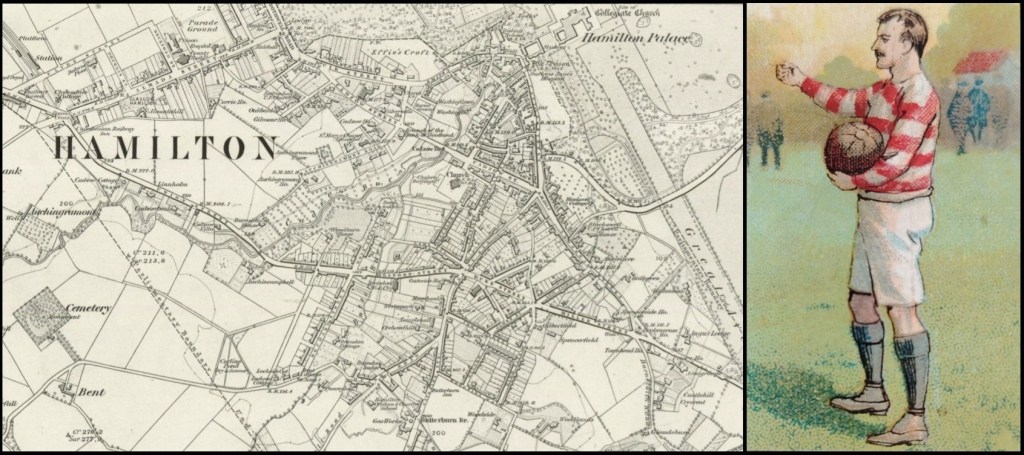
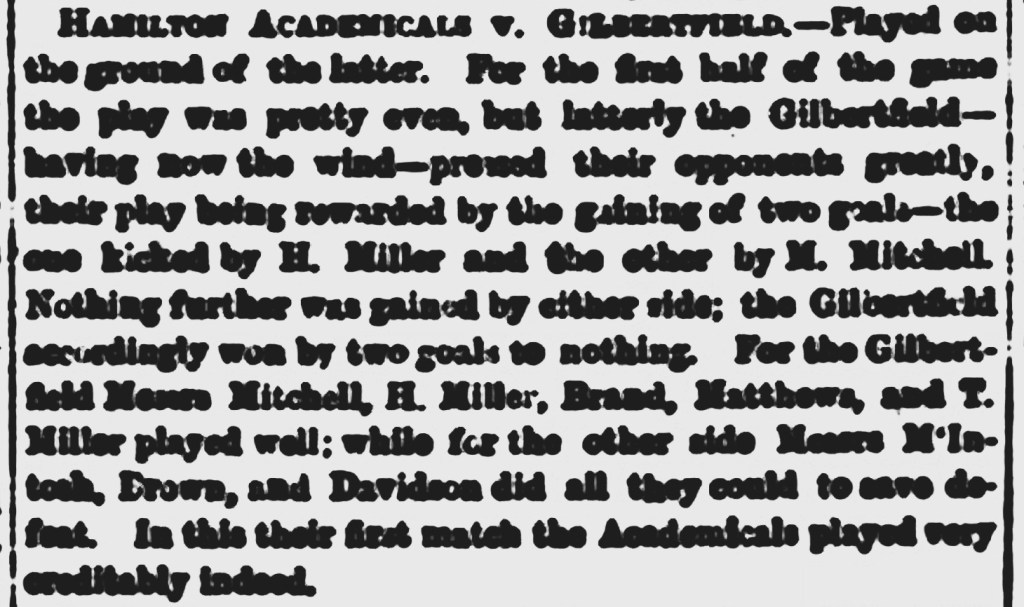
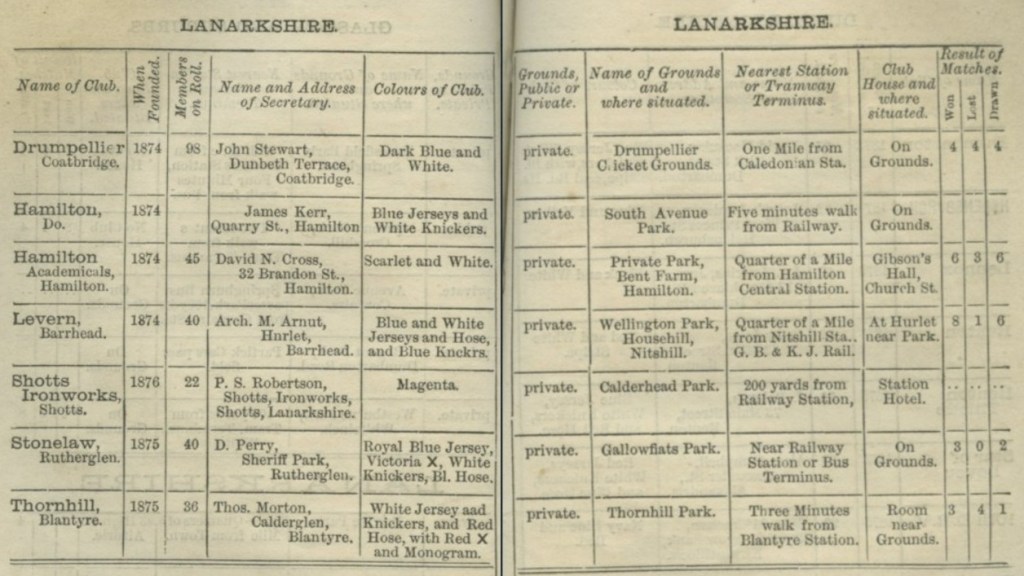
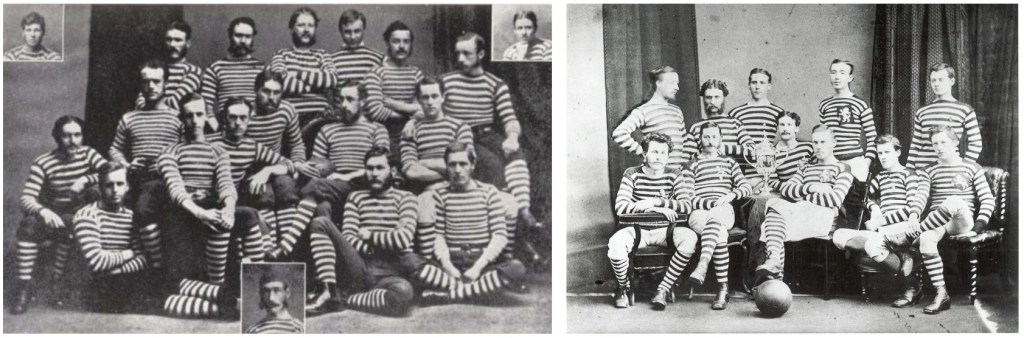
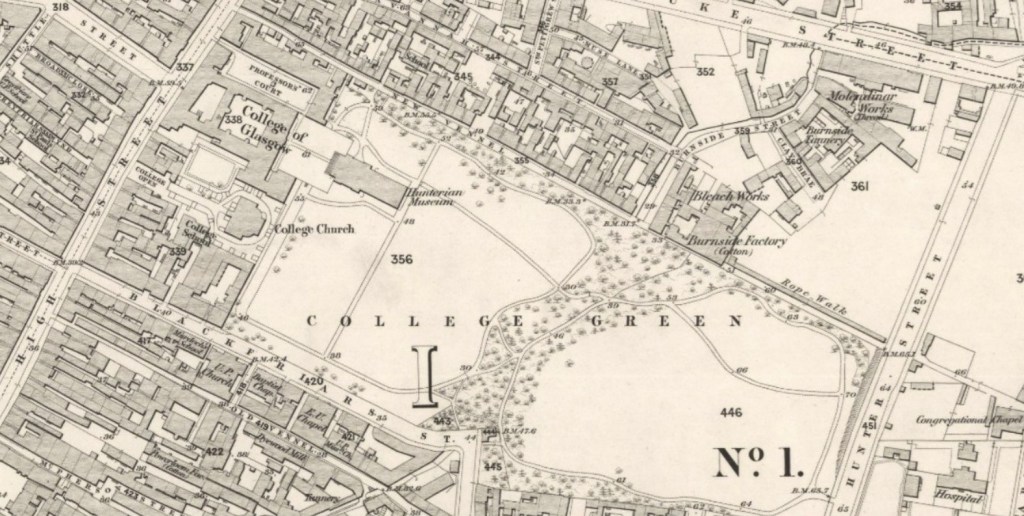
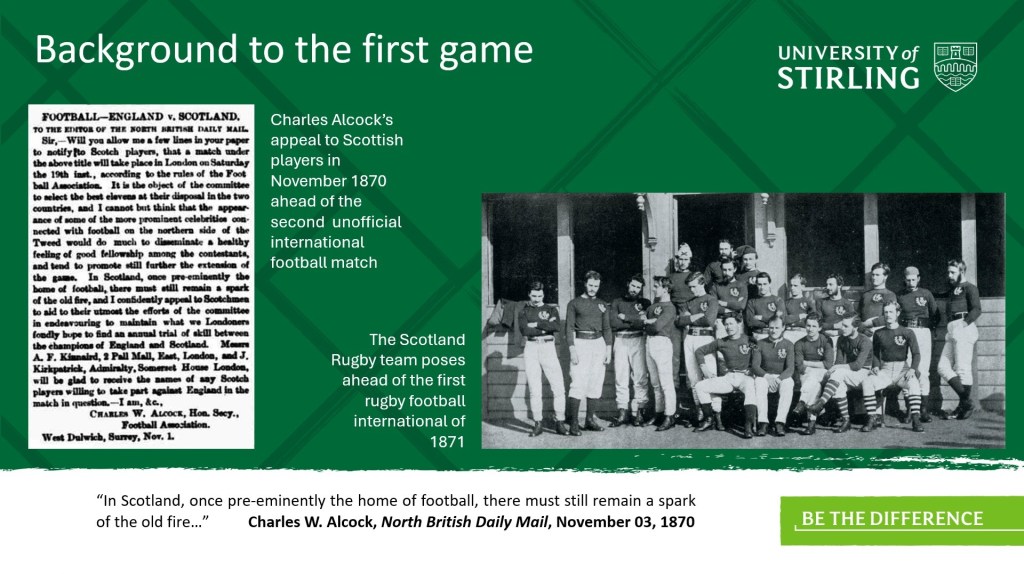
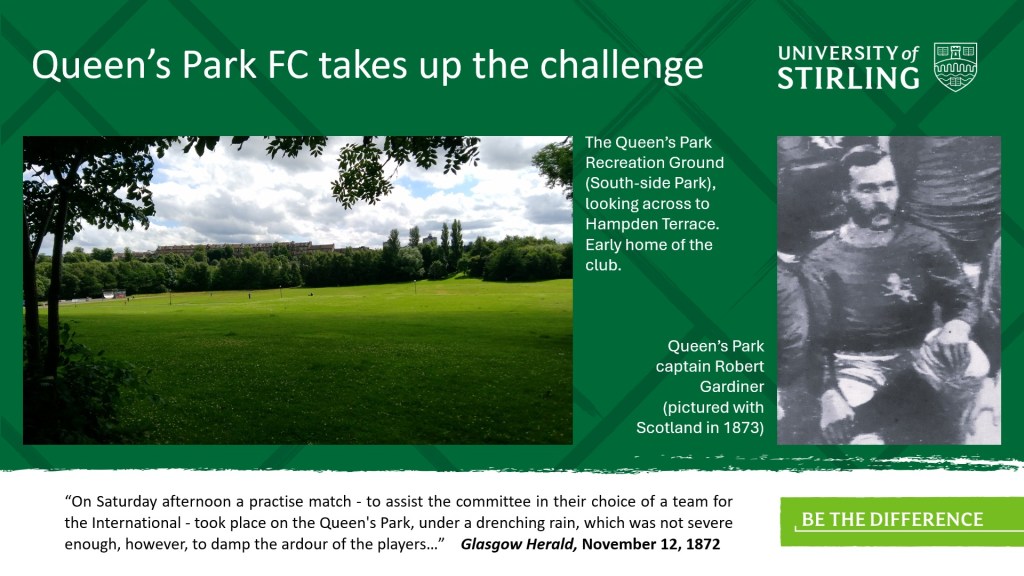
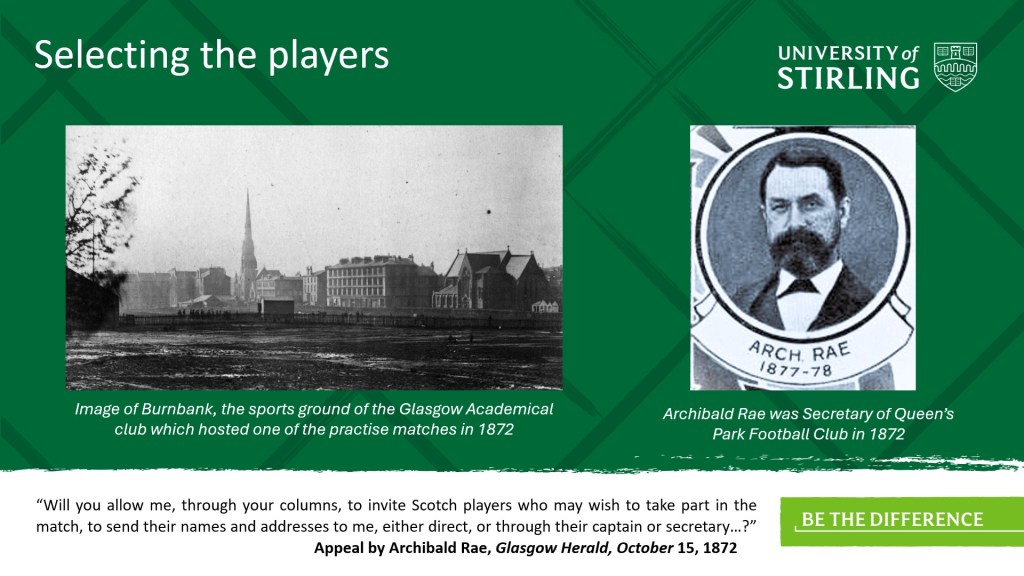
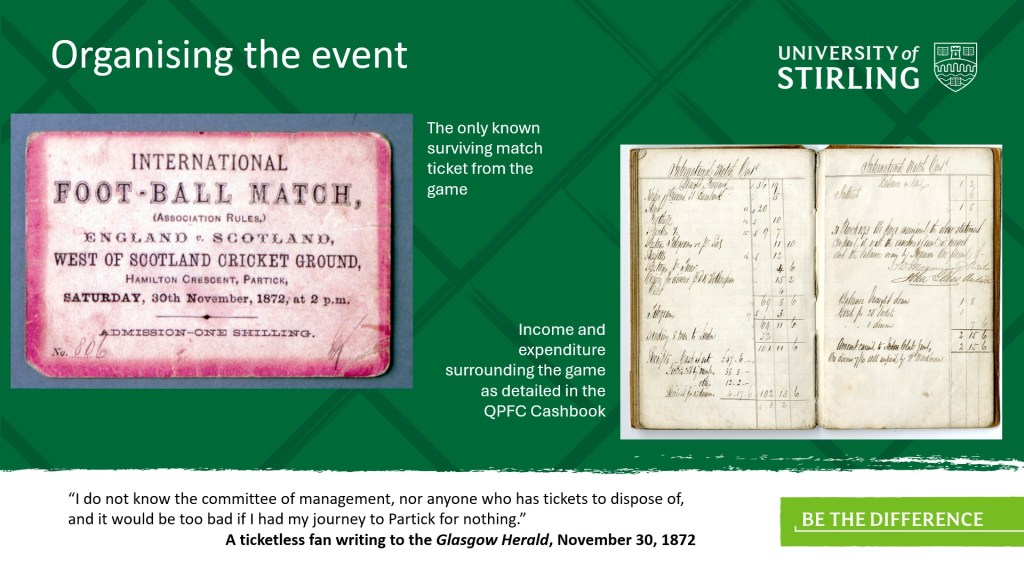

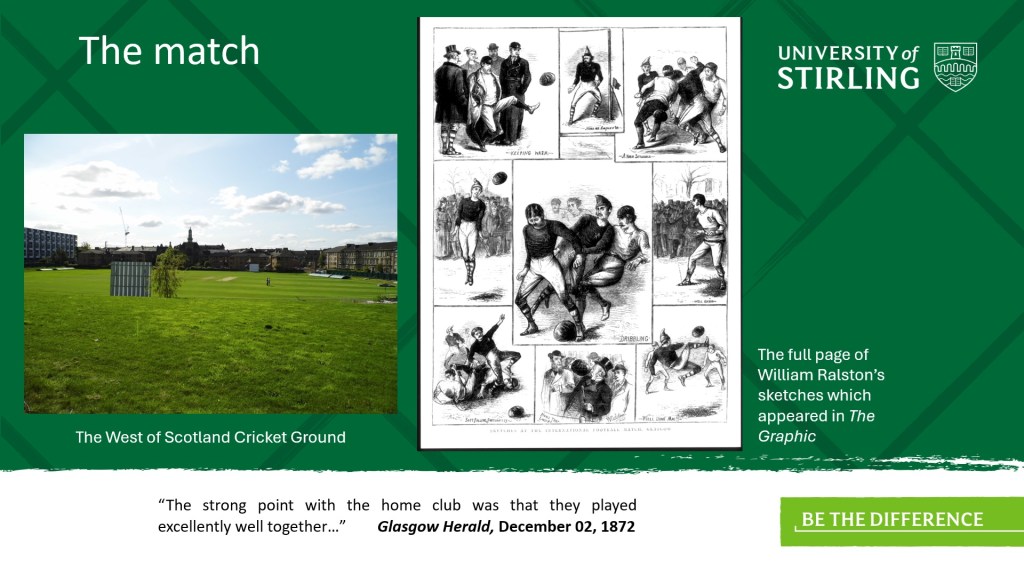
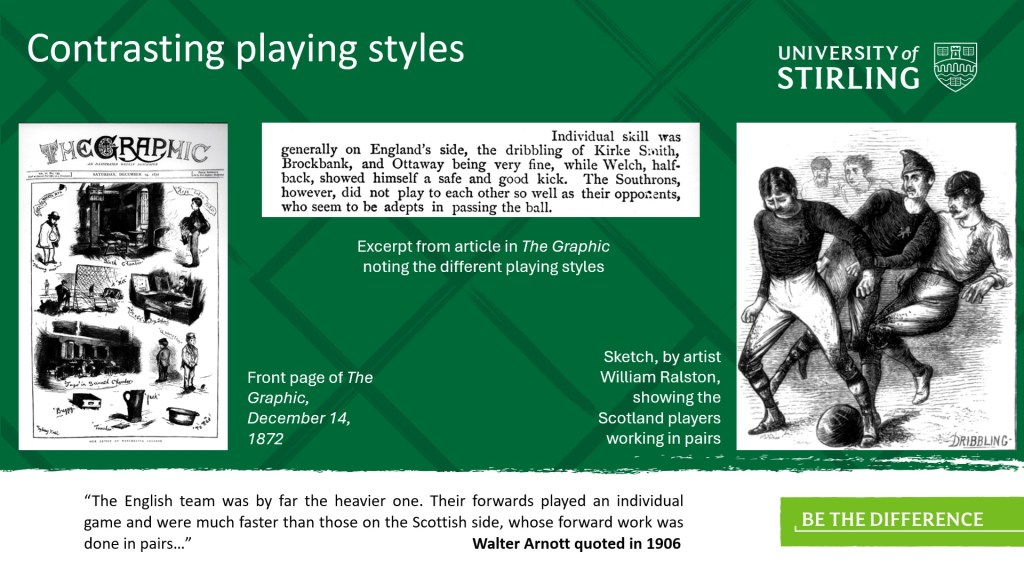
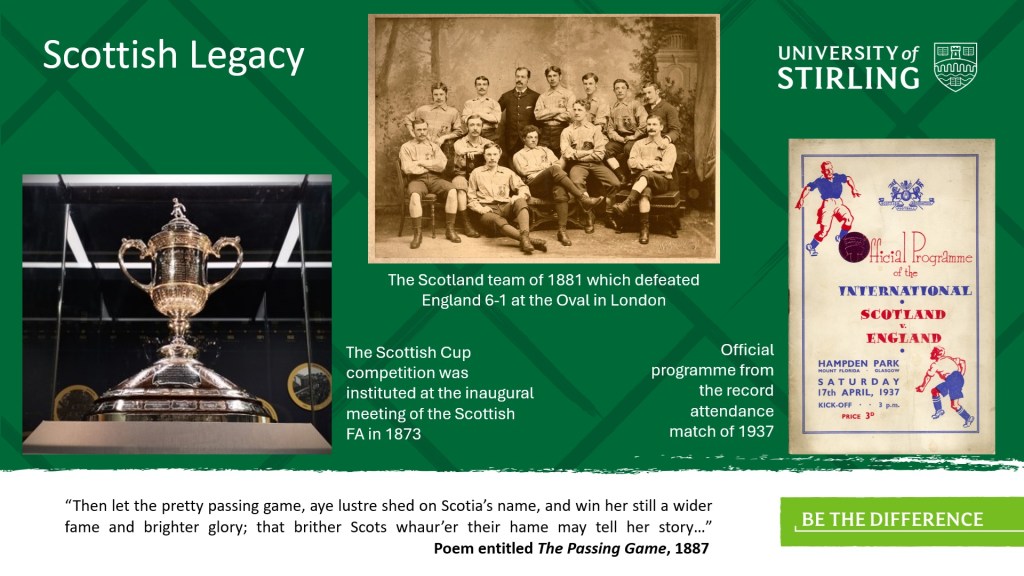
 scottishfootballorigins.org