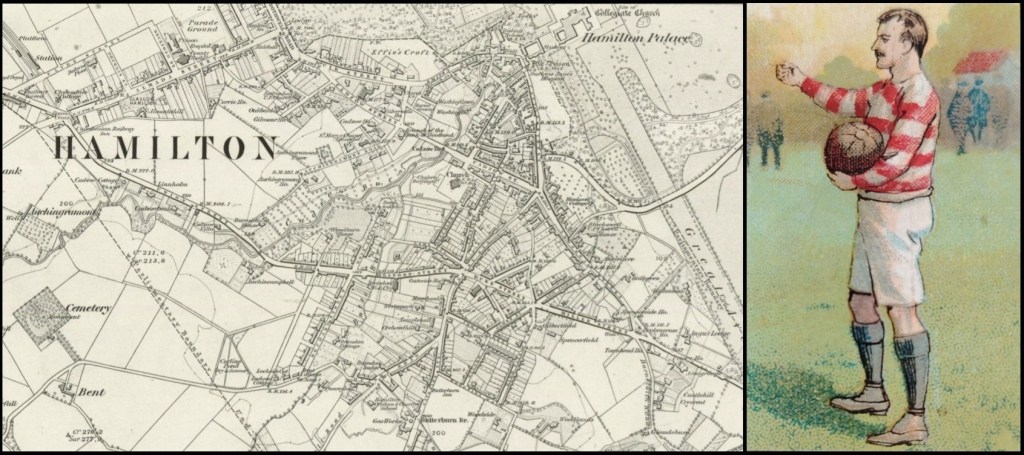
Left: Ordinance map of Hamilton, the ducal town, surveyed in 1858 and published in 1864. Reproduced with permission of the National Library of Scotland. Right: John Davie of Hamilton Academical FC.
Even a brief study of Hamilton Academical’s early history emphasises the incontrovertible fact that the football club, from the very beginning, was deeply rooted within the town. Not just through the connection with Hamilton Academy, from which the club derives its name, or the early locations of playing fields and meeting rooms, but through the early players and committee members who studied, worked and lived within the town. The extensive (but far from complete) list of addresses linked to early club members includes Haddow Street, Quarry Street, Brandon Street, Lamb Street, Leechlee Road, Cadzow Street, Campbell Street, Townhead Street and Miller Street.
In 1874, Hamilton Academy was located at Hope Street (it would not relocate to Auchincampbell Road until 1913). As one would expect, the early players were connected to the Academy and appear in school lists from the late 1860s and early 1870s. James Blacklock, the school rector, is understandably seen as a father figure in the early history of the club. Although Blacklock was a native of Wramphray in Dumfriesshire, he would enjoy a long association with Hamilton Academy, running from 1863 to 1897. Blacklock’s own house was located at the school and from the 1871 census we find the name of a future player listed within his household. Thirteen year old John McLay was one of five scholars lodging with Blacklock in 1871. A talented lad on and off the sports field, McLay would win a silver medal for scholarship in 1873 and is listed playing for Hamilton Academical FC in September 1875 against Carrington FC (of Glasgow).
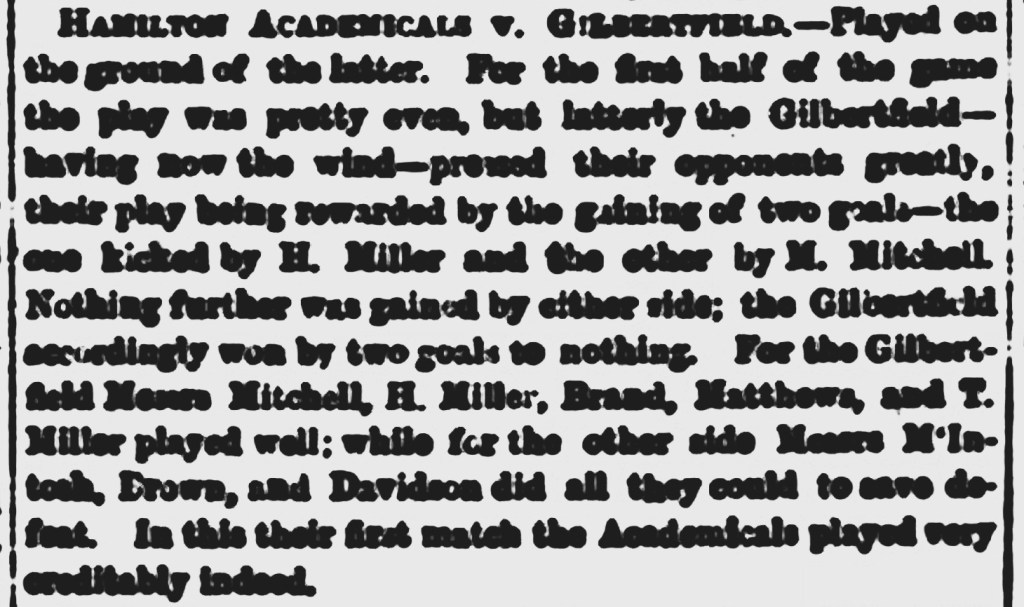
The football club can clearly be traced to 1874 (although for many years 1875 was believed to be the year of formation). Originally referred to as the ‘Hamilton Academicals Cricket and Football Club’, the summer months of 1874 witnessed the organisation of a number of cricket matches. However, the football club, as we know it today, can officially trace its starting point to Saturday 17th October, 1874. On that day ‘Hamilton Academicals’ (the club originally adopted an ‘s’ at the end of its name) participated in its first ever game – it can therefore be said that on Saturday 17th October, 2026, Hamilton Accies will officially be 152 years old!
The first game. Hamilton Academicals v Gilbertfield. As reported in the North British Daily Mail, October 19, 1874, p.6. The actual match took place on Saturday 17th October 1874.
The inaugural match of 1874 ended in a 2-0 defeat to Gilbertfield FC, another Hamilton based football club with links to a school. Gilbertfield House was a private school located at High Patrick Street. Although neither team is listed in the match report, three Accies players merited a mention for their performance and from out of that small list, two of the players can be traced. The first of these players was Alexander McIntosh and in the 1871 census, he is recorded as being 12 years old and living with his mother and brothers at 15 Campbell Street. His father, who had been a druggist (chemist), was deceased. Alexander could be found playing cricket for Hamilton Academicals in July 1874. He also featured in the return football match against Gilbertfield in November 1874, which ended in a draw, and would be elected joint secretary of the club at the Annual General Meeting (AGM) of 1875. The second player was Alexander Brown who in 1871 was living at 25 Quarry Street with his parents and brother. He was 11 years old and is listed as being a scholar. His father, Thomas, was employed as a house painter and glazier. Alexander would later be referenced at the Hamilton Academical Club AGM in January 1876 when he was elected onto the committee.
The AGM of March 1875 and the match against Carrington FC in September of the same year are particularly useful as more names of club members appear in the corresponding newspaper reports. For example, in the latter event, two additional players, Kenneth Sage and William McGhie can be quickly identified. Although Sage does not appear in the 1871 census he can be traced back to 1861, living with his parents, brother and sister at Ann Street in Hamilton. His father, John, would sadly die in 1865. In the 1881 census, Kenneth is employed as an iron moulder and is living at 17 Leechlee Road. William McGhie can be found in the 1871 census, aged 14 and living with his mother and stepsister at 1 Quarry Street. He became secretary of the football club in 1878 and followed in his father’s footsteps, by becoming a professional photographer.
In the AGM of 1875, William J. Haley was elected club president. He can be found in the 1871 census, listed as a 14 year old scholar, and living with his father James (a draper to trade), stepmother Mary, as well as three brothers, three sisters and two servants. By the time of the 1881 census, Haley was working as a general law clerk. The Haley family resided in Quarry Street during this period. William’s connections with the football club go back to 1874; he appears in the Accies team which in November of that year played against Woodbank FC at Queen’s Park in Glasgow’s southside. He must have been an influential figure within the club to be elected club president in 1875 (at the age of 18). A wider search for his name in the newspapers of the period shows that he was significantly involved in the world of politics, being secretary of the local Hamilton branch of the Irish Home Rule movement. The ‘Irish question’ was one of the big domestic political issues of the 1870s and 1880s and Haley’s interest may be linked to his father who had been born in Ireland.
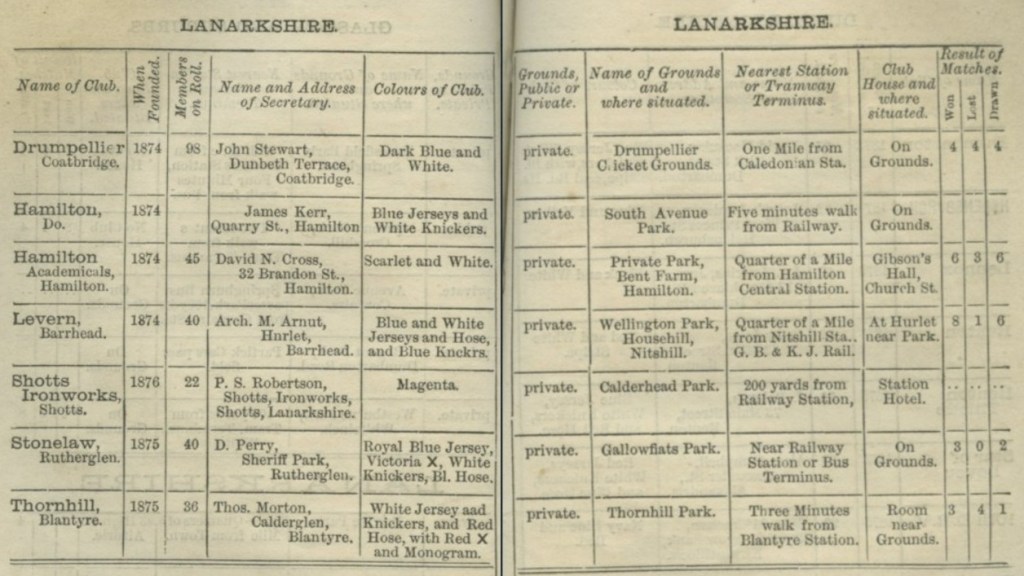
The football club appears to have advanced at a significant rate as by 1876 it was in a position to apply for membership to the Scottish Football Association. Amongst other things, this gave the club entry into the Scottish Cup competition, a tournament which had only commenced in season 1873-74 but which was making rapid strides in terms of prestige. On September 9th 1876, the Hamilton Advertiser announced that the club had been admitted into the Scottish Football Association. Hamilton Accies would therefore appear for the very first time in the Scottish Football Annual of 1876-77, and from this source we find some important information relating to the club. By then, David N. Cross had been handed the responsibility of acting as club secretary. A general law clerk (similar to William Haley), Cross lived with his parents and brother at 31 Lamb Street. His father, William, was a master tailor who was also born in the town. The contact address that David provides for the club entry in the Scottish Football Annual is 32 Brandon Street – this is likely to be his work address as it was not unusual for match secretaries employed as clerks to have club correspondence directed to their work address rather than to their home.
‘Scarlet and White’. Hamilton Academical’s entry in the Scottish Football Annual’s list of clubs from 1876. Image courtesy of the Scottish Football Museum.
Additional information from the Scottish Football Annual includes confirmation of the year of formation (1874), while the location of the club’s playing field is also identified. Accies’ earliest known football pitch was in a private park located at Bent farm, a quarter of a mile distance from Hamilton Central Station (which had only just opened in 1876). The club house is also identified, being Gibson’s Hall on Church Street, and of particular significance, the ‘colours’ of the football club are revealed for the first time – ‘Scarlet and White’.
Part 2 will continue to shed a light on the pioneers who featured in the formative years of the club’s existence and will examine some of the early challenges. As will be seen, the club faced a fight for survival from the earliest of times.
On St Andrew’s Day 1872, sides representing Scotland and England lined up against each other in the first official international football match under Association rules. A decent turnout of spectators made their way into the West of Scotland Cricket Ground and jostled round the ropes which marked out the boundary of the playing field. Despite the result being a no scoring draw, the game was widely regarded as being a major success.
The development of international football would have an important role to play in the expansion of the Association game. Today FIFA, world football’s governing body, has more affiliated national associations than the United Nations has member states.[1] The formation of FIFA in 1904, just 32 years after the staging of the first official international match, highlights the rapid growth of the game during the late Victorian era.
It can be argued that the international football match of November 1872 was one of the most important games to have been played in the history of Association football. As will be explained, a series of unofficial international football matches took place at the Kennington Oval Cricket Ground in London between March 1870 and February 1872 but these games, although an important development, lacked a degree of legitimacy due to the Football Association of England being solely responsible for both national teams. As the match of November 1872 had two separate organising committees based on either side of the Anglo-Scottish border it did not suffer from the same criticism.
Background
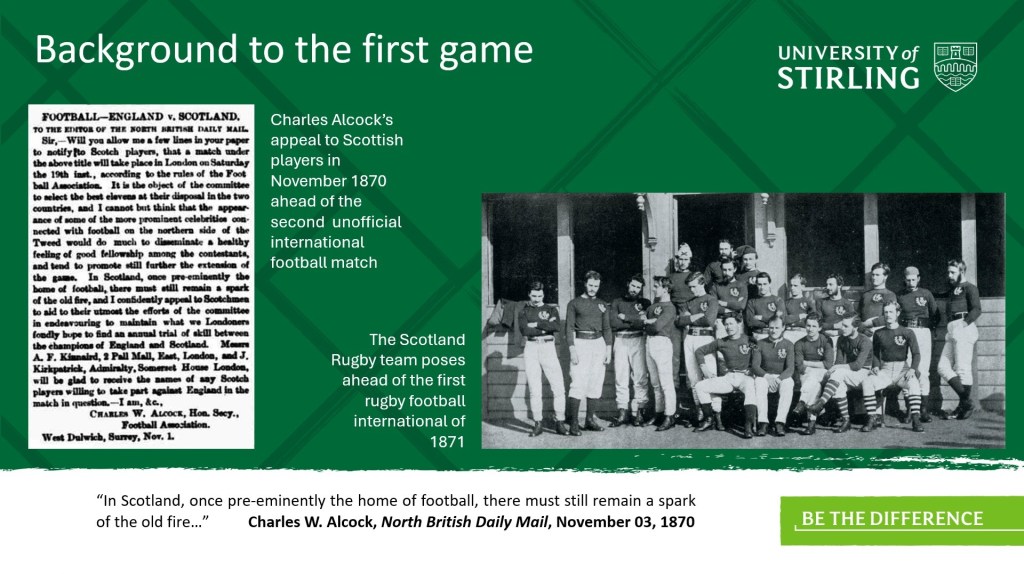
The initial efforts to establish the international football contests between England and Scotland formed part of a broader strategy to promote the code of Association football. By 1870, the year when the first and second unofficial international matches were played, the game had yet to take hold across a large part of the United Kingdom. Under the direction of Charles W. Alcock, secretary of the Football Association, the first unofficial international match took place on 05 March 1870 when a team of London based players with Scottish roots represented Scotland in a 1-1 draw with England. Ahead of the second match, which took place on 19 November 1870, Alcock contacted newspapers north of the border in order to issue an appeal for players in Scotland to participate. Alcock’s letter in the North British Daily Mail made the following appeal;
“In Scotland, once pre-eminently the home of football, there must still remain a spark of the old fire, and I confidently appeal to Scotchmen to aid to their utmost the efforts of the committee in endeavouring to maintain what we Londoners fondly hope to find an annual trial of skill between the champions of England and Scotland”.[2]
The second match of the series did not attract players based in Scotland but Robert Smith, a member of the Queen’s Park club of Glasgow was able to play as he was living in London at the time. The staging of the game, which ended in a 1-0 victory to England, was enough to provoke a response from figures representing the leading rugby football clubs in Scotland. In a unified action they responded through the columns of the Scotsman newspaper and the North British Daily Mail, stating that “the football power of the old country was not properly represented in the late so called International Football Match”.[3]
The discontent emanating from the leading Scottish rugby clubs over the staging of these matches, led directly to the first rugby football international match being staged in Edinburgh on 27 March 1871. The Football Association persevered with their own contests and in total five unofficial matches would be played in London.
The role of Queen’s Park FC
A number of important developments involving the Queen’s Park club need to be understood when examining the events that would lead up to the staging of the international football match in November 1872. From its formation in 1867, the Glasgow club had played a hybrid version of the Football Association’s Laws of the Game but in November 1870, Queen’s Park decided to become a full member of the London based organisation. As alluded to earlier, one of their members, Robert Smith, was based in London and not only could take part in the unofficial internationals, he could also attend FA meetings on behalf of Queen’s Park.
Queen’s Park entered the inaugural FA Cup competition in 1871 and in March 1872 were drawn to play against the Wanderers club of London. A creditable draw on the field ultimately meant that the club had to scratch the tie as they could not remain in London for a replay. However, the Glasgow Herald noted that, “The first appearance of the Queen’s Park Club in London may indeed be said to have been singularly successful”.[4] It was from this point on that the club began to seriously plan for an international football match to be held in Scotland.
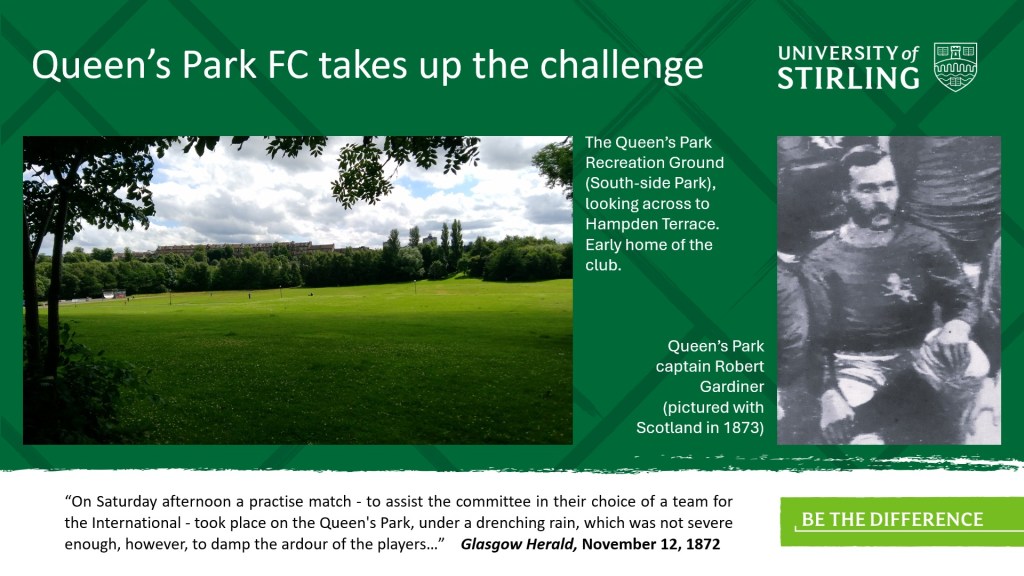
An obvious problem for Queen’s Park was finding an appropriate venue for the event to take place. The club played their home matches on the South-side Park; an open expanse of public land where anyone could wander up to watch their games.[5] Money needed to be raised to ensure that the event could be organised to an appropriate standard. Queen’s Park FC would ultimately settle on the ground of the West of Scotland Cricket Club at Partick, then an independent burgh on the outskirts of the west end of Glasgow. With a fence running around the perimeter of the ground, admission tickets could be sold to spectators.
In the build up to the game, the South-side Park was used for one of the practise matches. Robert Gardner, captain of the Queen’s Park club, was given responsibility to pick the team that would represent Scotland. Players from a number of clubs needed to be assessed. The practise game went ahead in spite of foul weather on Saturday 09 November, the Glasgow Herald opining that a “drenching rain” could not “damp the ardour of the players”.[6]
Team selection
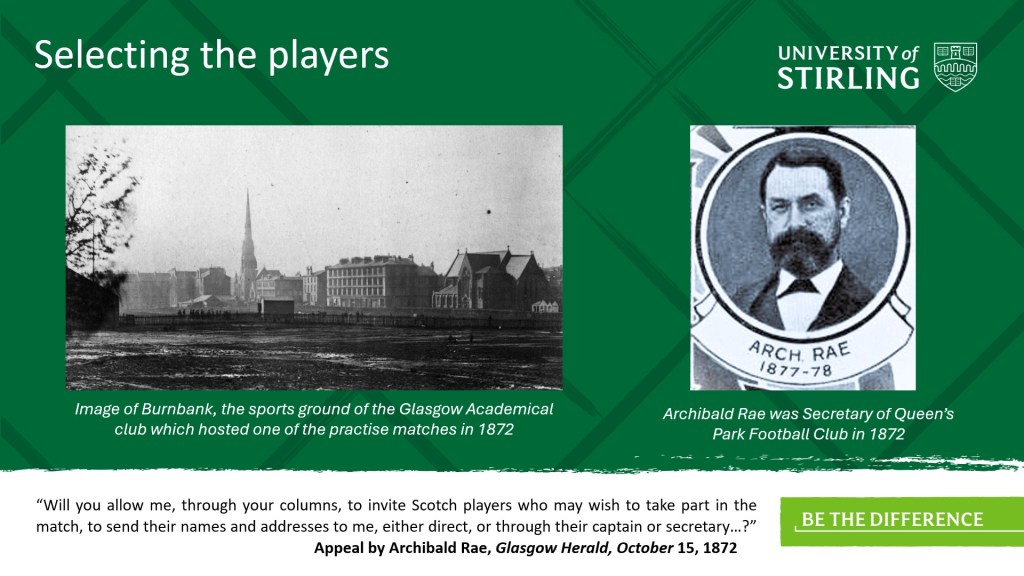
Although the Scotland team which ultimately lined up against England in November 1872 were all members of the Queen’s Park club, serious consideration had been made in the build up to the match to include non-members of the club. Indeed, Archibald Rae, as secretary of Queen’s Park FC, issued a general appeal to football players in three separate newspapers.[7]
This invitation appears to have been extended out to players more closely connected to the rugby game. For the practise match at the South-side Park, players from the West of Scotland and Glasgow Academical football clubs, both rugby organisations, had been invited to take part. Although the former club declined the invitation there was indeed representation from the Glasgow Academicals.[8] The approach made to the rugby clubs by Queen’s Park officials suggests that they were sufficiently worried about getting a strong enough pool of players from which to select the Scotland team.
The Glasgow Academical Club granted use of their Burnbank ground to the Queen’s Park Match Committee and a practise match took place there on Wednesday, 20 November. The preparations, however, were far from ideal for the players as the weather had not improved. An account of the practise session stated that,
“As on former practice days, the ground was very sloppy; little ponds here and there agreeably relieving the otherwise dreary landscape. Mud-slinging was the most prominent feature of the game, but as our knowledge of the niceties of that accomplishment is very limited, we refrain from commenting upon it.”[9]
Earlier in the week, the Glasgow Herald newspaper speculated as to the possible make-up of the Scotland team by providing a diverse list of possible candidates.[10] Whilst numerous players emanating from the Queen’s Park club appeared in the list, prominent rugby players in Thomas Chalmers of Glasgow Academicals and William Cross of the Merchistonians Club of Edinburgh were included. Association players from beyond Glasgow were also included in the shape of Reverand James Barclay of the Dumfries club and London based players Henry Renny-Tailyour of the Royal Engineers and the brothers John and Robert Smith of South Norwood. Admittedly the last two named were also members of Queen’s Park but were based in London and would be required to travel back to Glasgow.
Organising the event
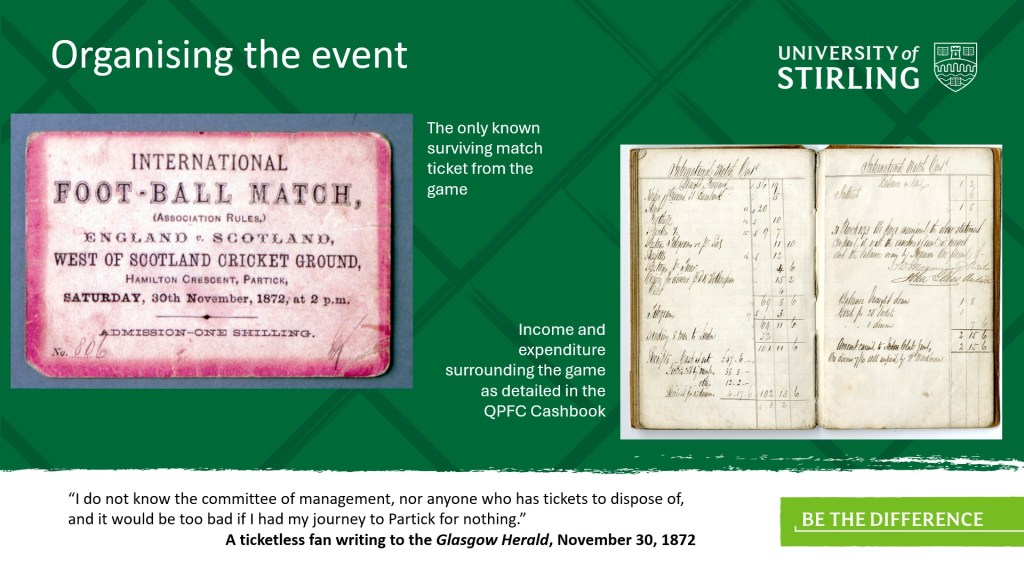
The original Queen’s Park cash book, which covers the financial affairs of the club from the formative year of 1867, has a small section devoted to the financial transactions surrounding the international match of November 1872.[11] The book itself is small in size and the extent of the financial information amounts to just three pages. However, the content is of great interest and helps to clarify some of the details surrounding the event. An area of contention relates to the size of the crowd. Some newspapers refer to a crowd as large as 4,000 while others have a lower estimate of approximately 2,500 spectators. The game was primarily a ticketed affair and one of the tickets, numbered 806, still exists and can be found in the collection of the Scottish Football Museum.
The process of obtaining match tickets does not appear to have been straight forward and one particular football enthusiast lamented that, “I do not know the committee of management, nor anyone who has tickets to dispose of, and it would be too bad if I had my journey to Partick for nothing.”[12] Thankfully for this particular supporter and no doubt for others in his predicament, the cash book states that money was accepted on the day of the game for admission into the ground. With an entry price of one shilling and overall takings recorded at £102, 13 shillings and 6 pence, a crowd figure around the 2,000 mark would be representative of the actual paying audience although the overall number may have been boosted by the fact that ladies were admitted free. The suggestion of a 2,000 attendance figure is corroborated by the testimony of future Queen’s Park and Scotland star Walter Arnot, who attended the match as a youth. In later years Arnott stated that “There would not be any more than 2,000 spectators present.”[13] Certainly the estimates of 2,500 which appear in several of the newspapers appear to be more accurate than the larger estimate of 4,000.
The cash book not only gives a breakdown of the incoming and outgoing fees, it also highlights the requirements to run a successful sporting event at this time. Advertisements for example were placed in four newspapers, one of them being the Edinburgh based Scotsman paper. Additional costs included the purchase of rope to keep spectators clear of the field, the presence of the police to keep order, the hiring of three gate keepers at the venue to manage the entry of the crowds, refreshments in the pavilion for the players and of course the fee for a dinner for the teams after the match. The administration of the game can also be seen through sundry payments covering the purchase of stationary, the issuing of telegrams and the hire of meeting rooms.
Story of the Scotland shirt badge
Looking down through the Queen’s Park FC cash book there is an entry for the purchase of 12 “Lions” which were used as shirt badges. The blue shirts that were worn by the Scotland team at the international match were owned by the players and were in fact Queen’s Park club shirts. The club would not adopt its now familiar black and white hooped shirts until October 1873. The blue shirts, however, needed a national emblem to signify the status of the team. While the rugby international shirts from the first match of 1871 had adopted the Thistle emblem, the association international shirts of 1872 adopted the Lion rampant. David Wotherspoon, a key figure at the club both as player and committee member, sought the services of his sister Marion who embroidered the white lions for each shirt.
The fact that a 12th badge was embroidered suggests that the club either kept a spare or had a player in reserve. One of the badges has survived although it is in poor condition. The Scottish Football Museum purchased the Lion from a direct descendant of David Wotherspoon who was living in South Africa. The badge has been conserved and is now on display in the museum. Marion continued to embroider Lions for the Scotland players after the match of 1872. Queen’s Park would take charge of the Scotland team for the second international match in 1873. The Scottish FA first took on the responsibility of managing the Scotland team the following year. The Scottish FA cash book for 1874 records a payment made to David Wotherspoon for “six lions”.[14] We know that six players made their international debut in 1874 and these new badges were issued to them. The humble origin of international football is perhaps best exemplified by the fact that the remaining five players who had already been issued with a Lion from one of the previous international matches were required to use them again in 1874.
The football match
In the build up to the game, newspaper reports suggested that both sides had lost valuable players. For example, on the Scottish side, the rugby player Thomas Chalmers pulled out of playing as goalkeeper on account of not being acquainted enough with the Association game while on the English side, Charles W. Alcock had to pull out through injury.[15] Although all 11 players in the Scotland team were members of the Queen’s Park club, three of those players were actually listed as playing for other clubs; the Smith brothers at South Norwood being joined with William Ker of the Granville club. The England side, with a larger pool of clubs to choose from, included players from nine different teams.
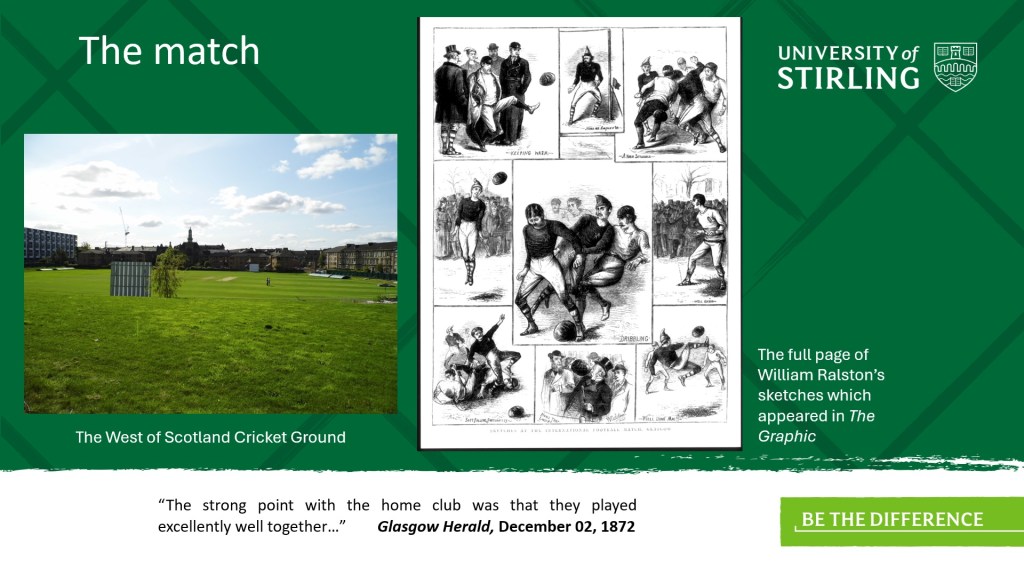
The players entered the ground at the allocated kick off time of two o’clock but the game would not start for another 15 minutes. The field was described as being soft and slippery as a result of rainfall from the previous day but the rain stayed away and the conditions were good enough for both sides to put in a decent performance. The advantage in weight and strength resided with the England side and was used as a tactic. For example, in one of the phases of play, England’s Frederick Chappell in dribbling forward with the ball is described as knocking aside “some half-dozen of his opponents”. The Scotland side, had one clear advantage; all of the players knew each other’s play and they worked effectively as a unit to stand up to a strong opponent. Although the match ended in a no scoring draw, the performance of both teams was well received, The North British Daily Mail enthusiastically reporting that,
“We hope it may not be the last; for we have never seen a finer display of skilful football than Saturday’s match exhibited.”[16]
Contrasting playing styles
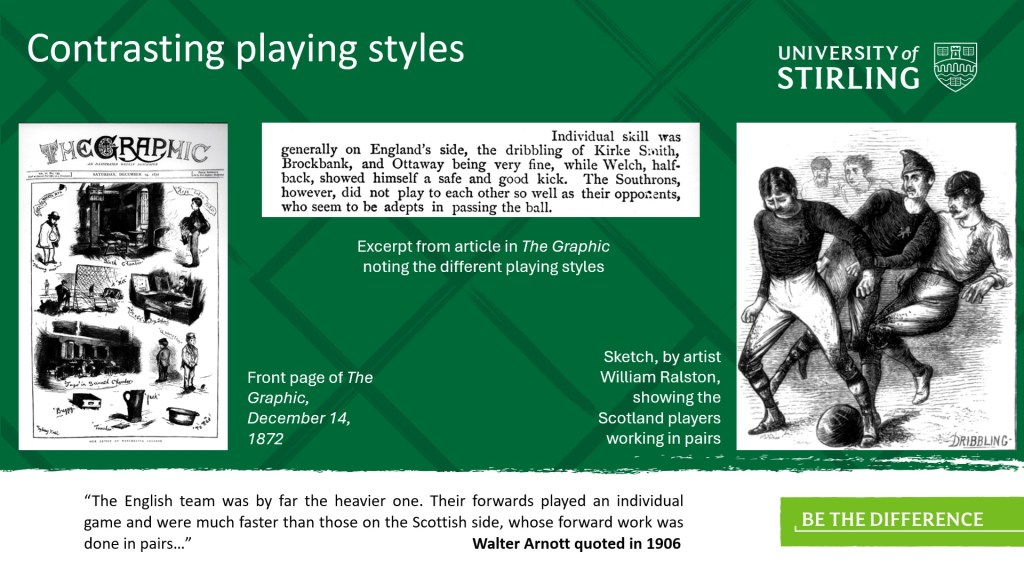
Looking specifically at the playing styles and formations of the two respective teams, some obvious differences stand out. The England team was completely dominated by the forward ranks with as many as eight forwards being deployed. Behind them a solitary midfielder and solitary defender provided a last line of defence. The style of play was dominated by individual dribbling towards the opposition goal. The player in possession charged towards goal and if he was knocked to the ground the forwards worked together in a pack to fight for possession of the ball. As passing between players was limited, only one defender was required to make a challenge. In the circumstance of a break away, the England defender simply had to stop the player in possession and clear the ball up field or delay the attack long enough for the forwards to get back behind the ball. It was a game of speed and skill but also a game of brute force.
The Scotland team, as mentioned in the Glasgow Herald, were on average two stones lighter than their English counterparts.[17] They could not compete by matching up individually with their opponents. The Scots played in a formation with six forwards divided up into pairs, with two half-backs working together in midfield and two full-backs acting as a defence in front of the goalkeeper. When in possession, the Scotland forwards dribbled the ball but also played short passes to their team mate in order to retain possession when they were in danger of being tackled. When defending, the players would work as a pair to tackle their opponent. Two clear examples of the difference in playing styles can be found in the match report which appeared in The Graphic illustrated newspaper and in Walter Arnott’s eyewitness description of the game. The Graphic reported that,
“Individual skill was generally on England’s side, the dribbling of Kirke Smith, Brockbank, and Ottaway being very fine, while Welch, half-back, showed himself a good and safe kick. The Southrons, however, did not play to each other so well as their opponents, who seem to be adepts in passing the ball.”[18]
In a similar vein, the observation of Walter Arnott highlights the difference in playing styles between both teams. In the words of Arnott,
“The English team was by far the heavier one. Their forwards played an individual game and were much faster than those on the Scottish side, whose forward work was done in pairs.”[19]
Scottish legacy
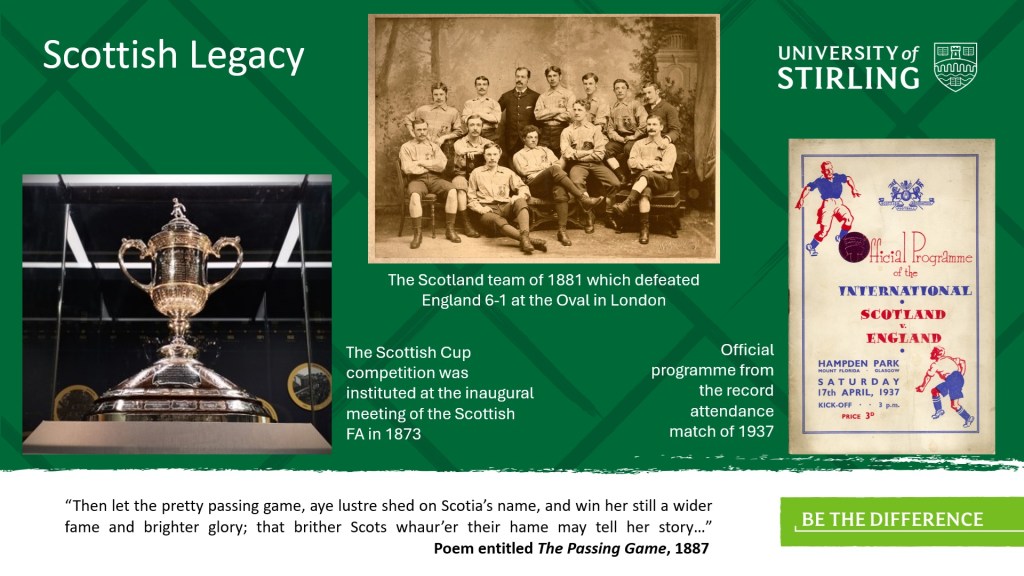
The aftermath of the game was significant in Scotland and is referred to by the Scottish Football Museum as the “Football Explosion”. Clubs sprang up across Glasgow and the West of Scotland, creating an impetus for Queen’s Park FC to build upon the success of the match. In March 1873, just a few months after the first international match, Queen’s Park sent a team down to London for the return fixture while back home in Glasgow they arranged the meeting which led to the establishment of the Scottish Football Association and the institution of the Scottish Cup competition. By October 1873 they had opened their first enclosed football ground, First Hampden Park, which would become the scene of Scottish Cup Finals and international matches.
The combination of dribbling and short passing which Queen’s Park had pioneered in 1872 quickly became a Scottish style, enabling much success at international level and by the 1880s, as the game turned professional in the midlands and north of England, leading Scottish players, referred to as “Scotch Professors” by contemporary English commentators, were enticed over the border in large numbers.
In 1876 Scotland played Wales for the first time and by 1882 Ireland had its own national team. From there, international football continued to grow, reaching continental Europe and South America by the beginning of the twentieth century.
The Scotland versus England fixture would remain hugely important to supporters north of the border. From 1908 to 1950 Third Hampden Park would become the biggest football stadium in the world off the back of this fixture. In 1937 the stadium set a then world record which remains the overall European record when a crowd of 149,415 spectators packed into Hampden to watch Scotland play England.
Reflections: Hamburg 2006
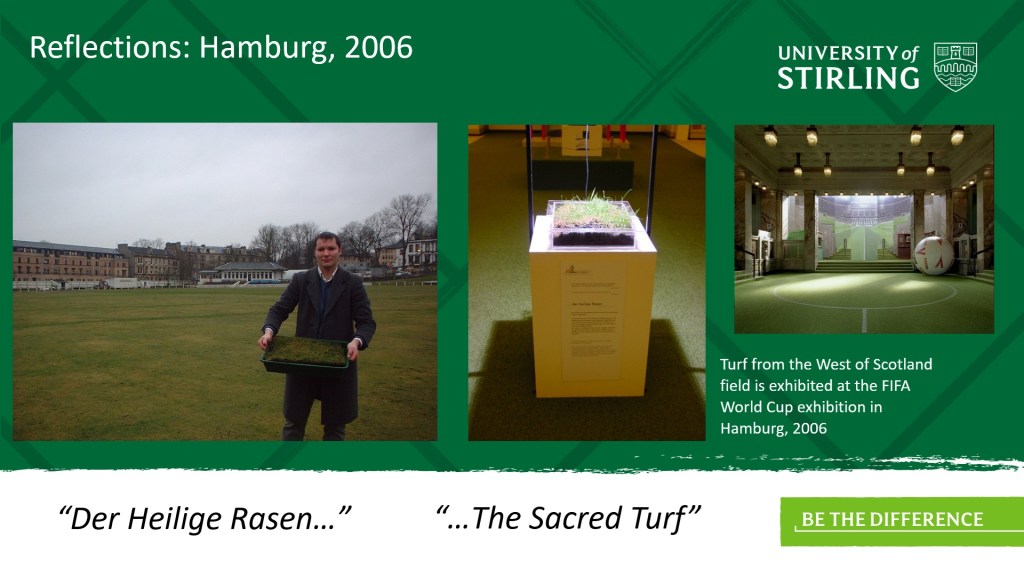
In 2006 Hamburg’s Museum für Völkerkunde hosted a major FIFA World Cup exhibition called Fascination Football. In total, 77 countries were represented within the exhibition which celebrated the ancient origins of football as well as the development of the modern global game. The German museum wished to represent the West of Scotland Cricket Ground as the place where the first official international match had been played. The Museum Director referred to the playing field as “the sacred turf”.
The author of this paper, who had been working with the museum in Hamburg, was asked to enquire as to whether a sod of turf from the cricket field could be obtained as an exhibit. Permission being sought and secured from the cricket club, a section of turf was dug up and transported to Hamburg, where, under artificial light, it was exhibited for the duration of the exhibition. As an audience of local visitors and international tourists descended on the museum, the sacred turf sat prominently in the centre of one of the main galleries, highlighting the role that organised sport in the Victorian era had to play in shaping the game of the present day.
[13] Arnott, W. (1905) England v Scotland: some famous games. In: Gibson, A. and Pickford W. (eds), Association football and the men who made it, Vol 4. London: Caxton Publishing Company, 22.
[14] This cash book forms part of the Scottish FA Collection and is a permanent part of the Scottish Football Museum’s collection.
[15]North British Daily Mail, December 02, 1872, 6.
[19] Arnott, W. (1905) England v Scotland: some famous games. In: Gibson, A. and Pickford W. (eds), Association football and the men who made it, Vol 4. London: Caxton Publishing Company, 22.



 scottishfootballorigins.org